Fighter Engine Thrust-to-Weight Ranked: F-35 Last
Eurofighter's EJ200 hits a 9.18 thrust-to-weight ratio, the best of 10 fighter engines in our database. The F-35's F135 ranks last at 6.70.

Via Wikipedia, McDonnell Douglas F-15 Eagle (shown for identification)
Ranked by thrust divided against its own empty weight, not the aircraft it flies on, the Eurofighter Typhoon’s Eurojet EJ200 tops the field at 9. The two most expensive, most publicized American stealth-fighter engines land at the bottom: the F-22’s F119 at 9th and the F-35’s F135 dead last at 7. This is the first time WeaponSpecs’ database has held a standalone engine category, added today with 14 records, and it produces a ranking most readers won’t expect: the newest, costliest engine in the American fifth-generation fleet has the worst power-to-weight ratio of any jet engine we track.
Which fighter engine has the best thrust-to-weight ratio?
WeaponSpecs’ spec database just added engine as its own system type: 14 records total, 10 of them afterburning turbofans built for fighter jets, the other 4 tank diesel and gas-turbine powerplants rated in horsepower rather than thrust (more on that split in the FAQ below). None of the 10 jet engines have appeared in a prior WeaponSpecs post, so this is genuinely new ground for the site, and every ratio below is computed the same way: thrust in kN times 1,000, divided by empty weight in kg times 9.80665, which converts mass to a weight force in newtons. Every published ratio already in the database checks out against that formula exactly.
| Rank | Engine | Aircraft | Country | Thrust | Weight | Thrust/Weight |
|---|---|---|---|---|---|---|
| 1 | Eurojet EJ200 | Eurofighter Typhoon | Germany/UK/Italy/Spain | 90 kN | 1,000 kg | 9 |
| 2 | GE F414 | F/A-18E/F, Gripen E, KF-21 | United States | 98 kN | 1,151 kg | 9 |
| 3 | Safran M88-2 | Dassault Rafale | France | 75 kN | 897 kg | 9 |
| 4 | Saturn AL-31F | Su-27, Su-30, J-10C | Russia* | 123 kN | 1,520 kg | 8 |
| 5 | GE F404 | F/A-18C, FA-50, Tejas | United States | 79 kN | 989 kg | 8 |
| 6 | Klimov RD-33 | MiG-29, MiG-35 | Russia* | 81 kN | 1,055 kg | 8 |
| 7 | P&W F100 | F-15 Eagle, F-16 | United States | 129 kN | 1,696 kg | 8 |
| 8 | GE F110 | F-14, F-15EX, F-16, KAAN | United States | 129 kN | 1,805 kg | 7 |
| 9 | P&W F119 | F-22A Raptor | United States | 156 kN | 2,268 kg | 7.01 (computed)† |
| 10 | P&W F135 | F-35A/B/C Lightning II | United States | 191 kN | 2,913 kg | 7 |
*Russian/state-linked manufacturer figures, not independently verified. †Computed from P&W/RTX’s own published thrust and weight figures, not a manufacturer-disclosed ratio.
The four lowest bars belong to the four highest-thrust engines in the dataset, the exception is the AL-31F at 4th, a Russian figure we haven't been able to independently verify.
Why does the EJ200 top the ranking?
The EJ200 produces a comparatively modest 90 kN of afterburning thrust, but it does it from an engine that weighs just 1,000 kg empty, the lightest core of any engine in this dataset. That combination, moderate thrust class paired with a genuinely light structure, is what pushes it past larger, more powerful American and Russian engines that all carry more casing and shaft mass per kN produced. Eurojet, the four-nation consortium behind the engine, has leaned on that efficiency as a selling point for years, and pilots flying the Typhoon back it up in practice.
“It’s because the pilots don’t have to worry about the engine. Instead, they can devote their full attention to their mission. They also praise the engine’s impressive power and excellent acceleration rates,” said Norbert Schmette, MTU flight test engineer for the EJ200 program (MTU AEROREPORT, April 17, 2024).
Why do the F119 and F135 rank last?
Look at the bottom four rows of the table and a pattern jumps out: the P&W F100, GE F110, P&W F119, and P&W F135, ranks 7 through 10, are also the four highest-thrust engines in the dataset at 129, 129, 156, and 191 kN respectively. All four are American, and all four were built for larger, heavier aircraft: the F-15, F-16, F-22, and F-35. As a single engine core scales up to produce more absolute thrust, the casing, shaft, and structural mass needed to contain that core doesn’t shrink proportionally. Power density, thrust per kilogram of engine, tends to erode toward the top of the thrust range, and this dataset shows that erosion clearly.
The F135 sits at the very bottom for a second, more specific reason beyond raw thrust class. It’s the only engine in this set built to be the sole power source for its aircraft: every F-35 variant, A, B, and C, flies on a single F135, with no second engine to share reliability margins the way the twin-engine F-15 or F-14 do. A single-engine fighter’s one engine has to be overbuilt for that reliability margin in a way a twin-engine jet’s engines don’t. The F-35B’s -600 variant adds another factor: its core shares a common design with a separate lift-fan module that drives STOVL flight, which pushes toward a heavier, more structurally robust core still. That said, this isn’t a perfectly clean single-versus-twin story: the F100 and F110 also power the single-engine F-16 even though they’re used as twins on the F-15, so single-engine duty is a contributing factor here, not the whole explanation, in a dataset of only 10 engines.
Does raw thrust class fully explain the pattern?
Mostly, but not perfectly. The Saturn AL-31F is the clean exception: at 122.6 kN it sits in the same high-thrust company as the F100 and F110, yet it still ranks 4th at 8.23, well ahead of every American engine in that thrust class. That’s worth flagging honestly rather than explaining away. It could reflect a genuinely well-engineered, decades-refined design, Russia has iterated on the AL-31 family since the late 1970s. It could also reflect an optimistic state-published figure, consistent with how we treat every Russian manufacturer claim on this site. We don’t have independent flight-test data to settle which it is, so we’re not resolving it here, only noting that it’s the one data point that breaks the “bigger thrust, worse ratio” pattern the rest of the dataset shows.
What does the F135 cost for its thrust, compared to the EJ200?
Only 2 of the 10 engines in this dataset publish a real unit cost, so this is an illustrative comparison between two data points, not a disclosure-rate study of the kind we’ve run elsewhere on WeaponSpecs. The EJ200 runs roughly $4.2 million per unit and produces 90 kN, working out to about $46,700 per kN of thrust. The F135 runs roughly $20.4 million per unit for 191 kN, about $106,800 per kN, close to 2.3 times the EJ200’s cost per unit of thrust despite producing only about 2.1 times the raw thrust. Cost per kN isn’t a clean efficiency metric on its own, a single-engine stealth fighter’s engine carries development, low-observable, and lift-fan-compatibility costs an EJ200 never had to pay, but the gap is large enough to be worth noting alongside the thrust-to-weight numbers. For more on what drives fighter engine and airframe pricing generally, see our fighter jet cost breakdown.
Does a lower ratio mean the F135 is a worse engine?
No, and this is the caveat worth ending on. The F135 still produces more absolute thrust, 191 kN, than any other engine in this database, and a thrust-to-weight ratio measures exactly one design axis: how much force an engine generates per kilogram of its own mass. It says nothing about fuel efficiency, infrared signature, maintainability, or the reliability engineering that a single-engine stealth fighter demands from its one and only powerplant. A 10-engine dataset and one computed ratio is a real, useful data point. It isn’t a verdict on which engine is “best,” and treating it as one would be reading more into a single number than the number can carry.
Browse the full engine category on WeaponSpecs for every powerplant in the database, or run your own comparison across fighter platforms in the Advisor.
Sources
Systems in this comparison
Every system covered above, with its photo and, where available, a video. Tap a card to open the full spec sheet.
Compare these side by side →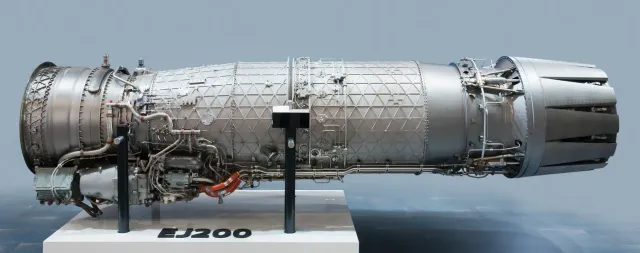
Engines & powerplants
Eurojet EJ200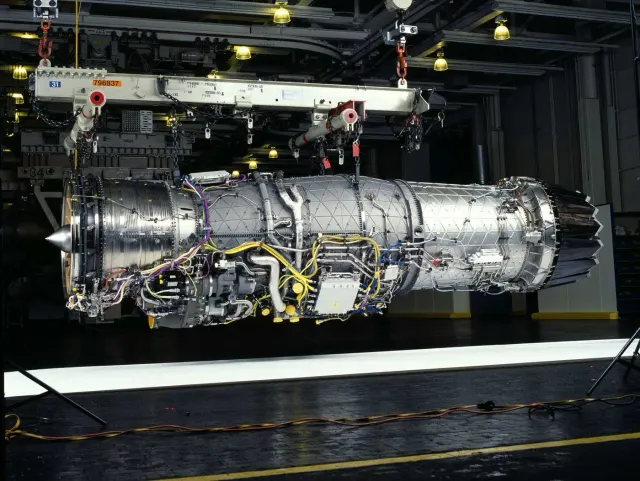
Engines & powerplants
Pratt & Whitney F135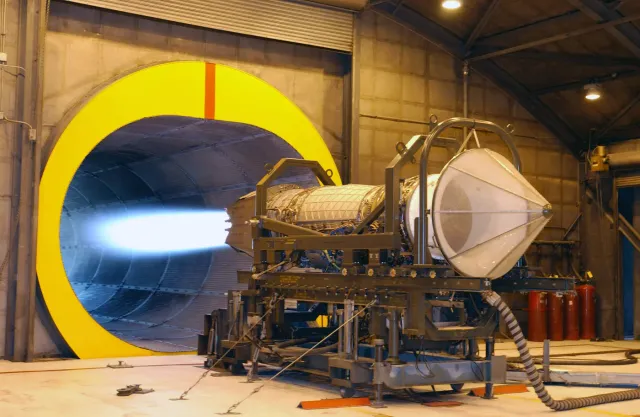
Engines & powerplants
Pratt & Whitney F119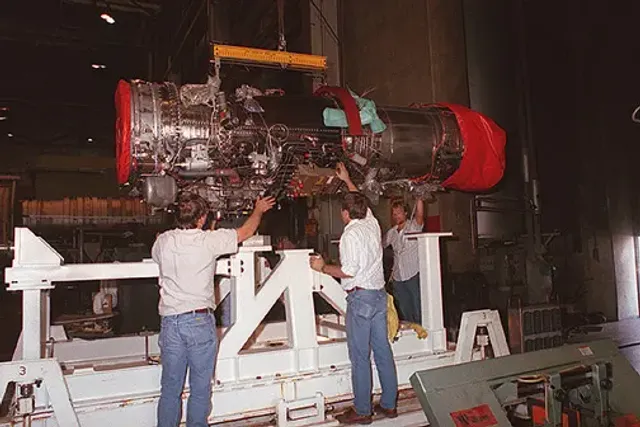
Engines & powerplants
General Electric F414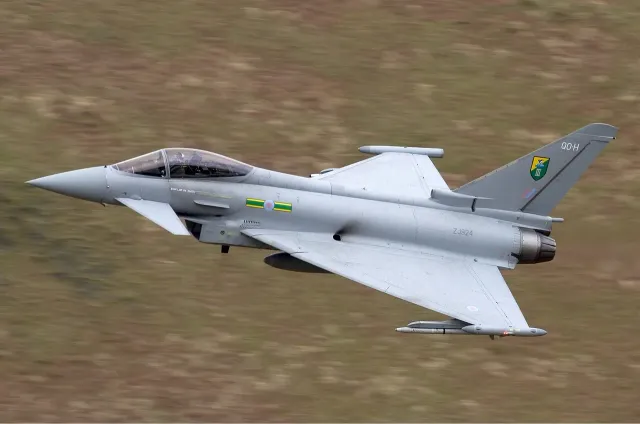
Fighter aircraft
Eurofighter Typhoon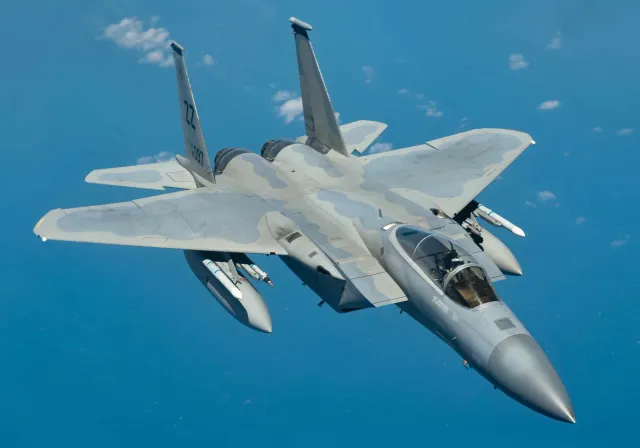
Fighter aircraft
F-15C EagleFrequently asked questions
How is an engine's own thrust-to-weight ratio different from a fighter aircraft's published thrust-to-weight ratio? +
They measure different things. Our earlier piece, [Fighter Thrust-to-Weight Ranked](/articles/fighter-thrust-to-weight-ratio-ranked/), divides an engine's thrust by the whole aircraft's combat weight, airframe, fuel, and stores included, which tells you how a jet accelerates and turns with a real war load on it. This post strips the airframe out entirely and divides thrust only by the engine's own empty weight, isolating how efficiently the engine itself converts its mass into thrust. A heavy airframe can drag down an aircraft-level ratio even when the engine bolted to it is a strong performer, and that's exactly the gap this post is built to show.
Why does the F-35's F135 engine rank last if the F-35 is considered one of the most capable fighters in service? +
A low engine-level thrust-to-weight ratio isn't a defect, it's a design tradeoff. The F135 is the sole power source for every F-35 variant, unlike a twin-engine jet where two engines share the reliability burden, a single-engine design has to be built with heavier structural margins because there's no second engine to fall back on. The F-35B's -600 variant compounds this: its core shares a common design with a separate lift-fan module for STOVL flight, which pushes toward a heavier, more robust core than a twin-engine fighter's engines ever need. The F135 also produces more raw thrust than any other engine in this dataset, and the F-35 program has consistently prioritized fuel efficiency, low infrared signature, and reliability over raw power density. None of that shows up in a thrust-to-weight ratio.
Is the Pratt & Whitney F119's ranking a figure Pratt & Whitney itself publishes? +
No. P&W and parent company RTX publish the F119's thrust and empty weight separately, but not a thrust-to-weight ratio. We computed the F119's <span data-spec="pratt-whitney-f119:propulsion.thrustKn">156</span> kN thrust against its <span data-spec="pratt-whitney-f119:physical.emptyWeightKg">2,268</span> kg empty weight using the exact same formula, thrust in newtons divided by weight in newtons, that every published ratio in this dataset independently matches. It's a derived figure built entirely from the manufacturer's own numbers, not an official P&W disclosure, and we've labeled it that way in the table.
Should Russia's AL-31F thrust-to-weight figure be trusted at face value? +
Treat it as a state and manufacturer claim, not an independently verified figure, consistent with how we treat every Russian-published spec on this site. It's also worth flagging as the one data point that breaks the pattern in this dataset: every other high-thrust engine here (F100, F110, F119, F135) ranks near the bottom, but the AL-31F's 122.6 kN puts it in the same thrust class as those four while it still ranks 4th at 8.23. That could reflect a genuinely well-engineered, decades-refined design, or it could reflect an optimistic published number. We don't have independent test data to resolve it either way, so we're flagging the uncertainty rather than picking a side.
Does a lower thrust-to-weight ratio mean the F135 is a worse engine overall? +
No. The F135 still produces more absolute thrust, 191 kN, than any other engine in this dataset, and thrust-to-weight is one design axis among several, alongside fuel efficiency, infrared signature, and reliability, that a real procurement decision weighs together. A single ratio computed from two published numbers is a useful data point, not a verdict on the whole engine. We'd caution against reading this ranking as anything more than what it measures.
Related reading


