Only 5 of 57 Tanks in Our Database Still Run a Gas Turbine
Only 5 of 57 database tanks still run a gas turbine, all Abrams or T-80. The M1E3 is swapping its AGT1500 turbine for a hybrid diesel drivetrain.

Sgt. Paul L. Anstine II, USMC, public domain, via Wikimedia Commons
Of the 57 tanks and IFVs in the WeaponSpecs database, 56 publish a propulsion type. Only 5 of those 56 (8.9%) run a gas turbine, and every single one belongs to just two tank lineages: the American M1 Abrams family and Russia’s T-80 family. No other tank or IFV design in the database, past or present, was ever built around a gas turbine. The other 51 (91.1%) run diesel, and the US Army, the service that pioneered the tank gas turbine in 1980, is now walking away from it: the M1E3 program is replacing the Abrams’ 1980-vintage AGT1500 turbine with a hybrid drivetrain built around a Caterpillar C13D diesel, targeting a 40-50% cut in fuel consumption, a claim from the Army itself, not yet independently verified in fielded use.
How many tanks in the database still run a gas turbine, and who builds them?
One system, the EMBT Enhanced Main Battle Tank demonstrator, has no propulsion type field at all and is excluded from these counts as undisclosed rather than diesel or turbine. Of the remaining 56, 51 (91.1%) publish a diesel powerplant and 5 (8.9%) publish a gas turbine. Those 5 split into three US Abrams variants and two Russian T-80 variants, nothing else.
Gas turbine propulsion never spread beyond two national programs in 45 years of tank development, and one of those two, the Abrams, is now leaving it behind.
| System | Country | In service since | Status | Power-to-weight | Range |
|---|---|---|---|---|---|
| M1A1 Abrams | United States | 1985 | Legacy | 24 hp/t | 465 km |
| M1A2 SEP v2 Abrams | United States | 2007 | Legacy | 24 hp/t | 426 km |
| M1A2 SEP v3 Abrams | United States | 2017 | Active | 24 hp/t | 426 km |
| T-80U | Russia | 1985 | Active | 26 hp/t (claim) | 335 km (claim) |
| T-80BVM | Russia | 2017 | Active | 24 hp/t (claim) | 400 km (claim) |
The T-80 rows carry a standing caveat: both figures are Russian manufacturer and state figures, not independently verified, the same treatment WeaponSpecs applies to every Russian-origin performance claim on this site.
Why did the US and the USSR choose a gas turbine in the first place?
Neither program picked a turbine on a whim. The AGT1500 gave the Abrams better power density for its weight than a comparable diesel of the era, and per Honeywell’s own AGT1500 page, it runs on jet fuel, diesel, marine diesel, or gasoline without modification, a deliberate multi-fuel design choice that simplified NATO fuel logistics rather than tying the tank to a single fuel type. A turbine also has fewer moving parts than a piston diesel of comparable output, runs quieter and with less vibration, and cold-starts faster, a real advantage for the Soviet T-80’s Arctic and Siberian garrisons where a diesel’s glow plugs can take minutes a crew under fire doesn’t have (Wikipedia: M1 Abrams; Wikipedia: T-80). Every one of those advantages was real in 1980. None of them was about fuel economy, and that’s exactly where the bill came due later.
What did the gas turbine actually cost the Army?
The real cost was never the engine itself, it was fuel logistics. A gas turbine’s efficiency collapses at idle and low load, and a tank spends most of its running hours idling in a defensive position or waiting in a column, not at full throttle. That idle inefficiency is what actually drives the AGT1500’s outsized fuel burn, and it made the Abrams fleet dependent on frequent fuel-truck resupply, historically a bigger operational liability for an armored formation than raw mission range ever was (TWZ: M1 Abrams diesel test coverage; TWZ: M1E3 production timeline).
The genuinely interesting part is that this isn’t new information to the Army. General Dynamics Land Systems already built and tested a diesel-powered Abrams, the “EuroPowerPack,” an MT-883 V12 diesel paired with an HSWL 295TM transmission, back in 1999-2000 for a Turkish export bid. It worked: 300 miles of reliability and maintainability testing, 70 main-gun rounds fired. Turkey bought the Leopard 2 instead, and the US Army never adopted the diesel option for its own fleet. The M1E3 isn’t a new technology; it is a 25-year-old shelved option the Army is only now acting on.
What is the M1E3 replacing the AGT1500 with?
The production-intent M1E3 pairs a Caterpillar C13D six-cylinder diesel (1,100 hp) with a 250 hp electric motor through SAPA’s ACT1075LP transmission, a hybrid-electric drivetrain rather than a straight diesel swap. The Army claims a 40-50% fuel-efficiency improvement over the M1A2 SEP v3 baseline, a figure that has not been independently verified in fielded use and should be read as a program target, not a proven result. General Dynamics Land Systems delivered an early prototype at the Detroit Auto Show in January 2026, years ahead of the program’s original schedule, and per Army Recognition, Initial Operational Capability currently sits around 2030, with the FY2027 budget request of $474 million supporting prototype completion ahead of planned production starting in FY2028.
| Engine | Program | Type | Power |
|---|---|---|---|
| AGT1500 | M1 Abrams, 1980-present | Gas turbine | 1,500 hp |
| Caterpillar C13D + electric motor | M1E3, in development | Hybrid diesel-electric | 1,100 hp diesel + 250 hp electric motor |
“That will again be this summer, early fall,” said Brent Ingraham, Assistant Secretary of the Army for Acquisition, Logistics and Technology, when asked when M1E3 prototypes will reach soldiers in operational “Transformation In Contact” units for field testing (TWZ, Mar 25, 2026).
Does Russia’s T-80 face the same pressure?
Yes, and Russia’s own newest production lines already show it. The T-80’s GTD-1250 gas turbine, an unrelated design lineage to the American AGT1500, was a Cold War-era choice built around Arctic garrison needs, but neither of Russia’s current new-build main battle tank programs uses it. The T-90M runs a V-92S2F diesel, and the T-14 Armata runs a ChTZ 12N360 diesel, both confirmed diesel in the WeaponSpecs database as our own records, not an external claim. T-80BVM is an upgrade of existing Cold War-era hulls rather than a new-build production line, so the turbine survives in Russian service mainly as a legacy holdover on refurbished tanks rather than a current design choice for anything Russia is building from scratch. As with every Russian performance figure in this piece, treat the underlying T-80BVM specs above as state and manufacturer claims, not independently verified results.
Which diesel tanks already outperform every gas-turbine tank on power-to-weight?
This is the sharper finding. The turbine’s whole justification for its fuel penalty was superior power density, and that advantage no longer holds against the newest diesel designs. Five modern diesel tanks in the database already beat every gas-turbine tank in the database on horsepower per tonne.
Every gas-turbine tank in the database, Abrams and T-80 alike, sits in the bottom half of this ranking. Five diesel designs, from four different countries, all beat them on the exact metric the turbine was originally chosen for.
| System | Type | Country | Power-to-weight |
|---|---|---|---|
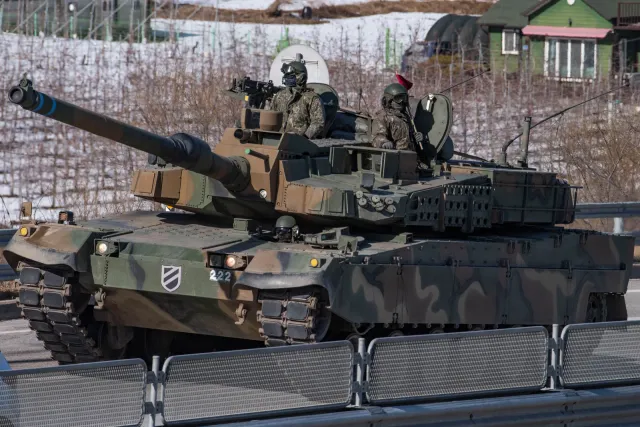
| K2 Black Panther | Diesel | South Korea | 27 hp/t |
| Type 10 | Diesel | Japan | 27 hp/t |
| Kaplan MT | Diesel | Turkey | 27 hp/t |
| Leclerc XLR | Diesel | France | 27 hp/t |
| T-84 Oplot | Diesel | Ukraine | 26 hp/t |
| T-80U | Gas turbine | Russia | 26 hp/t (claim) |
| M1A1 Abrams | Gas turbine | United States | 24 hp/t |
| M1A2 SEP v2 Abrams | Gas turbine | United States | 24 hp/t |
| M1A2 SEP v3 Abrams | Gas turbine | United States | 24 hp/t |
| T-80BVM | Gas turbine | Russia | 24 hp/t (claim) |
T-84 Oplot’s spot on this list is worth a footnote of its own: it runs the Ukrainian KMDB 6TD-2 diesel, a design lineage entirely separate from the Honeywell AGT1500 gas turbine that powers three of the tanks below it. The 6TD-2 is itself a sourced record in WeaponSpecs’ own engine database, built by the Kharkiv Morozov Machine-Building Design Bureau.
What this means for the next procurement decision
The gas turbine’s story on the tank battlefield is closing, not opening. It never spread past two national programs in 45 years, it is now leaving the fleet that made it famous, and the power-density case that once excused its fuel appetite has already been passed by five diesel designs built decades after the AGT1500. A buyer or analyst weighing a new heavy-tank program in 2026 has little reason to specify a turbine at all, unless idle-noise or cold-start performance matters more to that mission than fuel logistics ever did.
Run your own Abrams vs T-80BVM comparison with live specs, or browse the full tank category to see how propulsion choice tracks against every other spec on the sheet.
Sources
Systems in this comparison
Every system covered above, with its photo and, where available, a video. Tap a card to open the full spec sheet.
Compare these side by side →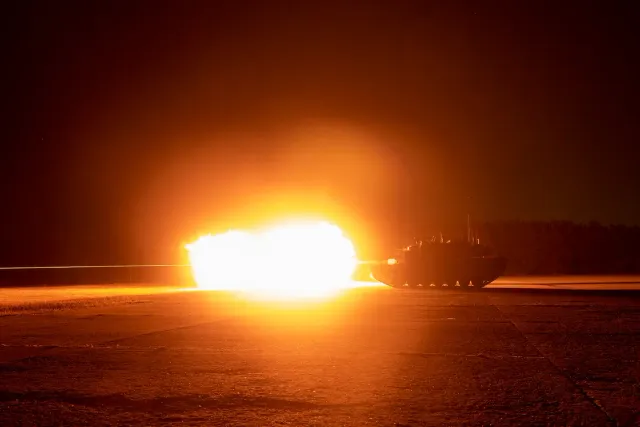
Main battle tank
M1A2 SEP v3 Abrams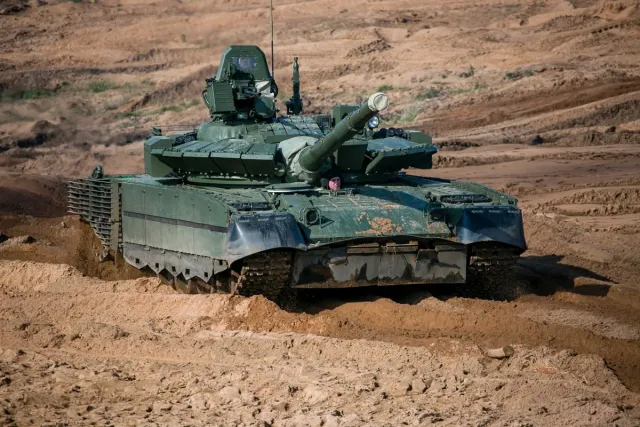
Main battle tank
K2 Black Panther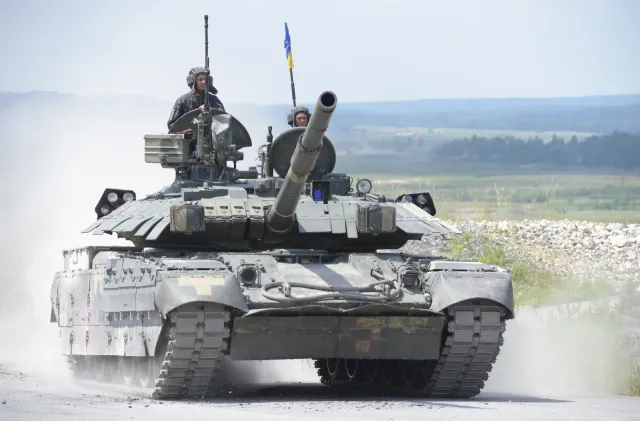
Main battle tank
T-84 Oplot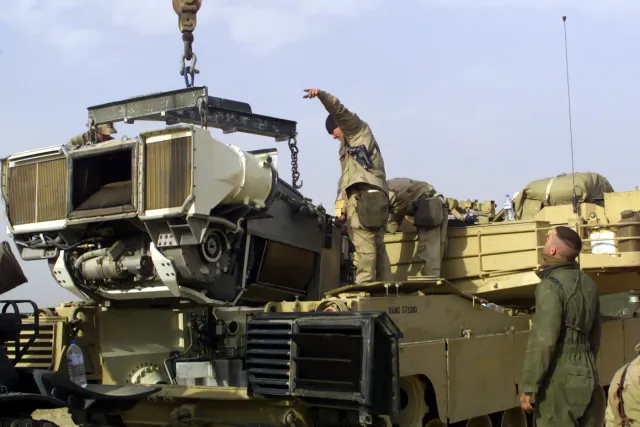
Engines & powerplants
Honeywell AGT1500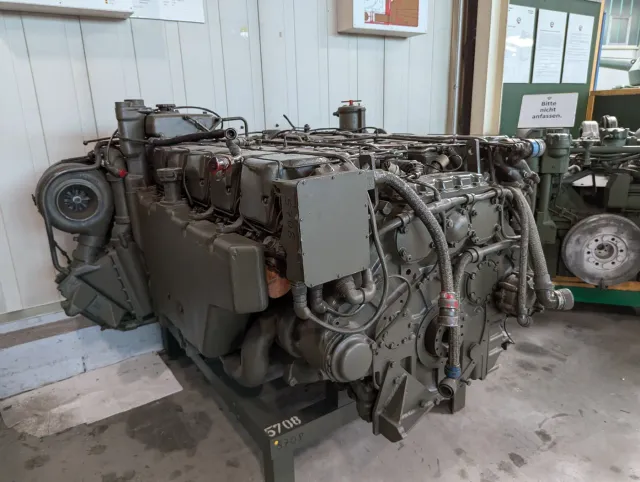
Engines & powerplants
MTU MB 873 Ka-501Frequently asked questions
Does the M1E3 remove the gas turbine entirely? +
Not yet. The M1E3 prototype currently in testing still runs the same AGT1500 gas turbine as every other Abrams variant. The production-intent design swaps that turbine for a Caterpillar C13D diesel paired with an electric motor, and that hybrid-diesel replacement, not the prototype hull itself, is the actual change being reported here.
Why did the Army choose a gas turbine for the M1 Abrams in 1980 if diesel is more fuel-efficient? +
Diesel's fuel-efficiency advantage wasn't the deciding factor in 1980. The AGT1500 offered better power density for its weight, ran on jet fuel, diesel, or gasoline without modification (a real advantage for NATO fuel logistics), had fewer moving parts than a comparable diesel, ran quieter, and cold-started faster, all valued more than fuel economy at the height of the Cold War.
Is Russia's T-80 gas turbine the same engine as the Abrams'? +
No. The T-80 runs a GTD-1250 gas turbine, a Soviet design with no shared lineage to the American AGT1500. The two programs arrived at gas turbines independently, for overlapping but not identical reasons, and the engines are not interchangeable or related beyond both being gas turbines.
Which diesel tanks now beat the Abrams and T-80 on power-to-weight? +
Five modern diesel tanks in the WeaponSpecs database, South Korea's K2 Black Panther, Japan's Type 10, Turkey's Kaplan MT, France's Leclerc XLR, and Ukraine's T-84 Oplot, all rank above every gas-turbine tank in the database on horsepower per tonne. The power-density argument that once justified the turbine's fuel penalty no longer holds against the newest diesel designs.
How is this different from WeaponSpecs' Abrams vs T-90M vs Type 99A power-to-weight comparison? +
That earlier piece, [our Abrams vs T-90M vs Type 99A comparison](/articles/abrams-vs-t90m-vs-type99a/), ranks three specific named tanks on one metric. This post is a propulsion-architecture census across all 57 tanks and IFVs in the database, turbine versus diesel, who builds each, and why the US Army is now walking away from the turbine it pioneered. Power-to-weight shows up here only as one supporting data point, not the spine of the piece.
Related reading


