Torpedo Range: The 50 km Number Everyone Misreads
South Korea's K761 Tiger Shark claims a 50 km range, 5.5x the US Navy's lightweight Mk 54 at 9.1 km. The gap is weight class, not a technology lead.

IDEF '07 defense exhibition, Wikimedia Commons, CC BY-SA 3.0 (shown for identification)
South Korea’s K761 Tiger Shark heavyweight submarine torpedo claims a 50 km range. The US Navy’s Mk 54, the lightweight torpedo six navies fly on helicopters and fire from destroyers, claims 9.1 km, about 5.5 times less. Read as a technology gap, that number says South Korea builds a dramatically better torpedo. Read correctly, it is a weight-class and delivery-method gap, and pound for pound the lightweight K745 Blue Shark actually covers more distance per kilogram of mass than either South Korean heavyweight.
How far can a torpedo actually reach?
Seven torpedo-family systems in the WeaponSpecs database publish a numeric field worth comparing, and an eighth, Russia’s air-dropped APR-2, publishes none at all: no mass, no range, no warhead, no cost. That silence is worth flagging on its own, not as a state-claim inflation (there is no claim here to inflate), just a genuine data gap in an otherwise comparable set.
Ranked by claimed range, the six torpedoes that publish one plus the K745A1 rocket delivery vehicle look like this:
- K761 Tiger Shark, South Korea, 50 km
- K731 White Shark, South Korea, 30 km
- K745 Blue Shark / K745A1 Red Shark, South Korea, 19 km each
- Mk 46 / Stingray, United States / United Kingdom, 11 km each
- Mk 54, United States, 9.1 km
Only two of these, White Shark and Tiger Shark, are true heavyweight submarine-launched torpedoes. The rest are lightweight systems built for a shorter, faster intercept, or in the Red Shark’s case, a rocket that carries a lightweight torpedo most of the way there.
The K745A1 Red Shark rocket vehicle is excluded here; its 820 kg figure is the whole rocket-plus-torpedo system, not a body mass comparable to the other six. The three lightweight points at bottom-left sit within a few kilograms and a couple of kilometers of each other, a tight cluster rather than three meaningfully different designs.
The full dataset, all eight torpedo-family records including the ones with missing fields:
| Model | Country | Class | Mass | Range | m/kg | Warhead | Unit Cost | Operators |
|---|---|---|---|---|---|---|---|---|
| K731 White Shark | South Korea | Heavyweight, submarine-launched | 1,100 kg | 30 km | 27.3 | 370 kg | $790,000 | 1 |
| K745 Blue Shark | South Korea | Lightweight, air/ship-launched | 280 kg | 19 km | 67.9 | not published | $1,000,000 | 1 |
| K745A1 Red Shark | South Korea | Rocket-boosted delivery vehicle for a K745 torpedo | 820 kg (whole system) | 19 km | n/a (not a comparable unit) | not published | $1,750,000 | 1 |
| K761 Tiger Shark | South Korea | Heavyweight, submarine-launched | 1,619 kg | 50 km | 30.9 | not published | $2,600,000 | 1 |
| Mk 46 | United States | Lightweight, air/ship-launched | 230 kg | 11 km | 47.8 | 44 kg | not published | not published |
| Mk 54 | United States | Lightweight, air/ship-launched | 276 kg | 9.1 km | 33.0 | 44 kg | $839,320 | 6 |
| Stingray | United Kingdom | Lightweight, air/ship-launched | 267 kg | 11 km | 41.2 | 45 kg | not published | 4 |
| APR-2 | Russia | Air-dropped, rocket-propelled ASW torpedo | not published | not published | not published | not published | not published | not published |
Why does a submarine-launched torpedo need 5x the range of one dropped from a helicopter?
Because the two weapons solve different problems in the hunt for a submarine. A heavyweight torpedo like White Shark or Tiger Shark is fired from a submarine engaging from stand-off range, since closing to short distance without giving away its own position is not always an option. Once fired, it is on its own for the entire run: acquire, track, correct course, detonate, with no outside sensor help. That is the profile Tiger Shark’s fiber-optic wire guidance and wake-homing were built for, per its Wikipedia-sourced record, a long independent run that still needs mid-course correction from the launching submarine over a physical wire.
A lightweight torpedo dropped from a helicopter or patrol aircraft, or fired from a destroyer’s deck tubes, starts from a different point on the kill chain. By the time it hits the water, something else, a sonobuoy pattern, dipping sonar, a towed array, a radar contact, has already localized the target to within a few kilometers. Its job is the last, short leg: acquire on its own seeker and finish the intercept. It does not need 30-50 km of range because nobody is asking it to search that far. Mk 54’s 9.1 km and Stingray’s and Mk 46’s 11 km each are sized to that terminal phase, not the whole hunt, which is exactly why comparing Tiger Shark’s 50 km against Mk 54’s 9.1 km as if they were competing designs misses the point. They answer two different questions, not one.
Is Tiger Shark actually the more efficient torpedo, or just the bigger one?
Just the bigger one, at least by the range-per-kilogram measure. Tiger Shark covers 30.9 meters of range for every kilogram of its 1,619 kg mass; White Shark, the design it succeeds, does slightly worse at 27.3 m/kg. The lightweight field beats both: Mk 46 posts 47.8 m/kg, Stingray 41.2 m/kg, Mk 54 33.0 m/kg, and South Korea’s own K745 Blue Shark tops the whole dataset at 67.9 m/kg, more than double Tiger Shark’s figure.
The warhead numbers explain the gap. White Shark’s published warhead is 370 kg, sized to crack a submarine’s pressure hull or a warship’s belt armor. The lightweight NATO torpedoes carry 44-45 kg warheads, an 8.4 times smaller charge, because a lightweight ASW torpedo only needs enough explosive to disable a hull it has already been vectored onto, not to guarantee a kill from a stand-off shot. Tiger Shark and White Shark do not publish their own warhead figures, but their heavyweight class shares White Shark’s pattern: the extra mass buys warhead, fuel for a longer independent run, and the bulk of a 533mm-diameter body rather than a 324mm one.
The class averages make the same point differently. The two heavyweight torpedoes average 40 km of range on 1,359.5 kg of mass; the four lightweight torpedoes average 12.5 km on 263.25 kg. Mass scales up about 5.2 times moving from lightweight to heavyweight class, but range only scales up about 3.2 times, diminishing returns, the opposite of what a reader would assume seeing the raw 50 km versus 9.1 km gap (5.5 times) and figuring mass and range scale together. A heavyweight torpedo buys warhead and endurance with its extra mass, not primarily extra reach.
What does the K745A1 Red Shark’s identical range number actually mean?
Honestly, not fully, and that is worth saying plainly rather than forcing a tidy answer. The K745A1 Red Shark is a vertically-launched rocket, functionally similar to the US RUM-139 VL-ASROC, that carries a K745 Blue Shark torpedo to a target area and parachute-releases it to conduct the actual homing attack. Wikipedia’s own record states that “the Red Shark missile has a range of 12 miles (19 km) and carries a K745 Blue Shark torpedo that is deployed by parachute near the intended target,” the exact same 19 km the standalone Blue Shark torpedo publishes.
That could be a genuine engineering coincidence: a rocket motor’s fuel supply and a torpedo’s battery endurance are two different range-limiting mechanisms that could converge near 19 km by chance. Or one spec sheet’s figure could have carried over into the other’s listing somewhere in the sourcing chain. WeaponSpecs’ own sourcing does not resolve which, so rather than guess, the honest position is that this is an open question. It is also why Red Shark is excluded from the scatter chart and every m/kg comparison above: its published 820 kg is the mass of the whole rocket-plus-torpedo system, not a body mass comparable to the other six torpedoes, and mixing system-level and component-level mass into one ratio would manufacture a false efficiency number.
Which torpedo should actually worry a submarine captain?
Not necessarily the one with the biggest number on its spec sheet. All three South Korean torpedoes, White Shark, Blue Shark, and Tiger Shark, show exactly one operator in the WeaponSpecs database, South Korea itself, with no discovered public record of an actual wartime shot. These are new, national-program weapons proven in trials, not combat. LIG Nex1’s own trials data, reported by Subsim.com, states Tiger Shark was fired twice each from a KSS-II and a KSS-III submarine in March and May, all four tests successful, at a reported cost of roughly 3.3 billion won, in line with the $2,600,000 unit cost in our database. Successful trials are real evidence the system works, but they are not the same as an independently observed maximum-range engagement, a caution that applies to every figure here, not to South Korea specifically. Compare that to the Mk 54’s six operators and Stingray’s four, decades-old designs with far wider fielding despite publishing a fraction of Tiger Shark’s range.
The more useful comparison for a heavyweight torpedo’s real ceiling sits outside our own database. The US Navy’s Mk 48 has no system record in WeaponSpecs yet, a real gap in the site’s torpedo coverage worth disclosing rather than papering over. Per Jane’s Naval Forces figures cited in a March 2024 USNI Proceedings essay, Mk 48 publishes a range of “up to 50 kilometers,” a 55-knot top speed, a 1,678 kg mass, and a 295 kg warhead. That matches Tiger Shark’s 50 km exactly, which raises the possibility that heavyweight torpedo range clusters near 50 km rather than Tiger Shark having broken new ground. Treat that as a two-data-point coincidence, not a statistically established ceiling, since our database holds only these two heavyweight submarine-launched systems with a published range at all.
“The Mk 48 is far from obsolete, but U.S. attack submarines will have critical new requirements placed on them in a maritime war against China, and the heavyweight torpedo is not the ideal weapon to meet all of them,” wrote Lieutenant Commander Patrick Rawlinson, U.S. Navy, in USNI Proceedings (March 2024).
That is the real question, not which torpedo posts the bigger range number, but which weapon matches the kill chain it fires into. A heavyweight’s stand-off reach and warhead mass matter when a submarine engages alone from distance; a lightweight’s shorter range is not a weakness when something else has already done the finding. Readers comparing specific systems side by side can pull live specs in the compare tool or run a threat profile through the Advisor before treating any single spec-sheet number as the whole story.
Sources
- Wikipedia, K731 White Shark
- Wikipedia, K745 Blue Shark
- Wikipedia, K745A1 Red Shark
- Wikipedia, Mark 46 torpedo
- Wikipedia, Mark 54 torpedo
- Wikipedia, Sting Ray (torpedo)
- Lieutenant Commander Patrick Rawlinson, U.S. Navy, "Torpedoes: Get Smaller to Think Bigger," U.S. Naval Institute Proceedings, March 2024
- Subsim.com, South Korea completes trials for the LIG Nex1 Tiger Shark torpedo
Systems in this comparison
Every system covered above, with its photo and, where available, a video. Tap a card to open the full spec sheet.
Compare these side by side →Munitions
K761 Tiger SharkMunitions
K731 White Shark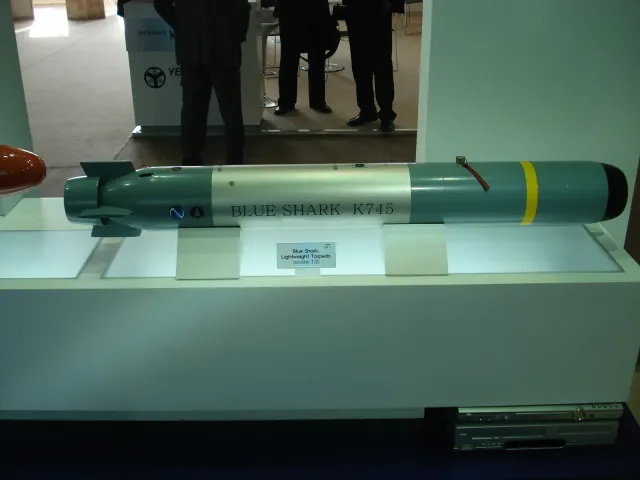
Munitions
K745 Blue Shark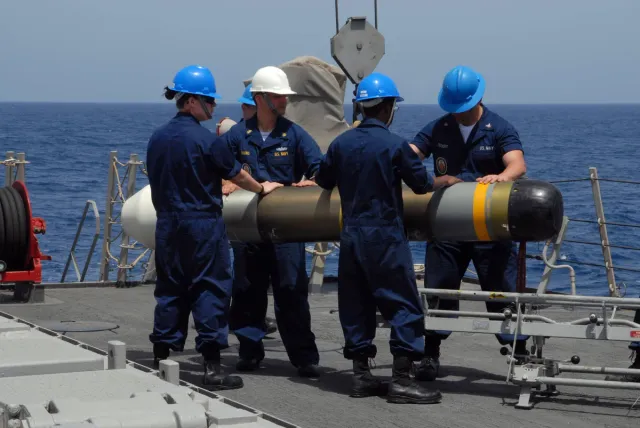
Munitions
Mk 54 torpedo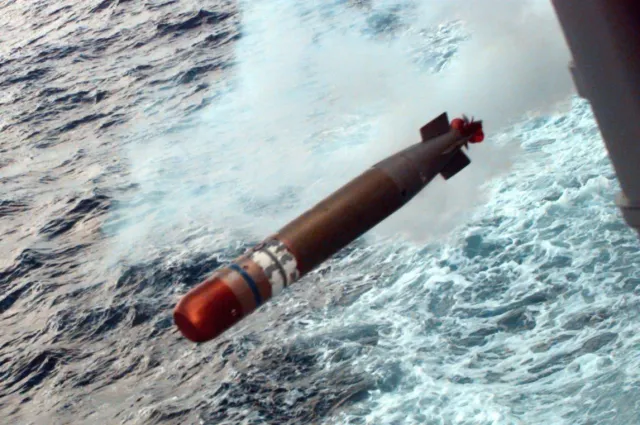
Frequently asked questions
What is the actual difference between a heavyweight and a lightweight torpedo? +
Heavyweight torpedoes (533mm diameter, roughly 1,100-1,700 kg) are submarine-launched and built to run an entire hunt-and-kill sequence alone from stand-off range against submarines and warships. Lightweight torpedoes (324mm diameter, roughly 230-280 kg) are dropped by helicopters and patrol aircraft or fired from surface ships that have already found the target through other means, sonobuoys, dipping sonar, a radar contact, and only need to complete a short terminal intercept. The weight difference is mostly a much bigger warhead (370 kg on South Korea's K731 White Shark versus 44-45 kg on Western lightweights) and more onboard fuel for the longer independent run.
Why does the Tiger Shark's 50 km range look so much bigger than the Mk 54's 9.1 km? +
Partly because it is a bigger torpedo doing a fundamentally different job, and partly because raw range is a misleading efficiency metric. Tiger Shark weighs 1,619 kg and covers 30.9 meters of range per kilogram of mass. The US Navy's lightweight Mk 54 weighs 276 kg and covers 33.0 meters per kilogram, essentially the same efficiency. South Korea's own lightweight K745 Blue Shark does even better at 67.9 m/kg. Tiger Shark's headline number comes from carrying far more mass, not from a more efficient design.
Have any of these torpedoes' claimed ranges been tested in actual combat? +
No, and that caution applies across the board, not to any single country. None of the seven torpedo systems examined here has a publicly documented combat launch at its claimed maximum range. South Korea's K731 White Shark, K745 Blue Shark and K761 Tiger Shark each show exactly one operator (South Korea itself) with no independently reported combat use. The Mk 54 and Stingray are decades-old, far more widely fielded designs, six and four operators respectively, but even their range figures rest on trials and manufacturer data, not a documented wartime shot at range.
Why does the K745A1 Red Shark show the exact same range as the K745 Blue Shark torpedo it carries? +
This is a genuinely unresolved question in WeaponSpecs' own sourcing, not a settled answer. Wikipedia states the Red Shark rocket has a range of 19 km and carries a K745 Blue Shark torpedo that parachutes down near the target, but it does not explain whether that shared 19 km figure is a real engineering coincidence (a rocket motor's fuel supply and a torpedo's battery life independently converging on a similar number) or whether one spec sheet's number simply propagated into the other's listing. We could not settle it and are saying so rather than guessing.
Does South Korea's higher torpedo range mean its torpedoes are better than NATO's? +
Not in any simple sense. Better at what is the real question. Tiger Shark's 50 km range and 370 kg-class warhead capacity (based on its predecessor White Shark's published figure) suit it to a submarine's job: reach out and kill a hull from stand-off distance. The Mk 54's 9.1 km range is not a shortcoming, it is sized for a helicopter or ship that has already localized a submarine and just needs the last few kilometers of terminal homing. Range alone answers a different question than the one a buyer or analyst should actually be asking, which weapon fits which kill chain.
Related reading


