Air-to-Air Missile Range: Guidance Type, Not Country
All 15 infrared-guided air-to-air missiles in our database top out at 50 km; all 15 active-radar ones start at 60 km. Guidance, not country, sets the tier.

Balon Greyjoy, CC0, via Wikimedia Commons
Every one of the 15 infrared-guided air-to-air missiles in the WeaponSpecs database tops out at 50 km. Every one of the 15 active-radar-homing missiles starts at 60 km. That’s a clean 10 km gap with zero overlap between the two tiers, across 30 missiles from a dozen countries. The one thing that reliably predicts a missile’s range tier isn’t who built it, it’s what kind of seeker sits in the nose. The exception, three legacy semi-active radar missiles that don’t fit either band, is the more interesting finding, and it explains why that guidance mode is dying out.
Most of the range figures below carry the standard caveat that applies across this database: Russian and Chinese manufacturer or state figures are claims, not independently flight-tested results, and that covers a majority of both tiers here. Details on each are flagged inline rather than repeated every paragraph.
Why do heat-seeking missiles top out around 50 km?
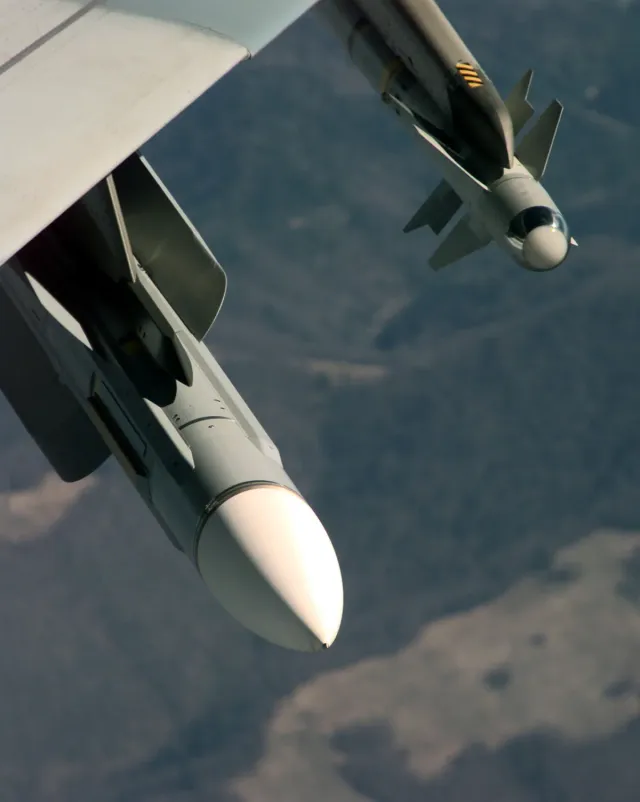
Infrared-guided missiles lock onto heat, almost always an engine’s exhaust plume, using a seeker that needs no help once it’s tracking. That’s a genuine engineering strength: cheap, jam-resistant against radar countermeasures, no reliance on a friendly radar. But it’s also a within-visual-range weapon by design. Russia’s Igla-V publishes just 5 km, Britain’s ASRAAM tops the tier at 50 km, and the 15-missile median lands at 16 km. That’s not a technology ceiling, infrared seekers themselves could arguably reach further, it’s a doctrine ceiling. Nobody builds a 100 km infrared missile because the mission these weapons fill, a fast, high-off-boresight dogfight shot, happens inside visual range or just past it. China’s PL-8, PL-5, and PL-10, and Russia’s R-73 and R-74, are manufacturer and state figures without independent verification, same caveat as always with these sources, but even taking them at face value, they still sit inside the same tight band as the American, French, Israeli, German, and South African entries. That consistency, across adversarial and allied programs alike, is what makes guidance type look like the real variable, not the flag on the missile.
What actually changes when a missile carries its own radar?
Active radar homing (ARH) missiles put a small radar transmitter and receiver inside the missile itself. After launch, the shooter provides mid-course guidance updates, often via datalink, until the missile’s own seeker takes over in the terminal phase and finds the target independently. That’s what “fire-and-forget” means in practice: the launching aircraft can maneuver away or engage a second target the moment the missile is guiding itself. Every ARH missile in the database, from Taiwan’s Tien Chien 2 at 60 km up to China’s PL-21 at a claimed 400 km, clears the 60 km floor. The 160 km AIM-120D AMRAAM, still the most widely fielded Western BVR missile per the AMRAAM program’s own public record, sits mid-pack. The 200 km Meteor and China’s 200 km PL-15 (the PL-15’s figure is a Chinese manufacturer claim, unverified independently) both use active electronically scanned array seekers, an upgrade on older ARH designs. Russia’s R-37M reaches a claimed 300 km, and China’s PL-21 tops the whole dataset at 400 km, though PL-21’s own guidance listing includes both active radar homing and infrared imaging as a hybrid seeker, worth flagging since it isn’t a pure single-mode ARH weapon even though active radar is its primary BVR function. Both figures are state or manufacturer claims with no independent flight-test confirmation.
Why do three “radar-guided” missiles break the pattern?
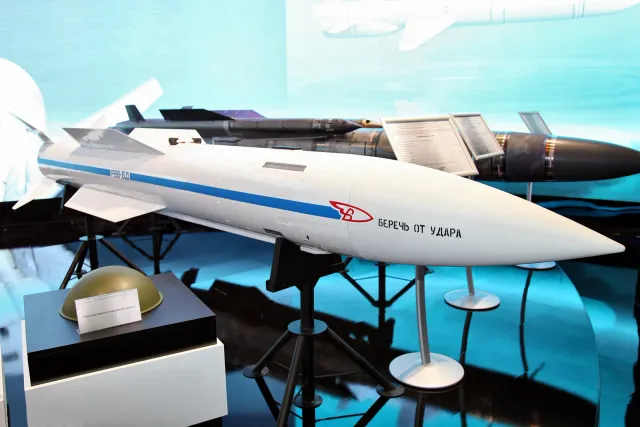
This is the part that actually explains the split, not just describes it. Three missiles in the database are radar-guided but don’t cleanly fit either tier: France’s Matra Super 530F at 25 km, the American AIM-7 Sparrow at 50 km, and Russia’s R-33 at 160 km. All three use semi-active radar homing (SARH), where the missile has no radar transmitter of its own, it just listens for radar energy that the launching aircraft’s own radar is bouncing off the target. Per the mechanics of semi-active radar homing, that means the shooter has to keep illuminating the target continuously, in a straight-enough flight path for its radar to hold the lock, until the missile hits. The launch aircraft can’t break away, can’t engage a second target, and stays a detectable, predictably-flying radar emitter for the missile’s entire time of flight. That’s a real tactical liability, not a range limitation, which is exactly why these three don’t cluster by distance the way pure infrared and pure active-radar missiles do: two of them (Super 530F, Sparrow) sit inside the infrared tier’s range band, while the third (R-33) is genuinely long-ranged. Range was never the constraint SARH was designed around, the illumination requirement was. Active radar homing missiles exist specifically to remove that constraint. Unsurprisingly, the Super 530 was retired and replaced by the ARH-guided MICA, and the Sparrow left frontline US service decades ago. Russia’s R-33 is the outlier that survives, but per its design history for the MiG-31 interceptor, that’s mainly because Russia never fully re-armed the MiG-31 fleet with a modern BVR missile, not because SARH itself aged well. The R-33’s 160 km figure is a Russian state claim, unverified.
The full ranking, tier by tier
| Missile | Country | Range (km) | Guidance | Status |
|---|---|---|---|---|
| PL-21 | China | 400 | Active radar homing (hybrid IR-imaging seeker) | active, unverified state claim |
| R-37M | Russia | 300 | Active radar homing | active, unverified state claim |
| PL-15 | China | 200 | Active radar homing (AESA) | active, unverified state claim |
| Meteor | United Kingdom | 200 | Active radar homing (AESA) | active |
| AIM-260 JATM | United States | 200 | Active radar homing | active, details sparse/classified |
| AIM-54 Phoenix | United States | 190 | Active radar homing | legacy (still flown by Iran) |
| R-33 | Russia | 160 | Semi-active radar homing + inertial | active, unverified state claim |
| AIM-120D AMRAAM | United States | 160 | Active radar homing | active |
| Astra / R-77 | India / Russia | 110 | Active radar homing | active |
| Gökbora / PL-12 / AAM-4 | Turkey / China / Japan | 100 | Active radar homing | Gökbora: announced, not yet fielded |
| MICA EM | France | 80 | Active radar homing | active |
| Derby | Israel | 65 | Active radar homing | active |
| Tien Chien 2 | Taiwan | 60 | Active radar homing | active |
| AIM-7 Sparrow | United States | 50 | Semi-active radar homing | legacy |
| ASRAAM | United Kingdom | 50 | Infrared homing | active |
| R-74 | Russia | 40 | Infrared homing | active, unverified state claim |
| AIM-9X Sidewinder | United States | 35 | Infrared homing | active |
| R-73 | Russia | 30 | Infrared homing | active, unverified state claim |
| Super 530F / IRIS-T | France / Germany | 25 | SARH / Infrared homing | Super 530F retired, IRIS-T active |
| Python-5 / PL-10 | Israel / China | 20 | Infrared homing | active |
| PL-5 | China | 16 | Infrared homing | active, unverified state claim |
| PL-8 / Python 4 / Magic 2 | China / Israel / France | 15 | Infrared homing | Python 4 legacy, others active |
| A-Darter / R550 Magic | South Africa / France | 10 | Infrared homing | active |
| TY-90 | China | 6 | Infrared homing | active, unverified state claim |
| Igla-V | Russia | 5 | Infrared homing | active, unverified state claim |
The tan cluster (infrared) and the accent cluster (active radar) never touch, they're separated by a real 10 km gap. The three red bars, all semi-active radar homing, scatter across both bands instead of forming their own, which is the tell that SARH's range was never the point, the illumination requirement was.
Which missiles does WeaponSpecs’ own database get wrong (or collapse into one record)?
Worth a database-honesty flag before closing. India’s Astra appears twice in the underlying data, once as “Astra Mk1” and once as “Astra,” both listing identical 110 km / Mach 4.5 figures. That’s a duplicate entry, not two missiles, and it’s excluded from every count and chart above rather than double-counted. Two more records were deliberately left out of the clean tiers entirely because they don’t map to a single guidance type. Russia’s R-27 has one WeaponSpecs record listing both semi-active radar homing and infrared homing as guidance, because the real R-27R (radar) and R-27T (infrared) are distinct missile variants sharing an airframe and a 130 km range figure, the database collapses two different weapons into one entry. Turkey’s Gökdoğan/Bozdoğan pair has the same problem: one DB record, “gokdogan-bozdogan-missile,” covers two physically separate TÜBİTAK-SAGE missiles that were live-fire tested together from an F-16 against drone targets in October 2025. Gökdoğan is the BVR active-radar-homing missile; Bozdoğan is the WVR infrared-homing missile. The shared 65 km figure in our data is really Gökdoğan’s engagement range, not an independent figure for Bozdoğan, whose real WVR range would be far shorter. Neither anomaly changes the finding above, but a dataset that hides its own seams isn’t one you should trust blindly, so we’re flagging ours.
What this means for the reader who has to decide something
For a procurement officer or analyst, the practical takeaway isn’t “longer range wins.” It’s that guidance type tells you the mission a missile is built for before you ever check a spec sheet: infrared means close-in, fire-and-forget dogfighting; active radar means stand-off engagement with the shooter free to maneuver; semi-active radar means an aging design that trades the shooter’s freedom of action for a simpler missile, and that trade is why it’s disappearing from new programs. When you’re evaluating a fighter’s loadout or a country’s air-to-air posture, the guidance type on the label tells you more, faster, than the range number next to it, and it tells you which claims to discount harder. State and manufacturer figures from Russia and China dominate both tiers here; treat every one of them as a claim until an independent flight test says otherwise.
Compare BVR and WVR loadouts side by side in the missile comparison tool, browse the full missile category, or see our earlier ranking of the longest-range air-to-air missiles, which covers pure BVR range order without the guidance-type angle this piece adds. For individual specs, see the AIM-120D AMRAAM, Meteor, AIM-9X Sidewinder, PL-15, R-37M, and the retired Matra Super 530F system pages.
Sources
Systems in this comparison
Every system covered above, with its photo and, where available, a video. Tap a card to open the full spec sheet.
Compare these side by side →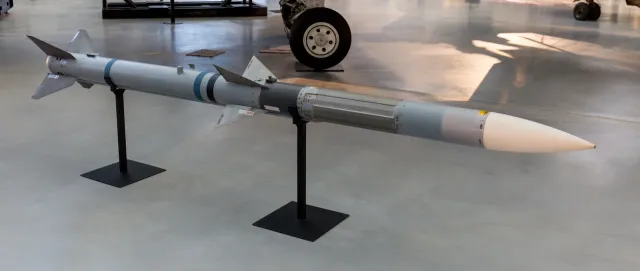
Frequently asked questions
What's the difference between infrared and active radar homing? +
Infrared homing missiles steer toward heat, usually an engine's exhaust plume, using an onboard seeker that needs no outside guidance once it locks. Active radar homing missiles carry their own tiny radar transmitter and receiver, letting them find and track a target independently in the missile's final phase, after receiving mid-course updates from the launching aircraft.
Why are heat-seeking missiles always short-range? +
Range isn't the limiting factor for infrared seekers themselves, it's doctrine. All 15 infrared-guided missiles in the WeaponSpecs database are built for within-visual-range dogfights, where engagements happen inside 50 km by design, so nobody has built a long-range infrared air-to-air missile because the mission doesn't call for one.
What is semi-active radar homing and why is it being phased out? +
Semi-active radar homing (SARH) requires the launching aircraft to keep illuminating the target with its own radar until the missile hits. That means the shooter can't break away, can't engage a second target, and stays a detectable, straight-flying emitter for the missile's whole flight. Active radar homing missiles were built specifically to remove that constraint, which is why 2 of the 3 SARH missiles in our dataset are already retired from frontline service.
What's the longest-range air-to-air missile in the database? +
China's PL-21 publishes 400 km, followed by Russia's R-37M at 300 km. Both are state and manufacturer claims, not independently flight-tested by a neutral third party, and the PL-21 listing itself describes a hybrid active-radar/infrared-imaging seeker rather than a single guidance mode.
What do WVR and BVR mean? +
WVR (within-visual-range) covers close-in dogfight engagements, typically under 50 km, where infrared-guided missiles dominate. BVR (beyond-visual-range) covers longer engagements where the target is detected and engaged before it's visible to the naked eye, the domain of active-radar-homing missiles.
Related reading


