UAV Payload vs. Range: Why the Two Don't Scale Together
Across 29 drones that publish both figures, payload and range correlate only moderately (r=0.615), revealing two distinct UAV design philosophies.

Bayhaluk, CC BY-SA 4.0
Twenty-nine of the 98 UAV systems in the WeaponSpecs database publish both a maximum range and a weapons payload figure. Across those 29, the two numbers track only moderately, Pearson r=0.615, which means a bigger airframe does not reliably mean more of everything. Some drones spend their extra design weight on fuel. Others spend it on ordnance. That choice, not the airframe’s raw size, is the real story a spec sheet hides.
Do bigger drones simply carry more and fly farther?
Only loosely. A correlation of 0.615 is a real, positive relationship, bigger UAVs do trend toward carrying more and flying farther, but it explains well under half the variance between the two numbers (r-squared of about 0.38). For a buyer, that means a manufacturer’s range figure alone tells you almost nothing about how much ordnance the airframe can actually deliver, and vice versa. Two drones with similar published ranges can differ in payload by an order of magnitude, and two drones with similar payloads can differ just as sharply in range.
The scatter below plots all 29 systems on a log-log grid, range against payload, with a dashed reference line marking where payload in kilograms equals range in kilometers exactly. Points that sit well above the line are payload-heavy for their range. Points well below it are range-heavy for their payload. The spread on both sides of that line, not the general upward drift, is the finding.
The dashed line marks where payload in kilograms exactly equals range in kilometers, the reference for the 1.0 ratio cluster discussed below. Points above the line carry more payload than their range in km would suggest; points below fly comparatively far on comparatively little.
The full ranked dataset, all 29 systems sorted by payload-to-range ratio, is below.
| System | Country | Range (km) | Payload (kg) | Payload/Range Ratio |
|---|---|---|---|---|
| MQ-1C Gray Eagle | United States | 400 | 488 | 1.22 |
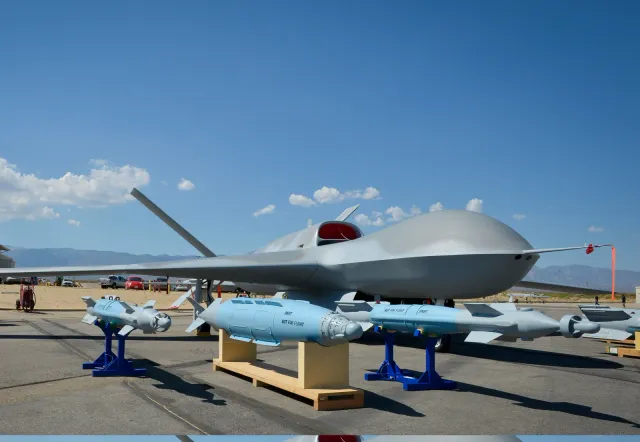
| Avenger (Predator C) | United States | 2,778 | 2,948 | 1.06 |
| Bayraktar TB2 | Turkey | 150 | 150 | 1.00 |
| ANKA-S | Turkey | 200 | 200 | 1.00 |
| Bayraktar Kizilelma | Turkey | 1,500 | 1,500 | 1.00 |
| Orion (Inokhodets) | Russia | 250 | 250 | 1.00 |
| MQ-9A Reaper | United States | 1,850 | 1,700 | 0.92 |
| Vampire | Ukraine | 20 | 15 | 0.75 |
| Anka-3 | Turkey | 1,600 | 1,200 | 0.75 |
| GJ-11 | China | 4,000 | 2,000 | 0.50 |
| Crossbow | France | 800 | 300 | 0.38 |
| Heron TP | Israel | 7,400 | 2,700 | 0.36 |
| MQ-9B SkyGuardian | United States | 6,000 | 2,155 | 0.36 |
| Hermes 900 | Israel | 1,000 | 300 | 0.30 |
| Bayraktar Akinci | Turkey | 6,000 | 1,500 | 0.25 |
| Mohajer-6 | Iran | 200 | 40 | 0.20 |
| MQ-1 Predator | United States | 1,100 | 204 | 0.19 |
| CH-5 (Caihong-5) | China | 6,000 | 1,000 | 0.17 |
| Wing Loong 10 | China | 3,000 | 480 | 0.16 |
| Bayraktar TB3 | Turkey | 2,000 | 280 | 0.14 |
| Aksungur | Turkey | 6,000 | 750 | 0.13 |
| Wing Loong II | China | 4,000 | 480 | 0.12 |
| CH-4 (Caihong-4) | China | 3,500 | 345 | 0.10 |
| Sokil-300 | Ukraine | 3,300 | 300 | 0.09 |
| AQ-400 Scythe | Ukraine | 750 | 43 | 0.06 |
| Punisher | Ukraine | 45 | 2.5 | 0.06 |
| Wing Loong I | China | 4,000 | 200 | 0.05 |
| Phoenix Ghost | United States | 120 | 3.7 | 0.03 |
| UJ-22 Airborne | Ukraine | 800 | 20 | 0.03 |
Which UAVs pack the most payload for their range?
The US Army’s MQ-1C Gray Eagle tops the list: 488 kg of payload against a 400 km range, a ratio of 1.22. That is a short-range, mission-focused strike and ISR platform built to loiter over a battlefield the Army already controls the airspace around, not to reach across a theater. General Atomics’ jet-powered Avenger is close behind at 1.06, and it carries the highest raw payload figure in the entire dataset, 2,948 kg against a 2,778 km range. A turbofan buys speed and survivability over a propeller-driven MALE drone, at a real fuel-efficiency cost that shows up directly in the ratio.
Four more systems land at an exact 1.00 ratio: Bayraktar TB2 (150 kg payload, 150 km range), ANKA-S (200/200), Bayraktar Kizilelma (1,500/1,500), and Russia’s Orion (250/250, a state/manufacturer claim, not independently verified). Payload in kilograms and range in kilometers are unrelated physical quantities, one measures how much weight an airframe can carry, the other how far it can fly on its fuel load, so there is no engineering reason for them to land on the same number. When four separate systems from three different manufacturers all do it, that is a signal about the precision of the underlying figures, not a coincidence about their designs. It reads as rounded, order-of-magnitude marketing estimates rather than flight-test maxima, worth remembering the next time a spec sheet payload number looks suspiciously clean.
Which UAVs fly far but carry comparatively little?
At the other end, four systems post ratios at or below 0.06. The US-made Phoenix Ghost (120 km range, 3.7 kg payload) and Ukraine’s UJ-22 Airborne (800 km, 20 kg) both land at 0.03, alongside China’s Wing Loong I (4,000 km, 200 kg, a manufacturer claim) at 0.05 and Ukraine’s Punisher (45 km, 2.5 kg) at 0.06. These are not failed strike drones that underperform on payload. They are a different category of aircraft: small, comparatively attritable loitering munitions and long-endurance ISR platforms built to reach a target or observe one, not to haul ordnance. A 3.7 kg payload on a drone with a 120 km range is a warhead sized for a single strike, not a bomb bay. Judging that airframe on the same ratio as a Gray Eagle misreads what it was built to do.
Where does the famous Bayraktar TB2 actually rank?
Near the bottom of the database’s large-UAV tier, and far below the two systems most often compared to it. TB2’s 150 km range and 150 kg payload are roughly 49 times smaller in range and 18 times smaller in payload than Israel’s Heron TP, which publishes 7,400 km and 2,700 kg. Against the US MQ-9A Reaper, at 1,850 km range and 1,700 kg payload, the Bayraktar TB2 is about 12 times smaller in range and 11 times smaller in payload.
Those numbers do not match the TB2’s reputation, and that gap is itself the point. The TB2 did not become the most recognized combat drone on earth by out-carrying or out-ranging the competition. It got there on cost, availability, and a combat record that outran its spec sheet.
“The TB2 is not a game-changer, nor does it represent some revolution of military affairs. It does, however, show how a well-built, commercially derived product can sustain attrition and keep on fighting,” wrote Aaron Stein, chief content officer at Metamorphic Media (Atlantic Council, August 30, 2022).
That is the honest read of the TB2’s place in this dataset. It is a modest airframe by payload and range, ranked accordingly here, whose real value came from being cheap enough to lose and simple enough to keep flying.
What does this mean for a buyer?
Choosing a UAV is really choosing how to spend a fixed weight budget: fuel tanks or ordnance racks. Avenger’s turbofan buys speed and a survivable radar signature at the cost of range per kilogram of fuel burned. Heron TP’s turboprop converts fuel into distance far more efficiently, which is why it wins on both raw payload and range at once, a genuinely uncommon combination in this dataset, propeller propulsion simply gets more distance out of the same fuel mass than a jet engine does. Neither answer is wrong. They are two different procurement problems: a platform built to survive close-in contested airspace with a heavy strike load, versus a platform built to watch or reach a target thousands of kilometers away.
A single spec sheet number, range or payload alone, tells a buyer almost nothing about which problem an airframe actually solves. The r=0.615 correlation across this dataset is the proof: knowing one number leaves real uncertainty about the other. Readers comparing specific platforms can pull the live specs side by side in the compare tool, or browse the full UAV category at /types/uav/ to see where a candidate system actually falls on this tradeoff before it becomes a line item in a budget.
Sources
Systems in this comparison
Every system covered above, with its photo and, where available, a video. Tap a card to open the full spec sheet.
Compare these side by side →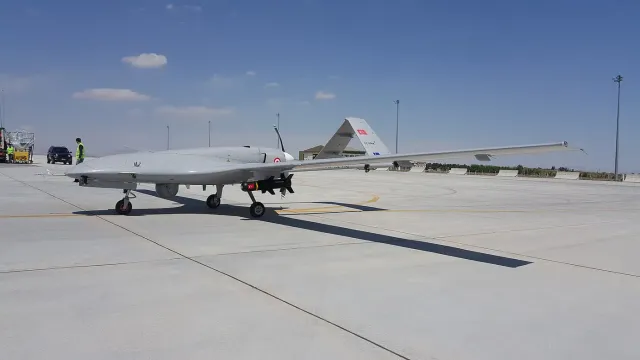
UAV / drone
Bayraktar TB2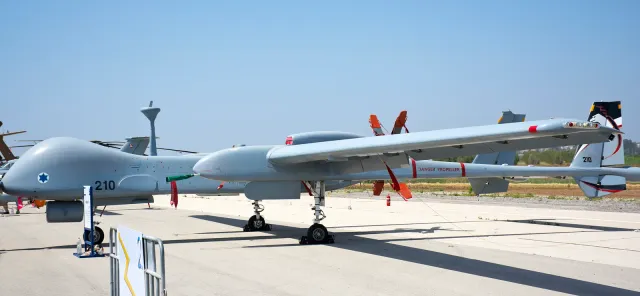
UAV / drone
Avenger (Predator C)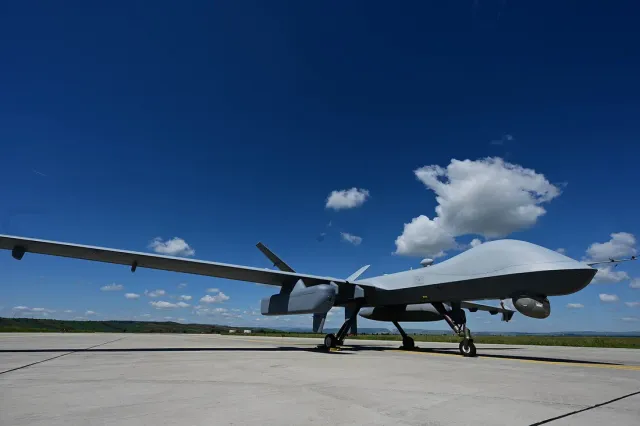
UAV / drone
MQ-9A Reaper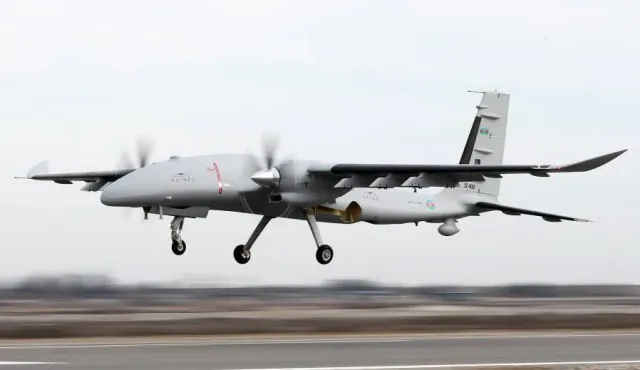
UAV / drone
Bayraktar Akinci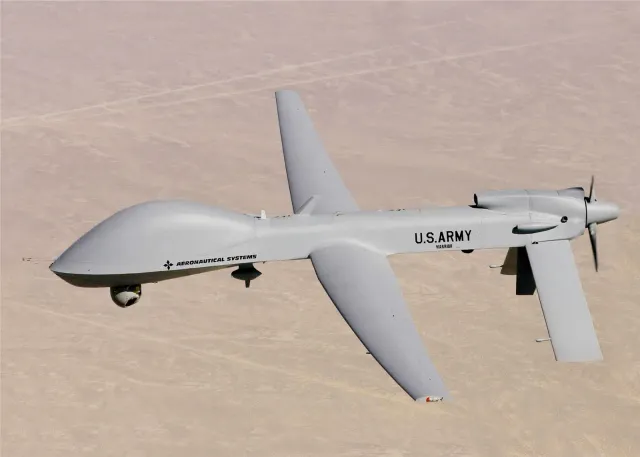
UAV / drone
MQ-1C Gray EagleFrequently asked questions
Do bigger UAVs always carry more payload and fly farther? +
Not tightly. Across the 29 of 98 UAVs in the WeaponSpecs database that publish both a maximum range and a weapons payload figure, the two correlate only moderately (Pearson r=0.615). A bigger airframe tends toward more of both, but the relationship is loose enough that knowing one number tells you little about the other. The real driver is where the extra design weight goes: into fuel tanks, or into ordnance.
Which UAV carries the most weapons payload relative to its range? +
The US Army's MQ-1C Gray Eagle posts the highest ratio in the dataset: 488 kg of payload against a 400 km range, 1.22 kg per km. General Atomics' jet-powered Avenger is close behind at 2,948 kg against 2,778 km (1.06), also the highest raw payload figure in the database. Four more systems, Bayraktar TB2, ANKA-S, Bayraktar Kizilelma and Russia's Orion, land at an exact 1.00 ratio, payload in kilograms precisely equal to range in kilometers, a pattern that reads more like a rounded estimate than a measured maximum, since the two units describe unrelated physical properties with no engineering reason to match.
Which UAVs fly far but carry comparatively little payload? +
The US-made Phoenix Ghost (120 km range, 3.7 kg payload, ratio 0.03) and Ukraine's UJ-22 Airborne (800 km, 20 kg, 0.03) post the lowest ratios in the dataset, alongside China's Wing Loong I (4,000 km, 200 kg, 0.05) and Ukraine's Punisher (45 km, 2.5 kg, 0.06). These are small, comparatively attritable strike or ISR platforms built to reach a target or observe, not to carry a meaningful weapons load.
Where does the famous Bayraktar TB2 actually rank on payload and range? +
Near the bottom of the database's 'large UAV' tier and far below its leaders. TB2's 150 km range and 150 kg payload are roughly 49 times smaller in range and 18 times smaller in payload than Israel's Heron TP (7,400 km, 2,700 kg), and about 12 times smaller in range and 11 times smaller in payload than the US MQ-9A Reaper (1,850 km, 1,700 kg). The TB2 became the most recognized combat drone in the world through its cost and its combat record in Nagorno-Karabakh and Ukraine, not through raw payload or range.
How reliable are the Russian, Chinese, and Iranian payload and range figures in this dataset? +
They are manufacturer or state disclosures, not independently measured results, the same caveat that applies to every figure in this analysis regardless of origin. China's GJ-11, CH-4, CH-5 and its three Wing Loong variants, Russia's Orion, and Iran's Mohajer-6, eight of the 29 systems in this dataset, come from state-linked manufacturer or export literature and should be read as claims, not verified facts.
Related reading


