Zumwalt Carries a Third of a Burke's Crew Per Ton
Of 56 warships in our database, Zumwalt runs 90.1 tons of ship per sailor, nearly 3x Arleigh Burke's 29.5 tons. That's automation, not just size.

Via Wikipedia, Zumwalt-class destroyer (shown for identification)
USS Zumwalt runs on 90.1 tons of ship for every sailor aboard, the highest ratio of any warship in the WeaponSpecs database, and nearly three times the 29.5 tons per sailor an Arleigh Burke needs. Across the 56 warships in our database with both a published crew complement and a published displacement, tons-of-ship-per-crew-member spans 13.7 to 90.1, a 6.6x range that functions as a rough proxy for how much a design leans on automation versus manpower. It is not a scoreboard for capability, a 14-ton-per-crew corvette isn’t a worse ship than Zumwalt, it just needs a minimum number of hands regardless of hull size. What the ratio does expose, when compared correctly, is which navies have engineered their way out of crew costs and which haven’t.
How many tons of ship does one sailor actually run?
Divide a warship’s full-load displacement by its crew complement and you get a number that has nothing to do with firepower or survivability and everything to do with staffing intensity. A ship that needs 90 tons of steel, sensors, and weapons per crew member has automated away tasks that another design still assigns to a human watchstander, a technician, or a damage-control party. A ship that needs 14 tons per crew member hasn’t necessarily failed to automate, it may simply be small enough that a minimum viable crew (bridge watch, engineering watch, weapons operators, damage control) already outweighs its hull tonnage.
Across our 56-ship dataset, the median is 31.2 tons per crew member and the mean is 36.6, both well below Zumwalt’s 90.1 at the top of the list. That spread matters because crew costs are not a rounding error in a warship’s budget, they are typically the single largest driver of a ship’s lifecycle cost once you look past the sticker price of the hull itself, a point we’ve made in detail in Why Sustainment Is 70% of a Weapon’s Real Cost. Every ton-per-crew point on this list, in other words, is a proxy for real money over a 30-plus-year service life, not a trivia stat.
Why does Zumwalt need a third of a Burke’s crew?
USS Zumwalt (full-load displacement 15,761 tons, crew 175) was designed for a complement of 147 ship’s company plus a 28-person aviation detachment, a total the Congressional Research Service’s RL32109 report and Wikipedia both describe as a deliberate target, less than half the crew of a comparable destroyer. The Arleigh Burke class, the destroyer Zumwalt was originally meant to succeed, carries 329 sailors on a 9,700-ton hull, 29.5 tons per crew member. Zumwalt runs roughly a third of that crew per ton of ship.
That gap isn’t incidental, it’s engineered. Automated damage control and fire suppression systems replace what used to be manual firefighting parties running hoses through smoke-filled passageways. Consolidated watch stations let fewer sailors monitor more systems from centralized displays instead of spreading them across the ship standing individual watches. The goal, per the same CRS reporting, was explicitly to cut operating and support (O&S) costs, the recurring bill for feeding, housing, training, and paying a crew over a ship’s decades of service, which dwarfs the one-time cost of the hull itself. A smaller crew is not a side effect of Zumwalt’s design, it was the design brief.
Is a high ratio just a big-ship effect?
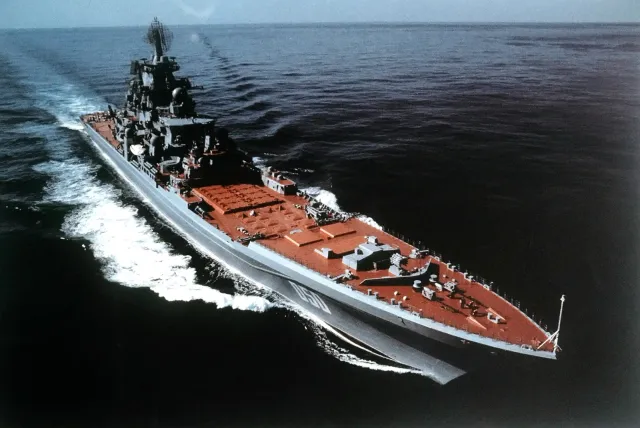
Here’s the catch, and it’s the reason a raw top-of-list ranking is actually misleading: Russia’s Kirov-class battlecruiser, a 1980-designed, Soviet-era, nuclear-powered ship with a crew of 710 on a 28,000-ton hull, posts 39.4 tons per crew member, higher than the 1991-designed Arleigh Burke’s 29.5. Kirov’s crew and displacement figures come from Russian state sources and aren’t independently verified, but even taken at face value, nothing about Kirov reflects modern automation investment. It simply has a much bigger hull spreading roughly the same crew-intensive fixed tasks, weapons operation, propulsion watches, damage control, across far more tons than Burke carries.
That’s the confound: tons-per-crew conflates ship size with automation, because a bigger hull dilutes a mostly fixed set of crew-intensive jobs across more displacement even with zero extra automation. The only valid test is a controlled comparison, same navy, similar size and role, different design era, which is exactly what the Zumwalt/Burke pair above is. Germany supplies an independent second data point: the future F126 frigate (10,000 tons full load, core crew of 114, in build, expected around 2028) runs 87.7 tons per crew member, against the Sachsen-class frigate Germany has operated since 2004 (5,800 tons, crew 243) at 23.9. Same navy, a 3.7x jump between the ship Germany is replacing and the one replacing it. That’s the automation-driven de-manning trend showing up independently outside the US Navy, not a one-country artifact.
Does leaner manning actually save money?
Here’s where the story gets less tidy. The US Navy’s broader, fleet-wide bet on smaller crews, the 2000s-era “optimal manning” initiative that trimmed complements across multiple ship classes, has a genuinely mixed record on the thing it was supposed to deliver. Per GAO findings reported by Navy Times, the personnel-cost savings from those cuts were largely offset by increased maintenance spending, because smaller crews had less onboard, organic maintenance capacity and the Navy had to lean harder on more expensive shore-based contractor maintenance to compensate. The total ownership cost didn’t fall the way the plan promised.
Zumwalt’s own case is worse in a different way: the manning model never got the fleet size to prove itself. The class was planned at 32 hulls, cut to 24, then 7, then ultimately just 3 built, driven largely by unrelated cost overruns, the Advanced Gun System’s per-round ammunition cost blew out to roughly $1 million once the shrinking class lost its economies of scale. A 175-person crew that was supposed to validate a fleet-wide manning philosophy instead sits on three ships that never got a mission the gun system was built for.
“The program made most of the mistakes that the acquisition manual tells you not to make,” said Bryan Clark, a naval analyst at the Center for Strategic and Budgetary Assessments (Roll Call, May 21, 2018).
Clark’s assessment is about the acquisition program’s collapse, the ammunition costs, the shrinking hull count, the years of re-missioning, not about the automated-manning engineering itself. The crew-reduction technology largely worked as designed. The program built around it did not survive intact long enough to bank the fleet-wide savings it was engineered to produce.
Which navies are already building this way?
The top of the ranked list is dominated by ships that haven’t entered service yet, or only recently have: Germany’s F126 (87.7 tons per crew, expected 2028), Japan’s Mogami-class frigate at 5,500 tons and 90 crew (61.1), Denmark’s Iver Huitfeldt and Absalon classes (66.5 and 63.0), the UK’s Type 31 Inspiration and Type 26 City frigates (56.6 and 51.0), and Australia’s Hunter class (48.9). Most of these are frigates entering service across the 2020s and into the early 2030s, not destroyers or cruisers, which tracks with a real if loose pattern in the dataset: tons-per-crew correlates with release year at r=0.415, a moderate positive relationship. Newer designs trend toward leaner crewing, but the correlation is far from a hard rule, there’s plenty of scatter, and plenty of newer ships (South Korea’s Sejong the Great class, released 2008, sits at just 33.3) that don’t fit the pattern cleanly.
Compare any of these designs directly, including crew and displacement alongside the rest of their specs, in the Compare tool, or browse the full warship category for the underlying systems.
The full ranked list
Kirov (marked with an asterisk, Russian state-sourced figures) is the outlier that proves the point: it out-ranks the pre-2010 Arleigh Burke on this chart despite predating it by over a decade, because its 28,000-ton hull dilutes a fixed crew workload rather than automating it away. The valid automation story is the same-navy pairs, Zumwalt vs. Burke and F126 vs. Sachsen, not this raw ranking alone.
The chart above curates 14 representative ships for readability. The full 56-ship dataset, every warship in the WeaponSpecs database with both a published crew complement and a published displacement, is below, ranked descending by tons per crew member.
| Rank | System | Country | Displacement (t) | Crew | Tons/Crew | Design Year |
|---|---|---|---|---|---|---|
| 1 | Zumwalt-class Destroyer | United States | 15,761 | 175 | 90.1 | 2016 |
| 2 | F126 | Germany | 10,000 | 114 | 87.7 | 2028 |
| 3 | Holland class | Netherlands | 3,750 | 50 | 75 | 2011 |
| 4 | Iver Huitfeldt-class | Denmark | 6,645 | 100 | 66.5 | 2011 |
| 5 | Absalon-class | Denmark | 6,300 | 100 | 63 | 2004 |
| 6 | Mogami-class | Japan | 5,500 | 90 | 61.1 | 2022 |
| 7 | Baden-Wurttemberg-class | Germany | 7,200 | 120 | 60 | 2019 |
| 8 | Type 31 Inspiration | United Kingdom | 6,000 | 106 | 56.6 | 2027 |
| 9 | Pohjanmaa-class (Squadron 2020) | Finland | 3,900 | 70 | 55.7 | 2026 |
| 10 | FREMM (Aquitaine class) | France | 6,000 | 108 | 55.6 | 2012 |
| 11 | Type 26 City | United Kingdom | 8,000 | 157 | 51 | 2028 |
| 12 | Miecznik | Poland | 6,000 | 120 | 50 | 2028 |
| 13 | Hunter-class | Australia | 8,800 | 180 | 48.9 | 2031 |
| 14 | Type 45 Daring | United Kingdom | 8,500 | 191 | 44.5 | 2009 |
| 15 | Type 055* | China | 13,000 | 300 | 43.3 | 2020 |
| 16 | Bonifaz class (F110) | Spain | 6,250 | 150 | 41.7 | 2026 |
| 17 | Arafura-class | Australia | 1,640 | 40 | 41 | 2022 |
| 18 | Formidable-class | Singapore | 3,600 | 90 | 40 | 2007 |
| 19 | Kirov-class* | Russia | 28,000 | 710 | 39.4 | 1980 |
| 20 | Andrea Doria class (Horizon) | Italy | 7,050 | 190 | 37.1 | 2007 |
| 21 | Constellation-class Frigate | United States | 7,291 | 200 | 36.5 | 2026 |
| 22 | Thaon di Revel class (PPA) | Italy | 6,250 | 171 | 36.5 | 2022 |
| 23 | Amiral Ronarc’h-class Frigate (FDI) | France | 4,460 | 125 | 35.7 | 2026 |
| 24 | Horizon class | France | 7,050 | 200 | 35.3 | 2008 |
| 25 | Bergamini class (FREMM) | Italy | 6,900 | 200 | 34.5 | 2013 |
| 26 | Maya-class | Japan | 10,250 | 300 | 34.2 | 2020 |
| 27 | Sejong the Great-class destroyer | South Korea | 10,000 | 300 | 33.3 | 2008 |
| 28 | De Zeven Provincien class | Netherlands | 6,300 | 202 | 31.2 | 2002 |
| 29 | Istif-class | Turkey | 3,200 | 106 | 30.2 | 2021 |
| 30 | Admiral Gorshkov-class* | Russia | 5,400 | 180 | 30 | 2018 |
| 31 | Ticonderoga-class Cruiser | United States | 9,800 | 330 | 29.7 | 1983 |
| 32 | Arleigh Burke-class Destroyer | United States | 9,700 | 329 | 29.5 | 1991 |
| 33 | Nilgiri class | India | 6,670 | 226 | 29.5 | 2025 |
| 34 | Sa’ar 6 | Israel | 2,000 | 70 | 28.6 | 2020 |
| 35 | Braunschweig-class | Germany | 1,840 | 65 | 28.3 | 2008 |
| 36 | Type 052D* | China | 7,500 | 280 | 26.8 | 2014 |
| 37 | Type 23 Duke | United Kingdom | 4,900 | 185 | 26.5 | 1990 |
| 38 | Ada-class | Turkey | 2,400 | 93 | 25.8 | 2011 |
| 39 | Daegu-class frigate | South Korea | 3,600 | 140 | 25.7 | 2018 |
| 40 | La Fayette class | France | 3,800 | 151 | 25.2 | 1996 |
| 41 | Alvaro de Bazan class (F100) | Spain | 6,250 | 250 | 25 | 2002 |
| 42 | Shivalik class | India | 6,200 | 257 | 24.1 | 2010 |
| 43 | SIGMA 10514 | Netherlands | 2,400 | 100 | 24 | 2007 |
| 44 | Sachsen-class | Germany | 5,800 | 243 | 23.9 | 2004 |
| 45 | Incheon-class Frigate | South Korea | 3,300 | 140 | 23.6 | 2013 |
| 46 | Visakhapatnam class | India | 7,400 | 315 | 23.5 | 2021 |
| 47 | Steregushchiy-class* | Russia | 2,200 | 100 | 22 | 2007 |
| 48 | Chungmugong Yi Sun-sin-class destroyer | South Korea | 6,520 | 300 | 21.7 | 2003 |
| 49 | Slava-class* | Russia | 11,490 | 529 | 21.7 | 1982 |
| 50 | Kolkata class | India | 7,500 | 350 | 21.4 | 2014 |
| 51 | Type 054A* | China | 4,053 | 190 | 21.3 | 2008 |
| 52 | Sa’ar 5 | Israel | 1,275 | 74 | 17.2 | 1994 |
| 53 | Tuo Chiang-class | Taiwan | 685 | 41 | 16.7 | 2014 |
| 54 | Visby-class | Sweden | 640 | 43 | 14.9 | 2002 |
| 55 | Hamina-class | Finland | 250 | 18 | 13.9 | 1998 |
| 56 | Skjold-class | Norway | 274 | 20 | 13.7 | 1999 |
*Kirov-class, Slava-class, Steregushchiy-class, Admiral Gorshkov-class, Type 055, Type 052D, and Type 054A carry crew and displacement figures from Russian or Chinese state and manufacturer sources, not independently verified, per WeaponSpecs’ standard state-claim caveat.
Every one of these ships, along with photos, full spec sheets, and the systems anchoring this analysis, is in the WeaponSpecs database. Start with Zumwalt-class Destroyer, Arleigh Burke-class Destroyer, or F126 frigate, browse the full warship category, or build your own side-by-side in the Compare tool to check any two hulls’ crew-to-tonnage math yourself.
Sources
- CRS Report RL32109: Navy DDG-51 and DDG-1000 Destroyer Programs: Background and Issues for Congress
- Zombie Zumwalt: The Ship Program That Never Dies, Roll Call
- Navy 'masking' extent of manning shortfalls in the surface fleet, watchdog agency says, Navy Times
- Zumwalt-class destroyer, Wikipedia
- F126 frigate, Wikipedia
- Arleigh Burke-class destroyer, Wikipedia
Systems in this comparison
Every system covered above, with its photo and, where available, a video. Tap a card to open the full spec sheet.
Compare these side by side →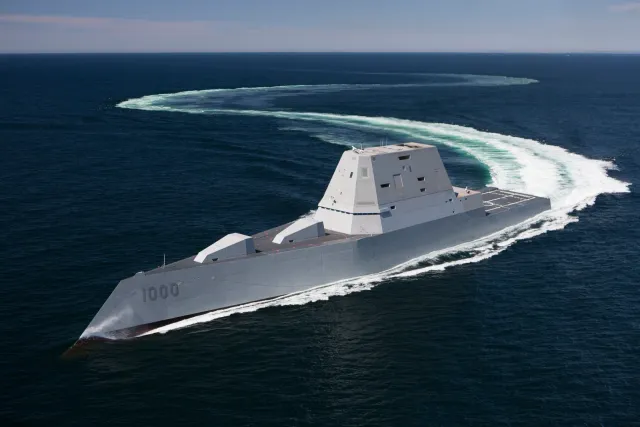
Warship
Zumwalt-class Destroyer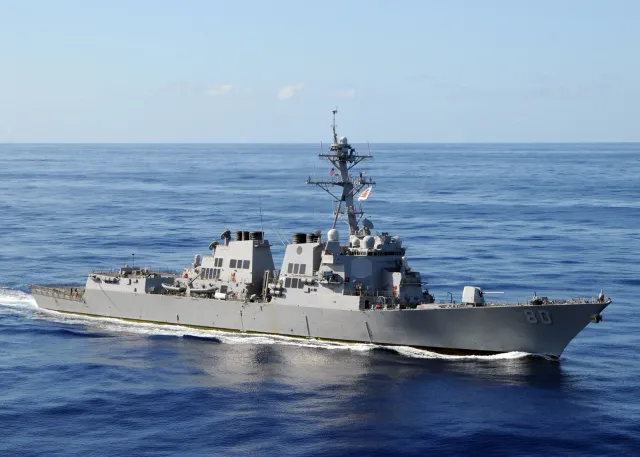
Warship
Arleigh Burke-class Destroyer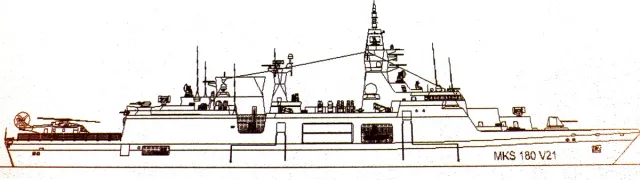
Warship
Kirov-class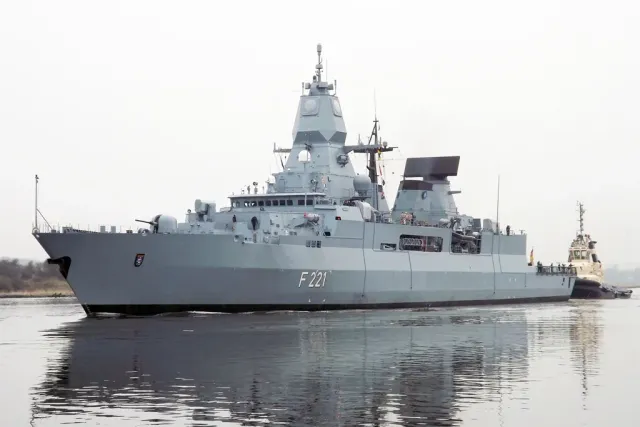
Warship
Sachsen-class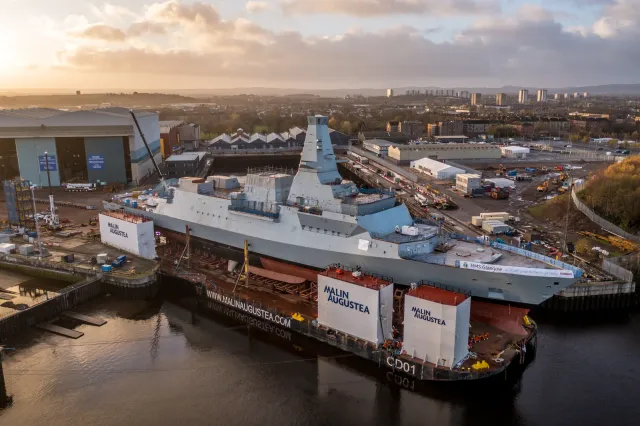
Warship
Type 26 CityFrequently asked questions
What does "tons per crew member" actually measure? +
It's full-load displacement divided by crew complement, a rough proxy for how much a warship design leans on automation versus manpower to operate and fight the ship. It is not a measure of combat capability. A small corvette with a low ratio isn't "worse" than a destroyer with a high one, it simply needs a minimum crew regardless of size.
Why does the Zumwalt need so much less crew than the Arleigh Burke? +
Per Congressional Research Service report RL32109 and Wikipedia, Zumwalt's complement of 175 (147 ship's company plus 28 aviation detachment) was a deliberate design target, less than half a comparable destroyer's crew, achieved through automated damage control and fire suppression and consolidated watch stations, specifically to cut the crew costs that dominate a warship's lifecycle operating and support budget.
Does a high tons-per-crew ratio always mean a more automated ship? +
No. Russia's Kirov-class battlecruiser, a 1980-designed Soviet-era ship with none of the automation investment of a modern warship, posts a higher ratio than the 1991-designed Arleigh Burke simply because it's a much bigger hull spreading roughly the same crew-intensive fixed tasks across more tons. The valid test is a controlled, same-navy comparison across eras, not a raw cross-navy ranking.
Has the US Navy's push for smaller crews actually saved money? +
The record is mixed. GAO findings reported by Navy Times show the Navy's 2000s-era optimal manning initiative cut crew sizes but saw much of the personnel savings offset by higher contractor maintenance costs, since smaller crews had less onboard maintenance capacity. Zumwalt's own manning model never got to prove out fleet-wide either, the class shrank from 32 planned hulls to just 3.
Which navies are building the leanest-crewed warships right now? +
Germany's F126, Japan's Mogami class, the UK's Type 31 and Type 26, and Australia's Hunter class all rank near the top of the ratio, and all are frigates entering service in the 2020s and 2030s. That clusters with a real but loose trend across the dataset: newer designs tend toward leaner crewing, correlation r=0.415 between release year and tons per crew.
Related reading


