India Widens Missile-Test No-Fly Zone to 3,760 KM for Aug 6-7
India abruptly extended its Bay of Bengal missile-test exclusion zone from 2,530 km to 3,760 km, fueling speculation over an Agni-series or K-4 SLBM trial.

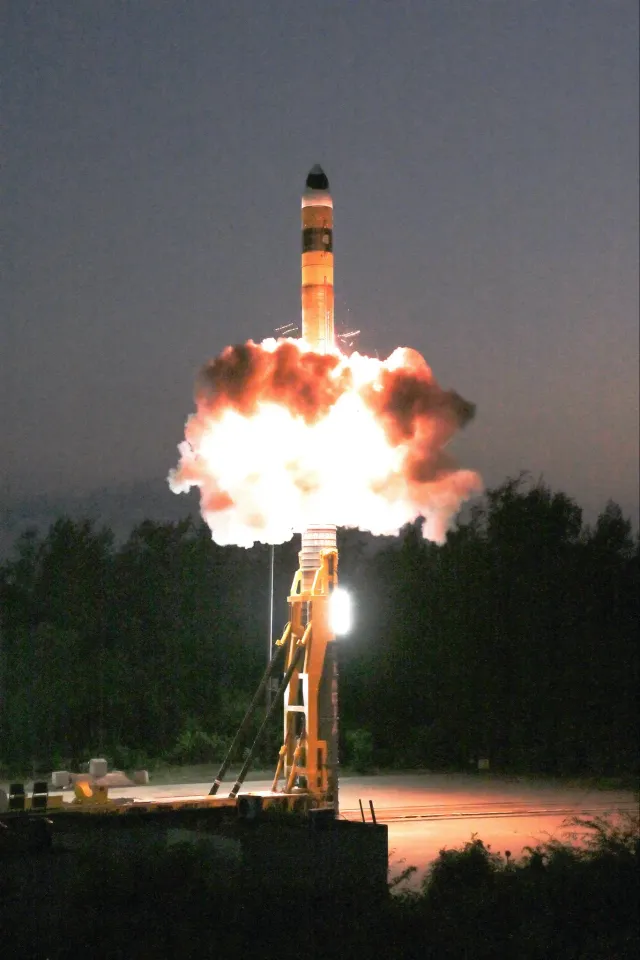
DRDO / Government of India, via Wikimedia Commons (GODL-India), captured 19 April 2012 at the Integrated Test Range, Wheeler Island, Odisha
India has abruptly extended the airspace and maritime exclusion zone for an upcoming missile test off the Odisha coast from 2,530 km to roughly 3,760 km, a jump large enough that Indian defense-watcher outlets are now speculating the country plans to test a longer-range Agni-series missile or its developing K-4 submarine-launched ballistic missile, though DRDO has not confirmed either.
The NOTAM jump, in plain terms
A Notice to Airmen, or NOTAM, is the mechanism countries use to close off a defined stretch of airspace and sea, warning civil and military aircraft and vessels to stay out of a zone while a weapons test is underway. India first published a NOTAM on August 2 establishing a 2,530 km exclusion corridor over the Bay of Bengal ahead of a test window running August 6 to 7, launched from Dr. APJ Abdul Kalam Island, also known as Wheeler Island, off the Odisha coast, the long-standing home of DRDO’s Integrated Test Range and the Strategic Forces Command facility used for the country’s most sensitive missile trials. By August 4, that same corridor had been extended to approximately 3,760 km, covering the area from sea level to unlimited altitude, according to idrw.org, while the test window itself stayed unchanged.
The scale of that revision is what has drawn attention. A NOTAM corridor is sized to the missile’s expected flight path, covering the distance and altitude the vehicle could plausibly travel or the debris could plausibly fall across, including safety margins. Extending it by roughly 1,230 km, from 2,530 to 3,760, without moving the test dates, strongly implies the planned flight profile changed, not just the paperwork around it, whether toward a longer downrange distance, a higher apogee trajectory, or both. That is a meaningfully different signature than a routine, previously-tested short or medium-range system would produce, which is why the exclusion-zone size itself, not any official statement, is driving the current round of speculation.
What analysts are speculating, and what isn’t confirmed
Indian defense-watcher outlets, attributing their assessments only to unnamed “defence analysts” or “experts” rather than any named DRDO or Ministry of Defence official, have floated two candidate systems. The first is an advanced variant of the Agni-V, India’s longest-range operational ballistic missile, a three-stage, solid-fuel, road-mobile weapon with a published range around 5,000 km and confirmed capability for a multiple independently targetable re-entry vehicle (MIRV) payload, carrying several warheads on a single missile that can each be aimed at a separate target. A test built around validating an extended-range variant or additional MIRV re-entry-vehicle performance would plausibly require a wider safety corridor than earlier Agni-V trials. The second candidate is the K-4, a submarine-launched ballistic missile still in development as the sea-based leg of India’s emerging nuclear triad, the doctrine of being able to deliver a nuclear strike from land, air and sea platforms independently. No K-4 entry exists yet in any public specification database, reflecting how much less mature and less publicly documented that program remains compared to the Agni series.
It is important to be precise about what is actually known here versus what outlets are inferring. Nothing beyond the NOTAM’s dimensions and the August 6-7 window has been officially confirmed by DRDO or India’s Ministry of Defence. Both missile candidates are attributed speculation from defense-watcher publications, not an official test announcement, and this story treats them accordingly, as informed guesses based on a real, verifiable procedural fact (the exclusion-zone extension) rather than as a confirmed test plan. Readers should not take “Agni-V” or “K-4” as settled fact until DRDO says so.
Why India tests this way, and why silence is normal
India’s practice of not publicly confirming what it tests until after a successful launch is well-established, not unique to this test. Historically, DRDO and the Ministry of Defence release detailed statements, sometimes including flight data and range achieved, only once a trial is complete and deemed successful; failed or aborted tests are frequently not acknowledged at all, or are confirmed only much later through indirect channels. That practice reflects a broader posture in Indian strategic-weapons testing: NOTAMs, being safety notices required under international civil aviation coordination, cannot be kept fully secret, since neighboring countries and commercial carriers need the exclusion zone to plan around it. But everything about the actual payload, whether it’s a new re-entry vehicle, a MIRV configuration test, or a wholly different missile, stays undisclosed until DRDO chooses to announce it, typically in the days following a successful flight.
This sits against the backdrop of India’s broader strategic-systems trajectory over the past several years: continued development of MIRV capability atop the Agni-V, ongoing work toward a credible sea-based deterrent via the K-4 and its Arihant-class submarine carriers, and a general posture of expanding the range and payload flexibility of its land-based deterrent rather than fielding entirely new missile families. A test that requires nearly 50 percent more exclusion airspace than a recent baseline fits that trajectory whether it turns out to be an Agni-V variant or a K-4 shot, both of which represent India pushing the outer edge of its existing missile programs rather than introducing something unprecedented.
What to watch next
The test window runs August 6 to 7, 2026. Under DRDO’s normal practice, the earliest realistic point for any official confirmation of what was actually tested, and whether it succeeded, is sometime after that window closes, not before. Until then, the only verified facts are the NOTAM’s dimensions, the unchanged test dates, and the launch site, everything else, including the missile’s identity, remains attributed speculation from defense-watcher sources rather than confirmed reporting. WeaponSpecs will treat any post-test DRDO statement as the operative source once it is published, rather than retroactively asserting today’s speculation was correct.
Sources
- Eyes on the Bay of Bengal: India Extends Missile Test NOTAM Range to Massive 3,760 Km Ahead of August 6-7 Trials — Indian Defence Research Wing (idrw.org), Aug 4, 2026
- India Issues 2,530 Km NOTAM For Strategic Missile Test Off Odisha — Indian Defence News, Aug 2, 2026
Systems mentioned
Every system named in this story, with its photo and, where available, a video. Tap a card to open the full spec sheet.
Frequently asked questions
What just happened? +
India widened the airspace and maritime exclusion zone for an upcoming missile test off its Odisha coast from 2,530 km to roughly 3,760 km, with the test window still set for August 6-7, 2026.
What missile is being tested? +
Unconfirmed. Indian defense-watcher outlets speculate it is either an advanced Agni-series ballistic missile, possibly validating MIRV or re-entry-vehicle technology, or the K-4 submarine-launched ballistic missile. DRDO has not officially named the system.
Why does the exclusion-zone size matter? +
A wider, longer corridor typically signals a longer-range trajectory or higher-apogee flight path than a routine short-range test, which is why analysts read it as a strategic-systems trial rather than a tactical one.
When will we know for sure what was tested? +
Per standard DRDO and Indian Ministry of Defence practice, official confirmation of the exact system and results is expected only after the test concludes, sometime after August 7, 2026.
More news


