20 of 20: Every 125mm Tank Gun Can Fire a Missile
Every 125mm-gun tank in the WeaponSpecs database can fire a missile through its main gun. Only 5 of 24 120mm tanks can. The gap is doctrine, not caliber.

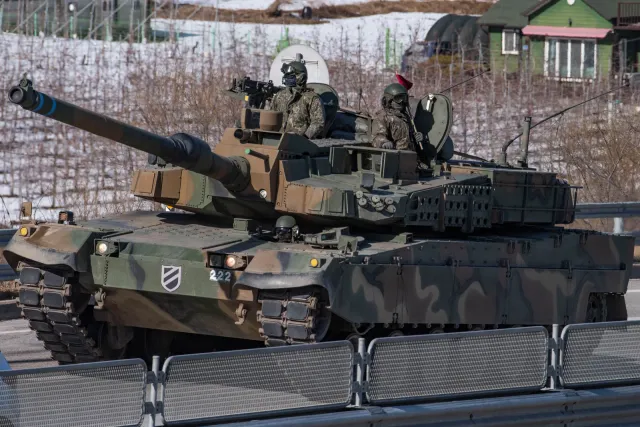
Via Wikipedia, K2 Black Panther (shown for identification)
Twenty of twenty 125mm-gun tanks in the WeaponSpecs database can fire a guided missile through the main gun. Five of twenty-four 120mm-gun tanks can do the same, and none of the five are built by the countries that set the 120mm standard in the first place. That is not a caliber effect, it is a lineage effect: every 125mm tank traces to the Soviet 2A46 gun family, which has shipped with gun-launched-missile compatibility as standard equipment since the T-64. Every major 120mm builder, the US, Germany, UK, France, Italy, Japan and Turkey, chose not to build the same trick into their guns at all.
How many tanks can actually fire a missile through the main gun?
Querying firepower.caliberMm and firepower.compatibleWeapons across every tank record in the WeaponSpecs database turns up 56 systems that publish a caliber, and the split by bore size is stark. Of the 20 tanks built around a 125mm gun, all 20 can fire a gun-launched missile. Of the 24 tanks built around the more common 120mm gun, only 5 can, roughly 21%. Ten 105mm-gun tanks split 2-for-10, about 20%. Two single-example calibers round out the set and don’t chart cleanly: Russia’s T-62M is the database’s only 115mm tank and lacks the feature, and Rheinmetall’s future KF51 Panther is the only 130mm entry, still at “announced” status, also without it. Overall, 27 of the 56 tanks that publish a caliber, 48%, can put a guided missile through the barrel.
105mm and 120mm land within a point of each other, near one-fifth. 125mm is not a gradual step up, it is a hard 100% floor, because every 125mm gun in the database descends from the same Soviet design tradition. The single-example 115mm (T-62M, no ATGM) and 130mm (KF51 Panther, announced, no ATGM) calibers are excluded from the chart, one tank each is too thin to plot as a rate.
Why does 125mm mean automatic ATGM capability and 120mm doesn’t?
Every 125mm-gun tank in the database, Russia, Ukraine, China, Pakistan, Iran, Poland, is built around the 125mm 2A46 gun family, a Soviet design lineage that has carried a laser beam-riding gun-launched missile, the 9M119 Svir/Refleks (NATO reporting name AT-11 Sniper), as standard-issue ordnance since the T-64 entered service. The missile is a Russian design with a stated maximum range around 5,000 meters at roughly 350 meters per second, a manufacturer/state-sourced figure, not independently verified, but the relevant point for a buyer isn’t the missile’s exact reach, it’s that any tank built to fire the 2A46’s ammunition family inherits the missile compatibility automatically, whether that specific customer wants it or not.
The 120mm gun tells a different story. NATO’s 120mm smoothbore, and the closely related guns fielded by Japan, South Korea and India, descend from a design tradition that never built a gun-launched missile into the base package. The US, Germany, UK, France, Italy, Japan and Turkey all field 120mm tanks today, the 120mm M1A2 SEP v3 Abrams, the 120mm Leopard 2A7, the Challenger 2 and 3, the Leclerc, and none fire a missile through the gun. That’s not a missing capability, those countries rely on separate dismounted or vehicle-mounted ATGMs like Javelin or Spike for the same mission instead, a gun tradition that never adopted the trick, not tanks that failed to achieve it.
Note the caveat that runs through every Russian, Chinese, and Iranian figure in this piece: the ATGM compatibility itself is well documented across open sources, but any specific performance number attached to those systems, missile range, penetration, guidance accuracy, is a manufacturer or state claim, not an independently verified figure. That applies to Russia’s T-64BV, T-72B3, T-72B3M, T-80BVM, T-80U, T-90A, T-90M and T-90M obr. 2022, China’s Type 96B, Type 99A, VT-4 and ZTZ-99A, and Iran’s Karrar and Zolfaghar. Ukraine’s T-84 Oplot, and Pakistan’s Al-Khalid, Al-Zarrar and Haider (the latter two co-developed with China’s Norinco but Pakistani-fielded), don’t get that same state-claim caveat, but Pakistan’s Norinco co-development is worth noting as relevant lineage context. The WeaponSpecs database lists T-64BV’s own country of origin as Russia, not Ukraine, despite the type’s original Kharkiv design lineage, so it stays in the caveated group above.
What happened to the US’s own gun-launched missile?
The United States built this concept first, and walked away from it. The MGM-51 Shillelagh was designed to fire from a 152mm gun on the M551 Sheridan light tank and the M60A2, entering service in the 1960s with the same basic idea Russia would later standardize on the 2A46: a missile that rides out of the same tube as the conventional rounds. It never worked reliably. The M60A2, nicknamed “Starship” for its unusual turret, was phased out of US service by 1981, and the broader Shillelagh program was retired in 1996 with very few of the roughly 88,000 rounds produced ever fired in anger.
The joint US-West German MBT-70 program, running from 1965 to 1971, tried to build a shared NATO main battle tank around the same 152mm gun-launched-missile concept. West Germany was skeptical the missile approach was worth the added complexity and wanted a conventional high-velocity gun instead, and that disagreement, compounded by cost overruns, helped sink the joint program. NATO tank design broadly moved on from gun-launched missiles after MBT-70 fell apart, which is a direct part of why the 120mm gun that emerged from that era never carried the feature Russia kept building into every 125mm gun that followed. The Soviet Union tried the same idea around the same period and, unlike the US, never abandoned it.
Who are the exceptions, and why did they bother?
Two lineages break the 120mm pattern, and both are independent latecomer adopters rather than the countries that defined the 120mm standard. South Korea’s 120mm K2 Black Panther fires KSTAM, an indigenous top-attack smart munition developed by South Korea’s Agency for Defense Development with Poongsan and Diehl, built for its own CN08 120mm L55 gun rather than inherited from anyone else’s gun tradition. Israel’s Merkava family, the 120mm Merkava Barak, Mk3 and Mk4, fires LAHAT, a laser-guided missile Israel developed on its own timeline and doctrine.
Both countries had reasons the core NATO members didn’t: South Korea and Israel each face armor-dense threats along contested borders where extended-range precision engagement, against fortified positions, ATGM teams, or armor beyond typical gun range, has clear operational value, and both built their own defense industrial base independent of the US or European tank-gun supply chain. The US, Germany, UK, France and Italy never had that same pressure to reinvent what MBT-70 had already tried and dropped.
Does this actually matter for a tank buyer?
Only for one specific mission. Gun-launched missile capability buys a tank the ability to engage a target 3 to 5 kilometers out, beyond the effective range of a standard kinetic or HEAT round, without a separate launcher taking up space or crew attention. That matters against a helicopter, a fortified bunker, or an ATGM team trying to stay outside normal tank-gun range. It says nothing about armor, mobility, sensor fusion, or crew survivability, the things that actually decide most tank-vs-tank outcomes, and a 120mm Leopard 2A7 or M1A2 SEP v3 Abrams not firing a missile through the gun isn’t giving anything up there, both rely on separate dismounted or vehicle-mounted ATGMs for the exact same engagement profile.
Read the caliber column, not as a quality ranking, but as a lineage fingerprint. It tells you which gun-design family a tank descended from, and that inheritance, more than any single spec, is what decided whether gun-launched missile compatibility showed up standard or not at all.
The full data set: caliber, country, and ATGM capability
| System | Country | Caliber | Gun-launched ATGM |
|---|---|---|---|
| B1 Centauro | Italy | 105 mm | No |
| Harimau | Indonesia | 105 mm | No |
| K1A2 | South Korea | 105 mm | No |
| Kaplan MT | Turkey | 105 mm | No |
| Leopard 1A5 | Germany | 105 mm | No |
| M60A3 Patton | United States | 105 mm | No |
| Merkava Mk1 | Israel | 105 mm | No |
| Merkava Mk2 | Israel | 105 mm | Yes (LAHAT) |
| Type 15 | China | 105 mm | Yes* |
| Type 74 | Japan | 105 mm | No |
| T-62M | Russia | 115 mm | No |
| Altay | Turkey | 120 mm | No |
| Arjun Mk1A | India | 120 mm | No |
| Arjun Mk2 (announced) | India | 120 mm | Yes (LAHAT) |
| C1 Ariete | Italy | 120 mm | No |
| Centauro II | Italy | 120 mm | No |
| Challenger 2 | United Kingdom | 120 mm | No |
| Challenger 3 (announced) | United Kingdom | 120 mm | No |
| EMBT (announced) | France/Germany | 120 mm | No |
| K2 Black Panther | South Korea | 120 mm | Yes (KSTAM) |
| Leclerc | France | 120 mm | No |
| Leclerc XLR | France | 120 mm | No |
| Leopard 2A4 | Germany | 120 mm | No |
| Leopard 2A5 | Germany | 120 mm | No |
| Leopard 2A6 | Germany | 120 mm | No |
| Leopard 2A7 | Germany | 120 mm | No |
| Leopard 2A8 | Germany | 120 mm | No |
| M1A1 Abrams | United States | 120 mm | No |
| M1A2 SEP v2 Abrams | United States | 120 mm | No |
| M1A2 SEP v3 Abrams | United States | 120 mm | No |
| Merkava Barak | Israel | 120 mm | Yes (LAHAT) |
| Merkava Mk3 | Israel | 120 mm | Yes (LAHAT) |
| Merkava Mk4 | Israel | 120 mm | Yes (LAHAT) |
| Type 10 | Japan | 120 mm | No |
| Type 90 Kyu-maru | Japan | 120 mm | No |
| Al-Khalid | Pakistan | 125 mm | Yes† |
| Al-Zarrar | Pakistan | 125 mm | Yes |
| Haider (announced) | Pakistan | 125 mm | Yes |
| Karrar | Iran | 125 mm | Yes* |
| PT-91 Twardy | Poland | 125 mm | Yes |
| T-14 Armata (announced) | Russia | 125 mm | Yes* |
| T-64BV | Russia | 125 mm | Yes* |
| T-72B3 | Russia | 125 mm | Yes* |
| T-72B3M | Russia | 125 mm | Yes* |
| T-80BVM | Russia | 125 mm | Yes* |
| T-80U | Russia | 125 mm | Yes* |
| T-84 Oplot | Ukraine | 125 mm | Yes |
| T-90A | Russia | 125 mm | Yes* |
| T-90M | Russia | 125 mm | Yes* |
| T-90M obr. 2022 | Russia | 125 mm | Yes* |
| Type 96B | China | 125 mm | Yes* |
| Type 99A | China | 125 mm | Yes* |
| VT-4 | China | 125 mm | Yes* |
| Zolfaghar | Iran | 125 mm | Yes* |
| ZTZ-99A | China | 125 mm | Yes* |
| Panther KF51 (announced) | Germany | 130 mm | No |
* Manufacturer/state claim (Russia, China, Iran), not independently verified. † Co-developed with China’s Norinco, Pakistani-fielded.
The buyer’s takeaway
If a mission genuinely calls for missile-range engagement fired straight through the main gun, the database says look at gun lineage first, not caliber. A 125mm Soviet-family gun ships with it. A 120mm NATO-family gun almost never does, unless it’s a K2 or a Merkava. Everything else in a tank’s spec sheet, armor package, fire control, mobility, still has to be judged on its own terms.
Run a side-by-side on any two systems in this piece with the comparison tool, browse the full tank category for every system in this data set, or build out a mixed force and see how gun-launched missile range factors into an engagement profile with the Force Builder.
Sources
Systems in this comparison
Every system covered above, with its photo and, where available, a video. Tap a card to open the full spec sheet.
Compare these side by side →
Main battle tank
K2 Black Panther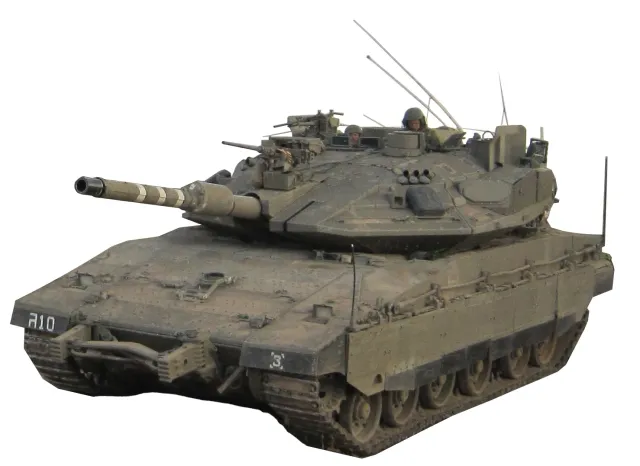
Main battle tank
Merkava Mk4
Main battle tank
M1A2 SEP v3 Abrams
Main battle tank
Leopard 2A7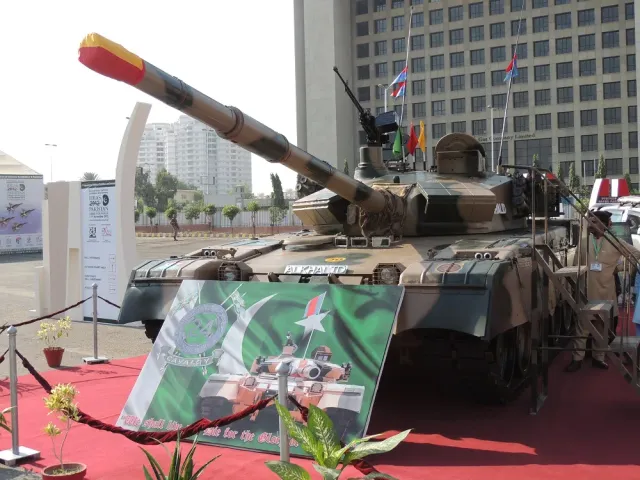
Frequently asked questions
What is a gun-launched anti-tank guided missile? +
It is a missile loaded and fired through a tank's main gun barrel like a conventional round, then guided to the target, usually by a laser beam-riding system, after leaving the tube. It lets a tank engage helicopters, dug-in positions, or ATGM teams well beyond the effective range of a standard kinetic or HEAT round, without carrying a separate launcher.
Why don't most 120mm NATO tanks have a gun-launched missile? +
It is a doctrine choice, not a technical gap. Our analysis of 56 tanks in the WeaponSpecs database found zero of the 24 120mm-gun tanks fielded by the United States, Germany, the United Kingdom, France, Italy, Japan, or Turkey carry one. Those countries standardized on the Rheinmetall-derived 120mm smoothbore and rely on separate dismounted or vehicle-mounted ATGMs (Javelin, Spike) for stand-off missile engagement instead of building the capability into the gun.
How far can a gun-launched missile like the 9M119 Refleks reach? +
Russia's 9M119 Svir/Refleks, NATO reporting name AT-11 Sniper, has a stated maximum range of about 5,000 meters at roughly 350 meters per second, per open-source figures. That is a Russian-origin, manufacturer/state-sourced figure and has not been independently verified at range.
Which Western tanks can fire a missile through the main gun? +
Only two lineages in the WeaponSpecs database: South Korea's K2 Black Panther, which carries the indigenous KSTAM smart top-attack munition, and Israel's Merkava family (Barak, Mk3, Mk4), which fires the indigenous LAHAT missile. Both are independent, non-NATO-core adopters, not the United States, Germany, or the UK.
Did the US ever build a tank that fired a missile through its main gun? +
Yes, first. The MGM-51 Shillelagh, fired from a 152mm gun on the M551 Sheridan and M60A2, entered service in the 1960s but suffered persistent reliability problems. The M60A2 was retired by 1981 and the wider Shillelagh program wound down in 1996, with very few of roughly 88,000 rounds produced ever fired in combat. The joint US-West German MBT-70 program, built around the same 152mm gun-launched-missile concept, collapsed in 1971 partly over West German skepticism of the missile approach. NATO tank design broadly walked away from gun-launched missiles after that.
Related reading

