IFV Autocannon Caliber: Why 30mm Isn't a Real Standard
30mm arms 19 of 55 IFVs in the WeaponSpecs database, more than any other caliber, but two incompatible ammunition families mean it isn't one true standard.

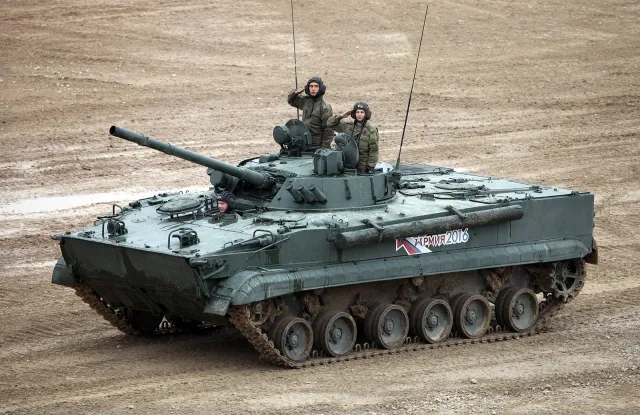
Jorchr, CC BY-SA 3.0, via Wikimedia Commons
Of the 76 IFVs in the WeaponSpecs database, 55 publish a main-gun caliber, and 19 of them, more than a third, carry a 30mm autocannon, making it the single most common caliber by a wide margin over any other. But that plurality is not a standard: two ballistically similar, physically incompatible 30mm ammunition families exist side by side, one NATO, one Russian-lineage, and even within NATO itself no single caliber has ever been agreed on for infantry fighting vehicles.
What’s the most common IFV gun caliber?
The 55 systems that publish a caliber split into four real tiers, not a smooth curve. Twelve are armed only with a machine gun, 7.62mm, 12.7mm or 14.5mm, APC-grade platforms that ride in the “ifv” category on the strength of a troop compartment rather than a real cannon. Twelve carry a light 20mm or 25mm autocannon, the original NATO IFV generation: Marder, the M2A3 Bradley, VBCI, Dardo. Twenty-five carry a heavy 30mm, 35mm or 40mm autocannon, the modern mainstream and the largest tier by far. And six carry a 73-105mm gun or gun-launcher, Soviet, Russian, Chinese, French or Japanese vehicles that blur the line between IFV and light tank.
Inside the heavy-autocannon tier, one caliber dominates. 30mm alone accounts for 19 of the 55 systems, 34.5% of the entire published-caliber set, more than double any other single caliber including 40mm (5 systems) or 25mm (8 systems). It is the modal choice across NATO members (Puma, Warrior, Lynx KF41’s stablemates), Russian-lineage operators (BMP-2, BTR-82A, T-15 Armata), and non-aligned buyers alike (ZBL-08, Hunter AFV).
| System | Country | Caliber | Main armament | Tier |
|---|---|---|---|---|
| FV432 | United Kingdom | 7.62 mm | 7.62 mm L37A2 general-purpose machine gun | MG-only |
| Casspir | South Africa | 7.62 mm | 7.62 mm machine gun (pintle-mounted) | MG-only |
| Achzarit | Israel | 7.62 mm | 7.62 mm machine gun | MG-only |
| Bushmaster | Australia | 7.62 mm | 7.62 mm machine gun (turret-mounted) | MG-only |
| RAM 2000 Sandcat | Israel | 7.62 mm | 7.62 mm or 12.7 mm machine gun (turret-mounted) | MG-only |
| Hawkei | Australia | 7.62 mm | 7.62 mm remote weapon station | MG-only |
| Eagle V | Switzerland | 12.7 mm | 7.62 mm or 12.7 mm remote weapon station | MG-only |
| Namer | Israel | 12.7 mm | 12.7 mm or 40 mm remote weapon station (variant-dependent) | MG-only |
| Anoa | Indonesia | 12.7 mm | 12.7 mm machine gun (turret-mounted) | MG-only |
| Guarani | Brazil | 12.7 mm | 12.7 mm remote weapon station (up to 30 mm variant) | MG-only |
| K808 White Tiger | South Korea | 12.7 mm | 12.7 mm/30 mm remote weapon station (variant-dependent) | MG-only |
| BTR-80 | Russia | 14.5 mm | 14.5 mm KPVT heavy machine gun | MG-only |
| Marder | Germany | 20 mm | 20 mm Rheinmetall MK 20 Rh 202 autocannon | Light autocannon |
| Ratel | South Africa | 20 mm | 20 mm GI-2 autocannon | Light autocannon |
| Wiesel | Germany | 20 mm | 20 mm Rheinmetall MK 20 autocannon | Light autocannon |
| Piranha | Switzerland | 25 mm | 25 mm or 30 mm autocannon (turret-dependent) | Light autocannon |
| LAV-25 | United States | 25 mm | 25 mm M242 Bushmaster chain gun | Light autocannon |
| ACV-15 | Turkey | 25 mm | 25 mm autocannon | Light autocannon |
| M2A3 Bradley | United States | 25 mm | 25 mm M242 Bushmaster chain gun | Light autocannon |
| Dardo | Italy | 25 mm | 25 mm Oerlikon KBA cannon | Light autocannon |
| Bionix | Singapore | 25 mm | 25 mm M242 Bushmaster chain gun | Light autocannon |
| Freccia | Italy | 25 mm | 25 mm Oerlikon KBA cannon | Light autocannon |
| VBCI | France | 25 mm | 25 mm autocannon | Light autocannon |
| M2A4 Bradley | United States | 25 mm (year N/A) | 25 mm M242 Bushmaster chain gun | Light autocannon |
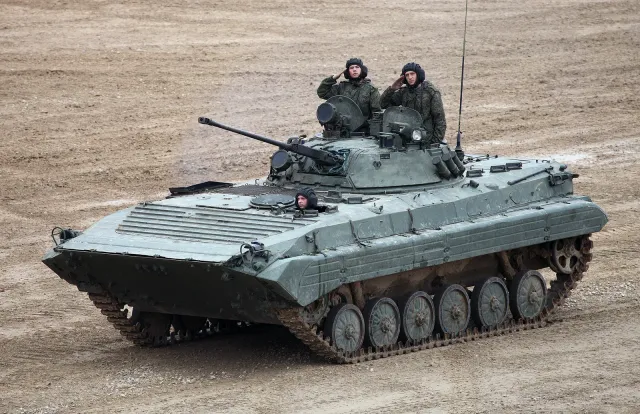
| BMP-2 | Russia | 30 mm | 30 mm 2A42 autocannon | Heavy autocannon |
| BMD-2 | Russia | 30 mm | 30 mm 2A42 autocannon | Heavy autocannon |
| Warrior | United Kingdom | 30 mm | 30 mm RARDEN cannon | Heavy autocannon |
| ASCOD | Spain | 30 mm | 30 mm or 40 mm cannon (variant-dependent) | Heavy autocannon |
| Pizarro | Spain | 30 mm | 30 mm Mauser MK 30 cannon | Heavy autocannon |
| Patria AMV | Finland | 30 mm | Remote weapon station, 12.7-30 mm typical | Heavy autocannon |
| Rosomak | Poland | 30 mm | 30 mm ZSSW-30 remote turret cannon | Heavy autocannon |
| BTR-4 | Ukraine | 30 mm | 30 mm ZTM-1 autocannon | Heavy autocannon |
| ZBL-08 | China | 30 mm | 30 mm autocannon | Heavy autocannon |
| BTR-82A | Russia | 30 mm | 30 mm 2A72 autocannon | Heavy autocannon |
| Tulpar | Turkey | 30 mm | 30 mm or 25 mm stabilized turret | Heavy autocannon |
| Puma | Germany | 30 mm | 30 mm MK 30-2/ABM autocannon | Heavy autocannon |
| T-15 Armata | Russia | 30 mm | 30 mm 2A42 autocannon (unmanned turret) | Heavy autocannon |
| Eitan | Israel | 30 mm | 30 mm or 12.7 mm remote weapon station | Heavy autocannon |
| AS21 Redback | South Korea | 30 mm | 30 mm Mk44S Bushmaster II cannon | Heavy autocannon |
| Lazar 3 | Serbia | 30 mm | 12.7 mm or 30 mm remote weapon station | Heavy autocannon |
| Hunter AFV | Singapore | 30 mm | 30 mm autocannon (unmanned turret) | Heavy autocannon |
| Borsuk | Poland | 30 mm | 30 mm ZSSW-30 remote turret cannon | Heavy autocannon |
| Kestrel WhAP | India | 30 mm (year N/A) | 30 mm autocannon turret | Heavy autocannon |
| Type 89 | Japan | 35 mm | 35 mm KDE autocannon; Type 79 Jyu-MAT ATGM | Heavy autocannon |
| Lynx KF41 | Germany | 35 mm | 35 mm Wotan autocannon (Lance turret) | Heavy autocannon |
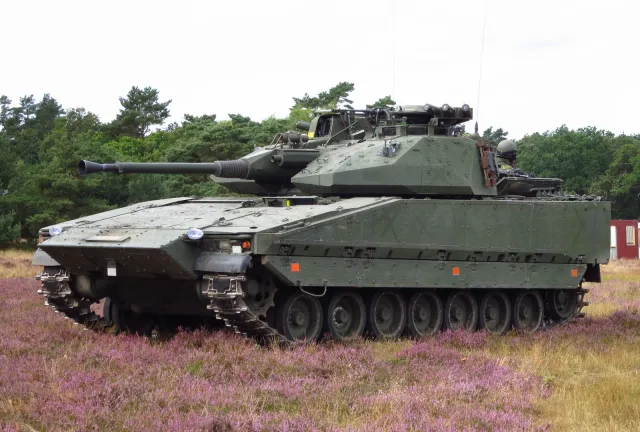
| CV90 | Sweden | 40 mm | Bofors 40 mm autocannon | Heavy autocannon |
| K21 | South Korea | 40 mm | 40 mm SNT Dynamics K40 autocannon | Heavy autocannon |
| EBRC Jaguar | France | 40 mm | 40 mm CTC (CTAS) automatic cannon | Heavy autocannon |
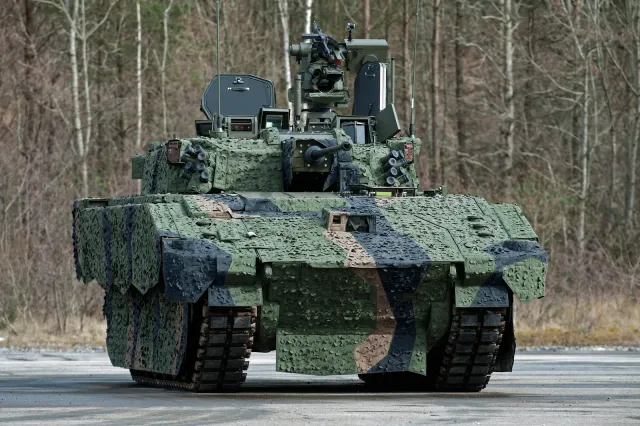
| Ajax | United Kingdom | 40 mm | 40 mm CT40 cased telescoped cannon | Heavy autocannon |
| BMP-1 | Russia | 73 mm | 73 mm 2A28 Grom low-pressure gun | Gun-launcher |
| BMP-3 | Russia | 100 mm | 100 mm 2A70 gun-launcher | Gun-launcher |
| BMD-4 | Russia | 100 mm | 100 mm 2A70 gun-launcher | Gun-launcher |
| ZBD-04A | China | 100 mm | 100 mm rifled gun/missile launcher | Gun-launcher |
| AMX-10RC | France | 105 mm | 105 mm rifled gun | Gun-launcher |
| Type 16 MCV | Japan | 105 mm | 105 mm rifled gun | Gun-launcher |
Russia’s and China’s manufacturer-published calibers (BMP-2, BMD-2, BTR-82A, T-15 Armata, ZBL-08, ZBD-04A) are state or state-linked figures, not independently audited, the standard caveat that applies across this site to RU/CN sourcing.
Why did IFV calibers creep from 20mm to 40mm?
Restricting the data to the true autocannon tier, 20-40mm systems with both a caliber and a release year on file, gives 35 systems, and the decade-by-decade average climbs steadily: 21.7mm in the 1970s (n=3), 28.3mm in the 1980s (n=6), 28.6mm in the 1990s (n=7), 30.0mm in the 2000s (n=7), 30.6mm in the 2010s (n=9), and 36.7mm in the 2020s so far (n=3, Ajax’s 40mm, Borsuk’s 30mm and EBRC Jaguar’s 40mm). Release year and caliber correlate at r=0.521, a moderate positive relationship, real caliber creep, not statistical noise, but a loose trend rather than a hard rule: plenty of 2010s-era vehicles, Rosomak, Patria AMV, T-15 Armata’s turret, are still 30mm, and the 2020s figure rests on just three data points, small enough that one or two more programs could shift it either way.
The dashed line on the chart below traces that decade-average creep against every autocannon-tier data point.
The dashed line traces the decade-average creep inside the 20-40mm autocannon tier (21.7mm in the 1970s to 36.7mm in the small 2020s sample, r=0.521); the gun-launcher tier sits in a separate, axis-compressed band above 45mm because it is a different design philosophy, not the far end of the same curve.
That creep tracks a real capability problem, not fashion. Analyst Christopher F. Foss, writing in European Security & Defence, describes the shift toward larger-caliber, fully stabilized weapons in remote turrets as driven by the need to “rapidly engage targets, including threat IFV and armoured personnel carriers, under almost all environmental conditions, at longer ranges and with increased target effect.” In plain terms, a 20mm autocannon that could shred a 1970s troop carrier struggles against a modern IFV’s applique armor, so buyers keep reaching for more caliber, and the newest airburst rounds in that same size class add a secondary use against small drones. But the 2020s figure rests on three systems, Ajax’s 40mm, Borsuk’s 30mm and EBRC Jaguar’s 40mm, and Borsuk alone shows the trend is a lean, not a rule: a brand-new 2022 IFV can still ship at 30mm.
Is 30mm actually a NATO standard?
No, and this is the part a spec sheet hides. NATO’s post-Cold-War generation of autocannons, the Bushmaster II/Mk44 family and Puma’s 30mm MK 30-2/ABM, standardized on the 30x173mm cartridge. Warsaw Pact and Russian-lineage forces standardized separately, decades earlier, on the 30x165mm round fired by the 2A42 and 2A72 autocannons found in BMP-2, BMD-2, BTR-82A and the T-15 Armata’s unmanned turret. The two rounds sit in a comparable pressure and performance class, which is exactly why both get casually called “30mm,” but they are physically different cartridges, and a round built for one family will not fire from the other’s chamber.
That split alone means a coalition mixing NATO and Russian-lineage 30mm platforms cannot pool ammunition, despite both spec sheets reading identically. And the fragmentation runs deeper than the NATO-versus-Russian divide. Foss’s own reporting makes the point bluntly:
“There has been a complete lack of standardisation of medium calibre weapons for their infantry fighting vehicles, with currently deployed vehicles in Europe being armed with 20mm, 25mm, 30mm, 35mm and 40mm calibre cannon,” wrote Christopher F. Foss (European Security & Defence, September 2020).
That is Europe alone, inside the alliance, with no third-country ammunition lineage in the mix. Five different calibers, all fielded, all current. 30mm is the plurality choice in the WeaponSpecs data, and it is genuinely the closest thing to a modal answer, but “most common” and “standard” are different claims, and this article’s own numbers are the evidence for the gap between them.
What about the 73mm-105mm gun-launcher tier?
Six systems in the database sit well outside the autocannon range entirely, and they trace back to one Soviet idea. The BMP-1 (1966, USSR) pioneered a low-pressure 73mm 2A28 Grom gun-launcher, a concept now effectively extinct outside a handful of direct descendants. The BMP-3 (1987) and BMD-4 (2004), both Russian, and China’s ZBD-04A (2008), each mount a 100mm 2A70 gun-launcher that can fire a conventional round or a gun-launched anti-tank missile from the same tube. France’s AMX-10RC (1981) and Japan’s Type 16 MCV (2016) take a different path, a conventional 105mm rifled gun with no missile option, wheeled fire-support vehicles that read closer to a light tank than a classic autocannon-and-troop-compartment IFV.
Their presence in the site’s “ifv” category is itself worth flagging: the taxonomy is broader than the textbook definition of an infantry fighting vehicle. A reader comparing “IFV guns” should know the category quietly includes gun-armed fire-support vehicles alongside the autocannon mainstream, which is exactly why this piece treats the gun-launcher tier as a separate band on the chart rather than the top end of one continuous curve.
One more caveat belongs here. Israel’s 13mm Namer is recorded at its original baseline armament, but later IDF variants have fielded 30mm or 40mm remote weapon stations on the same hull, a reminder that a single caliberMm field can only capture one configuration of a vehicle that exists in several.
What does this mean for a buyer?
The procurement lesson is not “pick 30mm because everyone else did.” It is that a caliber number alone tells a buyer almost nothing about ammunition logistics. Two nations can each field a “30mm-armed IFV” and still be unable to resupply each other in the field, because one is running NATO’s 30x173mm and the other is running Russian-lineage 30x165mm. A coalition force built around that assumption discovers the gap exactly when it matters least conveniently, mid-deployment, when a shared “30mm” line item on two allies’ logistics sheets turns out to mean two different rounds.
The practical fix is simple and unglamorous: verify the exact cartridge designation, not just the bore diameter, before assuming interoperability, and budget for it as a separate procurement line rather than folding it into “caliber compatibility.” Run the numbers yourself against the full 40mm CV90, 35mm Lynx KF41 or 40mm Ajax spec sheets with the compare tool, or browse every system in this piece on the IFV type page to see how caliber, ammunition family and armor protection actually line up before treating a matching gun size as a matching supply chain.
Sources
Systems in this comparison
Every system covered above, with its photo and, where available, a video. Tap a card to open the full spec sheet.
Compare these side by side →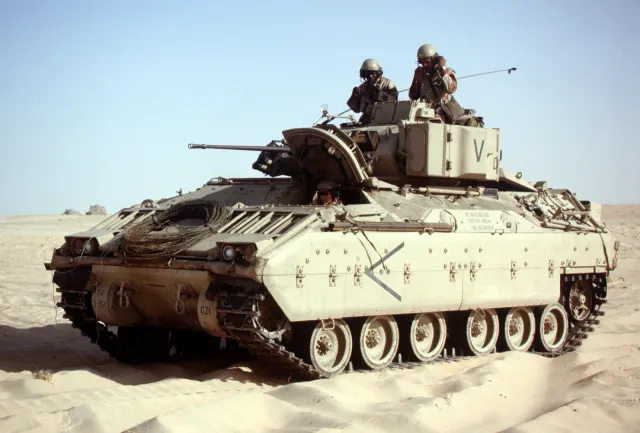
Frequently asked questions
What is the most common IFV autocannon caliber? +
30mm, by a wide margin. In the WeaponSpecs database, 19 of 55 IFVs that publish a main-gun caliber (34.5%) carry a 30mm autocannon, more than double the next closest caliber. But 30mm is not one standard weapon: NATO's 30x173mm (Bushmaster II/Mk44) and the Russian-lineage 30x165mm (2A42/2A72) are separate, non-interchangeable ammunition families that both get called '30mm.'
Is 30mm a NATO standard caliber? +
No. There is no single agreed IFV gun caliber even within NATO itself, 20mm, 25mm, 30mm, 35mm and 40mm autocannons are all in frontline European service today, according to defense analyst Christopher F. Foss writing in European Security & Defence. 30mm is simply the most common single caliber, not an alliance-wide standard, and NATO's own 30mm ammunition (30x173mm) does not interchange with the Russian-lineage 30x165mm round used on Soviet and Russian-designed vehicles.
Why are IFV gun calibers getting bigger? +
Mean autocannon caliber has climbed from about 21.7mm in the 1970s to 36.7mm in the small 2020s sample, a moderate but real trend (Pearson r=0.521 across 35 systems with both figures published). The driver is the need to defeat increasingly well-protected IFVs and armored personnel carriers at longer range, plus newer airburst ammunition useful against drones, not a single mandated caliber jump.
Can NATO and Russian-lineage 30mm autocannons share ammunition? +
No. NATO's 30x173mm (used in the Bushmaster II/Mk44 and Puma's MK30-2) and the Russian-lineage 30x165mm (used in the 2A42/2A72 aboard BMP-2, BTR-82A and the T-15 Armata's unmanned turret) are physically different cartridges. Both are commonly described as '30mm' guns and are ballistically similar in performance class, but a round built for one will not chamber or fire safely in the other.
What is the biggest gun on an infantry fighting vehicle? +
In the IFV category, 105mm rifled guns top the range, mounted on France's AMX-10RC and Japan's Type 16 MCV. Russia's BMP-3 and BMD-4, and China's ZBD-04A, mount a 100mm 2A70 gun-launcher that can fire both a conventional round and a gun-launched anti-tank missile. These are the exception, not the rule; the vast majority of IFVs in the database carry a 20-40mm autocannon.
Related reading


