Javelin vs TOW vs NLAW: What They Really Cost
Only 3 of the 16 anti-tank missiles in our database publish a real unit cost, and among the three, price tracks guidance autonomy almost exactly.

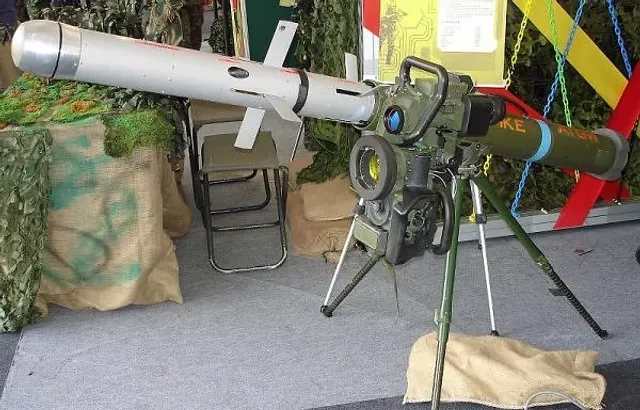
Via Wikipedia, FGM-148 Javelin (shown for identification)
Only 3 of the 16 portable and vehicle-launched anti-tank guided missiles in the WeaponSpecs database publish a real unit cost, and all three are American or Swedish. Among those three, price scales almost linearly with how much the guidance system does for the gunner instead of requiring the gunner to do. Sweden’s unguided NLAW round costs $30,000. The US wire-guided TOW round costs $95,000, about 3.2 times as much. The US autonomous, fire-and-forget Javelin round costs $178,000 alone, about 5.9 times NLAW, and $304,000 to $528,000 once you add its reusable launcher. That is not a story about age or scale. TOW is the oldest design here and by far the most mass-produced, yet it still costs three times NLAW, because guidance autonomy, not vintage, is what buyers are paying for.
How many anti-tank missiles actually publish a real price?
Our analysis of the 16 ATGMs in the WeaponSpecs database found that only three disclose a genuine unit cost rather than a vague “millions per battery” procurement figure: NLAW, BGM-71 TOW, and Javelin. That is a disclosure rate of roughly 19 percent, and it is not evenly spread. All three disclosed systems are procured by governments with public FMS pricing or parliamentary defense-budget reporting, the United States, Sweden, and the UK’s own order book. The other 13, including Israel’s Spike family and Russia’s Kornet, publish detailed guidance and range specifications but no per-round cost anywhere in open-source procurement data.
| Missile | Country | Guidance | Range (km) | Unit cost | Disclosed |
|---|---|---|---|---|---|
| NLAW | Sweden | Unguided, PLOS/OTA | 0.8 | $30,000 | Yes |
| BGM-71 TOW | United States | Wire-guided SACLOS | 4.5 | $95,000 | Yes |
| FGM-148 Javelin | United States | Autonomous IIR, fire-and-forget | 4 | $178,000 (round); $304,000-$528,000 (full system) | Yes |
| 9M133 Kornet | Russia | Laser beam-riding SACLOS | 10 | Not disclosed | No |
| Spike NLOS | Israel | EO/IR homing, fiber-optic/RF, NLOS | 32 | Not disclosed | No |
| Spike ER | Israel | EO/IR homing, fiber-optic/RF | 8 | Not disclosed | No |
| Almas | Iran | IIR + fiber-optic/radio (Spike-derivative, unverified) | 8 | Not disclosed | No |
| Spike LR2 | Israel | EO/IR homing, fiber-optic/RF | 5.5 | Not disclosed | No |
| Dehlavieh | Iran | Laser beam-riding (Kornet-derivative, unverified) | 5.5 | Not disclosed | No |
| Stugna-P | Ukraine | Laser beam-riding | 5 | Not disclosed | No |
| 9M114 Shturm | Russia | SACLOS + radio command | 6 | Not disclosed | No |
| HOT 3 | France/Germany | SACLOS + bispectral IR tracker | 4.3 | Not disclosed | No |
| HJ-8 | China | SACLOS wire guidance | 4 | Not disclosed | No |
| Spike MR | Israel | EO/IR homing, lock-on before launch | 2.5 | Not disclosed | No |
| Toophan | Iran | Wire-guided SACLOS (TOW-derivative, unverified) | 3.75 | Not disclosed | No |
| Spike SR | Israel | EO/IR homing, lock-on before launch | 1.5 | Not disclosed | No |
What does an NLAW round cost, and why is it so cheap?
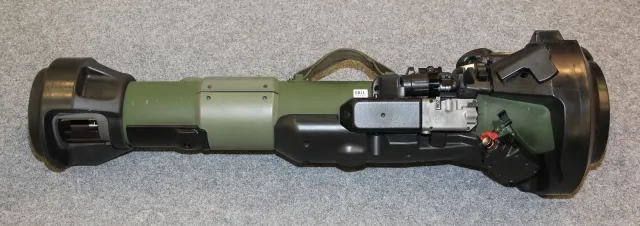
NLAW is the cheapest disclosed ATGM in our database at roughly $30,000 a round, with reported figures ranging $25,000 to $40,000. The UK’s 2022 order of several thousand rounds, worth roughly £280 million, sits comfortably inside that band once split across the order quantity. NLAW earns its low price by design: it has no seeker at all. The gunner tracks the target briefly before firing, and the missile either flies a Predicted Line-Of-Sight (PLOS) path to the point where the target will be, or launches an Overfly Top-Attack (OTA) shot that detonates as it passes above the vehicle. Both modes are single-shot, largely disposable rounds with no guidance electronics to track a moving target after launch, which is exactly what an infantry unit needs for a cheap, close-range, one-shot tank-killer and exactly why it costs a third of what TOW does.
What does a TOW missile cost?
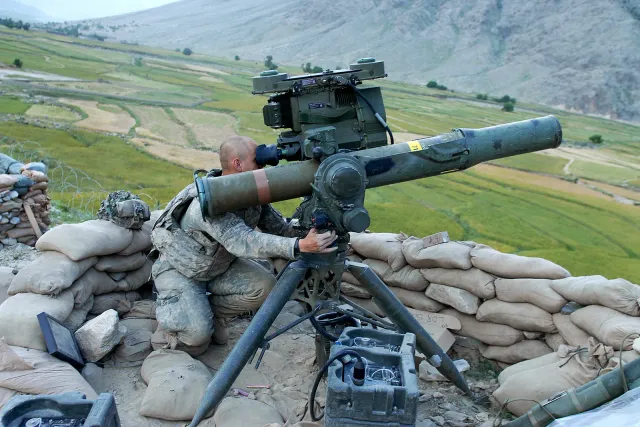
A BGM-71 TOW round costs about $95,000, with reported figures spanning $90,000 to $135,000 depending on variant, missile only, excluding the launcher itself. That is roughly 3.2 times NLAW’s price, and on the surface that is a strange result: TOW is the oldest missile in this comparison, fielded since 1970, and by a wide margin the most mass-produced, with roughly 700,000 units built across 45 operators per our database. Scale and age should push a price down, not up. What TOW is actually charging for is Semi-Active Command Line Of Sight (SACLOS) guidance: the gunner must keep the sight reticle on the target through the missile’s entire flight, all the way to impact, while wire (or on later variants, RF) carries the correction signal back to the missile. That is not a manufacturing cost, it is an operational one. The gunner stays exposed, tracking a moving target under fire, for the full time of flight, and TOW’s price reflects the fact that a wire- or RF-guided system needs more onboard guidance electronics than an unguided round, even though it demands more from the operator, not less.
What does a Javelin actually cost, all in?
Javelin is the anchor number in this comparison. The round alone costs $178,000, with reported figures up to $198,000, nearly 5.9 times NLAW and about 1.9 times TOW. Javelin’s imaging-infrared (IIR) seeker locks onto the target before launch and flies autonomously to impact with top-attack terminal guidance, a true fire-and-forget shot that lets the gunner move to cover the instant the missile leaves the tube. That autonomy is the single most expensive line item in this entire dataset. But the round-only price understates the real cost, because Javelin also requires a reusable Command Launch Unit (CLU) that houses the sight and fire-control electronics. The legacy CLU adds $126,000; the newer Lightweight CLU, procured from FY2024, adds roughly $350,000. Combined, a fielded Javelin system costs $304,000 to $528,000, a 10x to 17.6x multiple over NLAW’s per-shot cost, once the launcher is counted. Our database records roughly 50,000 Javelin units built across 30 operators since it entered service in 1996, a much smaller production run than TOW’s, which rules out “economies of scale” as the explanation for the gap between the two.
Does guidance sophistication explain the price gap?
Lay the three disclosed prices next to their guidance tier and the pattern holds without exception. Unguided (NLAW, PLOS/OTA, no seeker): $30,000. Manual wire-guided, gunner tracks through impact (TOW, SACLOS): $95,000, a 3.2x multiple. Autonomous fire-and-forget, imaging-infrared seeker (Javelin round): $178,000, a 5.9x multiple, rising to 10x-17.6x once the reusable launcher is included. Each step up in autonomy removes an operational burden from the gunner (manual line-of-sight tracking, then continuous exposure through impact, then eventually the exposure itself) and each step adds cost. This is the opposite of what “TOW is old and mass-produced, so it should be cheap” would predict, and it is the clearest evidence in our dataset that guidance sophistication, not age or manufacturing scale, is the actual price driver among ATGMs.
Price climbs with guidance autonomy, not age or scale: TOW, the oldest design here with 700,000 units built, still costs triple NLAW's price because SACLOS demands the gunner track the target through impact.
The accent segment on the bottom bar is the $178,000 round, identical to the row above it. The tan segment added on top is the legacy $126,000 Command Launch Unit, bringing the fielded system to $304,000. Swap in the newer Lightweight CLU, procured from FY2024 at roughly $350,000, and the same fielded system runs closer to $528,000, not shown on the chart above but worth keeping in mind when comparing procurement budgets rather than round-for-round costs.
Why don’t the other 13 publish a price?
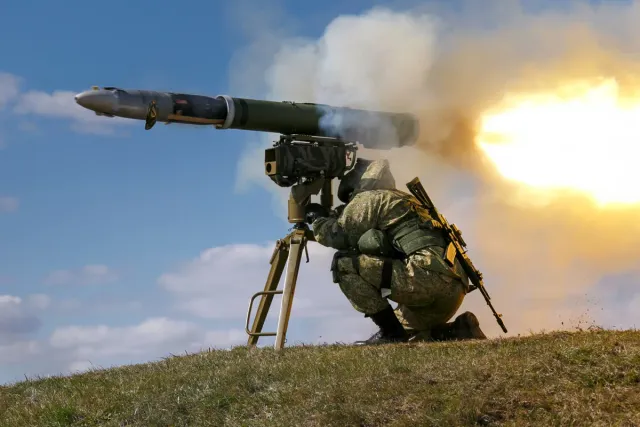
The gap here is not simply NATO versus non-NATO. Israel’s Rafael and IMI-built Spike family, Spike SR, MR, LR2, ER, and NLOS, is NATO-aligned and exported to dozens of allied militaries, yet none of those five publish a real unit cost anywhere in open-source procurement data. That rules out bloc membership as the explanation. What the three disclosed systems share instead is a specific kind of transparency requirement: US Foreign Military Sales pricing disclosure and Swedish and UK parliamentary defense-budget reporting norms both force a real number into the public record. Israel’s commercial-export model carries no equivalent disclosure obligation, so Spike pricing stays confidential even for allied buyers. Russia’s Kornet and Shturm, China’s HJ-8, and Ukraine’s Stugna-P fall under separate state secrecy that has nothing to do with alliance politics. Iran’s Almas, Dehlavieh, and Toophan are a distinct case again: all three are described in open sources as derivatives of Israeli, Russian, or American baselines respectively, and their performance and any cost figures attributed to them are manufacturer or state claims that have not been independently verified, not confirmed facts. The honest read of this table is government-procurement-transparency norms versus commercial-export and state secrecy, not “allies disclose, adversaries don’t.”
The buyer’s takeaway
Price alone does not rank these missiles, for that, see our range-ranked ATGM comparison, which looks at reach rather than cost. And this cost gap itself is one slice of a wider price-transparency gap across the whole WeaponSpecs database, most systems in most categories publish no price at all. What this narrower dataset adds is the “why” behind the three numbers that do exist: a lower price buys less autonomy, which means more gunner exposure, more training burden to track a target correctly through impact, and a shorter effective engagement window under fire. A buyer choosing NLAW over Javelin is not choosing a worse missile, they are choosing to accept an operational cost, gunner time-on-target under enemy observation, in exchange for a much lower per-round price and simpler logistics. Whether that trade makes sense depends entirely on the threat profile, the training pipeline, and the budget a given force is actually working with. Run your own threat profile and budget against the full ATGM category in the Advisor to see which guidance tier actually fits your procurement constraints.
Systems in this comparison
Every system covered above, with its photo and, where available, a video. Tap a card to open the full spec sheet.
Compare these side by side →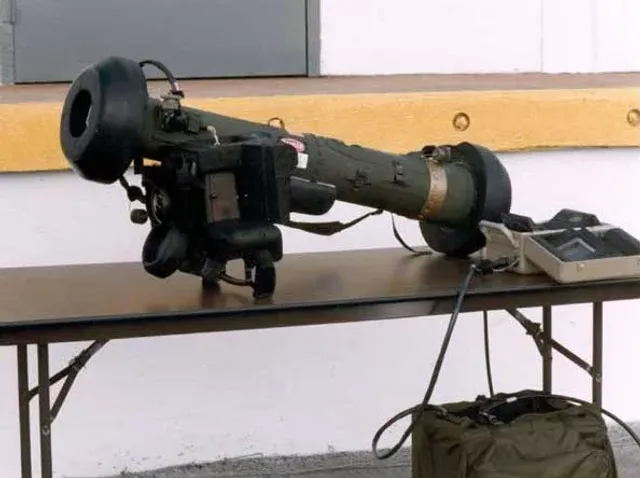
Frequently asked questions
How much does a Javelin missile cost? +
The FGM-148 Javelin round alone runs $178,000 to $198,000, per the WeaponSpecs database and open procurement reporting. Add the reusable Command Launch Unit, $126,000 for the legacy CLU or roughly $350,000 for the newer Lightweight CLU procured from FY2024, and the full fielded system runs $304,000 to $528,000.
How much does an NLAW cost? +
Sweden's NLAW is the cheapest disclosed anti-tank missile in the WeaponSpecs database at roughly $30,000 a round, reported in the $25,000 to $40,000 range and consistent with the UK's 2022 order of several thousand rounds worth about £280 million. It carries no autonomous seeker, the gunner either predicts the target's flight path (PLOS) or fires an overfly top-attack (OTA) shot, which keeps the unit cost low.
How much does a TOW missile cost? +
A BGM-71 TOW round costs about $95,000, reported between $90,000 and $135,000 depending on variant, missile only, excluding the launcher. That is roughly 3.2 times NLAW's price despite TOW being the oldest design in this comparison, fielded since 1970 with 700,000 units built across 45 operators, because wire-guided SACLOS demands the gunner keep the sight on the target through impact.
Why do so few anti-tank missiles publish a real price? +
Only 3 of the 16 portable and vehicle-launched ATGMs in the WeaponSpecs database disclose a real unit cost, and all three, NLAW, TOW, and Javelin, are procured by the US, Sweden, or the UK under government-procurement transparency norms such as FMS pricing disclosure and parliamentary defense-budget reporting. Israel's Spike family is NATO-aligned but commercially undisclosed, and Russian, Chinese, Ukrainian, and Iranian systems fall under separate state secrecy, so the real divide is procurement transparency, not bloc membership.
Does a higher price mean a better anti-tank missile? +
Not by itself. Price here tracks what the guidance system does for the gunner: NLAW's unguided predicted-line-of-sight shot is cheapest, TOW's wire-guided SACLOS costs more because the gunner must expose the sight through impact, and Javelin's autonomous fire-and-forget imaging-infrared seeker costs the most because it removes that exposure entirely. The right system depends on the threat profile and the operational cost a buyer is willing to accept, not the price tag alone.
Related reading


