Canada Signs $2.3B Telesat Deal to Wire the Arctic for Its Military
Ottawa's Defence Investment Agency signed Telesat for secure Arctic military satcom on its Lightspeed constellation, expanding capacity by 44%.

US Space Force photo by Gwendolyn Kurzen, Space Launch Delta 45, via DVIDS, public domain (CRS-34 Falcon 9 launch, Cape Canaveral Space Force Station, May 15, 2026)
Canada’s new Defence Investment Agency has signed a 15-year, $2.3 billion CAD contract with Telesat to deliver secure military satellite connectivity across the Canadian Arctic, a region conventional geostationary satcom struggles to reach, by expanding Telesat’s Lightspeed low-Earth-orbit constellation by 44 percent.
The gap this closes
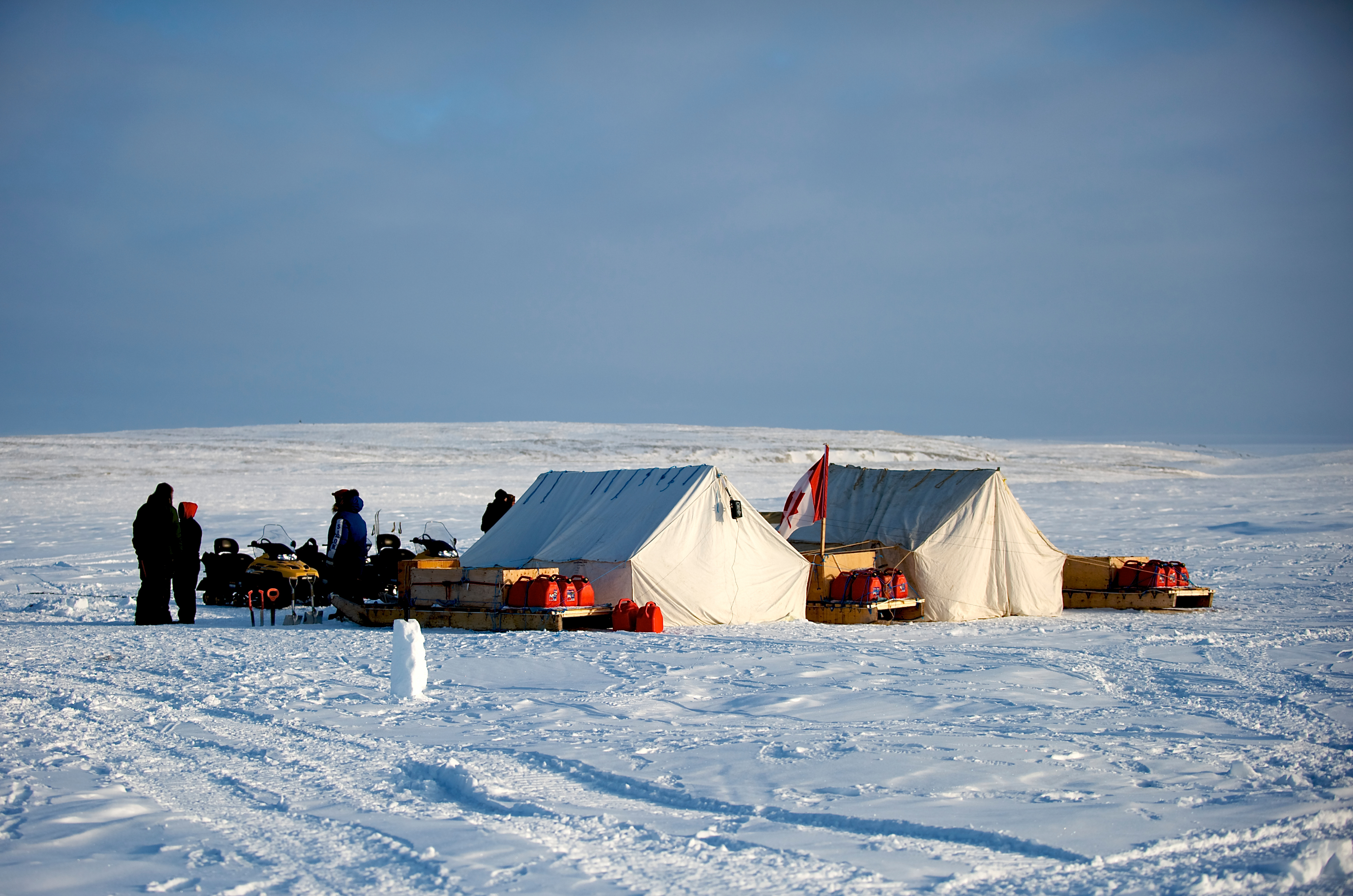
The contract, announced August 4, covers what the Department of National Defence calls the Enhanced Satellite Communications Project – Polar, or ESCP-P, and its purpose is narrow and specific: secure Military Ka-band connectivity across 65 to 90 degrees north latitude, the swath of Canadian territory that includes the High Arctic archipelago and the waters Canada claims sovereignty over. That zone has historically been the weak point in Canadian and allied military communications. Geostationary satellites sit fixed above the equator roughly 36,000 kilometers up, and the farther north a ground terminal is, the lower the angle at which it has to look through the atmosphere to reach one, degrading signal quality until, past a certain latitude, geostationary coverage becomes effectively unusable. That has left Canadian Armed Forces exercises in the far north, most visibly the annual Operation NANOOK sovereignty patrols, working around a communications blind spot that adversary activity in the same region has made harder to ignore.
Telesat LEO ULC signed the agreement directly with the newly formed Defence Investment Agency, itself a signal of how Ottawa is restructuring defense procurement around large infrastructure-style contracts. The deal’s scope goes beyond simply buying bandwidth: it covers end-to-end network integration, user terminals, ground and control infrastructure, and training and support services, meaning Telesat is delivering a functioning military communications system, not just leasing satellite capacity into an existing one.
What $2.3 billion actually buys
The core contract runs 15 years at $2.3 billion CAD, with two optional five-year extensions worth roughly $200 million CAD each, putting the total potential value at about $2.7 billion CAD if both options are exercised. All figures are Canadian dollars throughout, worth flagging given how easily a headline number like this gets miscast in a different currency.
That money funds a real expansion of Telesat’s Lightspeed constellation, the low-Earth-orbit network the company has been building for both commercial and government customers. Lightspeed grows from 156 to 225 satellites under this contract, a jump of 69 satellites and, per Telesat’s own figures, a 44 percent increase in total network capacity. The satellites are built by MDA Space at its Montreal facility and launched on SpaceX Falcon 9 rockets, the same rocket family pictured in this story’s cover photo, though that particular launch, a May 2026 cargo resupply mission from Cape Canaveral, is unrelated to Lightspeed; Telesat’s own satellites are not scheduled to begin flying on Falcon 9 until 2027 and 2028.
Timing is the other concrete anchor here. Global Lightspeed service, including the Arctic military capability this contract funds, is on track for the first quarter of 2028. That is roughly 18 months out, a reminder that this is an infrastructure commitment being made now against a capability that does not exist yet, and the practical value of the deal will not be testable until satellites are actually in orbit and terminals are fielded.
A sovereignty decision as much as a connectivity one
The strategic subtext of this deal is at least as important as its technical specifications. Canada had options here beyond building its own constellation: it could, in principle, have leaned on an existing foreign LEO network for Arctic coverage. Instead, the Department of National Defence structured this as a domestic build, satellites designed and manufactured by MDA Space in Montreal, operated under a Canadian services contract with Telesat, a Canadian company. That choice reads as a sovereignty decision, not just a procurement one. Russian and Chinese military and commercial activity in the Arctic has intensified scrutiny of Canada’s own surveillance and communications gaps in the region, a concern Canada’s own Operation NANOOK materials have raised directly in recent years. Relying on a foreign-owned satellite network for military communications in contested northern territory would have meant, in effect, depending on another country’s infrastructure to exercise sovereignty over Canada’s own. Building it domestically through MDA avoids that dependency, at the cost of a larger upfront commitment and a longer wait for the capability to actually arrive.
Sources
- Telesat secures $2.3 billion Arctic military satcom contract, expanding Telesat Lightspeed network and capacity by 44% — Telesat, Aug 4, 2026
- Ottawa awards Telesat $2.3B Arctic military satellite contract — BNN Bloomberg, Aug 4, 2026
- MDA Space Signs Strategic Partnership with the Department of National Defence and Telesat to Deliver Military Satellite Communications — MDA Space, Aug 4, 2026
- Canada picks Telesat and MDA to study Arctic military communications constellation — SpaceNews, Aug 4, 2026
- Defence Capabilities Blueprint: Enhanced Satellite Communications Project – Polar (ESCP-P) — Government of Canada, Aug 4, 2026
Frequently asked questions
What exactly did Canada just buy? +
A 15-year, $2.3 billion CAD (up to $2.7 billion CAD with options) services contract with Telesat for secure military Ka-band satellite connectivity across the Canadian Arctic, from 65 to 90 degrees north latitude, running on Telesat's Lightspeed low-Earth-orbit constellation.
Why does the Canadian military need a dedicated Arctic satellite deal, doesn't NORAD or the US already cover this? +
Geostationary satellites, which most conventional military satcom relies on, perform poorly or not at all at extreme northern latitudes because of the low look angle from the equatorial belt. Low-Earth-orbit constellations like Lightspeed, whose satellites pass more directly overhead, are needed to close that Arctic connectivity gap for Canadian Armed Forces operations such as Operation NANOOK.
Who's actually building the satellites, and when will this be operational? +
MDA Space builds the satellites in Montreal, and SpaceX launches them on Falcon 9 rockets. The constellation grows from 156 to 225 satellites. Global Lightspeed service, including the Arctic capability, is on track for the first quarter of 2028.
Is this just about connectivity, or does it have a strategic angle? +
Beyond bandwidth, it is a sovereignty play: Canada is building and operating its own Arctic surveillance and communications backbone domestically through MDA rather than depending on a foreign-owned system, at a moment when Russian and Chinese Arctic activity has sharpened Ottawa's focus on northern sovereignty gaps.
More news


