Space Force Pays SpaceX $1.6B for 18 Launches to Track Missiles
Space Systems Command locked in 18 Falcon 9 launches in a two-month sprint, seeding an orbital missile-tracking layer to back up the E-7 Wedgetail.

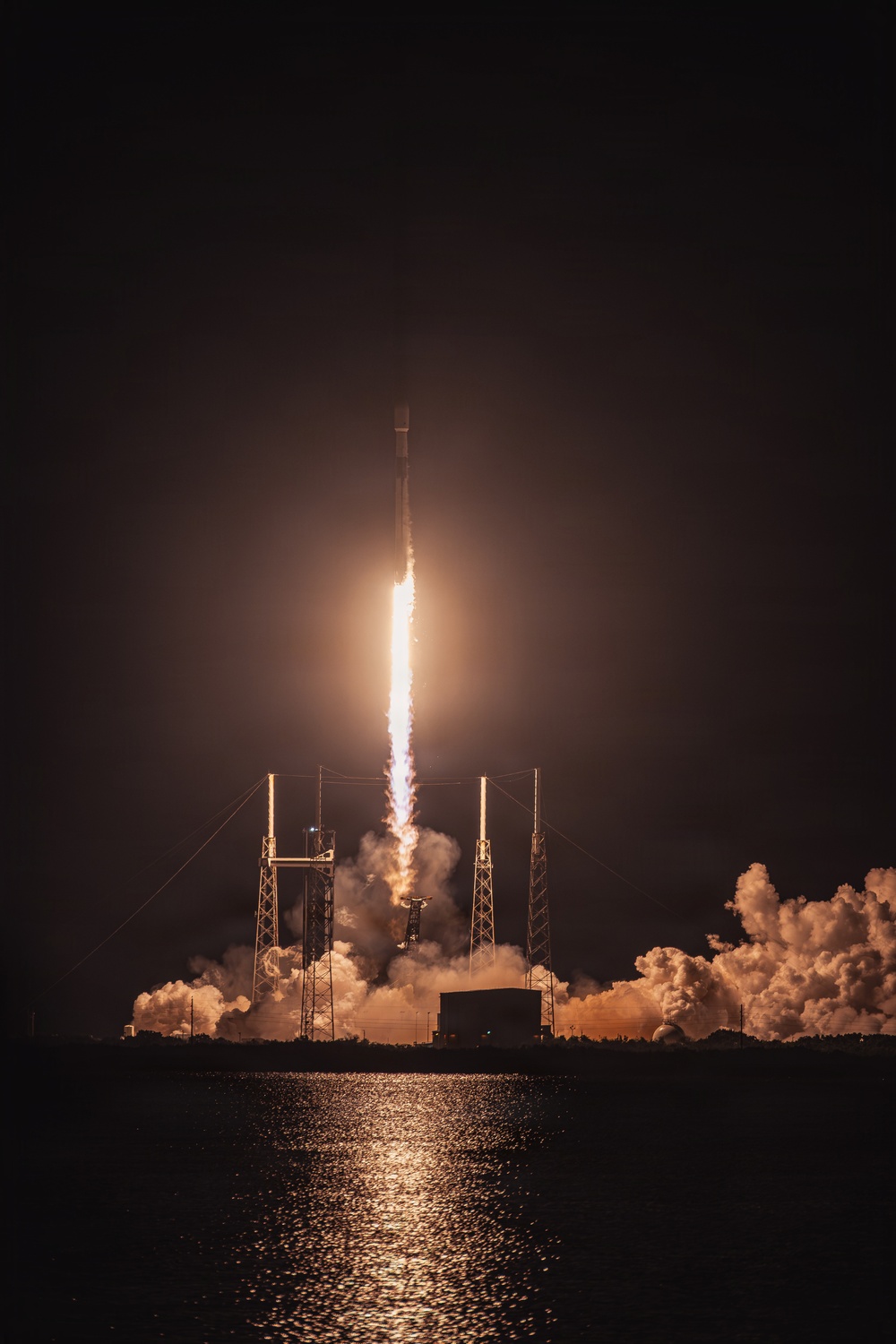
U.S. Space Force photo by Gwendolyn Kurzen, DVIDS, public domain. Representative Falcon 9 launch from Cape Canaveral, Florida, not the Vandenberg missions covered here.
The Space Force awarded SpaceX two task orders worth a combined $1.6 billion on July 29 for 18 Falcon 9 launches, the opening batch of missions meant to build a satellite layer that tracks aircraft, cruise missiles, and drones from orbit. The goal is to feed that tracking data to forces on the ground as a persistent, harder-to-shoot-down alternative to relying solely on the Air Force’s E-7 Wedgetail radar plane near contested airspace.
What the Space Force actually bought
Space Systems Command’s two task orders cover 18 Falcon 9 launches under NSSL, the National Security Space Launch program, specifically its Phase 3 Lane 1 vehicle for less-demanding missions that don’t require the heaviest-lift rockets. The launches will fly from Vandenberg Space Force Base in California through the end of 2027.
The payload is the Space-Based Sensing and Targeting portfolio, and within it specifically the Space-Based Air Moving Target Indication program, known as SB-AMTI, along with the related Space Data Network. SB-AMTI’s job is to track airborne objects, aircraft, cruise missiles, drones, from orbit and route that data across the Joint Force in near-real time. That is explicitly meant to complement, not replace, the Air Force’s E-7 Wedgetail airborne radar plane, giving commanders a way to maintain the same kind of moving-target tracking picture even in places where flying a manned radar aircraft close to contested airspace, such as the South China Sea or the Taiwan Strait, would be too risky. Exact satellite quantities for the constellation were not disclosed, which Space Systems Command attributes to operational security around the program.
Col. Eric Zarybnisky, the Portfolio Acquisition Executive for Space Access at Space Systems Command, described the pace at which this specific order came together as unusual even by the command’s own recent standards.
“We have set an unprecedented two-month acquisition timeline under the Phase 3 Lane 1 contract from requirement identification to award,” said Col. Eric Zarybnisky, Portfolio Acquisition Executive for Space Access, Space Systems Command (Air & Space Forces Magazine, July 29, 2026).
That speed matters because it is the same acquisition arm that has spent years being criticized for slow-moving, multi-year launch procurement cycles. A two-month window from identifying the need to signing the award is a meaningfully different operating tempo than the Space Force’s historical norm, and it is the kind of process change the command will need to repeat if it wants to keep pace with the launch volume it has now committed to.
The first order under a much bigger ramp-up
This award is the first task order issued since the Space Force raised NSSL Phase 3 Lane 1’s contract ceiling by $11.4 billion, to $17 billion total, on July 17, 2026. That same expansion increased the number of launches planned under the vehicle from 60 to 170 between 2025 and 2034. In other words, the $1.6 billion and 18 launches announced here are not a standalone purchase, they are the opening installment of a launch campaign roughly three times larger than what the Lane 1 program originally covered, with more task orders expected to follow as the SBST satellites are built and readied.
That build-out is itself already underway on a separate track. In May 2026, SpaceX separately won a contract to build the SB-AMTI satellites and the Space Data Network hardware itself, worth $4.16 billion according to Breaking Defense, awarded through an Other Transaction Authority vehicle after competition against eight other firms. That May contract paid for designing and manufacturing the satellites; this new $1.6 billion order pays only to launch them, under a completely separate contract vehicle. Together, the two awards show a single company controlling both ends of the pipeline, from satellite construction to the rocket that puts them in orbit, for a program the Pentagon has flagged as a near-term priority.
Breaking Defense describes this as the largest publicly announced batch of missions issued under NSSL Phase 3 to date. Part of the reason SpaceX won it comes down to infrastructure as much as price: ULA and Blue Origin also hold Lane 1 positions and remain eligible for future task orders, but neither currently matches SpaceX’s combined launch cadence and its established West Coast pad infrastructure at Vandenberg, the specific site these 18 missions need to fly from. For a sense of how fast that infrastructure has been getting used recently, see WeaponSpecs’ earlier coverage of Rocket Lab’s own Space Force launch contract for a new Alaska pad, part of the same broader push to add launch capacity across multiple providers and sites rather than concentrating it all in Florida.
Why an orbital layer, not just another radar plane
The strategic logic behind SB-AMTI is straightforward once the E-7 Wedgetail comparison is made explicit. A Wedgetail is a manned aircraft that has to fly, refuel, and stay within radar range of whatever it’s tracking, which makes it vulnerable in exactly the contested-airspace scenarios where the US most wants persistent tracking of enemy aircraft and cruise missiles. A satellite constellation doing the same moving-target-indication job doesn’t need to fly a racetrack pattern near a defended coastline, it’s already overhead. That’s also why the Space Force has been building out orbital training and simulation capacity in parallel, including the Space Systems Command’s separate contract effort covered in WeaponSpecs’ report on Space Force’s NITE-STAR orbital training program, which trains operators for exactly this kind of contested-space environment.
None of this replaces the Wedgetail outright. The Air Force has not announced plans to retire its E-7 fleet, and SB-AMTI is explicitly framed as a complement rather than a substitute. But the fact that the Pentagon is now spending well over $5 billion combined, factoring in both the satellite-build and the launch contracts, to stand up an orbital alternative signals real institutional concern about how long a manned radar aircraft can keep operating safely near the kind of advanced air defenses China and Russia have fielded.
Sources
- SpaceX wins $1.6B to launch Space Force 'sensing and targeting' sats — Breaking Defense, Jul 29, 2026
- Space Force to Launch 18 Comms and Targeting Missions by End of 2027 — Air & Space Forces Magazine, Jul 29, 2026
- $1.6 Billion In NSSL Phase 3, Lane 1 Task Orders Awarded To SpaceX — Defense Daily, Jul 29, 2026
Frequently asked questions
What did the Space Force just buy from SpaceX? +
Two task orders worth $1.6 billion for 18 Falcon 9 launches, announced July 29, 2026, to loft a new constellation of missile- and aircraft-tracking satellites through 2027.
What will these satellites actually do? +
They are part of the Space-Based Air Moving Target Indication program, designed to track airborne threats like aircraft and cruise missiles from orbit and feed near-real-time targeting data to forces on the ground, complementing the Air Force's E-7 Wedgetail radar plane.
How big is the total contract vehicle this falls under? +
NSSL Phase 3 Lane 1's ceiling was raised by $11.4 billion to $17 billion total on July 17, 2026, expanding planned launches under the program from 60 to 170 through 2034. This $1.6 billion order is the first task order issued after that expansion.
Is SpaceX the only company getting this work? +
No. ULA and Blue Origin also hold Lane 1 positions, but Breaking Defense reports SpaceX is currently the only company with the combined launch cadence and West Coast infrastructure at Vandenberg to support a campaign at this scale.
More news


