Why a Guided Missile Beats Every Tank Round on Paper
Of 39 anti-armor rounds in our database, the top penetration claim belongs to a 400 m/s guided missile, not a faster kinetic dart.

9M119M Invar missile (3UBK20 ammunition, labeled), photo by Vitaly V. Kuzmin via Wikimedia Commons (CC BY-SA 4.0)
Of the 39 armor-piercing rounds in the WeaponSpecs database that publish a penetration figure, the highest claim on the books does not belong to a kinetic tank round at all. It belongs to Israel’s LAHAT, a gun-launched anti-tank guided missile rated at 800 mm of rolled homogeneous armor equivalent (RHAe), narrowly ahead of the newest fielded U.S. kinetic round, the M829A4 APFSDS dart, at 750 mm. LAHAT gets there by trading speed for guidance: it leaves the barrel at just 400 m/s, a soft-launch speed shared by every gun-launched ATGM in the database that publishes one, against roughly 1,555 m/s for the M829A4 and up to 1,800 m/s for the fastest APFSDS darts on record. That nearly fourfold speed gap is precisely the reaction-time window modern hard-kill active protection systems are built to exploit, which means the rounds now topping the penetration table are also, in a real sense, the ones a defended tank has the best documented shot at shooting down before impact.
Which round actually claims the most armor penetration?
Ranked by their published penetrationMm figure, the top of the WeaponSpecs munitions database is not dominated by kinetic-energy tank rounds the way most procurement intuition expects. A gun-launched ATGM sits in first place, another sits fourth, and a third sits sixteenth on this list, interleaved among APFSDS darts from six different countries. The chart below shows the top 16 of the 39 rounds that publish a penetration figure.
Tan bars (guided, chemical-energy) and accent bars (kinetic APFSDS) are interleaved from the very top of the table, not segregated into separate tiers. An asterisk marks a Russian, Soviet, or Chinese manufacturer/state figure, not an independently verified result.
Why does a slower, guided missile out-penetrate a faster kinetic dart?
An APFSDS (armour-piercing fin-stabilized discarding sabot) round is a pure kinetic-energy weapon. A long, dense penetrator rod, usually tungsten or depleted uranium, is accelerated to very high velocity and punches through armor purely on the strength of its speed and mass at impact. Kinetic energy scales with the square of velocity, so an APFSDS round’s entire penetration budget depends on leaving the barrel as fast as possible, which is why the fastest rounds in the database, Russia’s 3BM60 Svinets-2 and 3BM42 Mango among them, reach 1,700-1,800 m/s.
A shaped-charge warhead works on different physics entirely. A cone-lined explosive charge focuses its blast into a narrow, extremely fast jet of molten metal that burns through armor via concentrated chemical energy released at the moment of impact, not the speed the round was traveling beforehand. That is why LAHAT, background via Wikipedia, and its gun-launched ATGM peers can arrive at only 400 m/s and still out-penetrate an APFSDS dart moving nearly four times faster: what matters to the warhead is its shaped-charge design and standoff distance at detonation, not impact speed.
Across the database, this plays out cleanly: APFSDS rounds (22 systems that publish both fields) average roughly 550 mm of penetration with a 750 mm ceiling, the M829A4. Gun-launched ATGMs and other chemical-energy rounds (17 systems) average roughly 535 mm, slightly lower, but their ceiling is higher at LAHAT’s 800 mm. The average tells a story of parity; the maximum is what makes the headline, guidance buys reach that raw kinetic energy alone has not yet matched on paper.
What does the identical 400 m/s across every gun-launched ATGM tell us?
Every one of the six gun-launched ATGMs in the database that publishes a muzzle velocity, LAHAT, 9M119M Invar, 9M119 Refleks, GP125, K281, and 9M112 Kobra, lists exactly 400 m/s. Six for six across four countries’ programs (Israel, Russia and the Soviet Union, China, South Korea) plausibly reflects a genuine physical constraint, not a data-entry artifact: a gun-launched ATGM has to survive being soft-launched from a smoothbore or rifled tank gun without a sabot, at a low enough velocity that its own airframe and guidance electronics survive the shock, before its rocket motor and seeker or beam-riding guidance take over. Read this as convergent engineering, the shared speed ceiling every gun-launched ATGM program apparently has to design around, not coincidence.
That convergence is specific to guided rounds, though, not to chemical-energy rounds generally, and it’s worth being precise about the difference. The U.S. M830A1 is a HEAT-MP shell, chemical-energy like LAHAT, but it carries no guidance package. Fired conventionally with no soft-launch requirement, it leaves the barrel at a full 1,410 m/s, roughly the same velocity class as an APFSDS round, and tops out at 600 mm, below both the guided ATGMs’ 800 mm ceiling and the APFSDS ceiling of 750 mm. Guidance, specifically the need to survive a soft launch, is what forces gun-launched ATGMs down to 400 m/s. Being chemical-energy by itself does nothing to a shell’s velocity; an unguided HEAT-MP round is just as fast as a kinetic dart and is not part of the “slow, interceptable” story this piece is about.
Can active protection systems stop these rounds, or only some of them?
This is where the penetration numbers stop being an abstraction. Active protection systems (APS) detect an incoming anti-tank threat and physically intercept or disrupt it before it reaches the hull, and the open-source consensus on what they can and cannot stop maps almost exactly onto the speed divide above.
“Trophy is designed to handle the chemical energy threats, the shaped-charge warheads, that dominate the threat environment below the level of tank-on-tank combat,” per militarymachine.com, which states plainly that Trophy “does not protect against kinetic energy penetrators, specifically armor-piercing fin-stabilized discarding sabot (APFSDS) rounds.”
That’s the load-bearing claim here: Trophy, the hard-kill APS with the deepest combat record, is documented as effective against ATGM- and RPG-class chemical-energy threats, the same broad category LAHAT belongs to, but not against fast kinetic APFSDS darts from a peer tank’s main gun. WeaponSpecs’ own survey of active protection across 133 tanks and IFVs found only 7 field a combat-proven hard-kill system at all, so even where the physics favors the defender, the hardware to exploit it is rare.
The picture isn’t unanimous, though. Elbit Systems, an Israeli manufacturer, makes a competing on-record claim about its newer Iron Fist Light Kinetic (IFLK) system:
“Rockets, ATGMs, recoilless rifle munitions, as well as HEAT rounds, armour-piercing fin-stabilised discarding sabot (APFSDS) rounds, and even loitering munitions,” said Elbit Systems of Iron Fist Light Kinetic’s claimed defeat capability, per euro-sd.com (Sidney E. Dean, January 2024), describing the interceptor’s blast as inducing yaw on an APFSDS projectile to reduce its effective penetration.
That runs directly counter to the more common Trophy-era consensus above, and the two aren’t reconciled anywhere in the open literature. Treat it as a genuine, unresolved tension: one maker says APFSDS defeat is achievable through induced yaw, the dominant view elsewhere says hard-kill APS is built for chemical-energy threats and doesn’t stop APFSDS. Neither source addresses whether APS can stop a full-velocity, unguided HEAT-MP round like the M830A1, and that specific case shouldn’t be assumed either way.
What the sourcing does support cleanly is the framing at the top of this piece. LAHAT and the other gun-launched ATGMs top the penetration table at 400 m/s, squarely inside the speed band the established APS literature describes as interceptable. The M829A4 and the rest of the APFSDS field sit just below them, at speeds that same literature treats as effectively immune to today’s fielded hard-kill systems, Elbit’s counterclaim notwithstanding. The highest number on the spec sheet and the hardest round to stop in the field are, right now, two different rounds.
The 39-round dataset, ranked
| Round | Type | Country | Penetration (mm RHAe) | Muzzle velocity (m/s) |
|---|---|---|---|---|
| LAHAT | Gun-launched ATGM | Israel | 800 | 400 |
| 9M119M Invar | Gun-launched ATGM | Russia* | 750 | 400 |
| M829A4 | APFSDS | United States | 750 | 1,555 |
| 9M119 Refleks | Gun-launched ATGM | Russia* | 700 | 400 |
| DM63 | APFSDS | Germany | 700 | 1,650 |
| GP125 | Gun-launched ATGM | China* | 700 | 400 |
| K281 | Gun-launched ATGM | South Korea | 700 | 400 |
| M829A3 | APFSDS | United States | 680 | 1,555 |
| 3BM60 Svinets-2 | APFSDS | Russia* | 650 | 1,800 |
| DM53 | APFSDS | Germany | 650 | 1,750 |
| K279 | APFSDS | South Korea | 650 | 1,700 |
| L52A3 | APFSDS | United Kingdom | 650 | 1,650 |
| OFL 120 G1 | APFSDS | France | 650 | 1,750 |
| Type 10 | APFSDS | Japan | 650 | 1,700 |
| 3BM46 Svinets | APFSDS | Russia* | 600 | 1,750 |
| 9M112 Kobra | Gun-launched ATGM | Soviet Union* | 600 | 400 |
| L27A1 CHARM 3 | APFSDS | United Kingdom | 600 | 1,600 |
| M829A2 | APFSDS | United States | 600 | 1,670 |
| M830A1 | HEAT-MP | United States | 600 | 1,410 |
| DM43 | APFSDS | Germany | 560 | 1,650 |
| DTW125 | APFSDS | China* | 550 | 1,700 |
| OFL 120 F1 | APFSDS | France | 550 | 1,700 |
| 3BM42 Mango | APFSDS | Soviet Union* | 500 | 1,700 |
| DM33 | APFSDS | Germany | 470 | 1,650 |
| 3BK15 | HEAT-MP | Soviet Union* | 450 | 905 |
| DM12 | HEAT-MP | Germany | 450 | N/A |
| K280 | HEAT-MP | South Korea | 450 | N/A |
| OECC 120 F1 | HEAT-MP | France | 450 | N/A |
| Type 10 multipurpose HEAT round | HEAT-MP | Japan | 450 | N/A |
| Type 90 | HEAT-MP | Japan | 450 | N/A |
| KM413 | HEAT-MP | South Korea | 400 | N/A |
| M325 | HEAT-MP | United States | 400 | N/A |
| M456 | HEAT | United States | 400 | 1,170 |
| KM33 | APFSDS | South Korea | 350 | 1,500 |
| M111 | APFSDS | United States | 350 | 1,500 |
| M735 | APFSDS | United States | 350 | 1,501 |
| S-8 | Rocket | Russia* | 350 | 692 |
| Type 74 | APFSDS | Japan | 350 | 1,500 |
| 3BM8 | APFSDS | Soviet Union* | 245 | 1,800 |
* Russian, Soviet-era, or Chinese manufacturer/state figure, not independently verified by a Western test agency.
Two data points here are worth flagging in prose, not just the footnote. The Soviet-era 3BM8 (1970s, 245 mm) against the modern Russian 3BM60 Svinets-2 (650 mm) shows roughly a 2.65x generational jump in Russian APFSDS penetration claims over five decades, both are state claims with no independent Western confirmation. And the M829 family’s own progression, A2 at 600 mm, A3 at 680 mm, A4 at 750 mm, is the clearest single-country evidence that kinetic penetration is still climbing too, background via Wikipedia, it just hasn’t caught the guided missile at the top of the list yet.
So what does this mean for a buyer or analyst?
A penetration figure alone tells you almost nothing about which round actually threatens a given tank in a real engagement. LAHAT’s 800 mm looks like the best anti-armor round in the database until weighed against a documented, if contested, countermeasure built for its speed class. The M829A4’s 750 mm looks merely competitive until you factor in that no source reviewed here describes a fielded system that reliably stops it. The real procurement question isn’t which round penetrates more on paper, it’s which round the defender’s own protection suite can actually engage, and right now those are two different rankings.
That’s also the throughline connecting this piece to two of our other primers: tank armor explained walks through how composite armor, explosive reactive armor, and APS stack together as layered defenses, and the active protection systems ranking shows just how few of the 133 tanks and IFVs in our database, 7, actually field a combat-proven hard-kill system to exploit the physics described here. For the ammunition side of the equation, see our breakdown of 125mm vs 120mm tank gun rounds, and browse full spec sheets for every platform in this piece, including the M1A2 SEP v3 Abrams and Russia’s T-14 Armata, in the tank category on WeaponSpecs.
Sources
- Active protection system - Wikipedia
- Armour-piercing fin-stabilized discarding sabot - Wikipedia
- Active Protection Systems Explained: How Trophy APS Stops Anti-Tank Missiles
- Active protection systems: an overview (euro-sd.com, Sidney E. Dean, Jan 2024)
- 9M119 Svir - Wikipedia
- LAHAT - Wikipedia
- M829 - Wikipedia
- GBU-28 - Wikipedia
Systems in this comparison
Every system covered above, with its photo and, where available, a video. Tap a card to open the full spec sheet.
Compare these side by side →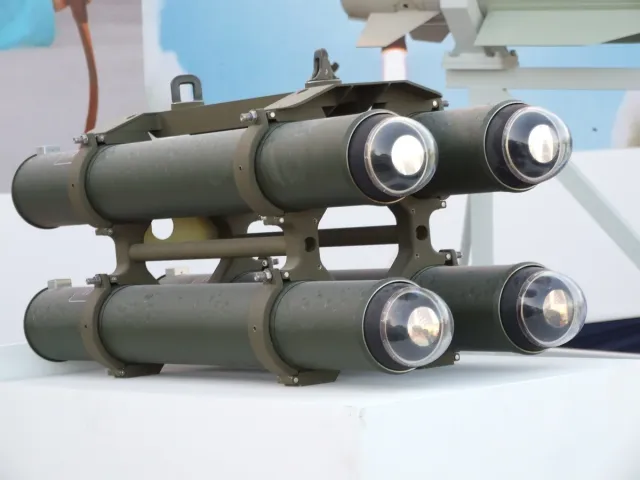
Munitions
LAHAT gun-launched ATGMMunitions
M829A4 APFSDS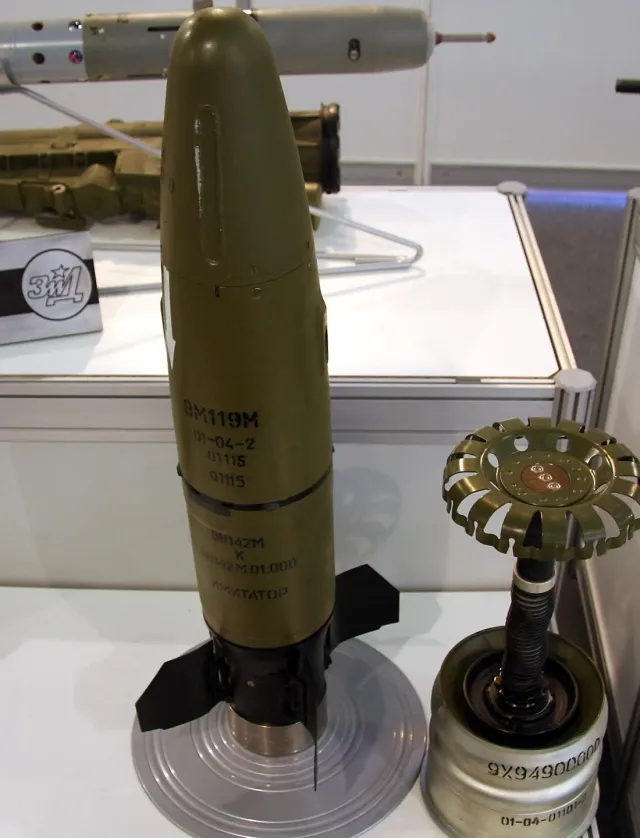
Munitions
9M119M Invar gun-launched ATGM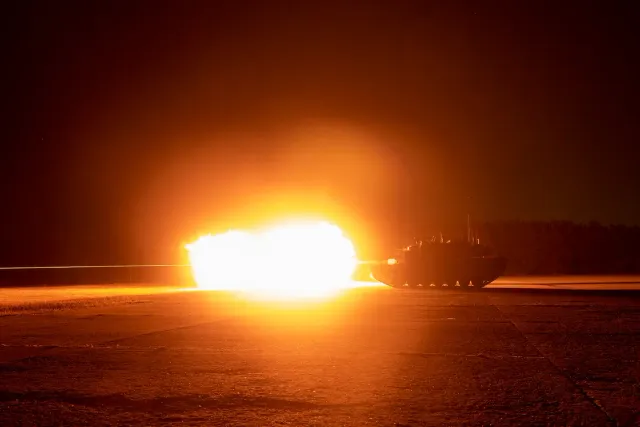
Main battle tank
M1A2 SEP v3 Abrams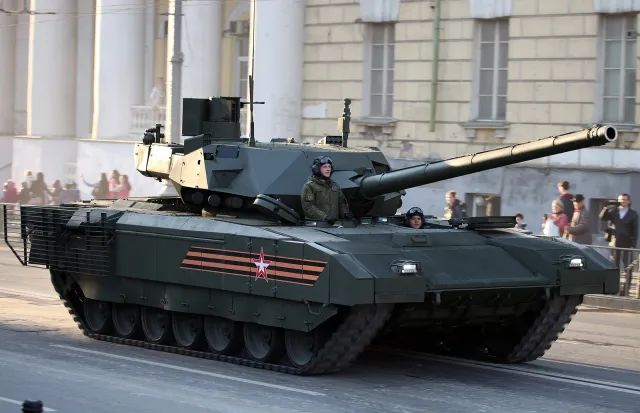
Main battle tank
T-14 ArmataFrequently asked questions
What does penetrationMm actually measure? +
It is the round's claimed penetration in millimeters of rolled homogeneous armor equivalent (RHAe), a standard unit for comparing anti-armor rounds against a uniform steel-armor benchmark rather than any specific tank's actual armor package. It is a lab or manufacturer figure, not a guarantee against a real, layered composite-and-reactive-armor target.
How can a 400 m/s missile out-penetrate a 1,555 m/s tank round? +
Penetration against armor comes from two different physics. An APFSDS dart relies purely on kinetic energy, speed and mass at impact, so it needs very high velocity. A shaped-charge warhead, like the one on a gun-launched ATGM, focuses a molten metal jet through chemical energy released at detonation, a mechanism that does not require high impact speed to achieve deep penetration.
Are Russian and Chinese penetration figures reliable? +
Treat them as manufacturer or state claims, not independently verified results. Figures for Russia's 9M119M Invar, 9M119 Refleks, 3BM60 Svinets-2, 3BM46 Svinets, and China's GP125 all come from the manufacturer or state defense establishment, with no independent Western test-agency confirmation of the underlying performance.
Can active protection systems stop APFSDS tank rounds? +
The dominant view in open-source literature is no. Trophy, the combat-proven Israeli hard-kill system, is documented as designed against chemical-energy threats, shaped-charge ATGMs and RPGs, not fast kinetic APFSDS darts. Elbit Systems has separately made an on-record manufacturer claim that its newer Iron Fist Light Kinetic system can defeat APFSDS by inducing yaw on the penetrator, a genuine open tension in the literature that has not been independently resolved either way.
Why do GBU-28 and GBU-39 show penetration figures far higher than any tank round? +
Because they are a different measurement entirely. GBU-28 and GBU-39 are aerial bunker-buster and glide bombs, and their penetrationMm figures describe how deep they drive into concrete and earth, not steel armor. Comparing an aerial bomb's concrete-penetration number to a tank round's RHA-steel figure is comparing different physics under the same field name, which is why both are excluded from this ranking.
Related reading


