Active Protection: Just 7 of 133 Are Combat-Proven
Of 133 tanks and IFVs in the database, only 7 field Trophy, the one active protection system with an independently reported combat record.

Via Wikipedia, Challenger 3 (shown for identification)
Of the 133 tanks and IFVs in the WeaponSpecs database, 28 list some form of active protection system, 21 percent. Of those 28, only 7 field Trophy, the one system with any independently reported combat record. The other 21 split into fielded-but-unproven hardware and outright unverified or hedged claims. A line on a spec sheet that says “active protection system: yes” can mean a real intercept history, a system that has never been shot at in anger, or a manufacturer’s own admission, in its own marketing copy, that the feature is optional and not standard equipment at all. Reading which of those three a given tank actually has is the entire point of this piece.
How many tanks and IFVs actually have an active protection system?
WeaponSpecs tracks 133 tanks and IFVs. Twenty-nine of them have a non-empty protection.activeProtectionSystem field in their spec record, but one of those 29 is a data-quality wrinkle worth flagging rather than hiding: Japan’s Type 10 has its own field populated with the text “none confirmed,” which is the record explicitly stating it does not have a confirmed APS, not claiming one. Exclude that entry and the real base is 28 of 133, 21 percent, claiming some form of active protection system across the tank and IFV categories combined.
That 21 percent is not one thing. It splits into three tiers by how real the claim actually is, and the split is lopsided toward the weak end:
More than half of every APS claim in the database, 15 of 28, sits in the weakest tier, a state claim, a hedged manufacturer qualifier, or a system still in evaluation.
Which of those actually has a combat record?
Seven systems, spanning four countries, Israel, the United States, the United Kingdom, and Germany, and they all trace back to the same piece of hardware: Rafael’s Trophy, an Israeli hard-kill system that entered service in 2009.
| System | Country | APS | Status | Release Year |
|---|---|---|---|---|
| Merkava Mk4 | Israel | Trophy | active | 2,004 |
| Merkava Barak | Israel | Trophy (upgraded) | active | 2,023 |
| Namer | Israel | Trophy | active | 2,008 |
| M1A2 SEP v3 Abrams | United States | Trophy | active | 2,017 |
| Challenger 3 | United Kingdom | Trophy | announced | 2,027 |
| Leopard 2A8 | Germany | Trophy (standard) | active | 2,025 |
| Leopard 2A7 | Germany | Trophy (select operators) | active | 2,014 |
The Israel Defense Forces have credited Trophy with more than 5,400 intercepted anti-tank attacks since it entered service in 2009, a figure IDF has publicized but which independent observers have not verified, per Military Machine’s reporting. Treat that number the same way this site treats any single-source figure: a claim from the party with every incentive to publish a big one, not an audited count. What sets Trophy apart from every other entry in the database is not that its number is bigger, it is that Trophy is the only APS with any independent, open-source combat reporting behind it at all, IDF-credited or otherwise.
That track record is why four more NATO members chose it in January 2026. Lithuania, the Netherlands, Czechia, and Croatia all selected Trophy for their Leopard 2A8 fleets, joining Germany. Rafael Executive VP Tzvi Marmor said the selection “reflects a clear consensus that active protection has become a foundational requirement for modern armored forces,” per Breaking Defense’s reporting. A manufacturer executive praising his own product is not independent evidence, but the underlying procurement pattern, five NATO armies now standardizing on the same hard-kill system for the same tank family, is a real signal in its own right, separate from anything Marmor said about it.
What does Russia’s own paperwork admit about Afghanit and Arena-M?
Start with the platform Afghanit sits on. T-14 Armata and its T-15 IFV sibling were unveiled at the same 2015 parade and both still carry the “announced,” not “active,” status in the database 11 years later, a gap this site has covered in detail. An APS on a tank that has not been fielded at scale has no combat record to point to, no matter how the promotional footage describes it. Afghanit’s capability claims, like every Russian state figure in this dataset, get the same treatment: a claim, not a fact, until independent reporting says otherwise.
The older Shtora-1 soft-kill jammer, fitted to the T-90A, T-90M, and the newest T-90M obr. 2022, is not a paper program, it is a decades-old design actually riding on tanks that have gone to war. That is exactly the problem. Open-source loss trackers have documented well over 150 confirmed T-90M losses alone, per Defence Blog’s coverage of OSINT tank-loss tracking in the Ukraine war. A soft-kill jammer built around 1980s-era threat assumptions was never designed against modern top-attack ATGMs or loitering munitions, and the war has repeatedly shown the gap between “has an APS” and “the APS stops the thing actually being fired at it.”
Russia’s answer to the drone half of that problem is Arena-M, an anti-drone hard-kill upgrade not yet tracked as its own database entry, background context here rather than a system row. In July 2026, per Defence Blog’s reporting on Militarnyi’s coverage, a Russian T-72B3A fitted with Arena-M’s anti-drone mode took a direct FPV drone hit near Maiak, Donetsk Oblast, its first publicly documented combat test and a failed one. That outcome should not have been a surprise. Months earlier, a Russian military analyst had already flagged the same weakness in blunt terms.
“The necessary algorithmic solutions have not yet been created,” said Viktor Murakhovsky, a Russian military analyst, on the Arena-M active protection system’s continued failure to reliably detect and track small attack drones (The Defence Blog, Nov. 7, 2025).
Murakhovsky is a Russian analyst commenting on a Russian program, which makes his skepticism unusually useful. He is not an independent Western source, but he is also not repeating a state marketing line, he is contradicting one. When the harshest public critique of a Russian APS claim comes from inside Russia’s own commentariat, that is worth more than a foreign think-tank press release would be.
Why do more than half the claims in the database hedge their own language?
Fifteen of the 28 systems that claim an APS fall into the weakest tier, either an unverified state claim on a barely-fielded platform, or language the manufacturer itself qualifies. China’s GL5 shows up on four separate tanks, Type 15, Type 99A, VT-4, and ZTZ-99A, and every single one of those four entries hedges GL5 in its own spec text: “optional,” “reported on some units,” or “reported.” That is a weaker signal than even Russia’s Afghanit claim, which at least asserts the system is standard equipment on the platform it names. A feature the manufacturer itself describes as optional is not a feature a buyer should assume is present on any given unit rolling off the line.
The rest of the tier is a mix of platforms still in testing or evaluation rather than fielded with confidence: Turkey’s Altay with its domestic Akkor system still in integration, India’s Arjun Mk2 proposing a Trophy-type system that remains announced, not active, France’s Leclerc XLR with its APS explicitly logged as “in evaluation,” Germany’s Lynx KF41 and Panther KF51 both offering StrikeShield as an add-on rather than standard fit, and Pakistan’s Haider with an unspecified soft-kill APS on a platform still tagged announced.
| Tier | System | Country | APS | Status | Release Year |
|---|---|---|---|---|---|
| 1 | Merkava Mk4 | Israel | Trophy | active | 2,004 |
| 1 | Merkava Barak | Israel | Trophy (upgraded) | active | 2,023 |
| 1 | Namer | Israel | Trophy | active | 2,008 |
| 1 | M1A2 SEP v3 Abrams | United States | Trophy | active | 2,017 |
| 1 | Challenger 3 | United Kingdom | Trophy | announced | 2,027 |
| 1 | Leopard 2A8 | Germany | Trophy (standard) | active | 2,025 |
| 1 | Leopard 2A7 | Germany | Trophy (select operators) | active | 2,014 |
| 2 | Eitan | Israel | Iron Fist | active | 2,016 |
| 2 | M2A4 Bradley | United States | Iron Fist (M2A4E1) | active | N/A |
| 2 | K2 Black Panther | South Korea | KAPS soft-kill system | active | 2,014 |
| 2 | K21 | South Korea | Soft- and hard-kill APS with ERA | active | 2,009 |
| 2 | Hunter AFV | Singapore | Soft-kill/hard-kill APS | active | 2,019 |
| 2 | Puma | Germany | MUSS soft-kill system | active | 2,015 |
| 3 | T-14 Armata | Russia | Afghanit | announced | 2,015 |
| 3 | T-15 | Russia | Afghanit | announced | 2,015 |
| 3 | T-90M obr. 2022 | Russia | Shtora-1 (soft-kill) | active | 2,022 |
| 3 | T-90A | Russia | Shtora-1 (infrared countermeasure) | active | 2,004 |
| 3 | T-90M | Russia | Shtora-1 (soft-kill) | active | 2,017 |
| 3 | Type 15 | China | GL5 (optional) | active | 2,018 |
| 3 | Type 99A | China | GL5 (reported on some units) | active | 2,011 |
| 3 | VT-4 | China | GL5 (optional) | active | 2,012 |
| 3 | ZTZ-99A | China | GL5 soft/hard-kill (reported) | active | 2,011 |
| 3 | Altay | Turkey | Akkor (domestic APS, in integration) | active | 2,023 |
| 3 | Arjun Mk2 | India | Trophy-type hard-kill (proposed) | announced | 2,021 |
| 3 | Leclerc XLR | France | In evaluation | active | 2,023 |
| 3 | Lynx KF41 | Germany | StrikeShield (optional) | active | 2,018 |
| 3 | Panther KF51 | Germany | StrikeShield (AMAP-ADS) | announced | N/A |
| 3 | Haider | Pakistan | Soft-kill APS (unspecified) | announced | 2,023 |
Every Russian and Chinese figure in that table rests on state media, manufacturer marketing, or export-brochure language rather than independent verification, the same caveat this site applies to any RU/CN/IR/KP-origin capability claim. That caveat is not a formality here, it is the actual finding: 9 of the 15 tier-three systems are Russian or Chinese, and none of the 9 carries language stronger than “reported,” “optional,” or a status still short of fielded.
What this means for reading an armor spec sheet
An armor spec sheet lists composite plating, explosive reactive armor, and an active protection system as though they were three interchangeable boxes to check. They are not, and this site’s tank armor explainer covers why each layer works differently against a different threat. What this post adds is the data-driven follow-up to that conceptual piece: given the protection stack exists, who actually has a real version of its newest layer. The answer, from WeaponSpecs’ own 133-system tank-and-IFV dataset, is 7 platforms with a combat-documented APS, 6 more that are fielded but unproven, and 15 where the claim itself admits it is not a sure thing.
That distinction should change how a buyer or analyst reads “APS: yes” on any comparison sheet. It is worth asking which of the three tiers above a given claim actually belongs to before treating it as a reason to prefer one platform over another.
Compare any of the platforms above head to head in the Compare tool, weigh protection alongside the rest of a platform’s profile in the Advisor, or see which Trophy-equipped tanks make the cut in Best Main Battle Tanks 2026.
Sources
Systems in this comparison
Every system covered above, with its photo and, where available, a video. Tap a card to open the full spec sheet.
Compare these side by side →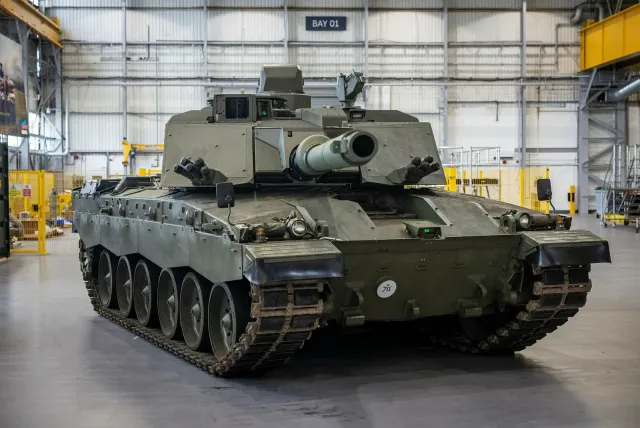
Main battle tank
Challenger 3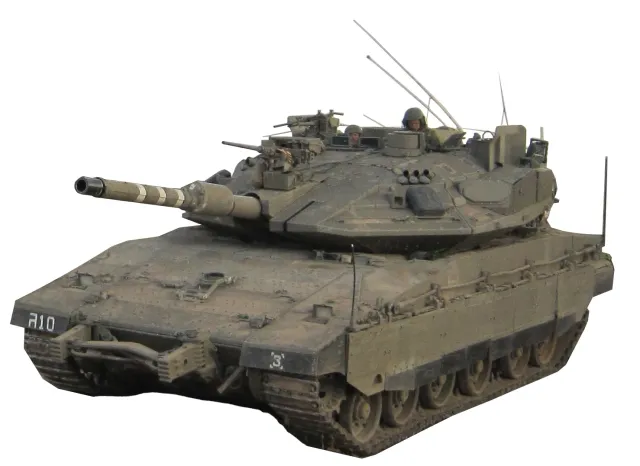
Main battle tank
Merkava Mk4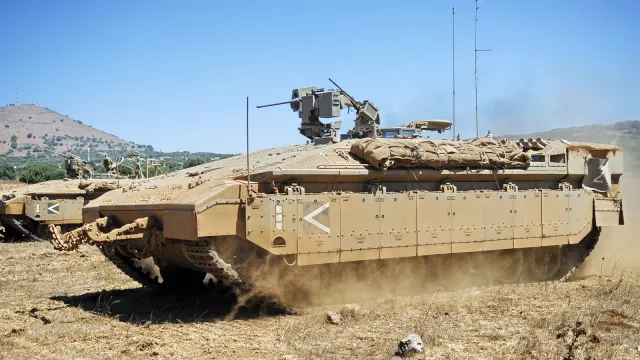
Main battle tank
M1A2 SEP v3 Abrams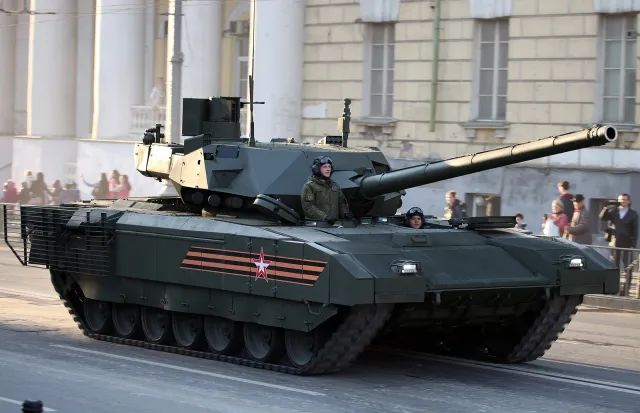
Main battle tank
T-14 Armata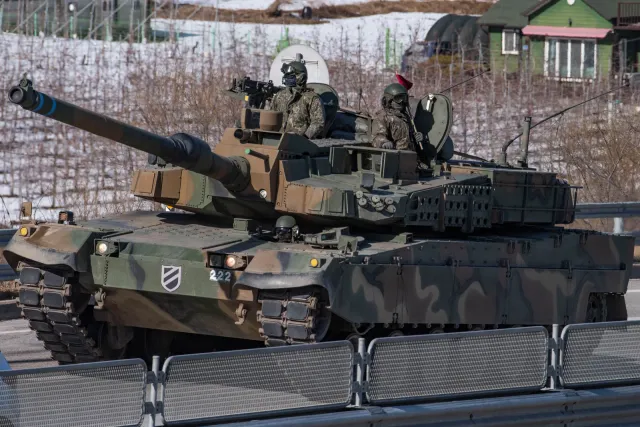
Main battle tank
K2 Black PantherFrequently asked questions
What is an active protection system (APS) on an armored vehicle? +
An active protection system detects an incoming anti-tank round, a missile, a rocket-propelled grenade, or in newer variants a drone, and either jams its guidance (soft-kill) or physically destroys it in flight (hard-kill) before it reaches the hull. It is an added layer on top of composite armor and explosive reactive armor, not a replacement for either.
Which tanks and IFVs actually have Trophy, the combat-proven APS? +
Seven systems in the WeaponSpecs database: Israel's Merkava Mk4, Merkava Barak, and Namer IFV, the US M1A2 SEP v3 Abrams, Germany's Leopard 2A8 and Leopard 2A7 (select operators), and the UK's Challenger 3, still announced ahead of a 2027 target. All seven carry Rafael's Trophy system or an upgraded variant of it, and none of the other 21 APS-equipped systems in the database can claim the same.
Does Russia's T-14 Armata really have a working active protection system? +
The database lists Afghanit as its APS, but T-14 and its T-15 IFV sibling remain tagged announced, not active, 11 years after their 2015 unveiling. A system that has not been fielded at scale has no operational record for its protection suite either, whatever the promotional material claims about it.
Can active protection systems stop attack drones, not just missiles? +
That is the open question Russia's own Arena-M anti-drone upgrade was built to answer, and its first publicly documented test failed: a T-72B3A fitted with it still took a direct FPV drone hit near Maiak, Donetsk Oblast, in July 2026. A Russian military analyst had already said months earlier that the necessary algorithms for reliably tracking small drones simply had not been built yet.
How many tanks and IFVs in the WeaponSpecs database have any APS at all? +
28 of 133, or 21 percent, list some form of active protection system in their spec record. Only 7 of those 28, all Trophy variants, carry any independently reported combat record; the rest range from fielded-but-unproven to explicitly hedged manufacturer language like optional, reported on some units, or in evaluation.
Related reading


