Which Fighter Jet Has the Longest Combat Radius?
China's J-20 claims a 2,000 km fighter combat radius, but 8 of the 12 longest reaches in our database are unverified Chinese or Russian state claims.

Via Wikipedia, Chengdu J-20 (shown for identification)
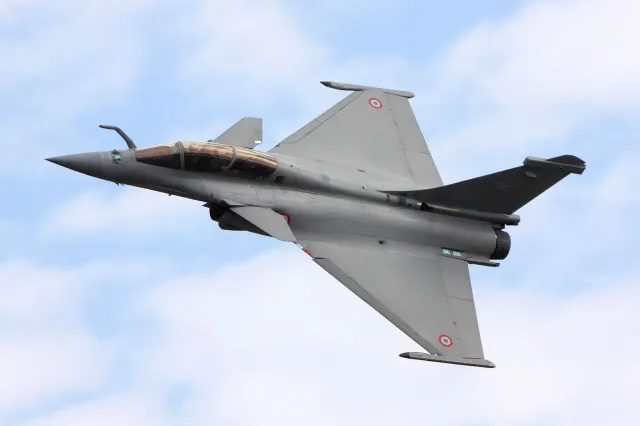
China’s J-20 publishes the longest combat radius in our analysis of the 54 fighters in the WeaponSpecs database that report a figure, at 2,000 km. No official Chinese source has ever confirmed that number; it is an open-source estimate. Strip out the unverifiable claims and the longest combat radius any NATO-aligned source will stand behind belongs to France’s Rafale, at 1,850 km on a stated penetration-mission profile. Look at the twelve longest published figures in the database and eight belong to Chinese or Russian aircraft that no independent source has confirmed. That is the headline for anyone using combat radius as a procurement input: half the leaderboard is marketing until proven otherwise.
Which fighter jet has the longest combat radius?
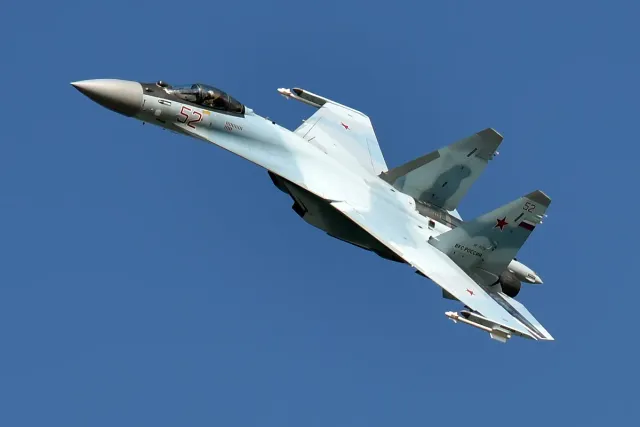
Ranked by published figure, the top of the table is dominated by aircraft whose numbers cannot be independently checked. The J-20 leads at 2,000 km. Behind it, Rafale C/F4 at 1,850 km, Su-35S at 1,600 km, then a cluster at 1,500 km made up of J-16, Gripen E, and Su-57. Of those top six figures, four (J-20, Su-35S, J-16, Su-57) are Chinese or Russian claims with no disclosed methodology. Only Rafale and Gripen E trace to a named manufacturer publishing a specific mission profile.
Four of the six longest published radii here trace to Chinese or Russian claims with no disclosed methodology; the longest figure any NATO-aligned source will stand behind, Rafale's 1,850 km, ranks second, not first.
Ninety-two percent of the fighters in our database, 54 of 59, publish some combat radius figure. That is a high disclosure rate, but disclosure is not the same as verification, and the two are easy to conflate when a spec sheet lists a number without a source.
The same six figures read differently plotted as range rings from a single point of origin rather than stacked bars. Distance from center is drawn to scale, so the gap between the J-20’s claimed reach and the F-22’s official one is a gap in radius, not just bar length.
Drawn to scale from a single base rather than as bar length, the ring gap between J-20's claimed 2,000 km and F-22A's confirmed 850 km is a genuine difference in operational reach, and half of that gap is built on a number no one has verified.
Why are the longest reaches the hardest numbers to trust?
This is the pattern that matters most for anyone comparing fighters on paper: the further up the ranking you go, the less traceable the figure gets. China has never published an official combat radius for the J-20. The 2,000 km figure circulating in open-source analysis is an estimate built from observed sortie patterns and airframe characteristics, not a Chengdu Aircraft Corporation or PLA Air Force disclosure. The same problem applies to the Su-35S at 1,600 km and the Su-57 at 1,500 km: both are United Aircraft Corporation or Russian Ministry of Defense claims, and neither discloses the assumed weapons load, fuel state, or mission profile behind the number.
Compare that to the aircraft with figures that at least trace to a named source on a stated profile. Dassault publishes the Rafale’s 1,850 km on a specific penetration-mission tactical scan. Lockheed Martin’s F-35A figure of 1,240 km is part of its official program materials. Saab states the Gripen E’s 1,500 km directly on its product page. None of these are independently audited either, manufacturer marketing has its own incentives, but there is a name attached, a profile assumption stated, and a paper trail if the figure is later challenged. State claims from closed procurement systems have none of that.
Look at the top twelve published combat radii in the database (J-20, Rafale, Rafale F4, JH-7, Su-35S, J-11, J-16, Gripen E, Su-27, Su-30SM, Su-57, Tornado GR4) and eight are Chinese or Russian aircraft with no independent confirmation. That is not a coincidence of physics. It reflects which countries’ defense industries face outside scrutiny and which don’t.
Why does the F-22 rank so low on reach?
| Fighter | Origin | Combat radius (km) | Figure type |
|---|---|---|---|
| J-20 | China | 2,000 | Open-source estimate, unverified |
| Rafale C/F4 | France | 1,850 | Manufacturer (Dassault) |
| Su-35S | Russia | 1,600 | State/manufacturer claim, unverified |
| J-16 | China | 1,500 | State/manufacturer claim, unverified |
| Gripen E | Sweden | 1,500 | Manufacturer (Saab) |
| Su-57 | Russia | 1,500 | State/manufacturer claim, unverified |
| Eurofighter Typhoon | Multi-national | 1,389 | Manufacturer/operator |
| F-35A | United States | 1,240 | Manufacturer/official (Lockheed) |
| F-15EX | United States | 1,200 | Manufacturer/official |
| F-22A | United States | 850 | Official (US) |
The F-22A Raptor publishes a combat radius of roughly 850 km, which lands it around 29th of the 54 fighters that report a figure, squarely in the middle-to-bottom of the table. That is not a data gap or a weak airframe. It is a design choice. The F-22 is built for supercruise and stealth air superiority, not strike reach: internal-only weapons carriage preserves its radar signature but caps payload and fuel efficiency, and the airframe trades range for the speed and low-observability that define its mission. Unlike the top Chinese and Russian claims, that 850 km figure traces to official US sources, so the ranking is trustworthy even if the position looks unimpressive next to a J-20 press estimate.
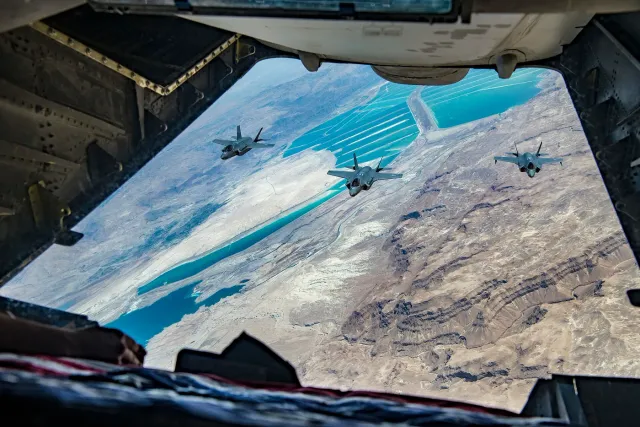
The F-35A sits mid-pack at 1,240 km, ahead of the F-22 but well behind Rafale and Gripen E. That gap says more about mission profile than about which airframe is “better.” A multirole strike jet built to penetrate and return needs a different fuel and payload balance than an interceptor built to hold a combat air patrol close to friendly airspace and dash to intercept.
What combat radius actually tells a buyer
Combat radius is a real operational constraint, not a leaderboard stat. A shorter radius means heavier tanker dependency and tighter basing requirements, both of which shape a procurement decision far more than a spec-sheet ranking. A jet with a strong published radius but no tanker fleet to support extended sorties does not deliver that radius in practice. A jet with a modest radius but forward basing close to the mission area may need no tanker support at all.
The number that should drive a decision is not “who has the longest reach” but “what reach does this mission need, and does the published figure survive a check for who published it and under what assumptions.” Discount the unverifiable Chinese and Russian claims accordingly, not because the underlying aircraft are necessarily weaker, but because there is no way to confirm the number as stated. Run your own mission profile through the range envelope tool rather than taking any single spec-sheet figure at face value, and use the Decision Advisor to weigh combat radius against basing, tanker availability, and the rest of the procurement picture before it becomes a line item.
Systems in this comparison
Every system covered above, with its photo and, where available, a video. Tap a card to open the full spec sheet.
Compare these side by side →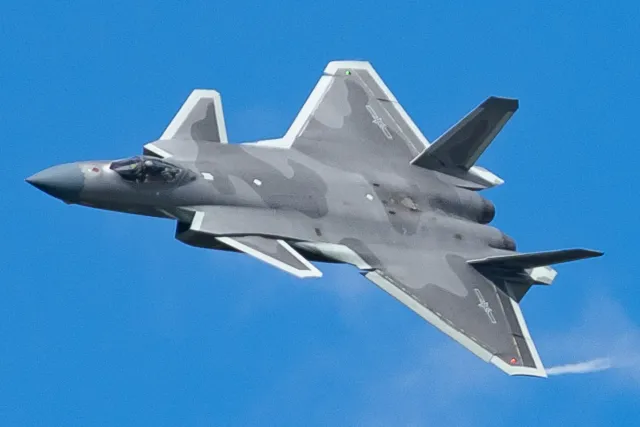
Fighter aircraft
F-35A Lightning II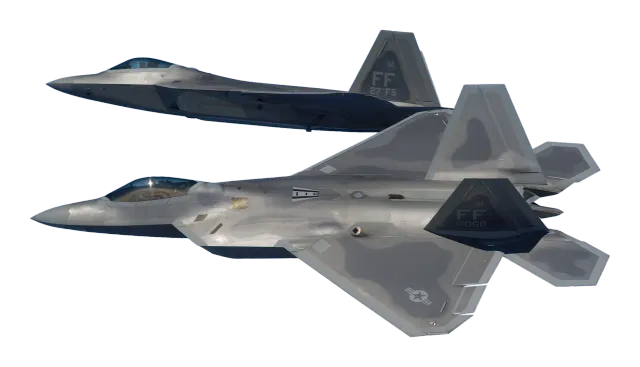
Fighter aircraft
F-22A Raptor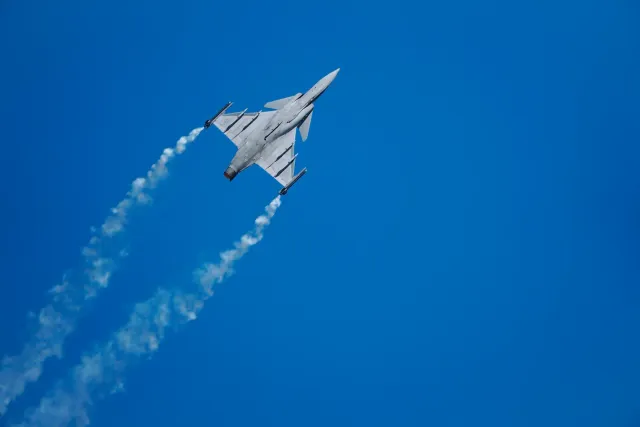
Fighter aircraft
JAS 39E GripenFrequently asked questions
Which fighter jet has the longest combat radius? +
In our analysis of 54 fighters that publish a figure, China's J-20 tops the list at 2,000 km, but that is an open-source estimate with no official Chinese figure behind it. The longest NATO-verifiable combat radius belongs to France's Rafale at 1,850 km on a stated penetration profile.
What is the difference between combat radius and range? +
Combat radius is the distance a jet can fly out to a target and return, on a specified load and mission profile with fuel reserves. Range (or ferry range) is a one-way maximum. Combat radius is always smaller and always depends on the assumed profile, so two figures are only comparable if the profiles match.
Why does the F-22 have a short combat radius? +
The F-22A publishes about 850 km, near the middle-to-bottom of the table, because it is optimized for supercruise and stealth air superiority rather than reach, and internal-only weapons carriage plus a fuel-hungry profile trade range for signature. Unlike the top Chinese and Russian claims, that figure traces to official US sources.
Are Chinese and Russian combat radius figures reliable? +
Treat them as manufacturer or state claims. No independent NATO source has confirmed the J-20's 2,000 km, the Su-35S's 1,600 km, or the Su-57's 1,500 km, and the assumed load and mission profile behind each is not disclosed.
Does a longer combat radius make a fighter better? +
No. A longer published radius reflects mission design and tanker dependency, not overall capability. A strike-optimized omnirole jet like the Rafale is built for reach, while an interceptor like the F-22 is built for speed and stealth. The right question is what reach a given mission needs and how many tankers back it up.
Related reading


