Amphibious Assault Ships Ranked by Aircraft Capacity
Spain's Juan Carlos I and China's Type 075 both carry up to 30 aircraft, more than the larger US America-class amphibious assault ship.

Via Wikipedia, Spanish ship Juan Carlos I (shown for identification)
By aircraft capacity, the top of this ranking is a tie: Spain’s Juan Carlos I and China’s Type 075 each carry up to 30 aircraft, more than the much larger US America-class, which carries 20. That gap alone is the most useful fact in this ranking, because it shows aircraft capacity doesn’t scale neatly with tonnage. Six amphibious assault ship classes are compared here on a single, comparable metric, aircraft carried, alongside full-load displacement, so the tradeoffs are visible rather than buried in marketing language about each ship’s size or nationality.
Key takeaways:
- Spain’s Juan Carlos I and China’s Type 075 each carry up to 30 aircraft, the most of any ship in this ranking.
- The US America-class displaces nearly 45,000 tonnes full load, the heaviest ship ranked, yet carries only 20 aircraft.
- Juan Carlos I matches Type 075’s 30-aircraft capacity at 27,100 tonnes, about 13,000 tonnes lighter than Type 075’s 40,000-tonne displacement.
- Japan’s Izumo-class carries the fewest aircraft in the ranking at 14, despite displacing 26,000 tonnes.
- Type 075’s 30-aircraft figure is a Chinese state and manufacturer disclosure not yet checked against a long independent operational record.
Which amphibious assault ship carries the most aircraft?
Juan Carlos I and Type 075 share the top spot at 30 aircraft each. America-class comes in third at 20, Mistral-class fourth at 16, Dokdo-class fifth at 15, and Izumo-class sixth at 14. Here’s the full ranking with displacement included, since that’s the number most often assumed to track directly with aircraft count, and it doesn’t.
| Rank | Ship class | Country | Aircraft carried | Full-load displacement |
|---|---|---|---|---|
| 1 | Juan Carlos I | Spain | 30 | 27,100 t |
| 1 | Type 075 | China | 30 | 40,000 t |
| 3 | America-class | United States | 20 | 44,971 t |
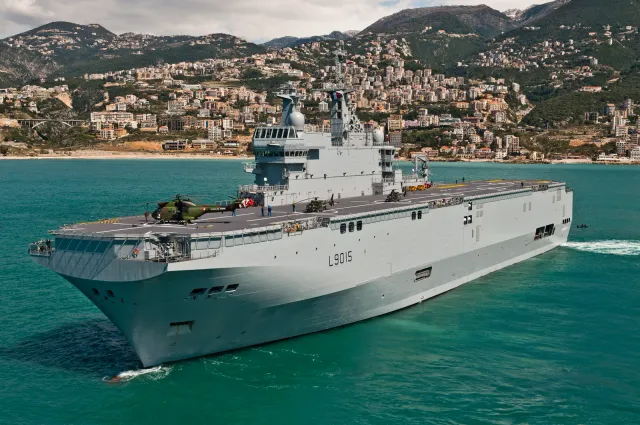
| 4 | Mistral-class | France | 16 | 23,542 t |
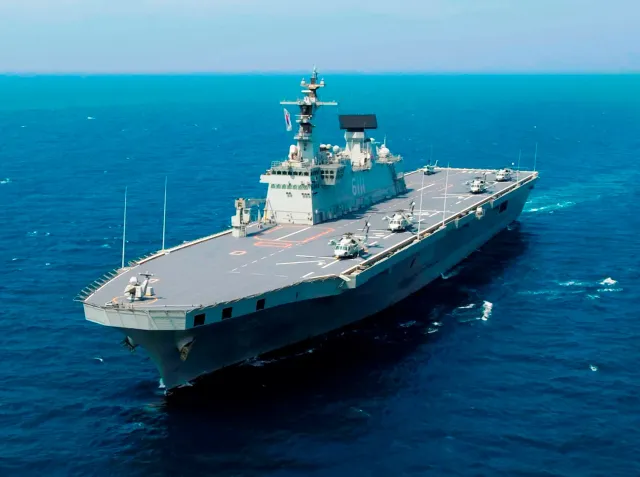
| 5 | Dokdo-class | South Korea | 15 | 19,500 t |
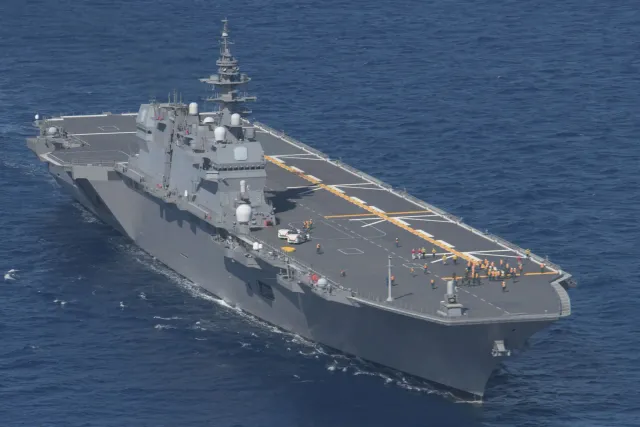
| 6 | Izumo-class | Japan | 14 | 26,000 t |
Juan Carlos I ties for first at 30 aircraft on nearly 18,000 fewer tonnes than the heaviest ship here, America-class, which carries only 20; capacity tracks design, not raw tonnage.
Why doesn’t aircraft capacity scale with displacement?
Because a ship’s tonnage is a budget, not a spec, and different navies spend that budget on different things. Juan Carlos I is the clearest example: at 27,100 tonnes full load, it’s the lightest ship in this ranking by a wide margin, yet it matches the 40,000-tonne Type 075 on aircraft carried, despite being about 13,000 tonnes lighter. That’s a genuinely efficient design, built by Navantia with a flight deck and hangar layout optimized specifically for aircraft throughput, including a secondary role as Spain’s de facto light carrier for its AV-8B Harriers and, prospectively, F-35Bs.
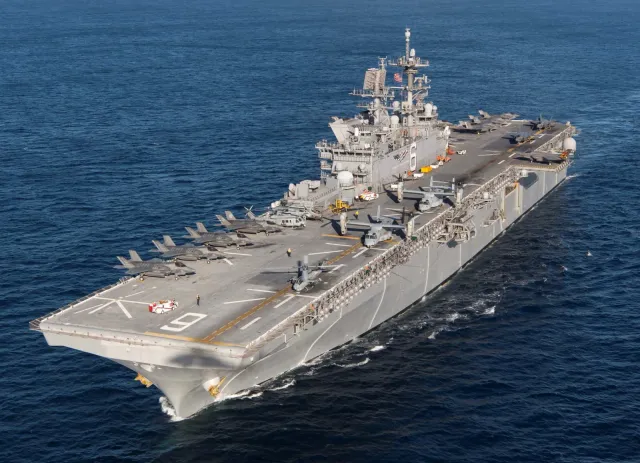
The heaviest ship on the list tells the opposite story. America-class, at 44,971 tonnes full load, is nearly 5,000 tonnes heavier than Type 075 and over 17,000 tonnes heavier than Juan Carlos I, but it carries only 20 aircraft, the fewest among the top three. That’s not a design failure, it’s a different allocation of the same tonnage. The first two America-class ships were built without a well deck at all, trading that space for a larger hangar, more aviation fuel, and expanded munitions storage built around sustaining a heavier F-35B and MV-22 Osprey air wing at a higher tempo over a longer deployment, rather than maximizing the raw number of aircraft parked on deck at any one time. Aircraft count and sustained sortie generation are related but not the same thing, and America-class was built to optimize for the latter.
Why does China’s Type 075 figure need a caveat?
Because it’s a state and manufacturer disclosure, not an independently verified number. Type 075 is the newest class in this ranking by a wide margin, entering service in the early 2020s, and it doesn’t yet carry the decades of open deployment history that Spain’s Juan Carlos I, Japan’s Izumo-class, or South Korea’s Dokdo-class do. Chinese authorities have historically published far less granular detail on warship specifications and operational performance than Western navies or Japan’s Ministry of Defense, and there’s no substitute yet for a public track record against which to check the claimed 30-aircraft figure. That doesn’t mean the number is wrong. It means it should be treated as a claim to watch, not a settled fact, until more deployments and more independent reporting accumulate around the class.
Independent regional analysts read Type 075’s deployments as a deliberate signal, separate from the aircraft-capacity figure itself. Its far-seas patrols are intended to “assert Beijing’s freedom of navigation through these waters, and symbolically to demonstrate its ability to break past the supposed US-led strategic containment within this chain,” said Collin Koh, a senior fellow at the S. Rajaratnam School of International Studies in Singapore, in the South China Morning Post, 20 August 2024.
LHD, LPH, or light carrier: does the label matter?
Less than it looks like it should. Juan Carlos I, Type 075, and Mistral-class are all LHDs (landing helicopter dock), meaning they pair a flight deck with a well deck that floods to launch landing craft, giving them both an air and a sea route to put troops ashore. Dokdo-class is generally described as an LPH (landing platform helicopter), built primarily around vertical-lift aircraft operations with a more limited well deck arrangement than the LHD designs above it. Izumo-class sits furthest from a clean fit: Japan formally classifies it as a “multi-purpose operation destroyer,” a designation rooted in Japan’s post-war constitutional constraints on power-projection carriers, even though the ship now operates F-35Bs and functions, in practice, closer to a light carrier or LHD than to any conventional destroyer. The category labels are useful shorthand, but they’re inconsistent across navies and sometimes shaped by domestic politics rather than pure capability, which is exactly why this ranking leans on one comparable number, aircraft carried, instead of the label each navy prefers to use.
What are these ships actually for?
Amphibious assault ships exist to put a landing force ashore and support it once it’s there, which is why aircraft capacity is a load-bearing number for this category in a way it isn’t for, say, a supercarrier optimized for strike aviation. Helicopters and vertical-lift aircraft move troops and equipment from ship to shore, LHD well decks add a parallel sea-based route via landing craft, and several of these classes, Izumo and Juan Carlos I among them, have grown into secondary light-carrier roles as embarked F-35B numbers increase. Most of these ships also pull regular duty well outside a combat context, disaster relief and humanitarian response chief among them, where the same aircraft and well-deck capacity that supports an assault landing supports moving people, water, and medical teams ashore just as directly.
The bottom line
On a single comparable metric, aircraft carried, Juan Carlos I and Type 075 tie for the top spot at 30, ahead of the larger America-class at 20. That’s the headline finding here, and it’s a useful reminder that displacement is a budget navies spend differently, not a scoreboard. Treat the Type 075 figure as a state disclosure pending more independent scrutiny, and remember that America-class trading aircraft count for fuel, munitions, and tempo isn’t a weakness, it’s a different design answer to a different mission profile. Run your own side-by-side comparison, browse the broader warship category, or let the Advisor tool help weigh these tradeoffs against your specific priorities.
Compare any two of these ships directly in the compare tool, browse the full warship category to see how other amphibious ships and carriers stack up, run your own tradeoffs through the Advisor, or read more rankings like this one on the WeaponSpecs articles page.
Sources
Systems in this comparison
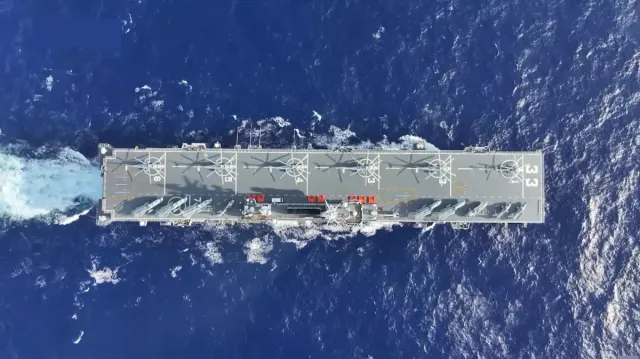
Every system covered above, with its photo and, where available, a video. Tap a card to open the full spec sheet.
Compare these side by side →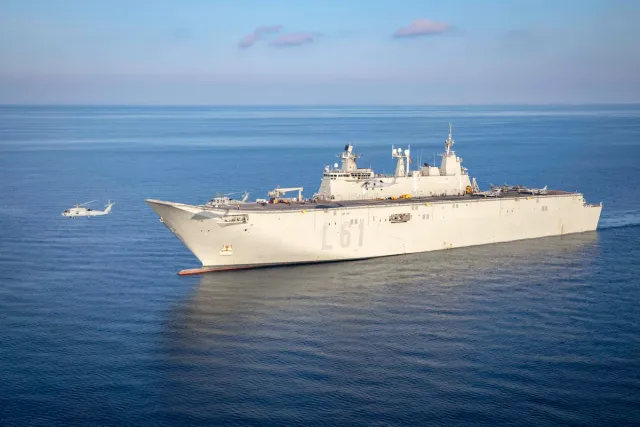
Frequently asked questions
Does a bigger amphibious assault ship always carry more aircraft? +
No. The heaviest ship in this ranking, the US America-class at nearly 45,000 tonnes full load, carries fewer aircraft (20) than either Spain's 27,100-tonne Juan Carlos I or China's 40,000-tonne Type 075 (30 each). Displacement buys internal volume, and a design can spend that volume on hangar space, fuel, munitions storage, or well decks. America-class spends more of it on sustained air-operations tempo and less on raw aircraft parking count.
What's the difference between an LHD, an LPH, and a light carrier? +
An LHD (landing helicopter dock) has a well deck for landing craft in addition to a flight deck, letting it land troops by both sea and air, as with Juan Carlos I, Type 075, and Mistral-class. An LPH (landing platform helicopter), like South Korea's Dokdo-class, is built primarily around helicopter and vertical-lift aircraft operations with a smaller or no well deck. A light carrier, in the loose sense some analysts apply to Japan's Izumo-class, is a flat-deck ship whose air wing leans toward fixed-wing STOVL jets rather than an embarked ground assault force. The category lines blur in practice, which is exactly why this ranking sticks to a single comparable metric instead of a label.
Why should the Type 075's aircraft capacity figure carry a caveat? +
The 30-aircraft figure for Type 075 comes from Chinese state and manufacturer disclosures, not from an independently verified source or a long public operational record. The class entered service only in the early 2020s, and Beijing has historically published far less detail on warship specifications than the US Navy, the Spanish Navy, or Japan's Ministry of Defense. Treat the number as a claim worth tracking against future deployments, not a confirmed baseline.
What are amphibious assault ships actually used for? +
Their core job is projecting an embarked landing force ashore, using a mix of helicopters, vertical-lift jets, and, for LHD designs, landing craft launched from a well deck. That makes aircraft capacity a genuinely load-bearing number for these ships, unlike a supercarrier where aircraft count is one input among many. Beyond amphibious assault, most of these classes also flex into disaster relief, medical evacuation, and, in Japan and Korea's case, roles adjacent to light carrier duty as embarked STOVL fighter numbers grow.
Why is Japan's Izumo-class called a destroyer instead of a carrier? +
Japan classifies the Izumo-class as a "multi-purpose operation destroyer," not a carrier, for constitutional reasons: Japan's post-war constitution has long been interpreted to bar power-projection carriers, so the ship was built and initially operated as a helicopter destroyer before later modifications added F-35B capability. Functionally, it now operates closer to a light carrier or LHD than to any conventional destroyer, but the designation itself is a legal and political artifact worth knowing when comparing it on a purely capability basis.
Related reading


