Documents
 South Korea
 HD Hyundai Heavy Industries
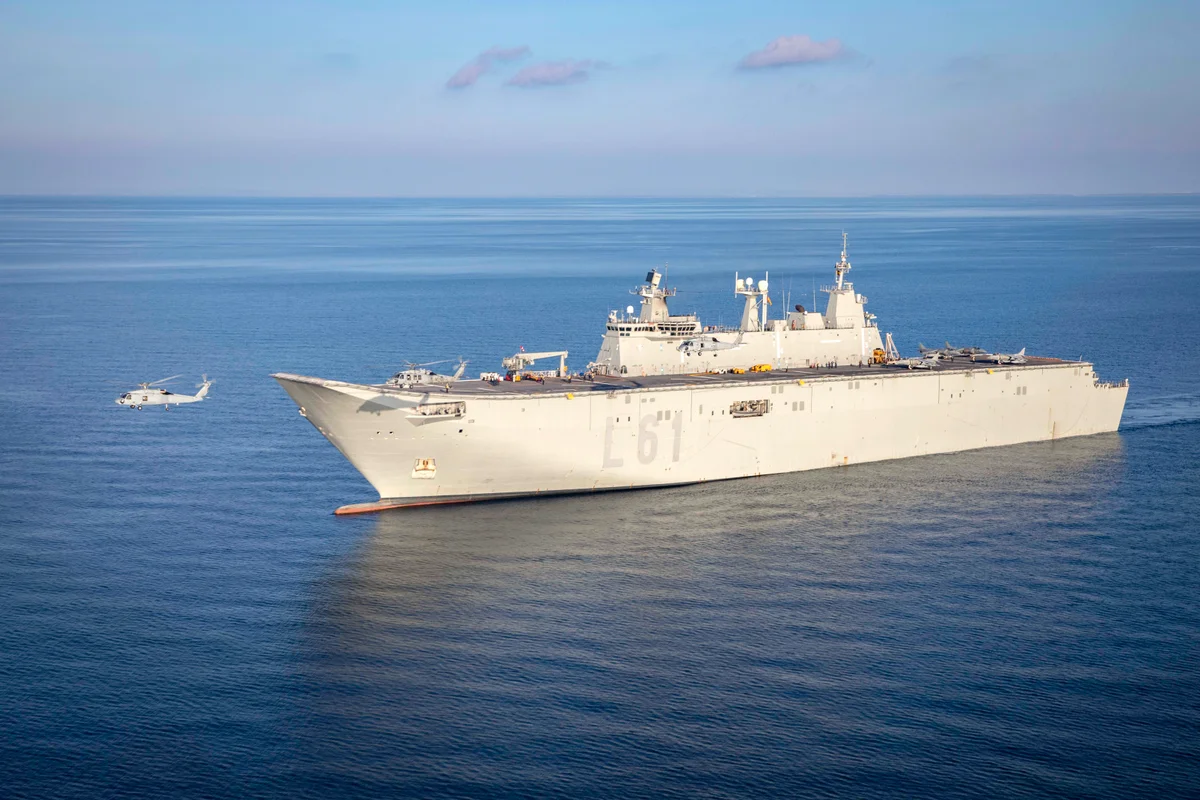
Dokdo-class amphibious assault ship
South Korea's largest amphibious assault ship class, providing the Republic of Korea Navy Marine Corps with a well deck and full-length flight deck able to operate up to 15 helicopters and support VTOL jets. Two ships are in service, with the second-in-class Marado adding K-VLS cells in place of the lead ship's RIM-116 launcher.
In service since 2007
Compiled from public sources ·primary reference ↗ ·last verified 2026-07-02
14,300
t
23
kn
4
VLS
330
crew
💲 ≈ $285,000,000, Well supported: the lead ship's construction cost is documented at KRW 325.77 billion in 2005-era pricing, which converts to almost exactly this figure at contemporary exchange rates. Later hulls and the upgraded Marado may carry different costs due to inflation and added systems.
Procurement snapshot
Availability & export
ROK export-licensed
DAPA-administered; aggressive export posture with financing/offset packages.
Channel: Government-to-government
Fielded & proven
Operator data not public
In service since 2007. Status: active · ~2 built.
Lifecycle cost (est.)
$713M – $998M
Acquisition is only ~30% of lifecycle cost, operating & support dominate over ~35 yrs. Rough 2.5–3.5× the unit price. How we estimate this →
Interoperability
Derived guidance from public data, export regime by country of origin, lifecycle from the GAO ~30% acquisition rule. Verify eligibility, pricing and offsets with the manufacturer and your acquisition authority.
Compatible munitions & weapons
Publicly reported weapons the Dokdo-class amphibious assault ship can carry. Linked items have a full spec page.

Full specifications
Firepower
Armament, payload and guidance.
| Main armament Primary weapon: main gun, cannon or missile type. | Goalkeeper or Phalanx close-in weapon systems |
|---|---|
| VLS cells Vertical-launch missile cells on a warship, a proxy for magazine depth. Higher means more missiles before rearming. | 4 |
Physical
Dimensions, weight and crew.
| Length Overall length including gun/probe where applicable. | 199 m |
|---|
Sensors & avionics
Radar, sensor suite and datalinks.
| Radar Primary radar. AESA (active electronically scanned array) is the current state of the art. | SMART-L air search radar, ELM-2248 multifunction surveillance radar, MW08 surface search radar |
|---|
Program
Cost, production scale and operators.
| Unit cost Approximate flyaway/unit cost where public. Defense pricing varies hugely by contract, offsets and configuration. Lower is cheaper. | $285,000,000 |
|---|---|
| Units built Total production run. Higher means proven manufacturing, mature logistics and spares availability. | 2 |
Specifications compiled from public HD Hyundai Heavy Industries and reference sources ↗. Published defense figures are approximations, treat comparisons as directional. Last verified 2026-07-02.
Compare with rivals
See how it stacks up
 Naval Group Amiral Ronarc'h-class Frigate (FDI)
  Navantia Alvaro de Bazan class (F100)
 Head-to-head comparisons
Dokdo-class amphibious assault ship vs
 Zumwalt-class Destroyer
 Frequently asked questions
What is the main armament of the HD Hyundai Heavy Industries Dokdo-class amphibious assault ship? +
The HD Hyundai Heavy Industries Dokdo-class amphibious assault ship's primary weapon is the Goalkeeper or Phalanx close-in weapon systems.
How much does the HD Hyundai Heavy Industries Dokdo-class amphibious assault ship cost? +
The HD Hyundai Heavy Industries Dokdo-class amphibious assault ship has an approximate unit cost of 285,000,000 USD. Defense pricing varies by contract, offsets and configuration, treat this as directional.
Similar systems
Related coverage