Why the E-2D Was Never Built to Replace the E-3
WeaponSpecs data show the E-2D Hawkeye has the shortest range and shortest endurance of all six AEW&C aircraft in its own database, by a wide margin.

Tomás Del Coro, via Wikimedia Commons, CC BY-SA 2.0 (shown for identification)
WeaponSpecs’ own spec database settles a question the Pentagon’s 2025 replacement plan glossed over: of the six airborne early warning and control (AEW&C) aircraft on record, the Northrop Grumman E-2D Advanced Hawkeye has both the shortest range and the shortest endurance, by a wide margin. When the Pentagon canceled the Boeing E-7 Wedgetail program in June 2025 and proposed leaning on additional E-2Ds to backstop the aging Boeing E-3 Sentry AWACS fleet, it was proposing to cover an 8-hour land-based patrol mission with a 6-hour carrier aircraft built to fold its wings and live on a flight deck. On March 27, 2026, that gap stopped being theoretical: an E-3G Sentry was destroyed in a drone and missile attack at Prince Sultan Air Base, Saudi Arabia.
Why does an AWACS aircraft’s endurance matter more than its range?
An AWACS does not fly to a destination and land. It flies out to an orbit inside its operating area and loiters there, rotating its radar dome and holding a picture of the surrounding airspace until it has to leave. That makes endurance, the number of hours one airframe can stay on that orbit, the spec that determines how many aircraft a wing needs to keep a radar picture up around the clock, not the aircraft’s maximum range.
Think of it as a stakeout rather than a road trip: what matters isn’t how far the car can drive on a full tank, it’s how long it can sit outside the building before someone has to relieve it. A jet with enormous range but short endurance still needs frequent swaps, more airframes, more crews, more vulnerable handoff windows. Range decides how far from home base an orbit can sit; endurance decides how many airplanes it takes to keep that orbit continuously staffed.
Which AEW&C aircraft actually has the longest time on station?
Pulling every AEW&C system in the WeaponSpecs database gives a full picture, and the ranking runs against what most people assume from an aircraft’s size.
| System | Country | Platform basis | Range (km) | Endurance (h) | Max speed (km/h) | Units built |
|---|---|---|---|---|---|---|
| Boeing E-3 Sentry | United States | Boeing 707 airliner | 7,400 | 8 | 853 | 68 (worldwide, historical) |
| Boeing E-7 Wedgetail | United States | Boeing 737 airliner | 6,500 | 10+ (Boeing figure, not yet a WeaponSpecs DB field) | 853 | not disclosed |
| Northrop Grumman E-2D Advanced Hawkeye | United States | Purpose-built, carrier-based | 2,708 | 6 | 648 | not published |
| Shaanxi KJ-2000 | China | Ilyushin Il-76 airframe | 5,500 | 8 | 850 | 5* |
| Shaanxi KJ-500 | China | Shaanxi/Xian Y-9 turboprop | 5,700 | 12 | 550 | 60* |
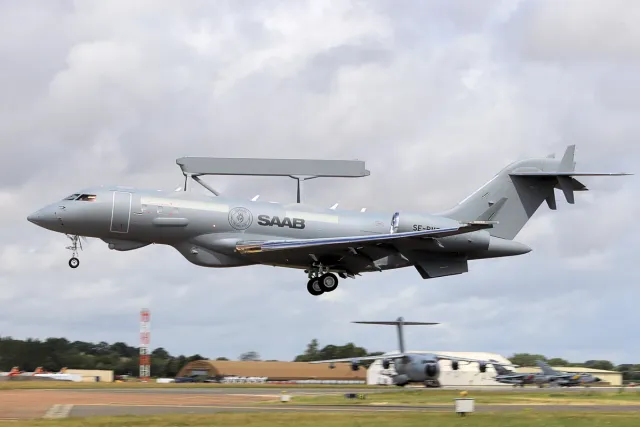
| Saab GlobalEye | Sweden | Bombardier Global 6000/6500 jet | 11,000 | 11 | 1,110 | 5 |
*Chinese manufacturer/state-sourced figures, not independently verified. The E-3’s 68-unit figure is the historical worldwide total across all operators (NATO, France, Saudi Arabia, the UK), a separate number from the US Air Force’s current operational fleet, covered further down.
The E-7 bar (dashed outline) is Boeing's own published "10+ hour" mission-duration figure. It has no WeaponSpecs database field yet, so it's marked separately from the five DB-sourced bars above and below it. Even with that caveat, the E-2D still sits last on the list.
The ranking carries a mechanism, not just an order. The two smallest airframes in the set, Saab’s GlobalEye (a converted Bombardier Global business jet with two turbofans) and the KJ-500 (built on a Y-9 turboprop transport), out-loiter both the much larger four-engine E-3 and the newer E-7. An efficient business-jet or turboprop airframe burning less fuel per hour buys more time on station than raw size does, a big part of why Saab markets GlobalEye against far larger competitors.
Why was the E-2D Hawkeye never a real substitute for the E-3 Sentry?
Swap the numbers side by side and the mismatch is stark. The E-2D’s endurance is 25 percent shorter than the E-3’s, 6 hours against 8. Its range is 63 percent shorter, 2,708 km against 7,400 km. Neither gap is an accident of engineering; it is the direct consequence of what each aircraft was built to do.
The E-2D is a purpose-built carrier aircraft. Its wings fold so it fits a flight-deck elevator, and its mission profile is short sorties launched and recovered from a moving ship close to the fight, per Northrop Grumman’s own published design and Wikipedia’s summary of the E-2 Hawkeye program. The E-3 Sentry, by contrast, is a converted Boeing 707 airliner built to take off from a fixed land base and hold an orbit as long as fuel and crew endurance allow, refueling in the air if needed. Filling an 8-hour land-based patrol gap with a 6-hour carrier jet built for a different launch platform and mission profile was never a like-for-like swap: it meant either flying more E-2Ds to cover the same window or accepting real gaps in the radar picture, and the Pentagon’s June 2025 budget request didn’t spell out which.
What happened to force the issue in March 2026?
The Air Force currently operates 16 E-3 Sentry aircraft, down from 31 a few years prior. The last new-production E-3 was delivered in 1992, and FY2024’s average mission-capable rate was 55.68 percent, meaning roughly half the fleet is flyable on any given day, according to reporting from TWZ.
“We basically have 31 airplanes in hospice care, the most expensive care there is,” said Gen. Mark Kelly, former head of Air Combat Command (TWZ).
Kelly’s line describes the fleet at its earlier 31-aircraft strength, before the further drawdown to today’s 16, but the underlying problem, decades-old airframes and engines past their design life, hasn’t changed. The Pentagon’s June 2025 budget request proposed canceling the E-7 outright, citing cost growth from about $588 million to $724 million per aircraft plus survivability concerns, and planned to lean on space-based ISR and additional E-2Ds instead, per The Defense Post. Congress reversed that cancellation in the FY2026 NDAA before any of this reached a crisis point, prohibiting E-3 retirements below 16 airframes unless enough E-7s are procured to cover the mission, per The Aviationist.
Then, on March 27, 2026, an E-3G Sentry was destroyed in the Prince Sultan attack, reigniting the debate Congress had already settled on paper. Within weeks the Air Force awarded new E-7 contracts totaling roughly $2.3 billion plus $99.3 million for radar-manufacturing sources, pushing total program value past $5 billion, with an Air Force spokesperson saying the aircraft procured “will allow the Air Force to mature the system design, conduct risk reduction, and perform comprehensive test and verification activities in accordance with Congressional intent,” per Breaking Defense. Boeing’s own claimed mission duration for the E-7, “over 10-hour mission duration, longer with aerial refueling” per its product page, has no structured WeaponSpecs field yet, but would beat the E-3 on endurance too if it holds up. The DB’s own $450 million E-7 unit-cost field is flagged as a rough cross-program average, not one confirmed price, a caveat worth pairing with the $588-724 million figure that triggered the 2025 cancellation attempt.
Why does China field two different AEW&C aircraft at once?
China operates the KJ-2000, built on an Ilyushin Il-76 airframe with 5 built, alongside the KJ-500, built on a Shaanxi Y-9 turboprop transport with 60 built, per the WeaponSpecs database. Combined, that’s 65 AEW&C aircraft, more than the US Air Force’s entire current operational E-3 fleet of 16. That needs a second caveat on top of the state-source one: the US also built 68 E-3s historically across every operator worldwide, a different, larger figure than the 16 flying in USAF service today, and the two totals should never be conflated.
Running two types simultaneously lets Beijing split roles: the KJ-2000’s larger Il-76 airframe suits longer-range, higher-payload missions, while the cheaper-to-scale KJ-500 delivers the longest endurance of any AEW&C aircraft in this dataset. As with every Chinese manufacturer and state-linked figure in this piece, unitsBuilt, endurance, and speed for both KJ types are claims rather than independently confirmed data, the same standard this site applies to Russian, Iranian, and North Korean sourced specs.
What this means for buyers and planners
The database’s own numbers make the procurement logic legible without a classified briefing. Endurance, not range, is the spec that buys continuous coverage, and on that spec the E-2D was always the shortest-legged aircraft in the fleet, a role mismatch the 2025 cancellation plan deferred rather than resolved. For the command-and-control side of this same modernization push, see our own coverage of Link 16 interoperability across NATO systems.
Compare the Boeing E-3 Sentry, the Boeing E-7 Wedgetail, the Northrop Grumman E-2D Advanced Hawkeye, the Shaanxi KJ-2000, the Shaanxi KJ-500, and the Saab GlobalEye directly, or run your own coverage-and-fleet math against these six systems in the Advisor.
Sources
- US Air Force's E-7 Wedgetail cancellation reversed
- Major Deployment Of Rickety E-3 Sentry Fleet For Iran Crisis Highlights Worrisome Gaps
- Pentagon's Mindset On E-7 Radar Aircraft It Tried To Axe Has Completely Changed: Hegseth
- E-3 AWACS loss in Saudi Arabia reignites E-7 Wedgetail debate
- Following Congressional Rebuke, Air Force Awards E-7 Contracts
- Boeing E-7 Wedgetail product page
- Saab GlobalEye product page
- Northrop Grumman E-2 Hawkeye, Wikipedia
- Shaanxi KJ-2000, Wikipedia
- Shaanxi KJ-500, Wikipedia
Systems in this comparison
Every system covered above, with its photo and, where available, a video. Tap a card to open the full spec sheet.
Compare these side by side →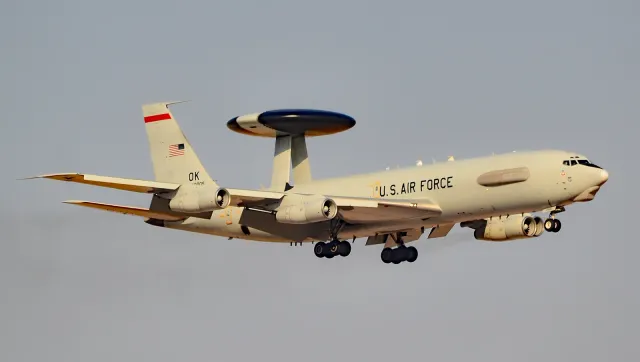
Other
E-3 Sentry (AWACS)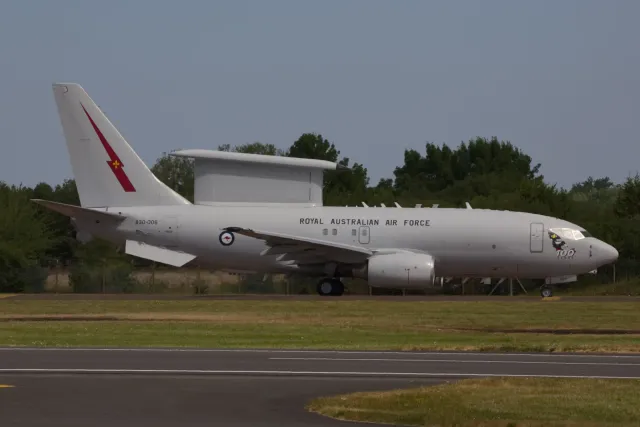
Other
E-7 Wedgetail
Other
E-2D Advanced Hawkeye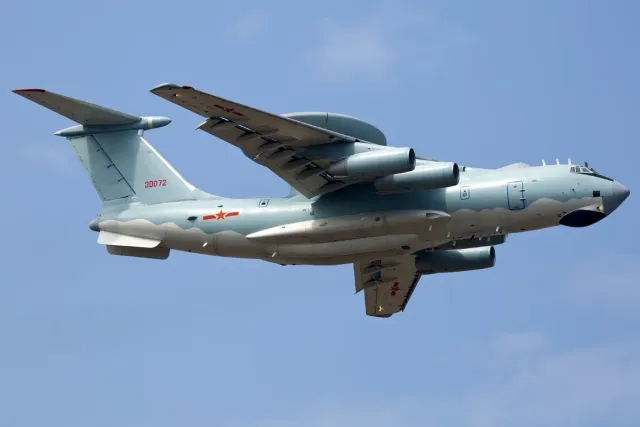
Other
KJ-2000 (Mainring)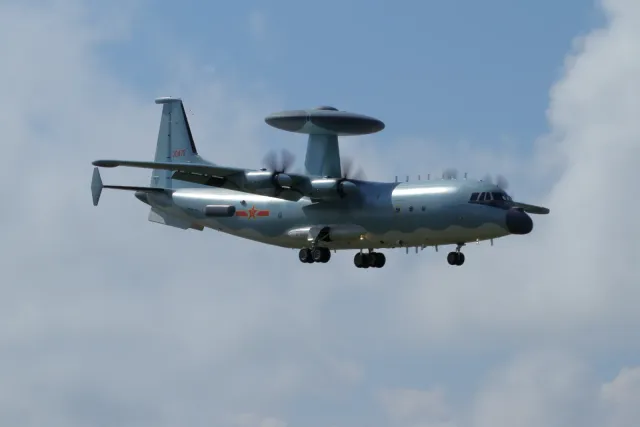
Other
GlobalEye AEW&CFrequently asked questions
Why does an AWACS aircraft's endurance matter more than its range? +
An AWACS orbits inside its operating area rather than flying to a destination, so what limits a radar picture is how long one airframe can stay on station, not how far it can fly in a straight line. Endurance sets how many aircraft a squadron needs to keep one orbit continuously covered; range mostly sets how far from base that orbit can sit.
Was the E-2D Hawkeye ever meant to replace the E-3 Sentry one-for-one? +
No. The E-2D is a carrier-based aircraft designed to fold its wings and fit a flight deck elevator, with a 6-hour endurance and 2,708 km range built around short carrier sorties. The E-3 Sentry it was proposed to backstop has an 8-hour endurance and 7,400 km range built around long, land-based patrols. The two aircraft were engineered for different missions.
What happened to the Boeing E-7 Wedgetail program? +
The Pentagon proposed canceling the E-7 in its FY2026 budget request in June 2025, citing cost growth from about $588 million to $724 million per aircraft and survivability concerns. Congress reversed the cancellation in the FY2026 NDAA, and the Air Force awarded new E-7 development contracts worth over $2.3 billion in March 2026.
How many E-3 Sentry aircraft does the US Air Force operate today? +
The Air Force currently operates 16 E-3 Sentry aircraft, down from 31 a few years earlier, with a reported FY2024 average mission-capable rate of 55.68 percent. That 16-aircraft figure is separate from the 68 E-3s built historically worldwide across all operators, which includes NATO, French, Saudi, and UK airframes built since the 1970s.
Why does China operate two different AEW&C aircraft types at once? +
China fields the KJ-2000 (built on an Ilyushin Il-76 airframe, 5 built per the WeaponSpecs database) alongside the KJ-500 (built on a Shaanxi Y-9 turboprop, 60 built). Combined, that is 65 aircraft, more than the US Air Force's entire current operational E-3 fleet of 16. These figures are Chinese manufacturer and state-linked sources and have not been independently verified.
Related reading


