Which Military C2 Systems Actually Speak Link 16?
13 of 17 command-and-control systems in our database publish support for NATO's Link 16 data link. Anduril's Lattice is a notable exception.
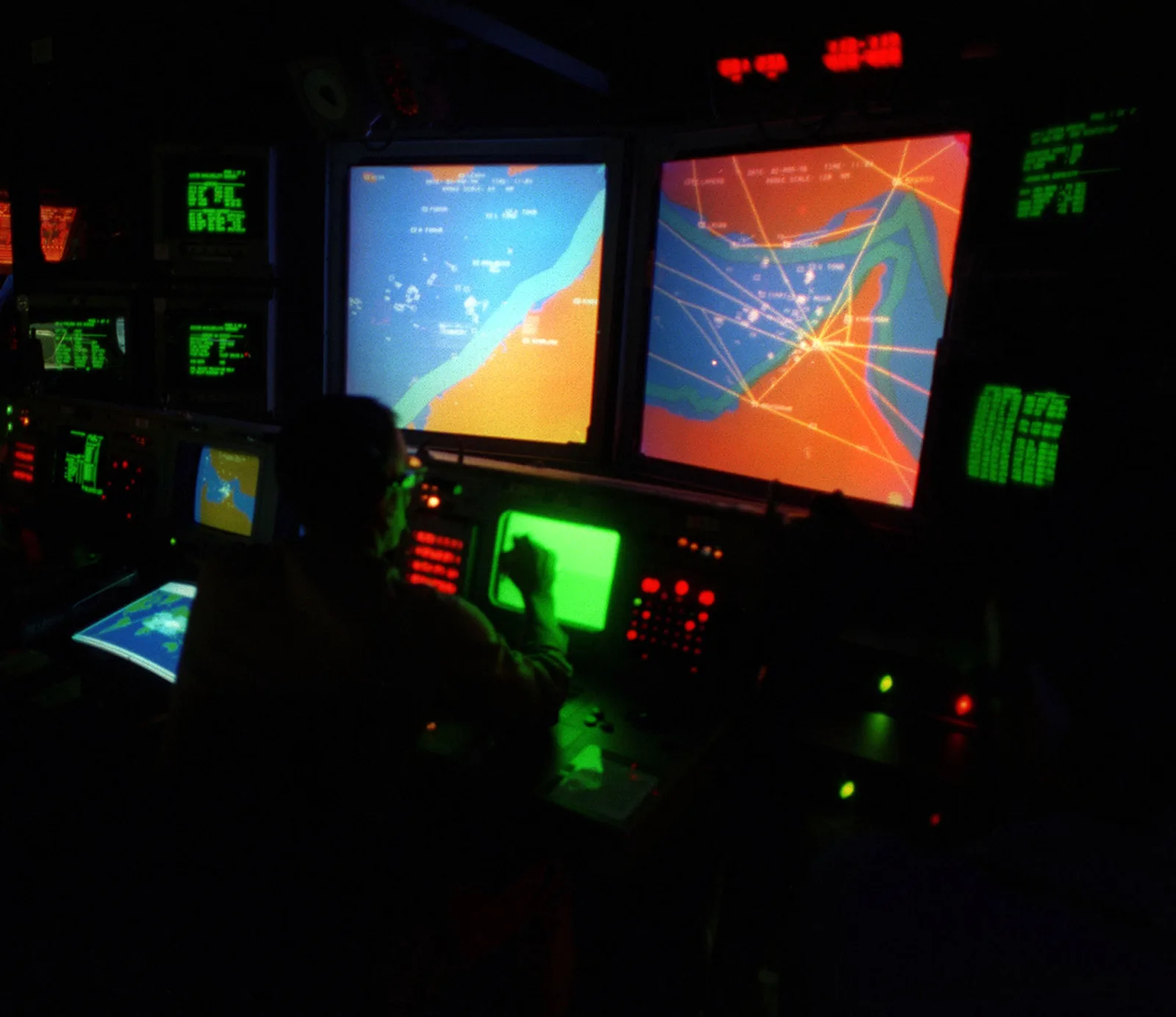
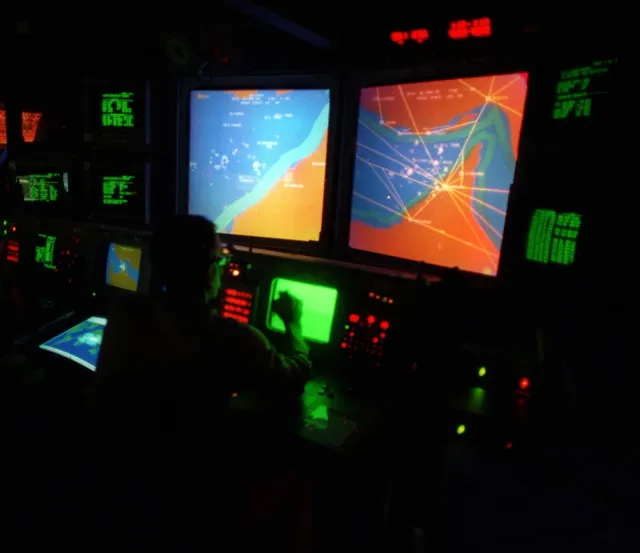
PH2 Gloria Barry, U.S. Navy, via Wikimedia Commons, Public Domain (shown for identification)
Thirteen of the 17 command-and-control and battle-management systems in the WeaponSpecs database publish support for Link 16, the NATO-standard tactical data link that lets allied aircraft, ships, and ground units share a common, jam-resistant real-time picture. Four do not, and the most notable exception is not a legacy holdout, it is Anduril Lattice, the most talked-about new entrant in U.S. defense software, which runs on a proprietary mesh network instead.
This is the first WeaponSpecs analysis of the “software” system category, our classification for command-and-control, combat-management, and battle-management platforms. Every prior data-driven post out of this column has covered hardware: tanks, missiles, aircraft, ships, small arms. Software has never been the subject, and it should be, because interoperability, not raw feature count, is the procurement question that actually decides whether a C2 system is useful in a coalition fight.
What is Link 16, and why is it the right metric here?
Link 16 is NATO STANAG 5516, a jam-resistant, encrypted tactical data link adopted across NATO air, sea, and land forces to distribute a shared real-time operating picture. It is not the only tactical data link in service, older links like Link 11 still exist, and several national systems run their own networks entirely, but Link 16 is the closest thing the alliance has to a common language. A command-and-control platform is only as useful to a coalition as the number of other systems it can talk to without a bespoke integration effort. For a C2 or battle-management system specifically, whether it speaks Link 16 is a more procurement-relevant question than almost any other spec on its sheet, because it determines whether the system plugs into an existing coalition picture or has to build a bridge to one.
Which systems support Link 16, and which don’t?
Here is every software-category system in our database, its published data link or links, whether Link 16 is among them, and its architecture classification.
| System | Country | Data link(s) published | Link 16? | Architecture |
|---|---|---|---|---|
| Anduril Lattice | United States | Proprietary Anduril mesh networking | No | Proprietary (open APIs for 3rd-party sensors) |
| ASELSAN MERKEZ CMS | Turkey | Link 16, Link 11 | Yes | Proprietary |
| BAE Systems INSYTE CMS | United Kingdom | Link 16, Link 11 | Yes | Proprietary |
| CETC Joint C2 System (ZTNS) | China | PLA tactical data network (claims-based, unverified) | No | Proprietary |
| Elbit TORCH-X | Israel | Link 16 | Yes | Proprietary |
| GCCS-J | United States | Link 16, TADIL, DII | Yes | Standards-based / open |
| Hanwha ATCIS | South Korea | Korean military tactical data network (claims-based, unverified) | No | Proprietary |
| HAVELSAN ADVENT BMS | Turkey | Link 16, MIP | Yes | Proprietary |
| Kongsberg NORCCIS | Norway | Link 16, Link 11 | Yes | Proprietary |
| Leonardo ATHENA CMS | Italy | Link 16, Link 11 | Yes | Standards-based / open |
| Link 16 / MIDS | United States | Link 16 (is the standard itself) | Yes | Standards-based / open (NATO STANAG 5516) |
| Lockheed Aegis Combat System | United States | Link 16, Link 11, Link 4A, CEC | Yes | Aegis Common Source Library (moving to open) |
| Northrop Grumman FAAD C2 | United States | Link 16, EPLRS | Yes | Proprietary |
| Rafael Fire Weaver | Israel | Proprietary Rafael networking | No | Proprietary |
| Saab 9LV CMS | Sweden | Link 16, Link 11 | Yes | Standards-based / open |
| SitaWare Headquarters | Denmark | Link 16, NFFI, MIP | Yes | Standards-based / open |
| Thales SYNAPS | France | Link 16, Link 11 | Yes | Standards-based / open |
The four non-Link-16 systems split into two different stories: CETC and Hanwha ATCIS are national systems never built for NATO interoperability, while Anduril Lattice and Rafael Fire Weaver are proprietary mesh networks built as an alternative to legacy data links, a design choice rather than a gap.
Why does the most-discussed U.S. system sit outside the Link 16 club?
Every other U.S. system in the database, GCCS-J, the Lockheed Aegis Combat System, Northrop Grumman’s FAAD C2, and Link 16 itself, publishes Link 16 support. Anduril Lattice is the outlier. According to Anduril’s own product description, Lattice runs on a proprietary mesh networking architecture with open APIs designed to integrate third-party sensors and autonomous systems, not on legacy tactical data links.
That is a deliberate architectural bet, not an oversight. Anduril has built its identity around software-defined, AI-native systems that it argues outperform data links designed decades ago. The company is not claiming Lattice failed to include Link 16, it is claiming its mesh approach is the better path forward. That claim may well be correct on its own terms. But it does not resolve the procurement question a coalition planner actually has to answer: how does a Lattice-equipped unit share a picture with the 13 other systems in this dataset, and with every allied Link-16 aircraft, ship, and ground station already fielded, if it isn’t speaking the same protocol? Anduril has publicly discussed integration work with existing military networks, but Lattice’s core architecture, as Anduril describes it, is not built around Link 16 the way Aegis or GCCS-J are. Any force adopting Lattice needs a clear answer to that bridging question before treating it as a drop-in coalition asset, not because Lattice is deficient, but because interoperability has to be engineered, not assumed.
Are the Chinese and South Korean systems really outside the standard, or just unverified?
Two systems, CETC’s Joint C2 System (ZTNS) and Hanwha’s ATCIS, report using national tactical data networks instead of Link 16. Treat both descriptions with caution. The CETC system’s tactical data network is described through Chinese state media, not independently verified Western reporting, so it should be read as a state claim, not a confirmed fact. Hanwha’s ATCIS description comes from manufacturer material, and South Korea does not publish military data-link specifics with the same transparency NATO members generally do, so that characterization is likewise not independently verified.
What is not in doubt is the underlying logic: neither system was built to interoperate with NATO forces. CETC’s platform serves the People’s Liberation Army’s own command structure, and ATCIS serves South Korea’s domestic military network. South Korea is a longstanding U.S. treaty ally, but ATCIS is a system built for Korean command relationships, separate from the NATO Link 16 standard, not a failed attempt to join it. Their absence from the Link 16 list is the expected outcome of who they were built for, not a mark against either system.
What about Rafael Fire Weaver, and is it the same story as Anduril?
Rafael Fire Weaver is closer to Anduril’s case than to CETC’s or Hanwha’s. Fire Weaver is a proprietary Rafael sensor-to-shooter networking system, built to connect sensors and shooters directly rather than route through a Link-16-style shared picture. Israel is a non-NATO U.S. security partner with its own extensive bilateral integration arrangements outside the Link 16 framework, so Fire Weaver’s absence from this list reflects a different networking philosophy and a different alliance structure, not a technical failure to meet a standard it was never trying to meet. The common thread with Lattice is that both are purpose-built proprietary mesh systems competing on the argument that their approach beats legacy data links on latency and flexibility, a genuine design difference worth weighing against the interoperability cost, not a spec gap to be dismissed.
Does “speaks Link 16” mean the same thing as “open architecture”?
No, and the two questions get conflated more often than they should. Which data link a system speaks is about interoperability. Whether its software architecture itself is open is a separate question about how easily it can be extended, audited, or integrated by outside vendors. Only six of the 17 systems, GCCS-J, Leonardo ATHENA CMS, Link 16/MIDS itself, Saab 9LV CMS, SitaWare Headquarters, and Thales SYNAPS, are described as standards-based or open architecture. The Lockheed Aegis Combat System sits in a transitional category: its Aegis Common Source Library is explicitly moving toward an open architecture, but the current baseline is not there yet. The other 10 systems in the dataset, including several that support Link 16 without issue, remain proprietary in their software architecture even while speaking the shared data link. A system can support Link 16 and still be a closed, single-vendor platform to integrate anything else into.
The buyer’s takeaway
Thirteen of 17 systems in our database support Link 16, and for a coalition-facing procurement, that is close to a baseline expectation, not a differentiator. The four exceptions are worth understanding individually rather than lumping together: CETC and Hanwha ATCIS are national systems that were never meant to join the NATO standard, so their absence is unsurprising. Anduril Lattice and Rafael Fire Weaver are proprietary mesh networks making a real architectural bet against legacy data links, an approach a buyer should evaluate on its own integration merits, not dismiss for missing a checkbox. Browse the full category in Types: Software, stack any two systems head to head in Compare, or run your own coalition interoperability profile in the Advisor to see how a given C2 platform fits alongside the systems your force already fields.
Systems in this comparison
Every system covered above, with its photo and, where available, a video. Tap a card to open the full spec sheet.
Compare these side by side →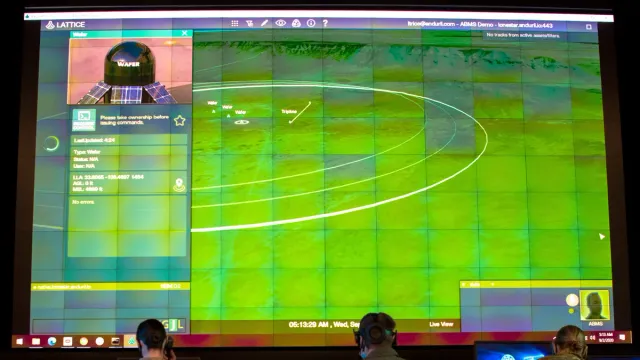
Software & C2
Aegis Combat SystemSoftware & C2
ATHENA Combat Management SystemSoftware & C2
Fire WeaverSoftware & C2
ZTNS / Joint Operations Command Information SystemSoftware & C2
9LV Combat Management SystemFrequently asked questions
What is Link 16 and why does it matter for command-and-control systems? +
Link 16 is the NATO-standard tactical data link (formally NATO STANAG 5516) that lets aircraft, ships, and ground units share a jam-resistant, real-time common operating picture across allied forces. A command-and-control platform that speaks Link 16 can plug into the same battlespace picture as every other Link-16-equipped unit in a coalition, without a custom integration project. One that doesn't has to build a bridge, or operate outside that shared picture entirely.
How many command-and-control systems in the WeaponSpecs database support Link 16? +
13 of the 17 software-category command-and-control and battle-management systems in our database publish Link 16 as a supported data link. Four do not: Anduril Lattice (United States), CETC Joint C2 System / ZTNS (China), Hanwha ATCIS (South Korea), and Rafael Fire Weaver (Israel).
Why doesn't Anduril Lattice use Link 16? +
Anduril built Lattice around its own proprietary mesh networking architecture rather than legacy tactical data links, with open APIs for integrating third-party sensors. That is a deliberate design choice, not an omission: Anduril's pitch is that an AI-native, software-defined mesh outperforms older links. The practical procurement question is different from a capability judgment, though: any force adopting Lattice needs to work out how, or whether, it bridges into a Link-16 picture that 13 of the other 16 systems in this dataset, including every other U.S. system, already share with coalition partners.
Does not supporting Link 16 mean a system is worse? +
No, and the four exceptions break into two different stories. CETC's Joint C2 System and Hanwha's ATCIS are national systems built for national command structures, China's and South Korea's respectively, that were never designed to interoperate with NATO forces in the first place, so their absence from the Link 16 list reflects their intended market, not a technical shortfall. Anduril Lattice and Rafael Fire Weaver are different: both are proprietary sensor-to-shooter mesh networks built as an alternative to legacy data links, a real design bet about how forces should network in the future, not a failure to include a checkbox feature.
Are the CETC and Hanwha ATCIS data-link descriptions verified? +
No. CETC's tactical data network for its Joint C2 System is described through Chinese state media, not independently verified Western reporting, and should be treated as a state claim. Hanwha's ATCIS is described through manufacturer material; South Korea does not publish military data-link details with the same transparency as NATO members, so that characterization is also not independently verified. Both are flagged as claims, not facts, in this analysis.
Related reading