What 'Rate of Fire' Means on an Artillery Spec Sheet
BM-21 Grad publishes the highest rate of fire in our artillery database: 40 rounds a minute. Averaged over its own reload cycle, it's closer to 4.
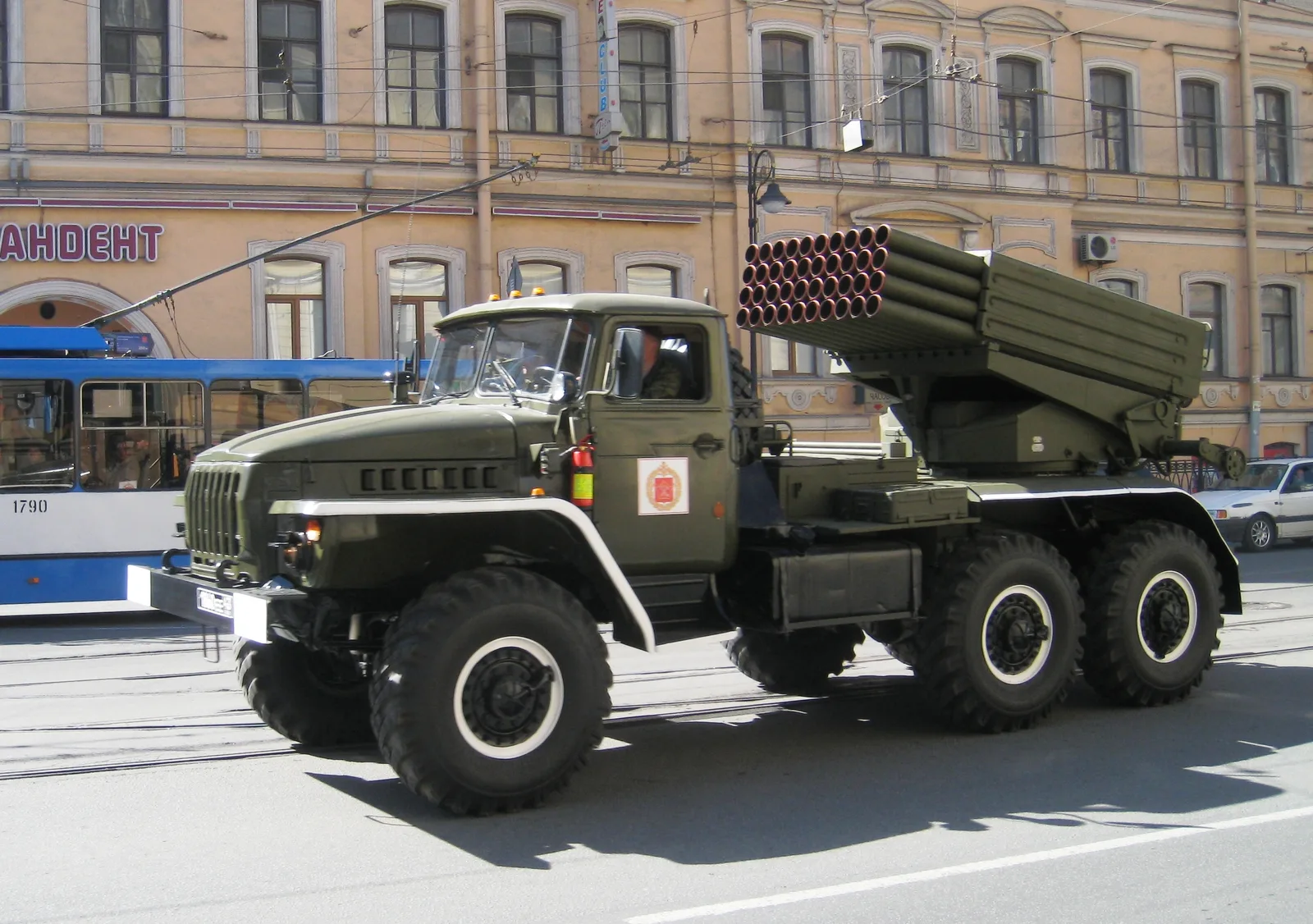
Via Wikipedia, BM-21 Grad (shown for identification)
Russia’s BM-21 Grad publishes the highest rate of fire of any artillery system in the WeaponSpecs database: 40 rounds a minute, the top figure among the 41 of 50 artillery systems that publish this field. But that number describes firing all 40 of its rockets in about 20 seconds, once. Fold in the launcher’s own manufacturer-cited 8-to-10-minute reload cycle and the effective sustained rate works out to roughly 4 rounds a minute, statistically indistinguishable from the US Army’s 4-round-a-minute M109A7 Paladin, a self-propelled howitzer that means its published figure literally, every single minute.
Key takeaways:
- 41 of 50 artillery systems in the WeaponSpecs database publish a
rateOfFireRpmfigure, and it means two different things depending on system type. - The BM-21 Grad’s published 40 rounds/min collapses to roughly 4 once its own 8-to-10-minute reload cycle is counted, converging on the M109A7 Paladin’s genuine, literal 4 rounds/min.
- Averaged across the database, rocket/MLRS systems publish 12.4 rounds/min (range 1-40) versus 6.0 for gun-tube howitzers and mortars (range 1-16), a gap driven entirely by measurement type, not real sustained output.
- The PzH 2000’s published 10 rounds/min is independently corroborated by 1997 test-firing data (army-technology.com), the rare case where a manufacturer figure and real test results nearly match.
- The 2S35 Koalitsiya-SV publishes the highest tube-howitzer rate of fire in the database, 16 rounds/min, but it is a limited-production system and an unverified Russian state claim.
What does “rate of fire” actually mean on an artillery spec sheet?
It depends entirely on what kind of artillery system is publishing the number, and the spec sheet gives no warning that the meaning changes.
For a self-propelled or towed gun-tube howitzer, rate of fire is a reload-cycle rate. A crew loads a shell, fires, loads again, fires again, and the published figure is how many times that cycle repeats in 60 seconds, minute after minute, as long as ammunition keeps arriving. It is a genuine, sustained pace.
For a multi-tube rocket launcher or MLRS, the same field name almost always means something else: the number of launch tubes fired in one near-simultaneous salvo. A 40-tube launcher with a published rate of fire of 40 is not describing a repeatable minute of fire. It is describing its entire onboard magazine emptying in a burst that is over in seconds, followed by a long silence while the crew reloads every tube by hand or with a resupply vehicle.
Both numbers sit in the same database field, performance.rateOfFireRpm, and both get reported the same way in press materials and spec sheets: as “rounds per minute.” Splitting the 41 systems in the WeaponSpecs database that publish this field into 10 rocket/MLRS-type launchers and 31 gun-tube howitzers and mortars shows the effect at scale: rocket systems average 12.4 rounds per minute (range 1-40), while tube systems average 6.0 (range 1-16). The database’s own highest published figure, the BM-21 Grad’s 40, is more than double the highest tube-gun figure, the 2S35 Koalitsiya-SV’s unverified 16. On paper, rocket artillery looks like it fires more than twice as fast as the fastest howitzer. In practice, the comparison is close to meaningless without the reload time attached.
This is not a data-entry error in WeaponSpecs’ database, and it is not unique to this site. It reflects how the underlying manufacturers and militaries define the field for their own system type, because the two families of weapon are built around genuinely different concepts of operation.
How much does the BM-21 Grad’s rate of fire change once its reload cycle is counted?
The BM-21 Grad is the anchor case, and the biggest gap in the dataset. Its 40 launch tubes can empty in as little as 20 seconds, according to Wikipedia’s technical entry on the system, which states “all 40 rockets can be away in as little as 20 seconds.” The Federation of American Scientists’ BM-21 spec sheet cites two figures for the reload that follows: a spec table entry of 10 minutes, and body text stating “the five-man crew can reload the launcher in 8 minutes.”
Using the faster of those two cited figures, a full cycle is 20 seconds of firing plus 480 seconds of reload, 500 seconds total, for 40 rounds. That works out to 40 ÷ 500 seconds × 60 = 4.8 rounds a minute. Using the slower 10-minute figure, the cycle stretches to 620 seconds, for 3.9 rounds a minute. Either way the honest range is roughly 4 to 5 rounds a minute, not 40, and for the single-number comparison below this analysis uses the more conservative lower figure so the point is not overstated.
| System | Type | Published rate of fire | Full-salvo / burst time | Reload time | Effective sustained rate (WeaponSpecs analysis) |
|---|---|---|---|---|---|
| BM-21 Grad | 40-tube rocket launcher | 40 rounds/min | 40 rockets in 20 sec | 8-10 min | ~4 rounds/min |
| 2S35 Koalitsiya-SV | Self-propelled howitzer | 16 rounds/min | n/a | n/a | ~16 rounds/min (unverified claim) |
| BM-30 Smerch | 12-tube rocket launcher | 12 rounds/min | 12 rockets in 38 sec | 20 min | ~0.6 rounds/min |
| Tornado-S | 12-tube guided rocket launcher | 12 rounds/min | ~20 sec (9A52-4 platform) | ~8 min (9A52-4 platform) | ~1.4 rounds/min |
| PzH 2000 | Self-propelled howitzer | 10 rounds/min | 3 rounds in 9 sec (burst) | continuous | ~10 rounds/min (test-verified) |
| Archer | Self-propelled howitzer | 8 rounds/min | n/a | n/a | ~8 rounds/min |
| M109A7 Paladin | Self-propelled howitzer | 4 rounds/min | n/a | n/a | ~4 rounds/min |
The connecting line only appears where the two numbers disagree. BM-21 Grad, BM-30 Smerch, and Tornado-S each publish a headline rate of fire that describes one simultaneous salvo, not a repeatable pace, once each system's own cited reload time is folded in, the sustained rate collapses to a fraction of the published number. PzH 2000, Archer, and M109A7 Paladin have no line because their published figure already is the sustained, repeatable rate.
The published 40 and the calculated ~4 both describe the same physical launcher. Neither is wrong. They are answers to two different questions: “how fast can it empty its magazine” versus “how many rounds can it deliver, minute after minute, over a sustained engagement.”
Do all rocket artillery systems inflate their rate of fire the same way?
The BM-21 Grad is the extreme case because it is a low-cost saturation system built to dump a large number of small unguided rockets on a grid square, not a system optimized for reload speed. Other Russian MLRS platforms in the database show the same pattern, just with different numbers.
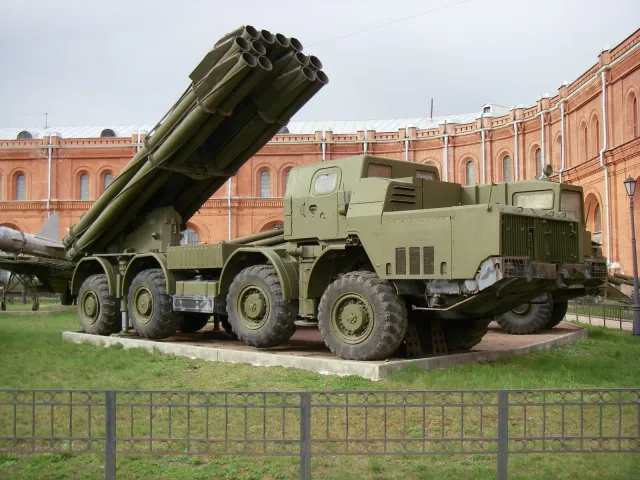
The BM-30 Smerch, a 12-tube 300mm system, publishes 12 rounds per minute. Its own specs table cites 12 rounds fired in 38 seconds, followed by a 20-minute reload. Run through the same math, that is 12 ÷ (38 + 1,200 seconds) × 60, or roughly 0.6 rounds a minute sustained, the widest published-to-effective gap of any system examined here.
Tornado-S, the guided successor built on the same 9A52-4 launch-vehicle platform documented at Wikipedia’s entry on the Tornado family, publishes the same 12 rounds per minute as the Smerch. That page states the platform’s “full salvo can be fired within 20 seconds” and “the 9A52-4 launching vehicle can be reloaded within 8 minutes.” Those figures describe the shared 9A52-4 platform rather than a separately tested Tornado-S cycle, but applying them gives 12 ÷ (20 + 480 seconds) × 60, or roughly 1.4 rounds a minute sustained.
The pattern reverses, interestingly, once guided long-range rocket systems enter the picture. Newer precision MLRS families in the database, including the PHL-16, PULS and TRG-230/TRG-300 series, publish rate-of-fire figures of just 1 to 4 rounds per minute, far below the BM-21 Grad’s saturation-era 40. That is consistent with a design tradeoff: fewer, larger, precision-guided munitions instead of dozens of unguided rockets, since one guided round can substitute for an entire unguided salvo against a point target. WeaponSpecs has not independently verified the exact test methodology behind each of those individual published figures, so this should be read as a plausible pattern in the data, not a confirmed fact about any single system’s testing.
There is a real doctrinal reason rocket artillery is built to burn its magazine and leave, rather than sit and grind through a sustained rate. “This tends to lead to Russian MLRS delivering a complete salvo before manoeuvring to reload. Russian howitzers tend to operate as complete batteries of six guns, delivering a fire mission against a grid square before manoeuvring,” said Jack Watling, Research Fellow for Land Warfare at RUSI, in a November 2019 RUSI Occasional Paper. Rocket launchers are built around shoot-and-scoot survivability against counter-battery fire. Reload speed is not the design priority, getting off the position after firing is.
Why do tube howitzers’ numbers hold up better?
Gun-tube howitzers are built around the opposite priority: staying in position and sustaining fire for as long as a fire mission requires, fed by a continuous resupply chain. That is why their published rate-of-fire figures already describe a genuine, repeatable pace rather than a burst.
The PzH 2000’s own Wikipedia specs table cites “3 rounds in 9 seconds (burst) / 10 rounds per minute,” the manufacturer’s sustained claim. Unusually for a published military spec, that figure has independent backing. Army-technology.com’s account of the system’s 1997 test firings documents real results: 12 rounds in 59.74 seconds (roughly 12 a minute) and 20 rounds in 1 minute 47 seconds (roughly 11.2 a minute across the full burst). Both independently-observed figures sit within a round or two of the manufacturer’s claimed 10, the tightest agreement between a published spec and real test data anywhere in this comparison.
Sweden’s Archer artillery system and the US M109A7 Paladin follow the same logic without needing a reload-time correction at all. Archer publishes 8 rounds per minute, the Paladin 4, both modern autoloader-fed sustained rates, not burst figures. Watling’s paper describes the doctrinal basis for numbers like these: a NATO-style battery sustaining eight rounds per minute per gun for 30 minutes using a magazine or carousel resupply system, “as long as ammunition continues to be moved forward.” That is precisely the design logic behind a howitzer’s published number meaning what it says.
For a broader look at how these same two artillery families differ on the range side of the spec sheet rather than rate of fire, see WeaponSpecs’ earlier coverage of the real range gap between tube howitzers and rocket artillery.
Which artillery system in the database has the highest genuine sustained rate of fire?
By published figure alone, Russia’s 2S35 Koalitsiya-SV leads every tube howitzer in the database at 16 rounds per minute, twice the PzH 2000’s rate. But that figure carries a caveat: the Koalitsiya-SV is a limited-rate-production system, and 16 rounds per minute is an unverified Russian manufacturer and state claim with no independent test data behind it, the same status applied to other Russian-published figures on this site.
The PzH 2000’s 10 rounds per minute is the more defensible number in the database, not because it is higher, but because it is the rare case where a published military spec has been checked against real test-firing results and holds up. For a procurement analyst deciding which number to trust, that gap between “highest claimed” and “most credibly verified” matters more than the raw figure on the page.
Compare rate-of-fire, range, and payload across the full artillery field in the artillery systems database, or run every published figure side by side in the comparison tool. For a broader capability match against a specific threat profile, the Advisor weighs rate of fire alongside range, mobility, and payload rather than any single spec sheet number in isolation.
Sources
Systems in this comparison
Every system covered above, with its photo and, where available, a video. Tap a card to open the full spec sheet.
Compare these side by side →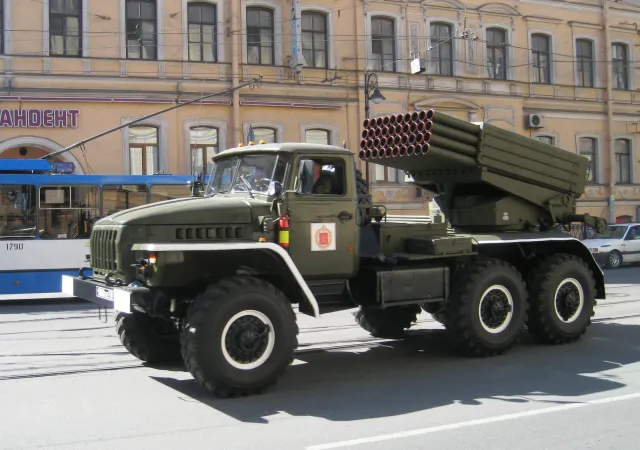
Artillery & MLRS
BM-21 Grad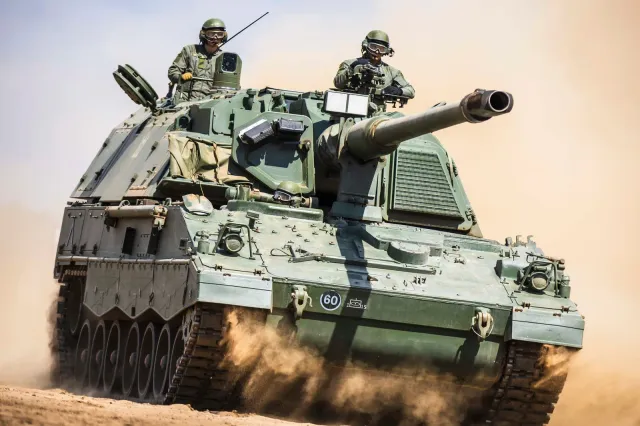
Artillery & MLRS
BM-30 Smerch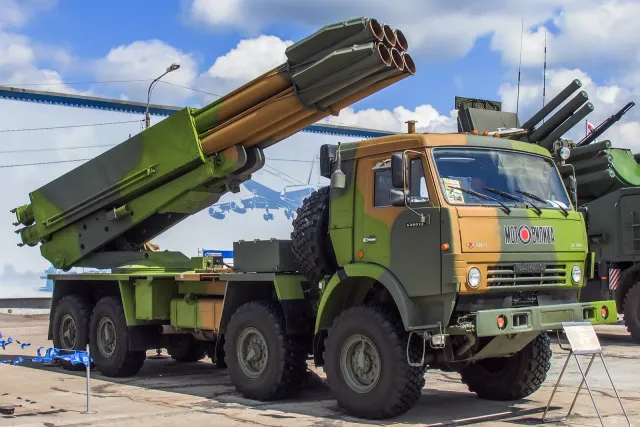
Artillery & MLRS
9A54 Tornado-S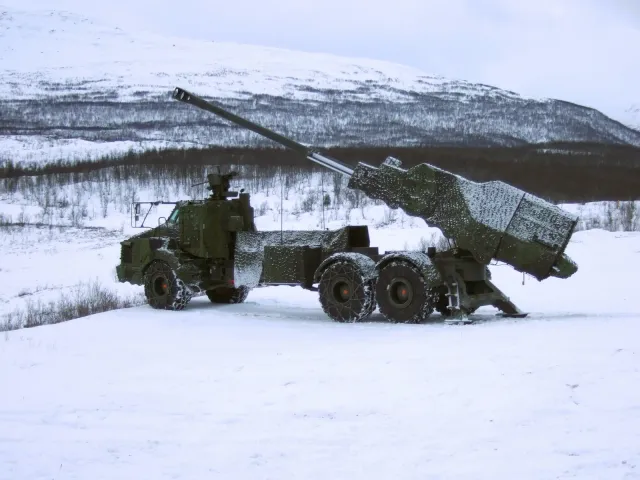
Artillery & MLRS
Archer Artillery System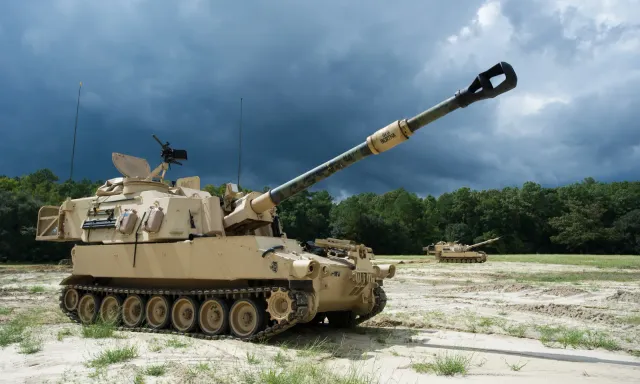
Artillery & MLRS
M109A7 PaladinFrequently asked questions
What does 'rate of fire' mean for a rocket artillery system like the BM-21 Grad? +
It means something close to a burst rate, not a repeatable pace. The BM-21 Grad's published 40 rounds per minute describes all 40 of its launch tubes firing in roughly 20 seconds, one salvo. After that the launcher is empty and its five-man crew needs a manufacturer-cited 8 to 10 minutes to reload before it can fire again. There is no minute in the BM-21 Grad's actual firing cycle where it puts 40 rounds downrange.
How is the 'effective sustained rate of fire' in this analysis calculated? +
It is WeaponSpecs' own calculation, not a manufacturer or state figure: rounds fired in one salvo or burst, divided by the total cycle time (salvo time plus reload time), converted to rounds per minute. For the BM-21 Grad that is 40 rounds divided by roughly 500 to 620 seconds (20 seconds of firing plus 8 to 10 minutes of reload), which works out to about 4 to 5 rounds a minute. This figure appears nowhere on a spec sheet. It exists to make salvo systems and sustained-fire systems comparable on the same basis.
Why do self-propelled howitzers like the PzH 2000 publish rate-of-fire figures that hold up better under scrutiny? +
Because the published number already describes a real, repeatable cycle rather than a single burst. The PzH 2000's manufacturer spec of 10 rounds per minute is a sustained autoloader rate, the gun keeps firing at close to that pace as long as ammunition is available. Independent 1997 test-firing data published by army-technology.com backs that up closely: 12 rounds in 59.74 seconds and 20 rounds in 1 minute 47 seconds, both within a round or two of the claimed figure over a full minute.
Is Russia's 2S35 Koalitsiya-SV really the fastest-firing tube artillery piece in the database? +
It publishes the highest rate of fire of any tube howitzer in the WeaponSpecs database, 16 rounds per minute, twice the PzH 2000's figure. But it is a limited-rate-production system and 16 rounds per minute is an unverified Russian manufacturer and state claim, the same caveat status applied to other Russian-published figures on this site. The PzH 2000's 10 rounds per minute is the more credible number in the database because it has independent test corroboration behind it. The Koalitsiya-SV's does not.
Why do some long-range guided rocket systems publish a much lower rate of fire than the BM-21 Grad? +
Newer guided rocket and MLRS systems in the database, including the PHL-16, PULS and TRG-230/TRG-300 families, publish rate-of-fire figures in the range of 1 to 4 rounds per minute, far below saturation systems like the BM-21 Grad's 40. This is consistent with those systems carrying fewer, larger, precision-guided munitions instead of dozens of small unguided rockets, one guided round can do the job of a whole unguided salvo. WeaponSpecs has not independently confirmed the exact test methodology behind each of those individual published figures, so treat this as a reasonable inference from the database's pattern, not a proven fact about any single system.
Related reading