Warship Top Speed: Why Tonnage Barely Matters
Displacement barely predicts warship top speed: r = -0.089 across 72 WeaponSpecs database ships, and 20 of them, 250 t to 100,000 t, all publish 30 knots.
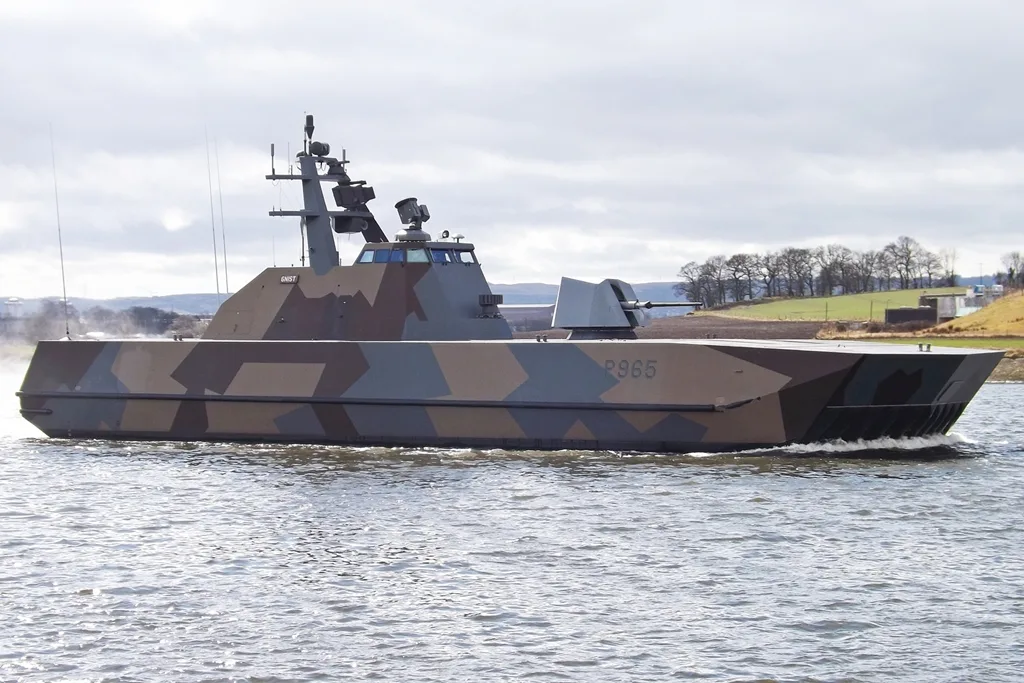
Via Wikipedia, Skjold-class corvette (shown for identification)
Every one of the 72 warships in the WeaponSpecs database that publishes a top speed shows the same pattern: displacement barely predicts it. Run the correlation across all 72 and you get a Pearson r of -0.089, statistically indistinguishable from zero. The clearest proof is a single number 20 different ships share: 30 knots, published by everything from Finland’s 250-ton Hamina-class missile boat to the United States’ 100,000-ton Nimitz and Gerald R. Ford-class supercarriers, a roughly 400-fold spread in tonnage producing an identical headline figure.
Key takeaways:
- Across 72 warships in the WeaponSpecs database, displacement and top speed correlate at r = -0.089, effectively no relationship.
- 20 of those 72 ships (28 percent) publish exactly 30 knots, from the 250-ton Hamina-class to the 100,000-ton Nimitz and 100,000-ton Gerald R. Ford-class.
- Amphibious assault ships form the slowest cluster in the database, 19-23 knots, despite several outweighing the destroyers that hit 30 knots.
- Norway’s Skjold-class corvette publishes the fastest speed in the dataset, 60 knots at just 274 tons, using an air-cushioned Surface Effect Ship hull.
- Mid-size conventional carriers (Charles de Gaulle, Cavour, Vikrant, Queen Elizabeth) all fall short of the 30-knot mark that the two U.S. supercarriers and China’s stated figures for the Fujian and Shandong clear.
Does a warship’s displacement determine its top speed?
Intuitively it should. More tonnage means more hull to push through the water, so bigger should mean slower, or at least the relationship should trend somewhere. Our analysis of all 72 warships in the WeaponSpecs database that publish naval.speedKnots says otherwise: the correlation between displacement in tons and top speed in knots is r = -0.089. In plain terms, that’s close enough to zero that displacement explains almost none of the variation in top speed, and the faint negative sign is not something you can lean on either. Knowing a ship’s tonnage tells you almost nothing about how fast it goes.
That matters because displacement is the easiest number to look up on any warship, and it is doing far less analytical work than most readers assume. The number that actually predicts speed is buried in the propulsion budget, not the displacement column, and the next section shows exactly where that budget gets spent the same way regardless of hull size.
Why do 20 different warships all publish exactly 30 knots?
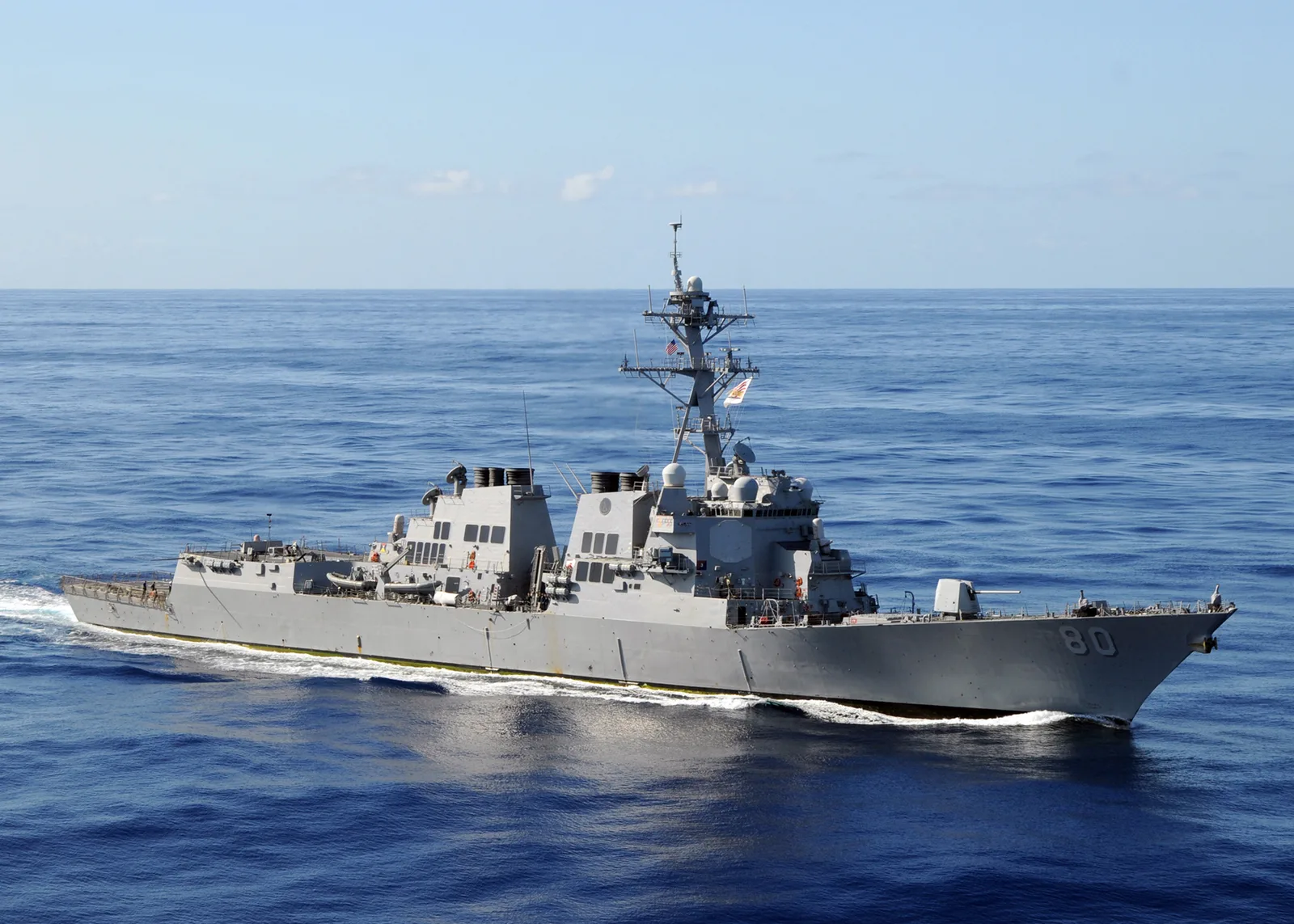
Sort the database by top speed and a flat line appears at 30 knots: 20 ships hold it, more than a quarter of every warship with a published figure. The two ends of that group make the case on their own. The 250-ton 30-knot Hamina-class missile boat, one of the lightest hulls Finland operates, publishes the identical top speed as the 100,000-ton 30-knot Nimitz-class and the 100,000-ton 30-knot Gerald R. Ford-class, the largest warships the United States operates. Between those extremes sit destroyers, frigates, and cruisers of every size: the 9,200-ton Arleigh Burke, Japan’s 8,200-ton Maya-class, South Korea’s 7,650-ton Sejong the Great-class, the Netherlands’ 6,048-ton De Zeven Provincien class, and Taiwan’s 685-ton Tuo Chiang-class corvette, all at exactly 30 knots.
That is not a rounding coincidence, it is a design target. A destroyer’s job is escorting a carrier or a battle group, and a ship that cannot match the formation’s cruising and surge speed cannot do that job regardless of how well-armed it is. The U.S. Congressional Research Service has made the size-versus-role distinction explicit for the smaller end of that fleet:
“FFs, however, are not particularly fast by the standards of U.S. Navy combatants, their maximum sustained speed, for example, is generally lower than that of U.S. Navy aircraft carriers, cruisers, and destroyers.” (Ronald O’Rourke, Specialist in Naval Affairs, Congressional Research Service, CRS Report R44972, May 29, 2019.)
Read alongside the database, that quote flips the usual assumption: frigates built for lower-cost patrol and escort work get a different speed target than destroyers and carriers whose mission depends on sprinting with the formation. Once the mission calls for keeping pace with a carrier, navies converge on the same number whether the hull holds 250 tons or 100,000.
The carrier speed split: nuclear and large hulls clear 30 knots, mid-size carriers don’t
Carriers split cleanly along the same logic, and tonnage again fails to predict which side a given ship lands on. The Nimitz and Gerald R. Ford-class both clear 30 knots on nuclear propulsion, and China’s stated figures put the Type 003 Fujian at 30 knots and the Type 002 Shandong at 31, both unverified state and manufacturer figures. But several mid-size, conventionally-powered carriers fall short: France’s Charles de Gaulle manages 27 knots at 42,500 tons, Italy’s Cavour reaches 29 knots at 27,100 tons, India’s Vikrant sits at 28 knots on a 40,000-ton hull, and the United Kingdom’s Queen Elizabeth-class, at 65,000 tons among the largest non-U.S. carriers afloat, tops out at just 25, slower than the much smaller Cavour. Propulsion choice and power-plant budget decide it, not tonnage, and the full 72-ship table below shows exactly where each carrier lands.
Why are amphibious assault ships the slowest ships in the database?
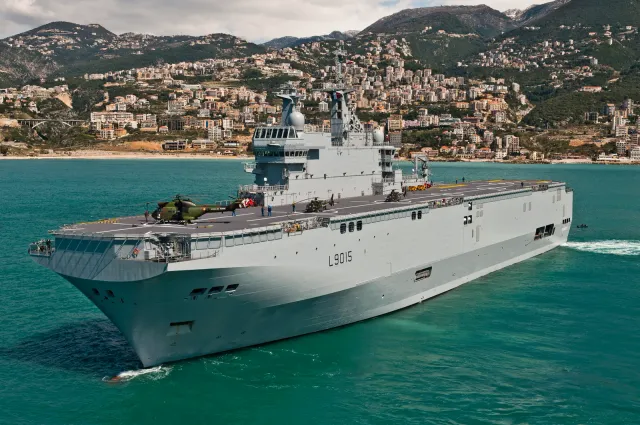
If the 30-knot cluster shows what a warship built to keep pace with a strike group looks like, amphibious assault ships show the opposite deliberate choice. France’s Mistral class tops out at 19 knots on a 21,500-ton hull, Spain’s Juan Carlos I and Turkey’s TCG Anadolu both sit at 21 knots, South Korea’s Dokdo-class and China’s stated figure for the Type 075 land at 23 knots, and the United States’ America-class, at nearly 45,000 tons among the largest ships in this entire dataset, still only reaches 22 knots. Every one of those hulls is bigger than the 9,200-ton Arleigh Burke destroyer publishing 30 knots, yet every one of them is 7 to 11 knots slower.
That gap is not a limitation, the Congressional Research Service’s most recent amphibious-ship report explains it as a direct cost tradeoff:
“The above-listed transit speed of about 14 knots would be less than the approximate 22-knot maximum sustained speed of larger U.S. Navy amphibious ships, but would be a relatively fuel-efficient speed for moving ships through water… which would permit the ship to be equipped with a less powerful and consequently less expensive propulsion plant.” (Ronald O’Rourke, Specialist in Naval Affairs, Congressional Research Service, CRS Report R46374, January 23, 2025.)
The underlying physics is simple: pushing a monohull through water gets disproportionately expensive in fuel above roughly 14-16 knots, because water resistance climbs steeply past that point. A destroyer that must sprint with a carrier group has no choice but to pay that cost. An amphibious ship, which delivers troops on a planned schedule rather than reacting to a moving formation, gains nothing from a pricier power plant built to chase a speed it will rarely use, so navies simply don’t buy one.
What explains the 60-knot outlier?
One hull breaks every pattern above: Norway’s Skjold-class corvette. At just 274 tons, the second-lightest hull in the database, it publishes a top speed of 60 knots, roughly double the fleet’s most common figure and the highest of any warship in the dataset. The mechanism is a Surface Effect Ship (SES) design, an air-cushioned catamaran hull that traps a cushion of air between twin side hulls, paired with waterjets and gas turbines. Instead of plowing through the water like a conventional hull, the ship rides partly on that air cushion, cutting drag enough for a genuinely tiny hull to move genuinely fast.
Here’s the honest caveat this column exists to flag: sources don’t agree on the exact top-end number. Wikipedia lists 60 knots, while naval-technology.com’s own project page states a maximum speed of “more than 100 km/h (55 knots)”. That’s a real discrepancy, worth sitting with rather than picking whichever number sounds more impressive. Both sources agree completely on the mechanism (the SES hull and waterjet propulsion) and the magnitude (roughly double a normal fast corvette’s speed), they diverge only on the last five knots of the headline figure, which is exactly the pattern to expect from an unclassified sprint-speed claim: the engineering logic is solid, the precise top-end number is soft.
For contrast, the second-fastest hull is Sweden’s Visby-class corvette at 35 knots on 640 tons, also a stealth composite-hull design but not an SES hull, a conventional planing hull optimized for radar cross-section rather than an air cushion. Visby proves a fast corvette doesn’t need Skjold’s specific mechanism to beat the 30-knot fleet, just the propulsion budget most navies choose not to spend outside their lightest, most specialized hulls.
The full 72-ship dataset, ranked by top speed
Every warship in the WeaponSpecs database that publishes a top speed, sorted highest to lowest. Countries flagged with an asterisk (*) are state or manufacturer figures for Chinese systems, not independently verified.
| Ship | Top speed (kn) | Displacement (t) | Country |
|---|---|---|---|
| Skjold-class | 60 | 274 | Norway |
| Visby-class | 35 | 640 | Sweden |
| Sa’ar 5 | 33 | 1,075 | Israel |
| Ticonderoga-class Cruiser | 32.5 | 9,800 | United States |
| Kirov-class | 32 | 24,300 | Russia |
| Slava-class | 32 | 9,800 | Russia |
| Thaon di Revel class (PPA) | 32 | 5,500 | Italy |
| Shivalik class | 32 | 4,900 | India |
| Type 002 Shandong | 31 | 66,000 | China* |
| Gerald R. Ford-class Aircraft Carrier | 30 | 100,000 | United States |
| Nimitz-class Aircraft Carrier | 30 | 100,000 | United States |
| Type 003 Fujian | 30 | 80,000 | China* |
| Izumo-class | 30 | 19,500 | Japan |
| Zumwalt-class Destroyer | 30 | 14,564 | United States |
| Type 055 | 30 | 12,000 | China* |
| Arleigh Burke-class Destroyer | 30 | 9,200 | United States |
| Maya-class | 30 | 8,200 | Japan |
| Sejong the Great-class destroyer | 30 | 7,650 | South Korea |
| Type 052D | 30 | 7,500 | China* |
| Visakhapatnam class | 30 | 7,300 | India |
| Kolkata class | 30 | 6,800 | India |
| Iver Huitfeldt-class | 30 | 6,645 | Denmark |
| De Zeven Provincien class | 30 | 6,048 | Netherlands |
| Chungmugong Yi Sun-sin-class destroyer | 30 | 5,500 | South Korea |
| Mogami-class | 30 | 3,900 | Japan |
| Daegu-class frigate | 30 | 3,100 | South Korea |
| Incheon-class Frigate | 30 | 2,500 | South Korea |
| Tuo Chiang-class | 30 | 685 | Taiwan |
| Hamina-class | 30 | 250 | Finland |
| Cavour | 29 | 27,100 | Italy |
| Type 45 Daring | 29 | 8,500 | United Kingdom |
| Horizon class | 29 | 7,050 | France |
| Andrea Doria class (Horizon) | 29 | 6,900 | Italy |
| Sachsen-class | 29 | 5,690 | Germany |
| Admiral Gorshkov-class | 29 | 4,500 | Russia |
| Istif-class | 29 | 3,000 | Turkey |
| Ada-class | 29 | 2,300 | Turkey |
| Alvaro de Bazan class (F100) | 28.5 | 5,800 | Spain |
| Vikrant | 28 | 40,000 | India |
| Nilgiri class | 28 | 6,670 | India |
| FREMM (Aquitaine class) | 28 | 6,000 | France |
| Type 31 Inspiration | 28 | 5,700 | United Kingdom |
| Type 23 Duke | 28 | 4,900 | United Kingdom |
| SIGMA 10514 | 28 | 2,365 | Netherlands |
| Charles de Gaulle | 27 | 42,500 | France |
| Hunter-class | 27 | 8,800 | Australia |
| Bergamini class (FREMM) | 27 | 6,700 | Italy |
| Type 054A | 27 | 4,000 | China* |
| Formidable-class | 27 | 3,200 | Singapore |
| Steregushchiy-class | 27 | 1,800 | Russia |
| F126 | 26 | 10,000 | Germany |
| Constellation-class Frigate | 26 | 7,291 | United States |
| Baden-Wurttemberg-class | 26 | 7,200 | Germany |
| Type 26 City | 26 | 6,900 | United Kingdom |
| Type 31 (Inspiration-class) Frigate | 26 | 6,000 | United Kingdom |
| Miecznik | 26 | 6,000 | Poland |
| Pohjanmaa-class (Squadron 2020) | 26 | 3,900 | Finland |
| Sa’ar 6 | 26 | 1,900 | Israel |
| Braunschweig-class | 26 | 1,840 | Germany |
| Queen Elizabeth-class | 25 | 65,000 | United Kingdom |
| Trieste | 25 | 33,000 | Italy |
| Bonifaz class (F110) | 25 | 6,089 | Spain |
| La Fayette class | 25 | 3,200 | France |
| Absalon-class | 24 | 6,300 | Denmark |
| Type 075 | 23 | 36,000 | China* |
| Dokdo-class amphibious assault ship | 23 | 14,300 | South Korea |
| America-class Amphibious Assault Ship | 22 | 44,971 | United States |
| Arafura-class | 22 | 1,640 | Australia |
| Holland class | 21.5 | 3,750 | Netherlands |
| Juan Carlos I | 21 | 25,000 | Spain |
| TCG Anadolu | 21 | 24,660 | Turkey |
| Mistral class | 19 | 21,500 | France |
This plots 27 representative ships from the full 72-ship dataset (displacement on a log scale, since the range spans roughly 400x). The flat dashed line is the story: 20 ships sit on the exact same 30-knot horizontal regardless of where they fall on the tonnage axis, while the amphibious cluster sits well below that line even though several of those hulls are heavier than the destroyers above it.
The bottom line
Tonnage tells you almost nothing about how fast a warship goes. What predicts it is the mission the ship was built for: keep pace with a carrier group and the database converges on 30 knots regardless of whether the hull is 250 tons or 100,000, accept a fixed transit schedule instead of a strike group’s tempo and the number drops into the high teens and low 20s on purpose, to buy a cheaper propulsion plant. The one hull that breaks the pattern, Skjold, does it by changing what a hull is (an air-cushioned catamaran, not a displacement monohull), not by getting smaller within the same design logic.
If you’re sizing up a warship’s real capability rather than its brochure numbers, don’t stop at displacement or a headline speed figure. Compare full performance profiles for any two ships in the Compare tool, browse the complete warship category to see where a specific class lands against this same 72-ship dataset, or run a mission profile through the Advisor to see which propulsion tradeoffs actually matter for the role you’re evaluating.
Sources
Systems in this comparison
Every system covered above, with its photo and, where available, a video. Tap a card to open the full spec sheet.
Compare these side by side →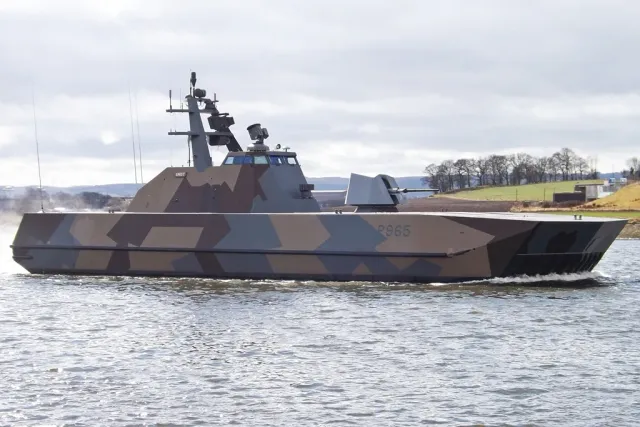
Warship
Skjold-class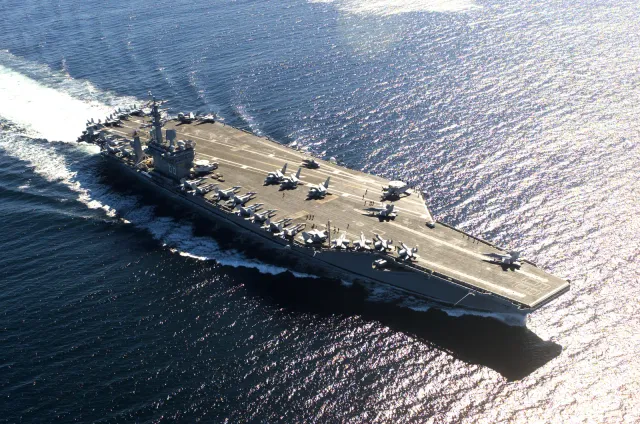
Warship
Nimitz-class Aircraft Carrier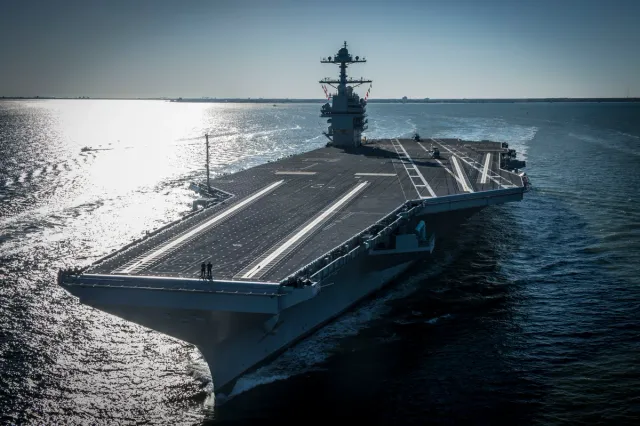
Warship
Mistral class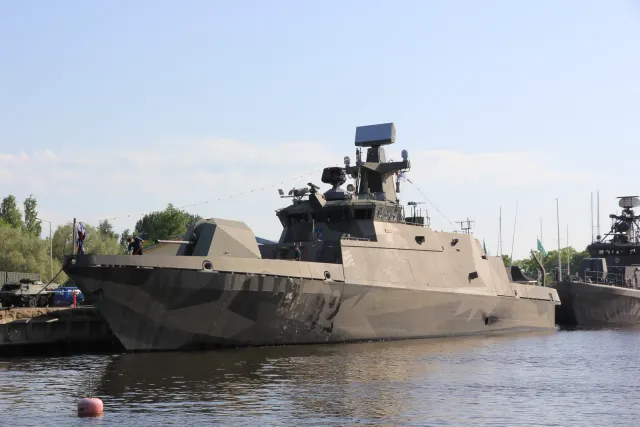
Warship
Hamina-class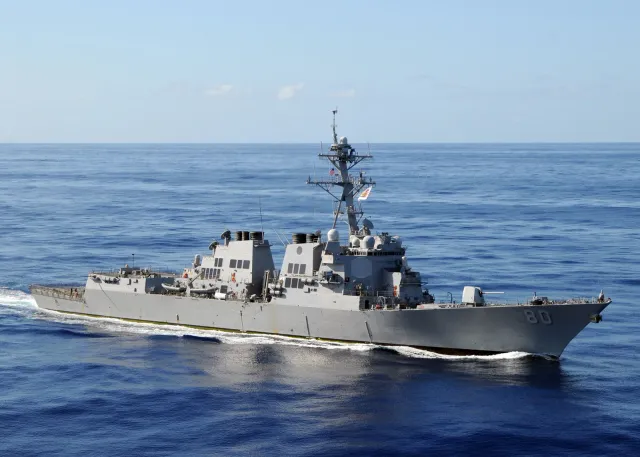
Warship
Arleigh Burke-class DestroyerFrequently asked questions
Does a warship's displacement determine its top speed? +
Barely. Across all 72 warships in the WeaponSpecs database that publish a top speed, the Pearson correlation between displacement and top speed is r = -0.089, statistically indistinguishable from zero. A 250-ton missile boat and a 100,000-ton aircraft carrier both publish 30 knots. Hull size sets a ceiling on what's physically achievable, but within the range navies actually build in, propulsion budget and mission role decide the number, not tonnage.
Why do so many different warships publish exactly 30 knots? +
20 of the 72 warships in the database, 28 percent, publish precisely 30 knots, spanning Finland's 250-ton Hamina-class missile boat to the 100,000-ton Nimitz and Gerald R. Ford-class supercarriers. The common thread is role, not size: 30 knots is the speed a surface combatant needs to keep pace with a carrier strike group or main battle group, not a figure hull physics imposes at a given displacement.
Why are amphibious assault ships slower than destroyers? +
Amphibious ships in the database cluster at 19-23 knots, roughly 7-11 knots under the 30-knot benchmark, despite often being larger than destroyers that hit 30. The U.S. Congressional Research Service has documented the logic directly: fuel consumption for a monohull ship rises steeply above 14-16 knots, so a ship never expected to sprint with a strike group is deliberately built with a smaller, cheaper propulsion plant, trading sprint speed for a fuel-efficient transit speed and a lower unit cost.
What is the fastest warship in the WeaponSpecs database, and why? +
Norway's Skjold-class corvette, at 274 tons the second-lightest hull in the dataset, publishes the highest top speed, roughly double the fleet's most common figure. It uses a Surface Effect Ship (SES) design, an air-cushioned catamaran hull that traps air between twin hulls, paired with waterjets and gas turbines, letting a very light hull plane rather than plow through the water.
Is a published warship top-speed figure fully reliable? +
Treat it as directionally accurate, not exact. Wikipedia lists the Skjold-class at 60 knots, while naval-technology.com's own project page states 'more than 100 km/h (55 knots).' Both sources agree on the mechanism (the SES hull) and the magnitude (roughly double a normal fast corvette), they diverge only on the precise top-end number, which is the pattern to expect from any unclassified sprint-speed claim: the propulsion logic is usually solid, the last knot or two of a headline figure is usually soft.
Related reading