The 10 Best Self-Propelled Howitzers of 2026, Ranked
A 10-to-1 countdown of the best self-propelled howitzers of 2026, ranked on real combat record, precision, survivability and program maturity.

Via Wikipedia, CAESAR self-propelled howitzer (shown for identification)
Ukraine’s 2S22 Bohdana was still a parade prototype when the full-scale invasion began. Design work started in 2016, and Ukraine put it into serial production during the war itself, ramping from roughly 10 units a month in mid-2024 to 40 a month by October 2025, more than 600 built, and over 800,000 rounds fired. By some counts Ukraine had become one of the fastest howitzer producers in the world, while its own factories were under attack. That’s not the best howitzer on this list, but it’s the most remarkable story in a category where artillery, not the tank, has become the decisive land weapon of the current war.
We ranked ten current self-propelled howitzers from 10 down to 1 on four criteria, in this priority order: real combat and operational record (most of these systems are actively documented in Ukraine right now, and we say plainly when one isn’t), precision and range (published maximum firing range with the best available projectile, with every Russian figure flagged as an unverified state claim), survivability and shoot-and-scoot speed (how fast a system displaces after firing, the single biggest survival factor in a drone-and-counter-battery war), and program maturity and logistics. Photos and full spec sheets for every system are in the gallery below the article.
Key takeaways:
- CAESAR, the #1 system, has a reported Ukraine fleet loss rate of only around 10 percent, two to three times lower than comparable howitzers.
- Ukraine’s 2S22 Bohdana scaled from roughly 10 units a month in 2024 to 40 a month by October 2025, with more than 600 built and over 800,000 rounds fired.
- Oryx has visually confirmed roughly 293 Russian 2S19 Msta-S losses across variants, the heaviest documented attrition on this list.
- Poland signed a $2.4 billion contract for 212 K9PL howitzers on 26 August 2022, the largest single procurement referenced in this ranking.
- The last-place 2S35 Koalitsiya-SV claims the longest range on the list at 70 km, an unverified Russian figure from a program with almost no confirmed combat use.
How we ranked them
- Real combat and operational record. A documented battlefield performance beats a better paper spec. We say plainly when a system has never fired in anger.
- Precision and range. Published maximum firing range with the best available projectile, accuracy reputation, guided-round integration. Every Russian figure flagged as an unverified state claim.
- Survivability and shoot-and-scoot. How fast a system displaces after firing, the biggest survival factor in a drone-and-counter-battery war.
- Program maturity and logistics. Whether it’s actually fielded, in what numbers, with what production base and allied sustainment.
10. 2S35 Koalitsiya-SV 

The artillery equivalent of the T-14 Armata: the highest paper numbers on this entire list, wrapped around a troubled, decade-long program that has barely reached the battlefield. State trials didn’t complete until 20 October 2023, years behind the original schedule, and only a small first batch, essentially pre-production vehicles, had been delivered by late 2023, with serial production continuing at low rate through 2025. Confirmed combat use in Ukraine has been sparse, isolated reported firings rather than documented battery-level engagements. Russian sources claim a 152mm gun with an unmanned turret, a 70-kilometer maximum firing range and a 16-round-per-minute rate of fire. All of it is an unverified state claim.
Advantages: a genuinely novel unmanned-turret and autoloader layout with a three-crew capsule; the highest claimed firing range, 70 km, and rate of fire, 16 rounds per minute, on this entire list; designed from the outset around modern automation.
Disadvantages: not fielded at meaningful scale more than a decade into the program; essentially no verified combat record; every headline figure, range, rate of fire and protection, is an unverified Russian state claim.
Like the T-14 tank, the Koalitsiya-SV’s most-documented appearances have been technology showcases and parades rather than the battlefield, while independent analysts have noted the version that finally shipped carries reduced specifications compared with the original promise.
9. Type 99 

A competent, conventional tracked 155mm howitzer with zero combat record, honestly the least battle-relevant Western-aligned system on this list. In JGSDF service since 1999, but Japan hasn’t fought since World War II, so there’s no combat record to weigh. The fleet was built slowly, roughly 6 to 9 units a year, totaling around 117 vehicles, with the last one delivered in 2022; it now serves alongside Japan’s newer wheeled Type 19.
Advantages: a modern 155mm/52 gun and fire control comparable to Western tracked peers; a mature, reliable domestic platform; well integrated into Japan Ground Self-Defense Force counter-battery doctrine.
Disadvantages: never combat-tested; a small fleet built at a trickle and expensive per unit; export-free and domestic-only, so no allied sustainment base or scale.
The closest a Type 99 has come to loss under fire was a non-combat incident: on 1 April 2001, a cargo ship carrying two Type 99s to the United States for testing sank shortly after departure.
8. 2S19 Msta-S

The most heavily used system in the bottom half of this list, and the war has been merciless to it. Russia’s standard 152mm self-propelled gun, in service since 1989, has fought continuously throughout the invasion. Open-source tracker Oryx has visually confirmed roughly 293 losses across variants, about 246 base Msta-S, including 194 destroyed, 14 damaged, 3 abandoned and 35 captured intact, plus 54 of the newer Msta-SM2, likely an undercount. Ukraine has turned captured examples against their former owners, and the gun has a longstanding reputation for accuracy among Soviet-lineage artillery.
Advantages: an accurate, battle-proven design produced in large numbers, roughly 1,000 built, with deep Russian sustainment; genuinely mass-available at scale; captured examples proved usable enough that Ukraine fields them itself.
Disadvantages: a catastrophic documented loss record in Ukraine; the shortest firing range on this list at 29 kilometers on a Soviet-era protection and automation generation; its range and rate-of-fire figures are Russian state numbers.
The Msta-S is one of the few systems on this list captured in real quantity and reissued by the other side. At least 35 taken intact, per Oryx, a blunt measure of how exposed Russian tube artillery has been in this war.
7. K9 Thunder 

No direct combat record, but the single most consequential industrial story in this category: the export and producibility juggernaut of the 2020s. Nine countries have ordered the K9 since 2001, roughly 1,900 built, making it the best-selling self-propelled howitzer in the world. The landmark deal came on 27 July 2022, when Poland signed a 672-unit framework with Hanwha, followed by a $2.4 billion executive contract for 212 K9PL units on 26 August 2022. The first 24 arrived in Poland that December, and the full first batch has since been delivered.
Advantages: the fastest, most proven production and delivery cadence of any howitzer maker, demonstrated at NATO scale by Poland; a strong 54-kilometer reach with automated loading; the widest and fastest-growing export and logistics club of any system on this list.
Disadvantages: never combat-tested in a peer war; not fielded in Ukraine, so no drone-war survivability data of its own; its capability rests on manufacturer and exercise figures rather than battlefield evidence.
Poland’s July and August 2022 orders, signed within months of Russia’s invasion, hundreds of guns with license production stood up on Polish soil, are the clearest single sign of how the war reshaped European artillery procurement, and they went to a system that has never fired a shot in anger.
6. M109A7 Paladin 

The deepest family combat record of any Western howitzer on this list, but be precise about which variant is actually fighting. The M109 lineage has served through Vietnam, the 1991 Gulf War and Iraq. Ukraine received older variants, not the A7: US M109A6 Paladins from 2023, plus Norwegian M109A3GN, Lithuanian and Italian M109A5OE and M109L vehicles, roughly 90 guns in service by early 2024. The M109A7 itself is BAE’s rebuild from 2015 onward, a new chassis sharing components with the Bradley powerpack, and it has no current-war combat record of its own.
Advantages: the deepest, longest-sustained howitzer production and logistics base in the world; the M109 family’s real, multi-war combat record and proven crew workflow; the A7’s new chassis and electronics give decades of growth margin.
Disadvantages: modest paper specs, the lowest rate of fire and shortest range tier on this list at roughly 30 kilometers; the A7 variant itself is unproven in the current war, since older M109s are the ones fighting; tracked and heavy relative to the wheeled shoot-and-scoot leaders above it.
Ukraine fields a mix of at least four national M109 sub-variants from four different donors simultaneously, a testament to how widely the family was exported, and a quiet logistics headache of four slightly different parts chains.
5. PzH 2000 

The most accurate, highest-rate-of-fire tracked gun in Ukraine, held out of the top tier by real, honestly reported maintenance strain. Donated from June 2022, initially 12 guns, 7 German and 5 Dutch, growing to around 22, Ukrainian crews have praised its accuracy past 40 kilometers and its 10-round-per-minute burst rate. The system is designed for roughly 100 rounds a day, but Ukraine reportedly fired up to 300 a day, and at times a third to half the fleet sat in repair. Feared barrel wear proved overstated: inspections found modest wear after 4,000 to 9,000 rounds, and one gun reportedly passed 20,000 rounds. Oryx confirms only about one destroyed and one damaged, a very low combat-loss rate; the real cost was availability, not attrition.
Advantages: best-in-class accuracy and a 10-round-per-minute rate of fire, the highest conventional gun rate on this list; a very low combat-loss rate in Ukraine; Western barrels proved far more durable in practice than early fears suggested.
Disadvantages: intensive use overwhelmed the automated loader and drove very high maintenance downtime; complex and expensive; the heaviest system on this list at 55.3 tonnes, so slower to displace than the wheeled leaders above it.
A single Ukrainian PzH 2000 barrel reportedly firing 20,000 rounds, roughly 200 times its one-intensive-day design assumption, became the headline evidence that Western artillery barrels were tougher in practice than the early wear-out alarm suggested.
4. AHS Krab 

The first foreign howitzer Ukraine received in real numbers, and one of the most extensively documented and effective systems it has fielded. A genuine hybrid design, marrying a South Korean K9 chassis to a British AS-90 Braveheart turret, it arrived among the earliest heavy Western guns delivered in 2022 and was used in the autumn 2022 Kharkiv counteroffensive, firing Excalibur rounds past 50 kilometers. Oryx confirms roughly 36 destroyed and 7 damaged. It’s been widely praised for range, accuracy and mobility, with far lower malfunction rates than Soviet-lineage guns, but roughly half its documented losses came from Lancet loitering munitions exploiting its thin overhead protection.
Advantages: a proven, well-documented combat record as one of Ukraine’s most effective self-propelled guns; dominates Russian analogues on range, accuracy and reliability; a fast burst rate plus good tactical mobility for a tracked gun.
Disadvantages: vulnerable top armor, roughly half its losses came from Lancet drones; a complex hybrid design that’s difficult to repair in the field; tracked and heavy at 48 tonnes, slower to displace than the wheeled top three above it.
The Krab is a genuine multinational mongrel, a Polish gun marrying a South Korean hull to a British turret, that became one of the most respected artillery pieces of the war, proof that an unglamorous parts-bin design can outperform purpose-built rivals when it actually shows up in numbers.
3. Archer 

The survivability and automation benchmark of this list, described in frontline reporting as one of the best guns in the war, held just below the top two only by its late arrival and small numbers. Sweden pledged Archer in January 2023, and 8 were delivered late that year to Ukraine’s 43rd and 45th Artillery Brigades on the open southern front, with deliveries since growing toward roughly 26 of 44 pledged. Its cab loads, aims and fires entirely automatically from behind armor, letting a crew put three rounds on a single target simultaneously and be moving again before the shells land. With guided rounds it reaches 40 to 60 kilometers, and reporting credits it with repeatedly destroying Russian artillery while surviving under pervasive drone coverage.
Advantages: the fastest shoot-and-scoot profile on this list, fully automated, firing and displacing in well under a minute; an excellent 60-kilometer published reach with multiple-rounds-simultaneous-impact fire; low crew exposure from an armored, largely automated cab.
Disadvantages: small numbers in Ukraine and a late-2023 debut, so a shorter combat track record than CAESAR, Krab or PzH 2000; complex automation raises field-repair and spares demands; a small global fleet of roughly 60 built.
An Archer crew can fire a three-shell salvo at a target roughly 40 kilometers away and drive off before all three rounds arrive simultaneously, the automation that made it, in frontline assessments, one of the best-surviving guns in a war where standing still gets artillery killed.
2. 2S22 Bohdana 

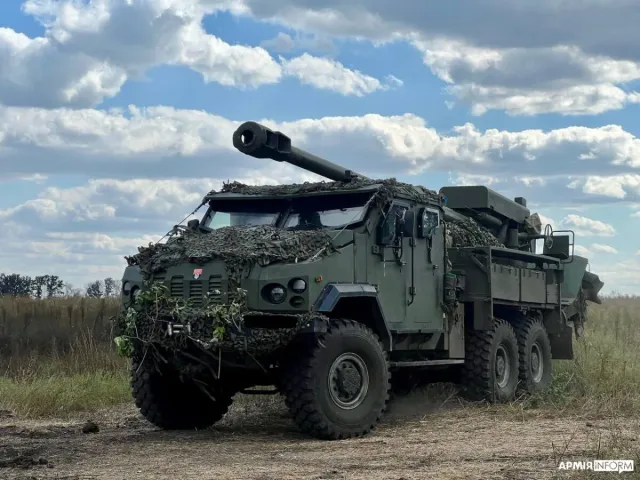
The standout story of this entire list, and now the backbone of Ukrainian artillery, but it sits at 2, not 1, because its balanced, proven maturity is still being written: a single operator with a combat history dating only to 2022. Design work began in 2016, the first prototype appeared at the 2018 Independence Day parade, and it saw its first combat as a prototype in May 2022, followed by the June 2022 shelling of Snake Island. It was officially adopted on 21 July 2023, and serial production stood up during the invasion itself, ramping from roughly 10 units a month in 2024 to 40 a month by October 2025, more than 600 built and over 800,000 rounds fired, at a manufacturer-stated cost of about 2.8 million euros each.
Advantages: a genuine, heavy, current combat record at massive scale; cheap and produced faster than any single donated type, uniquely sustainable for its own operator; wheeled mobility for fast shoot-and-scoot; a sovereign supply chain with no donor politics attached.
Disadvantages: a single operator with a service history only since 2022, so no long-run maturity or export base yet; specs and production figures come largely from the Ukrainian government and manufacturer amid wartime information control; protection is a wheeled truck cab, the same tradeoff CAESAR makes.
Ukraine did what almost no country under invasion has managed: it scaled a brand-new domestic 155mm howitzer from prototype to roughly 40 units a month while the factories themselves were under attack, turning a 2018 parade curiosity into the most-fired gun in its own arsenal by 2025.
1. CAESAR 

CAESAR wins this list on balance and record, the same logic that put the Leopard 2A7 and the Bradley atop our tanks and IFV rankings: the most complete package of proven combat effectiveness, survivability and program maturity. A 155mm/52 gun mounted on a 17.7-tonne wheeled chassis, donated from 2022, Ukraine reported its combat debut on 28 May 2022, crediting a CAESAR battery with destroying two tanks, two BMDs and several trucks using five rounds fired in 55 seconds at a range of 22 kilometers, a claim that remains Ukrainian-sourced and not independently confirmed by other reporting. France and Denmark have since committed 78 guns between them, and Russian troops have reportedly called it a nightmare. Most tellingly, France has reported CAESAR’s loss rate in Ukraine at only around 10 percent of the fleet, two to three times lower than comparable systems, thanks to its 100 km/h road speed and roughly one-minute shoot-and-scoot cycle.
“The lessons learned in three years of combat in Ukraine, where 120 CAESAR are now deployed, give us an outstanding position to offer the United States Army a state-of-the-art weapon which can be integrated on a U.S. tactical truck,” said Olivier Travert, Marketing and Sales Director at KNDS France, October 13, 2025.
Advantages: an extensive, highly successful, well-documented combat record with a notably low loss rate; unmatched strategic and tactical mobility, light enough for air transport, enabling the best shoot-and-scoot survivability of any full-size gun on this list; a mature, widely exported program with deep sustainment across 10 operators.
Disadvantages: minimal crew protection, an unarmored or lightly armored truck cab against tracked, armored rivals; a smaller magazine and no heavy armor for a stand-up fight; relies on guided rounds to reach past its 42-kilometer base range rather than raw tube range alone.
In its reported combat debut on 28 May 2022, a CAESAR battery destroyed multiple armored vehicles with five rounds fired in 55 seconds and relocated before counter-battery fire could answer, a compact demonstration of the shoot-and-scoot doctrine that made a 17-tonne truck-gun one of the most respected artillery systems of the war.
The 2026 ranking at a glance
| Rank | System | Origin | Chassis | Max firing range | Combat record | Combat weight |
|---|---|---|---|---|---|---|
| 1 | CAESAR | France | Wheeled 6x6 | 42 km | Ukraine, 2022- (low losses) | 17.7 t |
| 2 | 2S22 Bohdana | Ukraine | Wheeled 6x6/8x8 | 42 km | Ukraine, 2022- (built in-war) | 28 t |
| 3 | Archer | Sweden | Wheeled 6x6 | 60 km | Ukraine, 2023- | 30 t |
| 4 | AHS Krab | Poland | Tracked | 40 km | Ukraine, 2022- | 48 t |
| 5 | PzH 2000 | Germany | Tracked | 40 km | Ukraine, 2022- | 55.3 t |
| 6 | M109A7 Paladin | United States | Tracked | 30 km | Family: Gulf War, Iraq; older M109 variants in Ukraine | 40.6 t |
| 7 | K9 Thunder | South Korea | Tracked | 54 km | None | 47 t |
| 8 | 2S19 Msta-S | Russia | Tracked | 29 km* | Ukraine, 2022- (heavy losses) | 42 t |
| 9 | Type 99 | Japan | Tracked | 30 km | None | 40 t |
| 10 | 2S35 Koalitsiya-SV | Russia | Tracked | 70 km* | Unconfirmed, minimal | 48 t* |
*Russian state figure, not independently verified.
The #1 and #2 systems, CAESAR and Bohdana, sit mid-pack at 42 km, while the longest published range on this entire list, 70 km, belongs to the last-place 2S35 Koalitsiya-SV, an unverified state figure on a gun that has barely reached the battlefield. Range doesn't decide this list. Combat record does.
The bottom line
No self-propelled howitzer on this list wins on every axis, and the last three years made that trade-off impossible to ignore: artillery has become the decisive land weapon of the Russia-Ukraine war, and combat record now separates these systems more than any range figure does. CAESAR leads because it pairs a proven, low-loss combat record with unmatched shoot-and-scoot mobility, but Bohdana and Archer are close enough behind it that production capacity, budget and existing fleet compatibility should decide a real procurement call, not maximum range alone.
Run any two of these systems head-to-head in the comparison tool, browse the full artillery category on the types page to see towed and rocket systems too, or get a mission-tailored recommendation from the advisor. More rankings and breakdowns like this live on the articles page, including our recent countdowns of the best main battle tanks and best IFVs of 2026.
Sources
- CAESAR self-propelled howitzer, Wikipedia
- Bohdana artillery output hits 40 units monthly as Ukraine scales up defense production, Euromaidan Press
- 2S22 Bohdana, Wikipedia
- 2S19 Msta, Wikipedia
- 2S35 Koalitsiya-SV, Wikipedia
- Leonardo DRS and KNDS Sign Strategic Teaming Agreement to Offer High-Performance Self-Propelled Howitzer to U.S. Army, KNDS Group
Systems in this comparison
Every system covered above, with its photo and, where available, a video. Tap a card to open the full spec sheet.
Compare these side by side →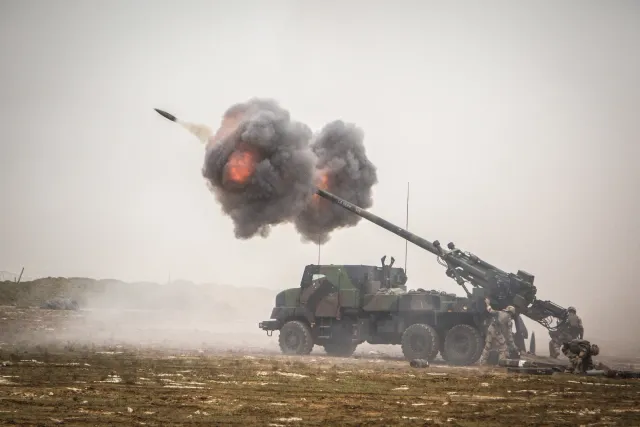
Artillery & MLRS
2S22 Bohdana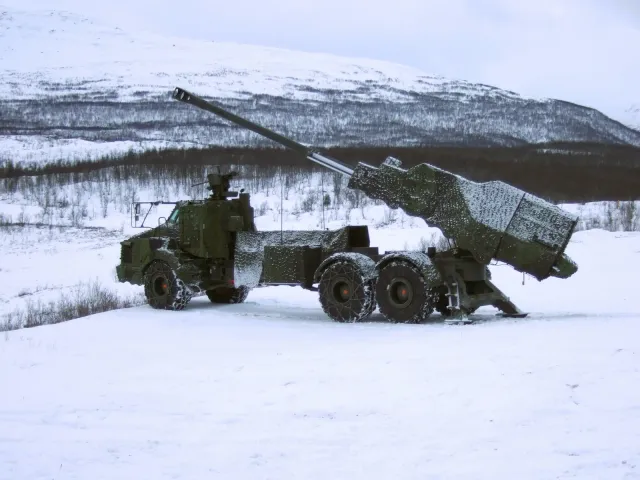
Artillery & MLRS
Archer Artillery System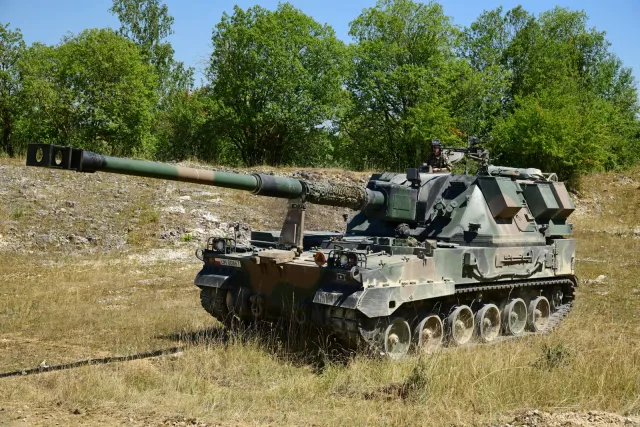
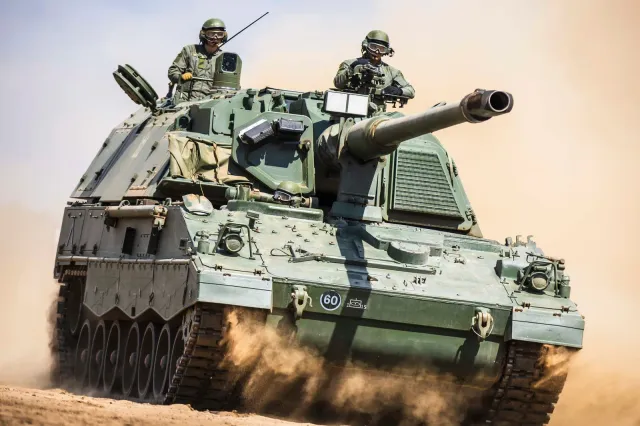
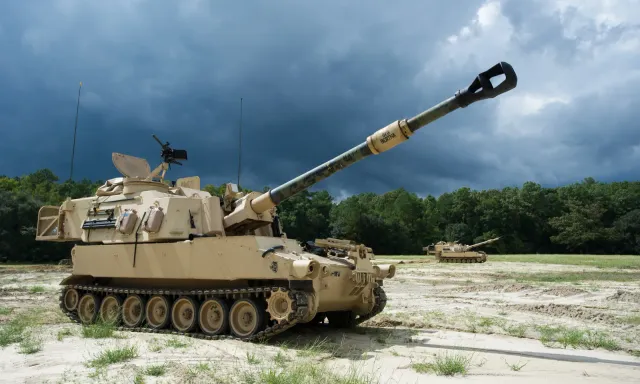
Artillery & MLRS
M109A7 Paladin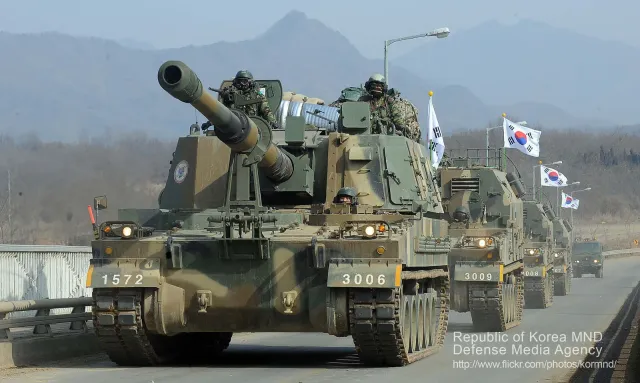
Artillery & MLRS
K9 Thunder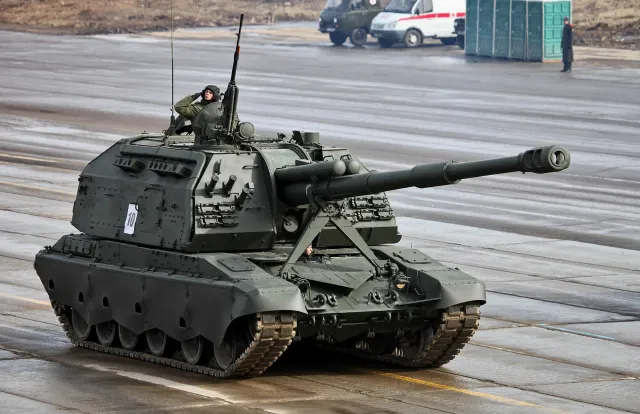
Artillery & MLRS
2S19 Msta-S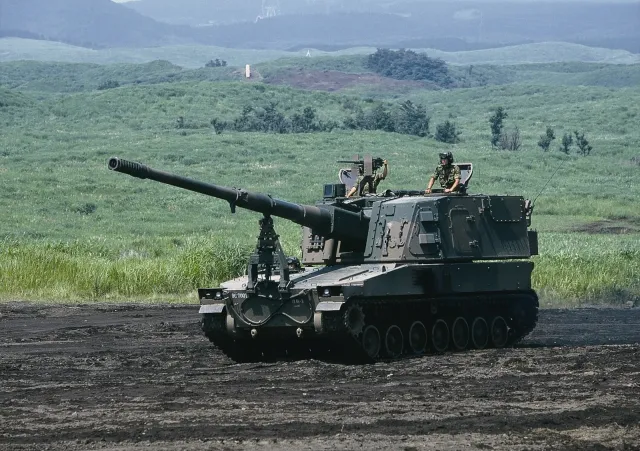
Artillery & MLRS
Type 99 155mm Self-Propelled Howitzer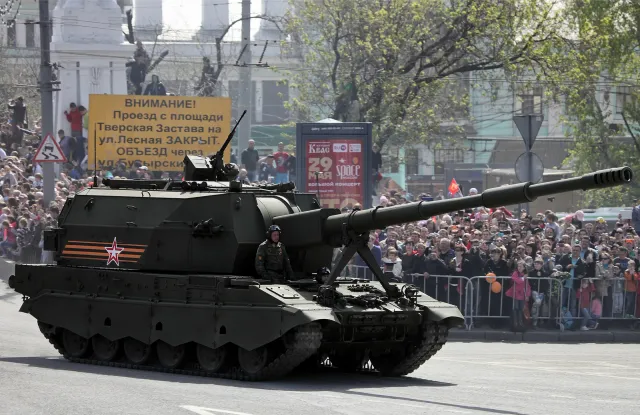
Artillery & MLRS
2S35 Koalitsiya-SVFrequently asked questions
What is the best self-propelled howitzer in 2026? +
CAESAR, on balance: the most complete combination of a proven, low-loss combat record in Ukraine, class-leading shoot-and-scoot mobility, and a mature, widely exported program. Rank isn't universal fit, Bohdana's producibility or the M109 family's sustainment base may matter more to a given army.
Which howitzer has the most remarkable story on this list? +
Ukraine's 2S22 Bohdana. It was designed before the war but pushed into serial production during the invasion itself, and is now built at roughly 40 a month, firing more rounds than any other gun in Ukraine's own arsenal. Standing up domestic heavy-artillery production while under active attack is historically rare.
Is the Russian 2S35 Koalitsiya-SV the best because it has the longest range? +
No. Its 70 km figure is an unverified Russian state claim, and the gun has barely reached the battlefield after more than a decade of delays, much like the T-14 Armata tank. Longest paper range, last-place real record.
Which M109 variant is actually fighting in Ukraine? +
Not the M109A7. Ukraine received older M109A6 Paladins from the US plus M109A3GN, M109A5OE and M109L variants from Norway, Lithuania and Italy, roughly 90 guns in total. The A7 is the newest US Army rebuild and has no current-war combat record of its own.
Why do wheeled truck howitzers like CAESAR rank so high? +
Survivability. In a war where artillery is hunted by drones and counter-battery radar within a minute of firing, a 17.7-tonne truck that shoots and drives off at 100 km/h survives where a slower tracked gun gets caught. Mobility is protection.
Related reading


