The Glide-Bomb Range Race: Russia vs the West
Russia's jet-powered UMPK-PD glide bomb is battlefield-reported at up to 200km, roughly double the West's leading combat-fielded glide munitions.

Via Wikipedia, UMPK (bomb kit) (shown for identification)
A jet-powered Russian glide bomb is now battlefield-reported at up to 200km of standoff range, roughly double the 74km that the US GBU-53/B StormBreaker publishes as a combat-fielded glide munition. That number is not a Russian spec sheet. Russia does not publish UMPK data. It comes from Western open-source defense reporting and Ukrainian official statements, pieced together from wreckage analysis, satellite imagery, and battlefield accounts. Handle it as the current best open-source estimate, not a confirmed figure, and the escalation it describes still matters: the range of Russia’s glide-bomb kits has climbed sharply in three years, and the powered variant now reaches distances no fielded Western glide bomb is reported to match.
How far can Russia’s glide bombs actually reach in 2026?
Start with the baseline. The UMPK (Unifitsirovannyi Modul Planirovaniya i Korrektsii) is a strap-on kit that bolts pop-out wings and a satellite-guidance module onto a plain Soviet-era FAB high-explosive bomb, converting a gravity weapon into a standoff glide bomb. In the WeaponSpecs database the FAB-500 UMPK carries a range of 70km and the heavier FAB-1500 UMPK about 60km, both using GLONASS plus inertial guidance and both in service since 2023. Forbes, in its 2026-07-01 assessment, describes the original kits as covering “60 to 80 kilometers” from release, which lines up with those database figures. Note the caveat up front: these ranges are open-source estimates, since Russia publishes no official UMPK performance data.
The next step up is aerodynamic. Forbes reports that upgraded versions now reach “up to 95 km”, a gain attributed to refined wing kits and higher, faster release profiles rather than any new propulsion. That is still an open-source reported figure, not a tested spec.
Then comes the jump that changes the category. The War Zone reports a powered variant, identified in reporting as the UMPK-PD, reaching “up to 124 miles (200 km)”, roughly double the unpowered baseline. It was combat-tested in September and October 2025 and is reportedly entering series production, with Ukrainian officials reporting strikes at 100-150km against Kharkiv and Sumy-area targets in late 2025. FDD’s Long War Journal, in October 2025, corroborated the broader range-extension trend. None of this is a Russian claim. It is Western reporting and Ukrainian statements, and the 200km figure should be read as battlefield-reported, not flight-tested.
What’s actually driving the range increase?
Two different mechanisms, and it is worth keeping them separate. The move from roughly 70km to roughly 95km is aerodynamic and procedural: better glide kits, higher release altitude, faster release speed. More energy at launch, more distance in the glide. No engine involved.
The move to a reported 200km is propulsion. According to The War Zone, open-source analysts identify the UMPK-PD’s powerplant as a Chinese-made Swiwin SW800Pro-Y turbojet, a small commercial-class engine that stops the weapon from bleeding energy the moment it separates from the aircraft. That is the qualitative shift: an unpowered bomb trades altitude for distance and runs out of both, while a powered one sustains its flight.
Here the sourcing distinction matters more than usual. The site’s standard caveat on Russian and Chinese systems is “manufacturer or state claim, not independently verified.” That is not what this is. Russia issues no claim at all. The 95km and 200km figures, and the Swiwin engine identification, come from Western open-source defense journalism reconstructing the picture from recovered wreckage, imagery, and Ukrainian official reporting. That chain is materially different from a state marketing number, and generally more credible, because no one in it has an incentive to inflate. But it is still not an independently instrumented flight test. Call it battlefield-reported, and treat 200km as the best current open-source estimate rather than a settled specification.
The numbers, side by side
| System | Type | Reported range | Guidance | Status | Source / caveat |
|---|---|---|---|---|---|
| FAB-500 UMPK (2023 baseline) | Unpowered glide kit | ~70km | GLONASS + inertial | In service since 2023 | WeaponSpecs DB; open-source estimate, no Russian spec |
| UMPK upgraded (2025-26) | Unpowered glide kit | ~95km | GLONASS + inertial | Fielded | Forbes / TWZ battlefield reporting |
| UMPK-PD (powered) | Jet-powered glide bomb | up to ~200km | GLONASS + inertial | Combat-tested Sept/Oct 2025, reportedly entering series production | TWZ; battlefield-reported, not flight-tested |
| GBU-53/B StormBreaker | Network-enabled glide munition | 74km | GPS/INS + tri-mode terminal seeker | US, combat-fielded | WeaponSpecs DB (Raytheon) |
| SPICE 2000 | Guided glide bomb | 100km | Electro-optical + GPS/INS | Israel, combat-tested | WeaponSpecs DB (Rafael) |
The single asterisked bar, UMPK-PD's roughly 200 km, is the only figure here that's battlefield-reported rather than flight-tested or manufacturer-published, yet it already dwarfs both fielded Western glide munitions beside it.
The asterisk on UMPK-PD is doing real work: that ~200km figure is battlefield-reported by the Western open-source defense press, not a published Russian specification and not an independently instrumented flight test. Read it as the leading open-source estimate, and read the Western entries beside it as manufacturer-published, combat-fielded numbers, a different and firmer class of data.
How does this compare to what the West actually fields?
Two systems in the WeaponSpecs database define the fielded Western and Israeli glide-bomb envelope. The GBU-53/B StormBreaker is a US network-enabled glide munition with a range of 74km and a tri-mode seeker combining GPS/INS with a terminal seeker that can engage moving targets, and it is combat-fielded. Israel’s SPICE 2000 reaches 100km using electro-optical plus GPS/INS guidance and is combat-tested. Both are published, verifiable figures from Western manufacturers, not open-source reconstructions.
Neither the US nor Israel is reported to field a glide bomb at anything near 200km. That is worth stating plainly, and worth not over-reading. The US does field far longer-reach standoff weapons, but they sit in a different weapon class: powered air-launched cruise missiles such as the Storm Shadow, a UK/France design that flies hundreds of kilometers under its own turbojet. A cruise missile is not a glide bomb. It is a more complex, far more expensive weapon built for a different mission, and comparing its range to a UMPK kit conflates two categories. The honest read is that the West chose cheap precision at tens of kilometers for its glide munitions and reserved long standoff reach for its missiles, while Russia is now trying to push a cheap glide kit into missile-class range. That is a design-philosophy difference, not an admission that the West cannot build a long-range glide bomb.
Why does the range number matter more than the warhead?
The warhead on a FAB-1500 UMPK is enormous, but the warhead is not the story. The range is. Modern point air defenses, the Patriot and NASAMS-class systems Ukraine operates, engage targets out to a few tens of kilometers depending on the interceptor and the target profile. The entire purpose of the UMPK program is to let the launching aircraft release its weapon from outside that bubble and turn away, never entering the engagement envelope at all.
At 70km, a Russian jet already sits at the edge of, or just beyond, many of those envelopes. At a reported 200km, it releases from a distance where no fielded Ukrainian surface-to-air system can reach the launch aircraft, and the defender is left trying to intercept the glide bomb itself, a smaller, harder target, on its way down. That is the shift that makes the range figure strategically significant, far more than the size of the warhead. For the engagement-range context on the interceptors that define those bubbles, see the Patriot vs S-400 vs SAMP/T breakdown. It is also why Ukraine’s own responses, such as domestic systems reported by Forbes and Western-supplied options like the GBU-62 JDAM-ER and the French AASM Hammer, are being weighed less on warhead and more on how far they let a launching aircraft stand off.
The bottom line
The glide-bomb range race is real, and the trend line is steep: roughly 70km in 2023, roughly 95km by 2026, and a reported 200km for the jet-powered UMPK-PD combat-tested in late 2025. The Western and Israeli fielded glide munitions in our database, StormBreaker at 74km and SPICE 2000 at 100km, do not match the top Russian figure, though the West’s longer standoff reach lives in a separate weapon class. Just keep the sourcing honest: the 200km number is battlefield-reported by open-source defense journalism, not a Russian spec and not a flight test, and it should be read as the current best estimate rather than a fixed capability.
Compare these systems side by side in the WeaponSpecs compare tool, or run a threat profile against them in the Advisor. For more sourced procurement analysis like this, browse the WeaponSpecs articles.
Systems in this comparison
Every system covered above, with its photo and, where available, a video. Tap a card to open the full spec sheet.
Compare these side by side →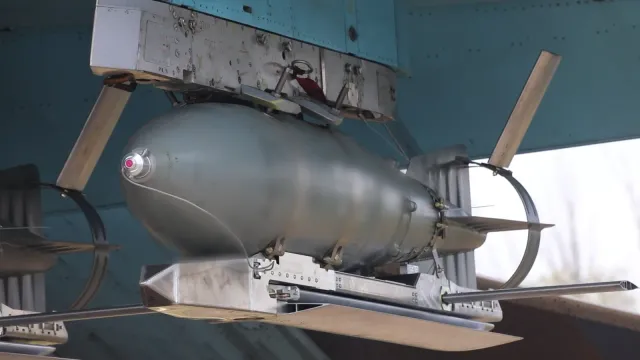
Missile
FAB-500 UMPK Missile
FAB-1500 UMPK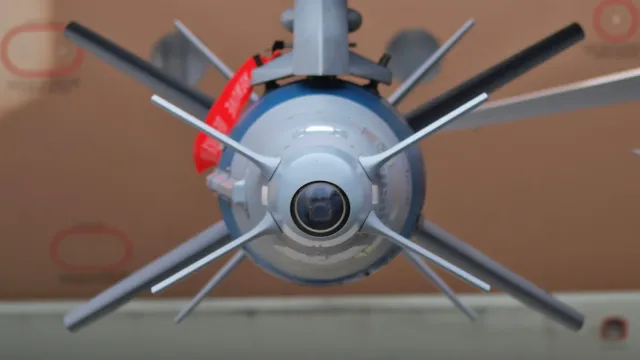
Missile
SPICE 2000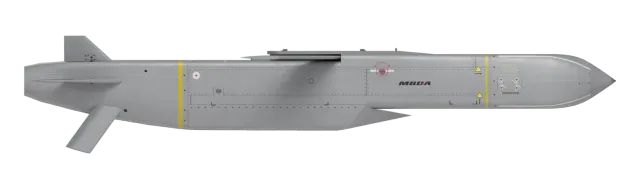
Missile
Storm ShadowFrequently asked questions
How far can Russia's UMPK glide bombs actually reach? +
The unpowered UMPK kit covered roughly 60-80km from release in 2023-2024, consistent with the FAB-500 UMPK figure of 70km in the WeaponSpecs database. Aerodynamic and guidance upgrades reportedly pushed that to around 95km through 2025-2026, and the jet-powered UMPK-PD variant is battlefield-reported at up to 200km after combat use in late 2025. Every one of these figures comes from Western open-source defense reporting and Ukrainian official statements, not published Russian specifications.
What powers the UMPK-PD glide bomb? +
According to The War Zone, open-source analysts identify the UMPK-PD's engine as a Chinese-made Swiwin SW800Pro-Y turbojet, a small commercial-class powerplant that turns the gliding kit into a powered standoff weapon. That identification is itself open-source analysis of recovered wreckage and imagery, not a specification confirmed by Russian officials, who do not publish UMPK data.
Does the US or Israel field anything comparable? +
The closest combat-fielded Western and Israeli glide munitions in the WeaponSpecs database are the US GBU-53/B StormBreaker at about 74km and Israel's SPICE 2000 at about 100km. Neither is reported to match the roughly 200km attributed to the powered Russian variant, though the US fields far longer-range standoff weapons in other categories, such as air-launched cruise missiles, which is a different design choice rather than a glide-bomb capability gap.
Why does glide-bomb range matter so much tactically? +
Range determines whether the launching aircraft can release its weapon while staying outside the defender's air-defense engagement envelope. Pushing release distance from around 70km to a reported 200km lets a Russian jet drop well beyond the reach of Ukrainian Patriot or NASAMS batteries, which is the real strategic story, not any single flight test number.
How reliable are these range figures? +
Treat them as best current open-source estimates, not confirmed specifications. They come from Western open-source defense journalism piecing together battlefield reporting, satellite and OSINT analysis, and Ukrainian official statements. That sourcing chain is different from, and generally more credible than, a state manufacturer claim, but it still falls short of an independently instrumented flight test. The 200km figure in particular is battlefield-reported, not flight-tested.
Related reading


