MV-75 vs Black Hawk: Does 'Twice as Fast' Hold Up?
The Army says its MV-75 flies twice as fast and far as the Black Hawk. Checked against 46 helicopters in our database, the claim mostly holds up.

Danazar, CC BY-SA 4.0, via Wikimedia Commons (V-280 Valor, shown for identification)
The Army’s line on the MV-75 Cheyenne II is that it flies “twice as fast, twice as far” as the UH-60 Black Hawk it’s built to replace. Checked against the 46 other helicopters in the WeaponSpecs database, that claim is close to accurate: 1.87x the Black Hawk’s cruise speed and, using the Army’s own combat-range figure, 2.50x its range, unusually honest marketing math by the standards of this column. The catch: every one of those numbers comes from a single prototype that hasn’t flown since 2020, not a fielded aircraft, and the tiltrotor family the MV-75 descends from, the V-22 Osprey, carries a cost premium and safety record worth knowing before anyone treats “2x” as settled fact.
Does “twice as fast” actually hold up?
Yes, almost exactly. The MV-75 Cheyenne II’s published cruise speed is 519 km/h, against the UH-60M Black Hawk’s 278 km/h, a 1.87x gap, not quite double but close enough that “twice as fast” isn’t a stretch. Widen the comparison beyond one aircraft and the claim holds up even better: our analysis of the 46 other helicopters in the WeaponSpecs database (excluding the MV-75 and the V-22, both tiltrotors that would skew the baseline) puts the average cruise speed at 269.0 km/h, so the MV-75 is running 1.93x that fleet-wide figure.
The reason is mechanical, not marketing. A conventional helicopter is capped by retreating-blade stall, the physics that limits how fast a single main rotor can push forward before its rearward-moving blade loses lift. A tiltrotor sidesteps that ceiling by converting to fixed-wing flight once airborne, which is also why the V-22 Osprey clears the pack at 446 km/h cruise. That speed matters operationally: it lets an air assault force launch from a base further from the objective and still arrive before a slower, closer-in staging area would give the mission away.
The MV-75 leads every fielded helicopter in the database on cruise speed, including its own tiltrotor sibling, but it's the only bar on this chart that hasn't flown since 2020.
What about “twice as far”, and which range figure are you even looking at?
Here’s the caveat: range depends entirely on which range you mean. The MV-75’s combat/effective range, flying loaded for a mission and coming back, is 1,481 km (Wikipedia’s own sourcing gives this as the top of a 930-1,480 km band). Against the Black Hawk’s 592 km, that’s 2.50x, and against the 46-helicopter fleet average of 706.5 km it’s 2.10x. Both comfortably support “twice as far.”
But Bell and the Army also publish a self-deploy, or ferry, range of 3,900 km (2,100 nautical miles), the distance the aircraft can cover flying itself somewhere with no combat load. Divide that by the Black Hawk’s range and you get 6.59x, a dramatic number and a genuinely wrong comparison: ferry range is how far the empty aircraft can be flown to a theater, combat range is how far it can fly a mission and still make it home. WeaponSpecs has flagged this same published-range-versus-real-range confusion before, on UAVs and air-defense interceptors. Nobody at Bell or the Army is claiming the 6.59x figure, but it’s exactly the number a reader could pick up from a press report that quotes “3,900 km” without saying which range that is.
| System | Status | Cruise Speed (km/h) | Range (km) | Troop Capacity | Unit Cost |
|---|---|---|---|---|---|
| MV-75 Cheyenne II | Prototype (one aircraft built) | 519 | 1,481 | 14 | Not disclosed |
| UH-60M Black Hawk | Fielded, ~4,000 built | 278 | 592 | 11 | ~$21.3M |
| V-22 Osprey | Fielded, ~400 built | 446 | 1,627 | 24 | ~$72M |
| CH-47F Chinook | Fielded | 260 | 741 | 33 | - |
| 46-helicopter fleet average | n/a | 269.0 | 706.5 | n/a | n/a |
Worth a sentence: the CH-47F Chinook is far slower than the MV-75 yet still carries 33 troops against the MV-75’s 14, a reminder that a tiltrotor buys reach and speed partly by giving up the lift a conventional heavy-lift helicopter still wins on.
How much of this has actually flown?
Not much yet, and that’s the load-bearing caveat on every number above. Everything attributed to the MV-75 here is a prototype spec, not a production one. Only one V-280 Valor demonstrator was ever built. It first flew on 18 December 2017 and, by December 2020, had logged just over 200 flight hours across 159 flights, per the MV-75’s own spec page. It hasn’t flown since.
The timeline since: Bell won the FLRAA competition in December 2022, the Army assigned the MV-75 designation in May 2025, and the name Cheyenne II followed in April 2026, alongside Bell completing the first production-representative wing structures that June (TheAviationist). First prototype delivery for Army testing is expected around the end of 2026 or early 2027, not yet locked in.
“Ultimately, we’ll have to make some risk decisions about when the performance of the system is not going to keep pace with the schedule,” said Maj. Gen. Clair Gill, commanding general of Army Aviation’s Center of Excellence (Breaking Defense, Mar. 25, 2026).
The total FLRAA program is now estimated near $70 billion, a program-level figure covering development and procurement, not a per-aircraft price (Breaking Defense, citing Army figures). A GAO review separately flagged the aircraft’s weight growth as putting payload capability at “moderate risk”: the program plans to cut 270 lbs, but the review found 2,000 lbs of cuts are needed to bring that risk down to low (TWZ, quoting the GAO report directly). More encouraging: Bell says the first MV-75 wing took 90% fewer labor hours than the first V-22 wing build, with a further 40% cut on the second wing (TheAviationist).
Does the tiltrotor’s own track record support the bet?
This is the part the speed and range numbers don’t tell you. The V-22 Osprey is Bell’s other tiltrotor, and it costs 3.38x more per aircraft than the Black Hawk it partly parallels, roughly $72 million against roughly $21.3 million. Its safety record is worse than the sales pitch suggests: fatal mishaps killed 20 people between 2022 and 2024, and December 2025 reviews by NAVAIR and the GAO found that of 12 Class A mishaps examined, 7 traced back to the Osprey’s gearing system: hard clutch engagements (the clutch connecting engine to proprotor gearbox slips and abruptly reengages, causing a sudden loss of torque and control) and steel impurities in X-53 gearboxes that broke apart in service (USNI News, Dec. 12, 2025). The same reviews cited poor communication between the Navy, Marine Corps and Air Force, the three services that fly different V-22 variants, as a factor that let the risk compound. Class A mishap rates rose sharply starting in fiscal 2023-2024, exceeding both the prior eight years and other aircraft types.
That record matters for the MV-75, but not as a direct inheritance. The V-22’s entire engine nacelles rotate to shift between vertical and horizontal flight; the MV-75/V-280 keeps its engines fixed horizontally and tilts only the prop-rotor gearboxes, a difference the MV-75’s own spec page credits with keeping exhaust away from the ground and leaving the fuselage sides clear for troops. A reader shouldn’t assume the MV-75 inherits every V-22 failure mode, since the mechanism behind most of the Osprey’s Class A mishaps sits in a different part of the drivetrain on the newer design. But the Osprey’s other lesson, that a program with three services and one gearbox supplier needs airtight cross-service coordination, is a management problem rather than a physics one, and it applies to whichever service ends up flying the MV-75 just as much as it applied to the Osprey fleet.
What a procurement watcher should actually track before the planned 2031 fielding: which range figure the production MV-75 ends up publishing once it’s no longer a single prototype’s number, whether the 2,000-lb weight cut the GAO wants actually happens, and whether the gearbox lessons from the Osprey reviews show up in how the MV-75’s own drivetrain gets built and maintained. The speed and range claims already check out. Whether the aircraft behind them ships on schedule, on weight, and without repeating the Osprey’s mechanical history is still open.
Run your own mission profile in the Advisor, or see how the MV-75 stacks up against every other rotorcraft in the helicopter category.
Sources
- Army says first MV-75 tiltrotor helo to be delivered by end of 2026 for testing
- 'Too early to tell' if timeline holds for delivery of Army's tilt-rotor MV-75 for testing: Official
- Army Punches Its MV-75 Tiltrotor Program Into Overdrive
- Bell MV-75 Cheyenne II
- Sikorsky UH-60 Black Hawk
- New V-22 Mishap Reviews Find Material Issues with Osprey, Poor Communication Between Services
- The MV-75: The Army's New Aircraft and Future of Air Assault Warfare
- MV-75 Cheyenne II Progresses As Bell Completes First Wing Structures
- Bell MV-75
Systems in this comparison
Every system covered above, with its photo and, where available, a video. Tap a card to open the full spec sheet.
Compare these side by side →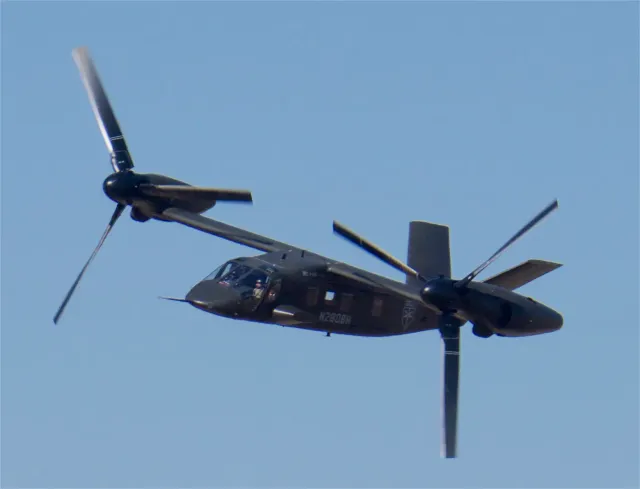
Helicopter
MV-75 Cheyenne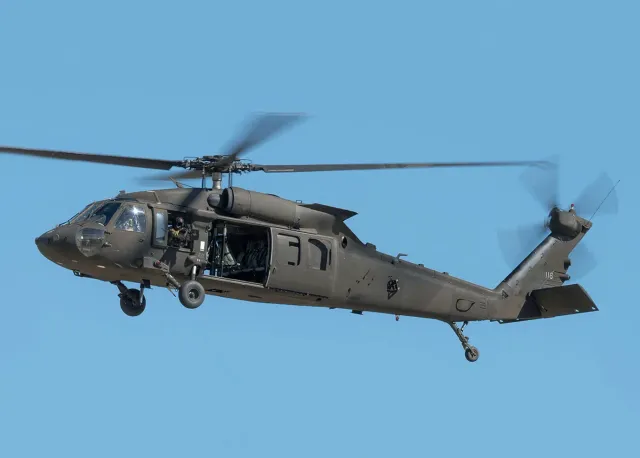
Helicopter
UH-60M Black Hawk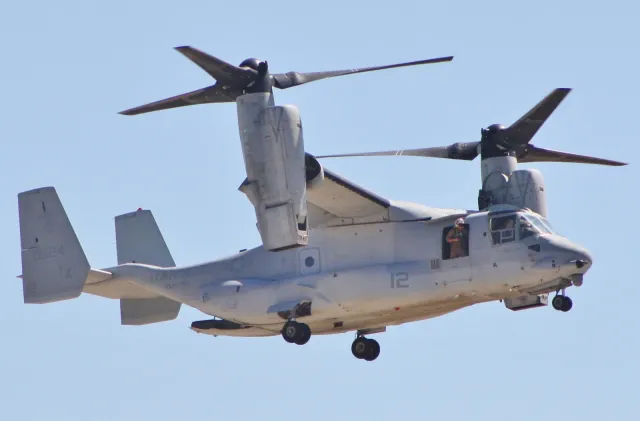
Helicopter
V-22 Osprey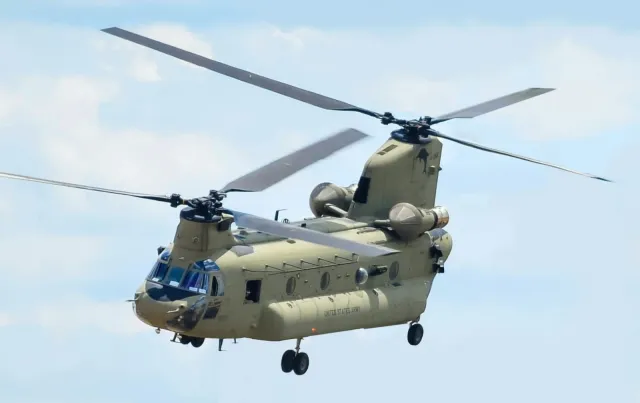
Helicopter
CH-47F ChinookFrequently asked questions
What is the MV-75 Cheyenne II? +
It's the U.S. Army production designation for Bell's V-280 Valor tiltrotor, selected in December 2022 as the winner of the Future Long Range Assault Aircraft (FLRAA) competition to replace the Sikorsky UH-60 Black Hawk. The Army assigned the MV-75 designation in May 2025 and added the name Cheyenne II in April 2026.
Has a production MV-75 actually flown? +
No. Only the V-280 Valor demonstrator has flown, and it hasn't left the ground since December 2020 after logging just over 200 flight hours across 159 flights. The first MV-75 prototype delivery for Army testing is expected around the end of 2026 or early 2027.
Why do different sources give different MV-75 range figures? +
Press and Army briefings cite a combat/effective range of roughly 930 to 1,480 km (580-920 miles), which describes how far the aircraft can fly loaded for a mission and still return. A separate self-deploy or ferry range of 3,900 km describes flying the aircraft itself across long distances without a combat payload. They answer different questions and aren't interchangeable.
Is the MV-75 the same design as the V-22 Osprey? +
Related but distinct. The V-22's entire engine nacelles rotate to shift from vertical to horizontal flight. The MV-75/V-280 keeps its engines fixed horizontally and tilts only the prop-rotor gearboxes, a difference the aircraft's own spec record credits with keeping exhaust away from the ground and clearing the sides of the fuselage for troops.
How much will the MV-75 cost? +
Unit cost hasn't been publicly disclosed. The total FLRAA program is estimated near $70 billion, a program-level figure, not a per-aircraft price. For comparison, the Black Hawk it replaces costs roughly $21.3 million per unit and the V-22 Osprey, built by the same tiltrotor maker, costs roughly $72 million per unit.
Related reading


