Iron Beam Laser Sits Idle Eight Months After Delivery
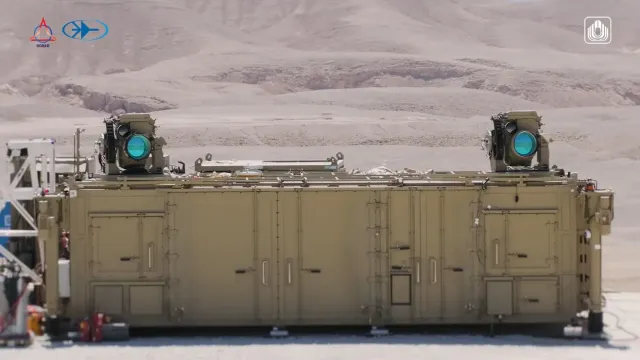
Rafael's roughly $2-per-shot laser interceptor was delivered to Israel's military in December but still isn't cleared for operational use.

Spokesperson and Public Relations Division, Israeli Ministry of Defense, via Wikimedia Commons, CC BY-SA 4.0.
Rafael delivered its Iron Beam laser air-defense system to the Israeli military roughly eight months ago, around December 2025, and it still has not been cleared for operational use. The gap matters because of what Iron Beam is supposed to fix: a single laser shot costs about $2 in electricity, against roughly $100,000 for a standard Iron Dome interceptor, making every month the system sits idle a month Israel keeps burning through six-figure interceptors on threats a laser was built to handle for pocket change.
Delivered in December, still not cleared eight months later
Iron Beam reached the IDF’s air-defense array around December 2025, consistent with WeaponSpecs’ own systems database, which lists a 2025 release year and describes the system as having “reached initial operational status with the Israeli military” that year. Current reporting complicates that framing rather than contradicting it outright: All Israel News and Ynetnews both report that, eight months on, Iron Beam is still not cleared as fully operational. Rafael has acknowledged that some of the system’s subsystems are still being modified as testing continues. That is a meaningful distinction for readers comparing sources: an initial handover to the military is not the same as a unit being certified ready to fight, and this story is not silently overwriting WeaponSpecs’ existing database language, just noting plainly that the two framings describe different stages of the same rollout.
Why a laser this cheap still isn’t in service
The obstacles reported are practical, not exotic. Iron Beam’s performance reportedly degrades in rain and adverse weather, a real limitation for a country that gets meaningful winter rainfall. Its 10 km engagement range is short enough that fielding it well requires new tactical integration rather than simply swapping it in for existing batteries. And it competes for scarce IDF manpower and budget against systems with a longer combat track record: reporting indicates the Defense Ministry has prioritized restocking proven missile interceptors over standing up an entirely new laser unit, including the training pipeline and operational doctrine that unit would need from scratch. Rafael chairman Yuval Steinitz said earlier this year that he expected the remaining work to take no more than a few days, according to All Israel News; that estimate has not held up, and the system remains uncleared months later. Iron Beam has reportedly engaged several incoming Hezbollah drones during the war, which shows the underlying intercept technology works in at least some real conditions, but broader questions about its reliability across weather, range and threat type remain unresolved.

The cost math that makes the wait worth watching
The economics are the real reason this delay is a story rather than a routine procurement footnote. A single Iron Beam shot costs roughly $2 in electricity. A single Iron Dome interceptor, the Tamir, costs on the order of $100,000. David’s Sling’s interceptor runs closer to $1 million, and Arrow-3, Israel’s exo-atmospheric interceptor, costs $2 million or more per shot. A night of drone or rocket fire that would ordinarily burn through a few dozen Tamir interceptors, several million dollars of hardware, could in principle be answered with a system that costs less than the price of a fast-food meal per intercept. That gap is precisely why Israel spent years developing Iron Beam in the first place: interceptor stock is finite and expensive to replace, while a laser’s marginal cost per shot is close to zero as long as the power supply holds.
Bars are scaled to each figure's order of magnitude rather than linearly, since a linear bar for Iron Beam's roughly $2 shot would be invisible next to Arrow-3's multi-million-dollar interceptor. Iron Dome, David's Sling and Arrow-3 figures come from Ctech and All Israel News reporting; Iron Beam's per-shot electricity cost is Rafael's own commercial figure, cited by the same sources.
What Iron Beam does and doesn’t replace
None of this means Iron Beam is meant to make Iron Dome, David’s Sling or Arrow-3 obsolete. WeaponSpecs’ own systems data describes Iron Beam as designed to complement Iron Dome, adding a near-zero-marginal-cost intercept layer against the high-volume, low-value threats, rockets, mortars, short-range drones, that otherwise chew through expensive interceptor stock for no good reason. Its 10 km engagement range and 3,000-meter engagement altitude put a hard ceiling on what it can reach; longer-range or higher-altitude threats will keep needing Iron Dome, David’s Sling or Arrow-3 regardless of how reliable Iron Beam eventually becomes. The economic case for finishing the job is still strong. The operational case, weather performance, doctrine, a trained unit, is exactly what remains unfinished eight months after delivery.
Sources
- Israel's Iron Beam laser defense system still not operational eight months after delivery — All Israel News, Aug 10, 2026
- Israel's Iron Beam laser system sits idle despite war — Calcalist / Ctech, May 28, 2026
- Iron Beam delivered to IDF, but 'game-changing' laser shield remains offline months later — Ynetnews, Aug 9, 2026
Systems mentioned
Every system named in this story, with its photo and, where available, a video. Tap a card to open the full spec sheet.
Frequently asked questions
How much cheaper is Iron Beam per shot than existing interceptors? +
Roughly $2 in electricity per shot, against about $100,000 for an Iron Dome interceptor, around $1 million for a David's Sling interceptor, and $2 million or more for an Arrow-3 interceptor, per Ctech and All Israel News reporting.
Why isn't it operational yet if it was delivered in December 2025? +
Rafael has said some subsystems are still being modified as testing continues. Reporting also points to degraded performance in rain and adverse weather, the tactical adjustments required by its short 10 km range, and competing IDF budget and manpower priorities that favor restocking proven missile interceptors over standing up an unproven laser unit.
Has Iron Beam ever actually shot anything down? +
It reportedly engaged several incoming Hezbollah drones during the war, but broader questions about its combat reliability remain open.
Does Iron Beam replace Iron Dome? +
No. WeaponSpecs' own systems data describes Iron Beam as designed to complement Iron Dome by adding a near-zero-marginal-cost intercept layer against short-range threats like rockets, mortars and drones, not to replace missile-based interceptors for every threat type.
More news


