Ukraine's Sea Baby: Cheaper Per Kilogram Than Any Missile
Ukraine's naval drones deliver warhead payload for about $289/kg, versus $735-$13,500/kg for guided missiles in our database, a real cost gap.

Wikimedia Commons, CC BY-SA 4.0, photo by User:Zenwort (Sea Baby USV on museum display, Kyiv)
Ukraine’s Sea Baby delivers a kilogram of warhead downrange for about $289. The cheapest guided missile in the WeaponSpecs database with both a public warhead figure and a public price, the AGM-86 ALCM, costs $735 to deliver that same kilogram. BrahMos costs $13,500. That is not a rounding gap, it is a roughly 47x spread, and it is the clearest economic explanation available for why cheap, attritable naval drones are multiplying across navies that historically built nothing smaller than a frigate. It is not evidence that a drone is a better weapon than a missile, and treating it that way would misread the data entirely.
What do Ukraine’s three naval drones actually cost, and deliver?
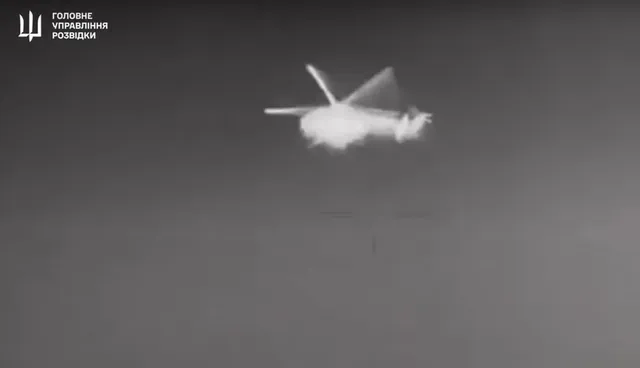
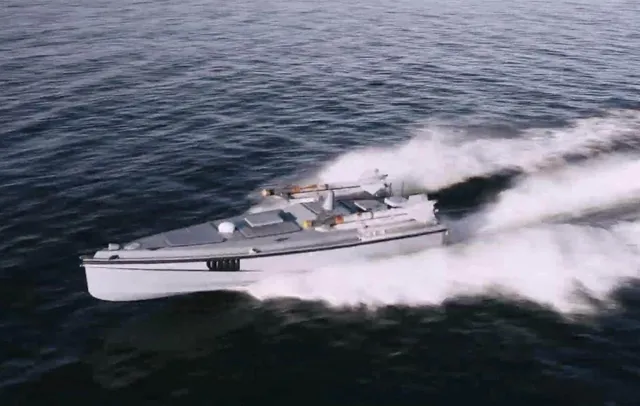
Ukraine’s naval drone program has produced three systems with real combat records: Magura V5, which became the first uncrewed naval drone credited with sinking a crewed warship when it hit the corvette Ivanovets in February 2024; Sea Baby, the platform used in the July 2023 strikes on the Kerch Strait (Crimean) Bridge; and Magura V7, which USNI Proceedings reports downed two Russian Su-30 fighter jets in May 2025, the first uncrewed surface vessel credited with shooting down crewed combat aircraft (per USNI Proceedings). All three of those outcomes rest on Ukrainian government and military reporting, HUR and SBU statements on kills, warhead size, and cost are Ukraine’s own state claims, not independently audited figures, and this column applies the same skepticism to them it applies to Russian or Chinese state claims elsewhere.
The table below is our own cost-per-kilogram cut across those three drones plus the six most directly comparable stand-off, cruise, and anti-ship missiles in the WeaponSpecs spec database, every missile record that publishes both a unit cost and a warhead mass.
| System | Category | Warhead/payload (kg) | Unit cost (USD) | Cost per kg delivered | Range (km) | Note |
|---|---|---|---|---|---|---|
| Sea Baby | Ukrainian USV | 850 (2023-24 generation; DB field publishes 2,000 kg for the newer, price-undisclosed generation) | $245,581 (“early production,” not officially disclosed by SBU) | $289/kg | 1,500 (newest generation only) | First naval drone used to strike the Kerch Strait/Crimean Bridge, July 2023 |
| Magura V5 | Ukrainian USV | 320 | $275,000 (estimated $250K-$300K, not officially disclosed by HUR) | $859/kg | 800 | First uncrewed naval drone credited with sinking a crewed warship in combat (Feb 2024, corvette Ivanovets) |
| Magura V7 | Ukrainian USV | 650 | Not publicly disclosed | N/A | 1,480 | Shot down 2 Russian Su-30 fighter jets, May 2025; unit cost never published |
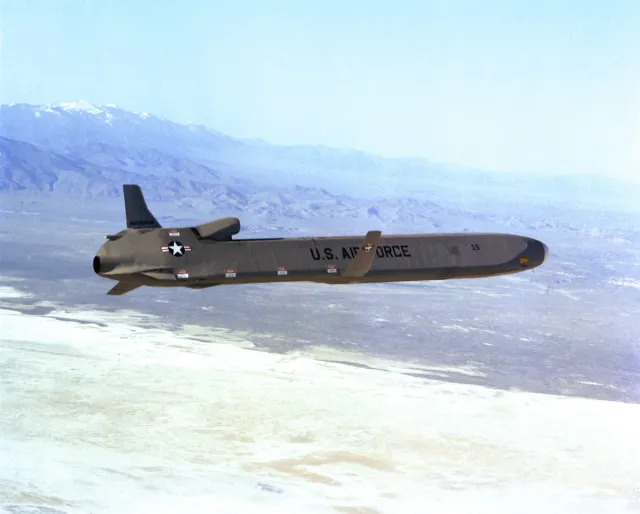
| AGM-86 ALCM | US air-launched cruise missile | 1,360 | $1,000,000 | $735/kg | - | Cold War-era design; cheapest $/kg missile in the DB, mostly because of an unusually large warhead class, not efficient design |
| Tomahawk Block V | US land-attack cruise missile | 450 | $2,000,000 | $4,444/kg | - | |
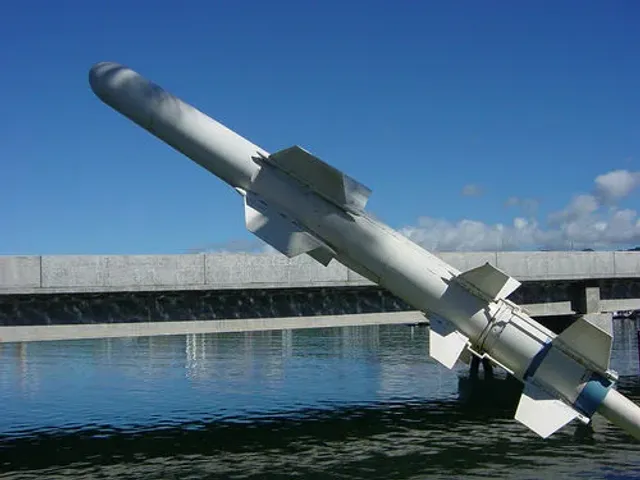
| Harpoon Block II | US anti-ship missile | 221 | $1,200,000 | $5,430/kg | - | The reference anti-ship missile most readers will know |
| AGM-158C LRASM | US anti-ship cruise missile | 450 | $3,000,000 | $6,667/kg | - | |
| Storm Shadow | UK/France cruise missile | 450 | $3,000,000 | $6,667/kg | - | |
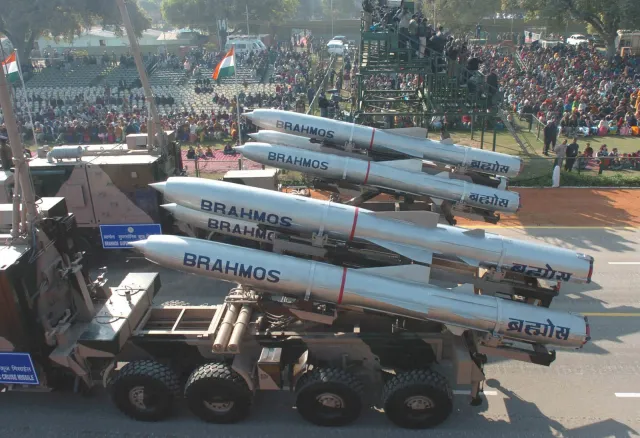
| BrahMos | India/Russia supersonic anti-ship/land-attack missile | 200 | $2,700,000 | $13,500/kg | - | Most expensive $/kg here; supersonic speed and seeker sophistication, not raw mass, is what that price buys |
Why $289/kg for Sea Baby, not the $123/kg its own two fields suggest?
This is the moment worth slowing down for, because it is a mistake the database’s own honest data can produce if you are not careful. Sea Baby’s record pairs two numbers from different production generations. The firepower.warheadKg field reads 2,000 kg, describing the newest generation the SBU publicly unveiled in October 2025. The commercial.unitCostUSD field reads $245,581, and the record’s own priceNote says plainly that this is an early-production figure, “later, longer-range, higher-payload generations have not had a public unit cost disclosed.”
Divide those two fields naively and you get an eye-popping $123/kg. It is wrong. It pairs an early-generation price with a payload from a generation whose price was never made public. A more defensible, same-era estimate pairs that same $245,581 figure against the roughly 850 kg payload the platform actually carried by late 2023 and 2024, the generation in service when the price was reported, per Sea Baby’s own database description field. That math gives $289/kg, the number used throughout this post.
Both numbers are our own computation from two DB fields, not a single field the database publishes directly, which is why the $/kg figures themselves carry no data-spec wrapper, only the raw individual fields feeding them do. The lesson generalizes past this one platform: a spec database can be entirely honest at the field level and still produce a misleading number the moment someone divides two fields that were never meant to travel together. That is exactly the kind of laundering this column exists to catch, whether the source is Ukrainian, Russian, or American.
How does that cost gap look against six comparable missiles?
The drone row runs from Sea Baby's $289/kg to Magura V5's $859/kg; the missile row runs from the AGM-86 ALCM's $735/kg, the cheapest missile in the set, to BrahMos's $13,500/kg. Even the cheapest missile in this comparison barely reaches the naval drones' most expensive end.
The two rows barely touch. Sea Baby’s $289/kg sits at roughly a fortieth of BrahMos’s $13,500/kg, and even Magura V5’s $859/kg, the drone side’s high end, undercuts every missile in the set except the AGM-86 ALCM, whose low $/kg is itself an artifact of a Cold War design carrying an unusually large warhead class rather than a sign of unusual efficiency. That asymmetry is exactly why an analyst who has watched procurement budgets for a while treats these platforms as a genuine category shift, not a novelty.
“The cost of USVs such as Magura V5 and Sea Baby is about $250,000, which is inexpensive relative to their significant tactical and strategic success,” said Roy Gardiner, an open-source weapons researcher and former Canadian Armed Forces officer, quoted in David Kirichenko, “Small Craft, Big Impact: Ukraine’s Naval War and the Rise of New-Tech Warships” (CIMSEC, June 3, 2025).
Gardiner’s framing is the right one for a buyer: not “which platform wins a duel,” but “which platform’s cost lets you absorb losses and still come out ahead.” Ukraine’s own naval drone toll against the Black Sea Fleet, eight Russian warships destroyed and six damaged in the program’s first year, per USNI Proceedings’ account of over $500 million in damage, only pencils out economically because losing individual drones at $245,000-$275,000 apiece is sustainable in a way that losing $1-3 million missiles on a comparable strike volume is not.
Does cheaper per kilogram mean naval drones are replacing missiles?
No, and this is where the data cut above stops being useful if you don’t hold the caveat in view. A Sea Baby or Magura V5 is a surface craft moving at 20-40 knots across open water in daylight, no radar cross-section reduction, no sea-skimming terminal profile, no active countermeasures against a warship’s close-in weapon system. Against a functioning naval air-defense picket, or simply a helicopter crew with a machine gun, it is one of the easiest targets in modern naval warfare to intercept. It has worked against the Black Sea Fleet largely because Russia’s Black Sea air-defense coverage has been thin and its warships have often operated without adequate escort, a specific and possibly non-repeatable operational gap, not a universal truth about drone survivability.
A missile like Harpoon Block II, Storm Shadow, or BrahMos exists specifically to defeat the kind of layered defense a drone cannot. Sea-skimming flight profiles, terminal maneuvering, supersonic closure speed, electronic countermeasures resistance, these are engineering answers to the exact intercept problem a slow surface drone has no answer for at all. The $6,667-$13,500/kg price of that capability buys penetration against defended targets, not just mass.
The real story in the cost table above is procurement economics, not weapon superiority. A Sea Baby that gets intercepted nine times out of ten against a competent air-defense picket can still be the better buy than a missile that gets through nine times out of ten, if the mission is saturating an under-defended target and losses are cheap enough to absorb. That logic, mass over precision, attritable over exquisite, is exactly what’s driving the US Navy’s growing unmanned-surface-vessel efforts and comparable interest across other navies watching Ukraine’s results, not a claim that the drone is a better weapon in a like-for-like fight.
Buyers weighing where attritable mass fits a real threat picture, versus where guided precision still earns its price, can run both sides of that tradeoff against the full spec set in the systems comparison tool or get a mission-specific recommendation from the procurement advisor.
Sources
Systems in this comparison
Every system covered above, with its photo and, where available, a video. Tap a card to open the full spec sheet.
Compare these side by side →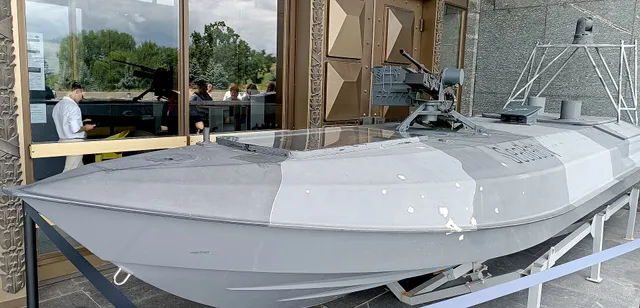
Frequently asked questions
How much does a Ukrainian naval attack drone actually cost? +
Public reporting puts Magura V5 at roughly $250,000-$300,000 and Sea Baby's early production run at about $245,600, both figures are Ukrainian-side estimates, not independently audited numbers, and neither Kyiv nor SBU has published a formal unit-cost breakdown. Magura V7's cost has never been disclosed at all. Treat every figure here as a claim, the same caveat this column applies to Russian or Chinese state figures.
Why does this post use $289/kg for Sea Baby instead of the $123/kg you get from dividing its listed cost by its listed warhead weight? +
Because those two numbers in the WeaponSpecs database come from different production generations. The database's warheadKg field (2,000 kg) describes the newest Sea Baby generation the SBU unveiled in October 2025, a generation whose unit cost has never been disclosed. The unitCostUSD field ($245,581) is explicitly flagged in the record's own price note as an early-production figure. Dividing one generation's price by a later generation's payload produces a misleadingly low $123/kg. Pairing that same early-production price against the roughly 850 kg payload the platform actually carried in 2023-24, the generation in service when that price was reported, gives the defensible $289/kg figure used throughout this post.
Does a lower cost per kilogram mean naval drones are more effective than anti-ship missiles? +
No, and this is the point of the piece, not a footnote to it. A surface drone crawling across open water at 20-40 knots with no stealth shaping is trivially interceptable by a functioning air defense system or even a helicopter with a machine gun. A sea-skimming or supersonic cruise missile like Harpoon, Storm Shadow, or BrahMos is specifically engineered to defeat exactly that kind of defense. The cost gap explains why cheap, attritable mass is proliferating as a category, it does not mean a $289/kg drone out-performs a $6,667/kg missile in a contested engagement.
Why has Magura V7's unit cost never been disclosed, even after it shot down two fighter jets? +
Ukraine's military and intelligence services have disclosed rough cost ranges for older platforms like Magura V5 and Sea Baby's early production run, but newer, more capable systems tend to get less public financial detail, likely a mix of operational security around an active weapons program and the simple fact that a still-evolving platform's cost isn't fixed enough to publish. Magura V7's May 2025 Su-30 shootdown, per USNI Proceedings, is the platform's most publicized achievement, but it came with a capability claim, not a price tag.
Is this cost-per-kilogram logic showing up in other countries' naval drone programs, not just Ukraine's? +
Ukraine's combat results have visibly accelerated interest in low-cost attritable naval drones well beyond its own program, the US Navy's growing unmanned-surface-vessel efforts are the most closely watched example, and several other navies have publicly discussed similar attritable-mass concepts. This post does not assert specific cost figures for those foreign programs, most haven't published comparable numbers yet, but the procurement logic Ukraine's data illustrates here is the same logic driving that broader interest.
Related reading


