Norway Adds $270M in US 155mm Shells, Stockpile Push Tops $370M
State Dept clears a $270M FMS sale of M795 artillery rounds to Norway, layering onto a $99.99M case as Oslo funds a 10-year, $12B rearmament plan.

U.S. Army photo by Dori Whipple, DVIDS, public domain
The U.S. State Department has cleared a possible $270 million Foreign Military Sale of M795 155mm high-explosive artillery rounds to Norway, an add-on to a smaller $99.99 million case that pushes the combined value of Norway’s recent shell purchases to nearly $370 million. The notification, published August 5 to 6, 2026, covers the projectiles themselves plus technical assistance, documentation and contractor logistics support, with American Ordnance and General Dynamics Ordnance and Tactical Systems (GD-OTS) named in reporting as the prime contractors. No delivery schedule was disclosed.
What the notification actually covers
A Foreign Military Sale notification is not a signed contract. It sets a ceiling value and scope that Congress reviews before a formal agreement is negotiated, which is why the State Department release gives a ballpark figure and a general description, M795 projectiles, technical documentation, engineering and logistics support, without a unit count or a delivery date. What makes this case notable is its structure: it stacks on top of an earlier $99.99 million M795 case that was small enough to clear without triggering the formal congressional notification threshold on its own. Combined, the two cases put Norway’s recent M795 commitment at roughly $370 million, a scale that only becomes visible once the two notifications are read together rather than as isolated line items.
That pattern, a small case followed by a larger add-on for the same round, is itself informative. It suggests Norway is not making a single large one-time purchase decision but steadily building out its 155mm stockpile in stages, consistent with a multi-year procurement plan rather than a reaction to a specific shortage or emergency.
The rearmament plan behind the purchase
Norway announced in March 2026 that it would commit an additional NKr 115 billion, roughly $12 billion, in military funding through 2036, on top of its existing defense budget, explicitly aimed at reaching NATO’s 3.5%-of-GDP spending target by 2035. That commitment sits separately from Norway’s support for Ukraine, and this M795 purchase fits inside it as one line among many rather than a standalone event. Norway also had a $2.6 billion helicopter procurement approved in July 2025, part of the same broader pattern of a NATO Arctic-flank country steadily rebuilding capability across multiple weapon categories at once.
The State Department’s stated rationale for approving the sale is that it “improves Norway’s capability to meet current and future threats” and increases interoperability with US and allied forces, standard FMS language that nonetheless tracks with the wider strategic picture: Norway sits on NATO’s northern flank facing Russia directly, and artillery ammunition is exactly the kind of consumable stockpile that a war in Ukraine has shown gets drawn down fast under sustained use.
The round itself, and the production line behind it
The M795 is not a new or exotic round. It is the standard 155mm high-explosive projectile fired by essentially every current US and allied towed and self-propelled howitzer, including the M198, M777 and the M109 Paladin family. Per GD-OTS’s own published datasheet, the round carries 23.8 pounds of TNT or insensitive IMX-101 explosive fill and extends 155mm HE range from 17.5 kilometers to 22.5 kilometers, a 29 percent increase, over the legacy M107 HE round it replaced, with the manufacturer citing a 100 percent lethality increase against personnel and an 80 percent increase against trucks compared to that older round. Over one million M795 rounds have been produced since the type entered service.

The “so what” here is production capacity, not just the round’s ballistics. GD-OTS opened a new load-assemble-pack facility in Camden, Arkansas, in April 2025, specifically to expand 155mm shell output as the US Army works to relieve the ammunition shortage NATO’s collective support for Ukraine exposed, targeting roughly 50,000 rounds a month from that site alone. Norway’s purchase draws on that same surged production line, which means this deal is less a story about one country’s stockpile than a data point in how much of the alliance’s expanded shell capacity allied buyers are now absorbing. Norway fields the K9 VIDAR variant of South Korea’s K9 Thunder self-propelled howitzer as one of the delivery platforms for 155mm rounds like the M795, a 52-caliber gun system with a published maximum firing range of 54 kilometers using extended-range ammunition; WeaponSpecs’ database lists Norway among 11 countries operating the K9 family.
Reading this alongside the interceptor production surge
WeaponSpecs covered a related but distinct thread earlier this week: Lockheed Martin’s $58.6 billion PAC-3 MSE production contract and a separate Pentagon push on THAAD and Patriot component suppliers, both dated August 4, 2026. Those deals cover guided missile interceptors, a fundamentally different category of weapon from an unguided artillery shell, so they should not be read as the same procurement story. What connects them is the underlying industrial-base dynamic: after several years of sustained combat consumption in Ukraine and the Middle East, the Pentagon and its allies are simultaneously surging output across categories that don’t normally get grouped together, cheap conventional ordnance on one hand, expensive precision interceptors on the other, because both got drawn down by the same run of conflicts.
Sources
- Norway – 155mm High Explosive (HE) M795 Projectile — U.S. State Department, Bureau of Political-Military Affairs, Aug 6, 2026
- US approves $270m sale of 155mm HE M795 projectiles to Norway — Army Technology, Aug 6, 2026
- Norway to buy more artillery shells from the US — Defence Blog, Aug 6, 2026
Systems mentioned
Every system named in this story, with its photo and, where available, a video. Tap a card to open the full spec sheet.
Compare these side by side →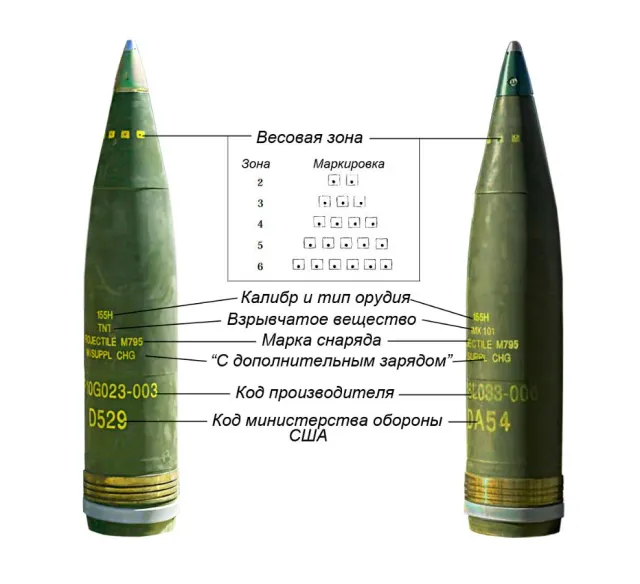
Munitions
155mm M795 HE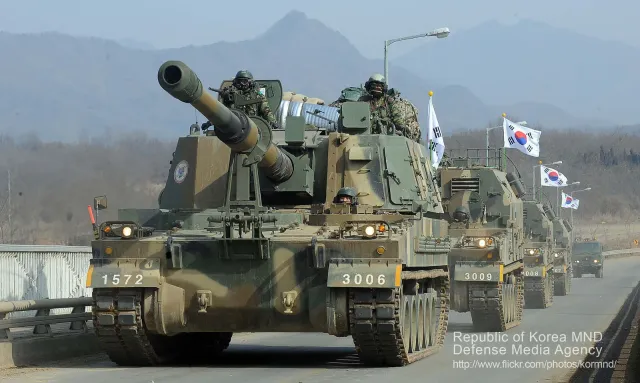
Artillery & MLRS
K9 ThunderFrequently asked questions
Why is Norway buying more M795 shells now? +
The purchase lands mid-way through a roughly $12 billion, 10-year rearmament program Norway announced in March 2026 to reach NATO's 3.5%-of-GDP defense-spending target by 2035, part of a broader buildup of ammunition stockpiles as a NATO frontline Arctic state, not a single isolated purchase.
How does this connect to the Patriot and THAAD production deals WeaponSpecs already covered? +
Different category of weapon (unguided artillery shells versus guided missile interceptors), but the same industrial-base story: the Pentagon and its allies are simultaneously surging conventional shell output and interceptor output after Ukraine aid and Middle East operations drew both down.
Does this mean Norway is running low on shells? +
That is not stated in the notification. The sale is framed around future capability and interoperability with US and allied forces rather than emergency replenishment, though Norway, like most NATO members, has donated artillery ammunition to Ukraine.
What is the delivery timeline? +
Not specified. A State Department Foreign Military Sale notification sets a ceiling value and scope for congressional review; the actual contract and delivery schedule are negotiated afterward and were not disclosed here.
More news


