The C-17 Hauls 7x More Cargo Per Km Than the KC-46
The C-17 moves 7x more cargo per km of range than the KC-46 Pegasus, not because it's a better airlifter, but because tankers spend their weight budget on fuel.

Boeing, official product image, background removed
The Boeing C-17 Globemaster III moves 17.3 kg of published cargo payload for every kilometer of its rated range. The Boeing KC-46 Pegasus tanker moves 2.4 kg for every kilometer of its rated range, roughly 7 times less. That gap isn’t a verdict on which aircraft is “better.” It’s what happens when one airframe is built to haul cargo over a modest distance and the other is built to carry fuel over a very long one, and the tradeoff shows up in every transport aircraft in the WeaponSpecs database that publishes both figures.
Which transport aircraft actually carries the most cargo?
Of the transport aircraft in the WeaponSpecs database (systemType: "transport", air category), 13 unique aircraft publish both a cargo payload figure and a range figure, the two numbers needed to compute cargo moved per kilometer of range. By raw payload alone, the ranking looks different from what follows: the Lockheed Martin C-5M Super Galaxy tops the field at 129,274 kg, nearly 52 tonnes ahead of the C-17’s 77,519 kg. China’s Y-20 (66,000 kg, state figure) and Russia’s Il-76MD-90A (60,000 kg, state figure) round out the top four.
That’s a legitimate answer to “which aircraft can carry the most weight in one load,” and it’s a different question from the one this piece is actually about. The C-5M’s huge payload comes paired with a huge design range, 12,800 km unrefueled, more than 2.8 times the C-17’s 4,482 km. Once you divide payload by range, the C-5M drops from first to second, and the C-17 takes over.
Why does the C-17 move 7x more cargo per kilometer than the KC-46?
Every kilogram an aircraft carries has to come from somewhere in its weight budget. An airframe designed to fly very far without refueling has to devote more of that budget to internal fuel tankage, structure to carry it, and the reinforced wing and fuselage that go with a long-range mission profile. An airframe designed for a shorter, more tactical mission radius doesn’t need nearly as much of its weight given over to fuel, so more of it can go to cargo relative to the distance the aircraft is actually rated to cover. That’s the mechanism behind the ranking below.
The 9 pure airlifters average 8.0 kg/km; the 4 dual-role tanker-transports average 5.0 kg/km, but that average hides a 3.8x spread inside the tanker group itself, from 2.4 to 9.2, which the next section explains.
Il-76 and A400M land on an identical 10.0 kg/km ratio (60,000 kg over 6,000 km, and 37,000 kg over 3,700 km), which is a plausible sign of rounded published figures rather than individually flight-tested maxima, not a proven fact, just a pattern worth noting.
What’s actually different between a strategic and a tactical tanker-transport?
The chart’s legend groups the KC-390, Il-78, A330 MRTT, and KC-46 together as “tanker-transports,” and on average that group does move less cargo per kilometer than pure airlifters, 5.0 kg/km against 8.0. But averaging across that group buries the real story: the KC-390 posts 9.2 kg/km, close to the pure-airlifter pack, while the KC-46 and A330 MRTT post 2.4 and 3.0. The category label “tanker-transport” is doing too much work; it covers two genuinely different design problems.
The KC-46 and A330 MRTT are strategic tankers first, built for very long unrefueled range (12,200 km and 14,800 km) to support aircraft operating far from friendly airfields. The KC-390 is a tactical tanker-transport, built around a much shorter 2,820 km range and closer to a battlefield-adjacent, austere-airfield mission than a strategic one. That design split is exactly what a Northrop Grumman executive was describing when the company pitched a KC-390-based tactical tanker against the KC-46 for a US Air Force requirement.
“This is an agile combat employment type of aircraft when the KC-46 is not,” said Tom Jones, president of Northrop Grumman Aeronautics Systems, contrasting a tactical tanker-transport concept against the KC-46 Pegasus (Air & Space Forces Magazine, Feb. 19, 2026).
Agile combat employment means dispersing aircraft across small, austere airfields rather than concentrating them on a handful of large, fixed bases that are easy to target. A tanker built for that mission doesn’t need the KC-46’s 12,200 km design range; it needs to operate from short, rough strips near the fight, which is a shorter-legged, cargo-heavier design problem, not a smaller version of the same one. That’s the design logic behind the KC-390’s 9.2 ratio sitting closer to the C-130J (5.7) than to the KC-46 (2.4), even though the KC-390 and KC-46 share the same “tanker-transport” label. “Tanker” isn’t one design intent, it’s at least two, and the payload-per-range numbers show exactly where the line falls.
A data-integrity note: the KC-390 is in this database twice
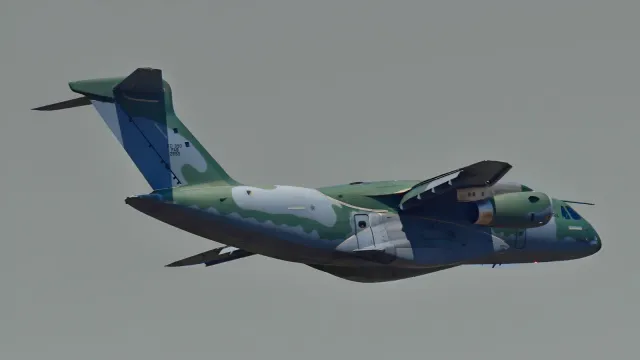
Building the chart above surfaced a genuine bug in the WeaponSpecs database, not just an analytical quirk. Embraer’s C-390/KC-390 Millennium has two separate records: embraer-c-390 and embraer-kc-390-transport. Both cite the identical Wikipedia source (Embraer C-390 Millennium) and each lists the other as an alias, so this is one real aircraft entered twice, not two variants. Both records agree on a 26,000 kg maximum payload. They disagree sharply on range: embraer-c-390 pairs that payload with a 5,020 km range, while embraer-kc-390-transport pairs the same payload with 2,820 km.
Checked against Embraer’s own payload-range curve, in the Wikipedia article and in Embraer’s KC-390 brochure PDF, only one of those pairings is physically consistent. The real curve runs roughly 2,000 km at the full 26-tonne payload, about 2,720 km at 23,000 kg, and only reaches 5,020 km at a much lighter 14,000 kg load. The embraer-c-390 record took its payload figure from one end of that curve and its range figure from the other, a classic case of pairing two numbers that were never measured together. The embraer-kc-390-transport record’s 26,000 kg / 2,820 km pairing is the physically consistent one, close to the real 23,000 kg / 2,720 km point on Embraer’s own curve.
This table uses the corrected 2,820 km figure for that aircraft, not the live embraer-c-390 record’s own range field, which still carries the mismatched 5,020 km value at the time of writing. It’s a concrete illustration of a broader trap: a range number by itself doesn’t mean much until you know what payload it was measured at, and this database’s own entry fell straight into that trap by quietly mixing two points from the same curve.
The full ranking
| Rank | System | Country | Payload (kg) | Range (km) | Ratio (kg/km) |
|---|---|---|---|---|---|
| 1 | C-17 Globemaster III | United States | 77,519 | 4,482 | 17.3 |
| 2 | C-5M Super Galaxy | United States | 129,274 | 12,800 | 10.1 |
| 3 | Il-76MD-90A | Russia (state claim) | 60,000 | 6,000 | 10.0 |
| 4 | A400M Atlas | Multinational (Europe) | 37,000 | 3,700 | 10.0 |
| 5 | C-390/KC-390 Millennium | Brazil | 26,000 | 2,820 (corrected, see note above) | 9.2 |
| 6 | Y-20 | China (state claim) | 66,000 | 7,800 | 8.5 |
| 7 | C-130J Super Hercules | United States | 19,051 | 3,334 | 5.7 |
| 8 | Il-78M | Russia (state claim) | 40,000 | 7,300 | 5.5 |
| 9 | Kawasaki C-2 | Japan | 30,000 | 6,500 | 4.6 |
| 10 | Y-9 | China (state claim) | 25,000 | 5,700 | 4.4 |
| 11 | A330 MRTT | Multinational (Europe) | 45,000 | 14,800 | 3.0 |
| 12 | KC-46 Pegasus | United States | 29,500 | 12,200 | 2.4 |
| 13 | C-295 | Spain | 9,250 | 5,400 | 1.7 |
Russian and Chinese figures above are manufacturer or state claims, not independently verified by a Western evaluator; treat the Il-76, Il-78, Y-20, and Y-9 rows accordingly.
Run the C-17 against the KC-46 directly in the Compare tool, or browse the full field in transport aircraft to see where every other airlifter and tanker lands on payload, range, and cost. If you’re weighing a real airlift-versus-tanker mix for a force-planning exercise, the Decision Advisor is built to weigh that tradeoff directly rather than by a single spec-sheet number.
For a raw-payload ranking without the range tradeoff, see Military Transport Aircraft Cargo Capacity, Ranked.
Sources
Systems in this comparison
Every system covered above, with its photo and, where available, a video. Tap a card to open the full spec sheet.
Compare these side by side →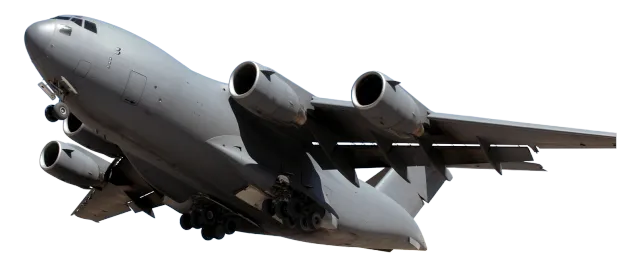
Transport & tanker
C-17 Globemaster III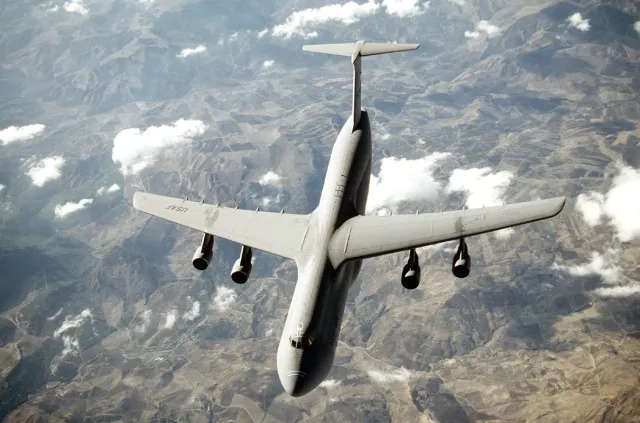
Transport & tanker
C-5M Super Galaxy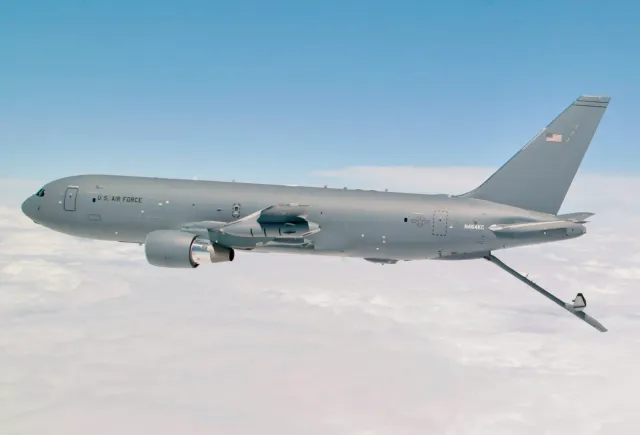
Transport & tanker
KC-46 Pegasus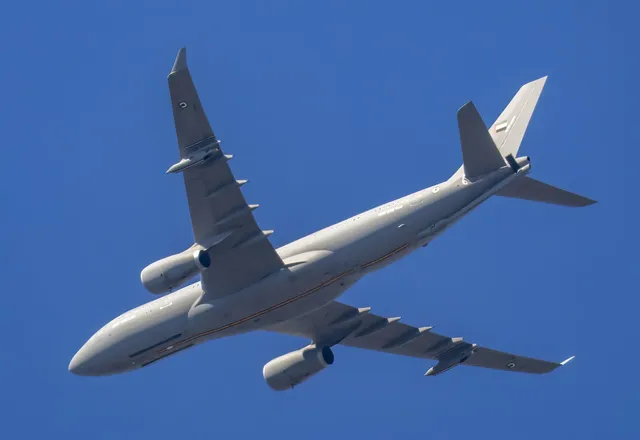
Transport & tanker
Embraer C-390 Millennium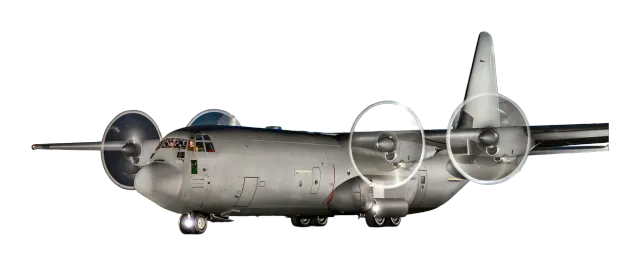
Transport & tanker
C-130J Super HerculesFrequently asked questions
Which transport aircraft carries the most cargo? +
By raw published payload, the Lockheed Martin C-5M Super Galaxy leads the WeaponSpecs database at 129,274 kg, well ahead of the Boeing C-17 Globemaster III at 77,519 kg. But raw payload and cargo moved per kilometer of range are different questions, and the C-17 wins the second one by a wide margin.
Why does the C-17 beat the C-5M on cargo per kilometer despite carrying less total cargo? +
The C-5M is built for long unrefueled range (12,800 km), which means more of its weight budget goes to internal fuel rather than cargo relative to the distance it's rated to fly. The C-17 is rated for a shorter 4,482 km range, so proportionally more of its design effort goes toward moving cargo over each kilometer it's built to cover: 17.3 kg/km against the C-5M's 10.1 kg/km.
Is the KC-46 Pegasus a worse cargo hauler than the C-17? +
Not really, they're built for different missions. The KC-46 is primarily an aerial refueling tanker with a secondary cargo role, designed around a 12,200 km unrefueled range that eats into its payload-to-range ratio. Judging it as a pure airlifter against the C-17 misreads what it was designed to do.
Are the C-390 and KC-390 the same aircraft in the WeaponSpecs database? +
Yes. Embraer's C-390/KC-390 Millennium appears twice, as embraer-c-390 and embraer-kc-390-transport, both citing the same Wikipedia source and each listing the other as an alias. The two records pair the same 26,000 kg payload figure with two different range numbers, 5,020 km and 2,820 km, which turns out to be a real data-integrity bug, not two different aircraft.
What's the real difference between a strategic and a tactical tanker-transport? +
Design range and the mission it implies. Strategic tanker-transports like the KC-46 and A330 MRTT are built for very long unrefueled range to support operations far from a home base, which pulls their cargo-per-km ratio down to 2.4-3.0. A tactical tanker-transport like the KC-390 is built for shorter, austere-airfield operations, the kind Northrop Grumman's Tom Jones called agile combat employment, and it posts a 9.2 ratio, closer to a pure tactical airlifter than to the strategic tankers it shares a category label with.
Related reading

