AI Jet Flies 27 Autonomous Intercepts on Live Sensor Data
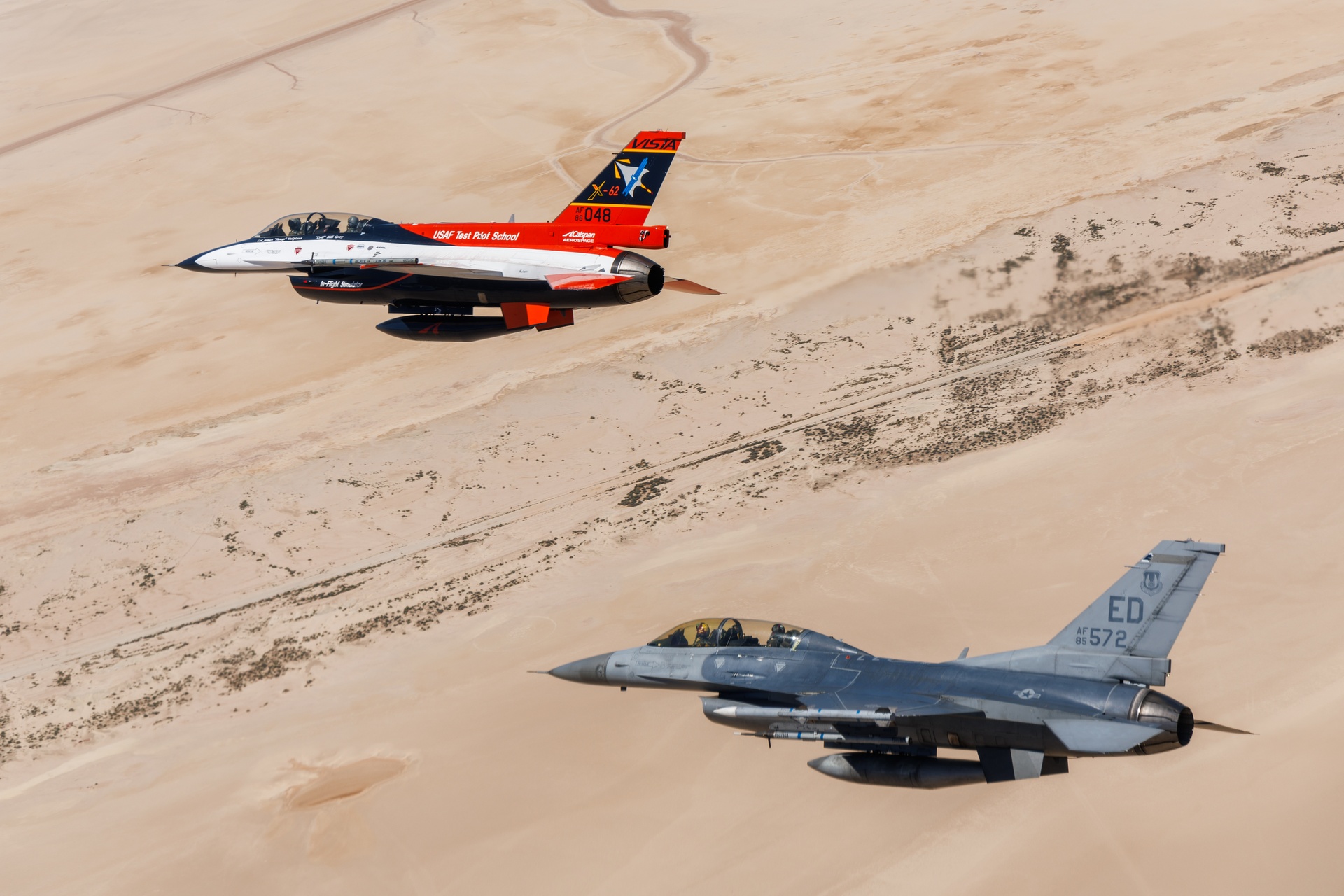
Lockheed and the Air Force had an AI agent fly the X-62A VISTA through 27 real intercepts using live infrared data, not simulated feeds.

U.S. Air Force photo by Richard Gonzales, DVIDS, public domain
An AI agent flew the Air Force’s X-62A VISTA test aircraft through 27 autonomous, AI-controlled intercepts across 8 flights at Edwards Air Force Base in April 2026, using live infrared sensor data in real time rather than simulated inputs, Lockheed Martin and the Air Force disclosed this week. The program, named HAVE HEAT, is described by both organizations as the first time an AI agent has consumed real-world sensor data, not a synthetic feed, to independently detect, track and pursue a target aircraft it had no data connection to.
What HAVE HEAT tested, and where
The tests ran at Edwards Air Force Base, California, in April 2026, though Lockheed and the Air Force did not disclose the results publicly until August 4 and 5. Across 8 flights, an AI agent controlling the X-62A VISTA, a heavily modified two-seat NF-16D long used by the Air Force Test Pilot School for in-flight simulation work, executed 27 autonomous intercepts against a live T-38 Talon acting as an adversary aircraft. The sensor that made it possible was Lockheed Martin’s Legion Pod, an infrared search-and-track system that detects and tracks targets passively, without emitting a radar signal an adversary could detect or jam.
Ron Fehlen, Vice President and General Manager of Lockheed Martin Skunk Works, described what the AI was actually doing with that data:
“Our autonomous agents consumed classified infrared search and track feeds and executed combat-critical maneuvers in real time,” said Ron Fehlen, Vice President and General Manager, Lockheed Martin Skunk Works (Lockheed Martin press release, August 4, 2026).
The companion effort, HAVE HOLIDAY, integrated the modular software and new sensor-processing hardware into the X-62’s Enterprise Open Mission System Architecture computer, including updated safety constraints, the plumbing that let the Legion Pod’s live feed actually reach the autonomy stack controlling the aircraft. Lockheed and the Air Force put the development timeline for this specific capability at roughly three months.
Why “live sensor data” is the actual headline, not the intercept count
Twenty-seven intercepts is a real number, but the more consequential detail is what the AI was reacting to. The Air Force’s widely covered 2024 demonstration, in which the X-62A flew a simulated dogfight against a human-piloted F-16, later turned out to rely on the two aircraft directly exchanging position data throughout the engagement, a cooperative data link. The War Zone’s reporting frames that as a genuine limitation: an AI that only works when its target is sharing its own location isn’t yet proven against a genuinely non-cooperative threat, which is the entire premise of a real adversary.
HAVE HEAT is built to close exactly that gap. The T-38 target’s position in these tests was independently sensed through the Legion Pod’s infrared feed, not transmitted to the X-62A over a data link, meaning the AI had to actually find and track the target the way it would need to against a real opponent. Stacy Kubicek, Vice President and General Manager of Lockheed Martin Sensors and Global Sustainment, framed the significance of that shift directly: “This project demonstrates how sensing and autonomous AI can come together as a force multiplier,” Kubicek said, adding that “the real advantage comes when that data can connect seamlessly with AI to take action,” according to Lockheed Martin’s August 4 release, corroborated by DefenseScoop’s August 5 report.
The Air Force Test Pilot School’s role, and what comes next
Lt. Col. Joshua Strafaccia, faculty dean at the Air Force Test Pilot School, situated the test within the broader autonomy push: “HAVE HEAT represents a meaningful expansion of avionics capability towards integrated, AI-driven control,” Strafaccia said, according to DefenseScoop’s August 5 report. Air Force Test Pilot School commandant Col. Maryann Karlen separately emphasized the cross-team collaboration behind the effort, according to the same report.
Both Lockheed and the Air Force tie this work explicitly to the Collaborative Combat Aircraft program, the Air Force’s planned fleet of uncrewed, autonomous “wingman” drones intended to fly alongside crewed fighters, with fielding targeted around 2030. The X-62A itself will never be a combat aircraft; its role is to de-risk the sensor and autonomy stack that CCA drones will eventually need to fly with. A comparable effort is underway elsewhere in the industry: General Atomics has separately flown an MQ-20 Avenger equipped with a similar sensor pod in an AI-driven mock dogfight, a parallel data point rather than a competing claim about this specific test. Planned next steps for the X-62A program include integrating RTX’s PhantomStrike radar alongside expanded computing and networking, to test multiple sensors and combat systems operating together rather than the single infrared feed used in HAVE HEAT.
Sources
- Skunk Works Advances Sensor-Powered AI Fighter Intercept — Lockheed Martin, Aug 4, 2026
- Air Force expands autonomous flight tests with live, AI-enabled intercepts — DefenseScoop, Aug 5, 2026
- X-62A Toting Infrared Search And Track Pod Used Its AI 'Brain' To Autonomously Intercept An 'Enemy' T-38 — The War Zone, Aug 4, 2026
Frequently asked questions
What did the X-62A actually do? +
In April 2026 tests at Edwards Air Force Base, an AI agent flew the X-62A VISTA test aircraft through 27 autonomous, AI-controlled intercepts across 8 flights against a live T-38 target, using real-time infrared sensor data rather than simulated inputs to detect and pursue the target.
Why does using live sensor data instead of simulated data matter? +
Earlier autonomy demonstrations, including a widely reported 2024 AI-versus-human dogfight, relied on a data link between the two aircraft. This test is presented as the first to have the AI act purely on independently sensed infrared data against a target it wasn't data-linked to, a closer approximation of a real, non-cooperative adversary.
What is this actually being built toward? +
The Air Force and Lockheed frame HAVE HEAT and its companion HAVE HOLIDAY software and hardware integration effort as groundwork for the Collaborative Combat Aircraft program, uncrewed autonomous "wingman" drones the Air Force plans to begin fielding around 2030.
What sensor made this possible? +
Lockheed Martin's Legion Pod, an infrared search-and-track system that can detect and track targets passively, without emitting a radar signal that could be jammed or detected.
More news


