155mm Dominates Artillery Calibers, Not Interoperability
155mm arms 21 of 33 gun and mortar platforms in our database, more non-NATO countries than NATO ones, yet the caliber still isn't one true standard.

Via Wikipedia, K9 Thunder (shown for identification)
Of the 53 artillery systems in the WeaponSpecs database, 48 (91%) publish a caliber figure. Strip out the 13 rocket and MLRS launchers, whose “caliber” measures a rocket body’s diameter, and the 2 guided precision shells that are ammunition rather than platforms, and 33 real gun-tube and mortar systems remain. Of those, 21 (64%) are built to 155mm, NATO’s Joint Ballistics MoU standard bore. Those 21 systems come from 16 different countries split almost evenly, 7 NATO members and 9 non-NATO states, which is the actual story here: 155mm has become the default caliber for anyone building modern artillery, not a badge of alliance membership. But sharing a bore diameter is not the same as sharing a supply chain, and that gap is where the second half of this piece lives.
Which caliber actually dominates modern artillery?
“Caliber” looks like a single, comparable field until you separate what it’s actually measuring. On a gun tube or mortar, caliber is bore diameter, the shell’s own width. On a rocket or MLRS launcher, caliber is the rocket body’s diameter, a number driven by motor volume rather than a barrel’s chamber. And on a guided precision shell like the M982 Excalibur or the Vulcano round, caliber describes ammunition designed to fit an existing gun, not a platform at all. Mixing all three into one “artillery caliber” ranking would be comparing three different kinds of hardware as if they were the same measurement, which is exactly the trap a raw database export sets for anyone who doesn’t separate the categories first.
Restrict the field to the 33 systems that are genuinely gun-tube howitzers or mortars, and a clear leader emerges: 21 of them, 64%, are chambered for 155mm, the bore NATO’s Joint Ballistics MoU and STANAG 4425 standardized decades ago.2 What makes that 64% figure worth a second look is who is building to it. Those 21 systems trace back to 16 different countries, and the split is close to even: 7 NATO members (the United States, United Kingdom, France, Poland, Turkey, Germany, Sweden) and 9 non-NATO states (India, Ukraine, Israel, South Africa, South Korea, Serbia, China, Singapore, Japan). South Korea’s 155mm K9 Thunder, Serbia’s Nora B-52, Singapore’s Primus SSPH 1 and China’s PLZ-05 and PCL-181 are all built to the same bore as Germany’s PzH 2000 or France’s CAESAR, with no treaty obligation forcing any of them there. Export economics and ammunition-supply gravity did the work that alliance membership didn’t have to.
One clarifying wrinkle on the NATO side of that count: Sweden only formally joined NATO on March 7, 2024,4 so its Archer Artillery System spent most of its service life as a non-NATO 155mm platform and only recently flipped columns in a count like this one.
"Other" combines four single-example calibers, one system each: 105mm (UK's L118 Light Gun), 122mm (Russia's 2S1 Gvozdika), 203mm (Russia's 2S7 Pion) and 240mm (Russia's 2S4 Tyulpan mortar). 120mm's two mortars are shown in their own row.
Why does Russia still build to 152mm?
Six of the 33 platforms, 18%, hold to the old Soviet 152mm bore: Russia’s 2A65 Msta-B, 2S19 Msta-S, 2S3 Akatsiya, 152mm 2S35 Koalitsiya-SV, and 2S5 Giatsint-S, plus the Czech Republic’s 152mm DANA. Every one of those Russian figures is a manufacturer or state claim, not independently verified, and should be read as such.
The 152mm holdout is not really a mystery. Russia’s artillery industrial base, and the ammunition stockpiles that feed it, were built around that bore across generations of the same gun family, and nothing in Russia’s export market or doctrine has ever forced a switch. The genuine anomaly sits in the Czech Republic. Prague has been a NATO member since 1999, more than a quarter-century, yet its DANA howitzer is still tagged 152mm in the WeaponSpecs database, a Warsaw-Pact-caliber gun still on the books of an alliance built around the opposite standard. It’s legacy stock that never got swapped for a 155mm platform, not a policy choice anyone would design from scratch today.
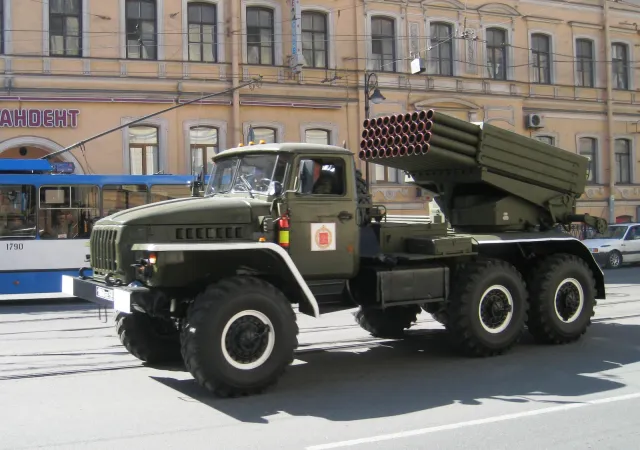
A smaller coincidence worth a single sentence: the number “122” shows up twice in the caliber census for two unrelated weapons, Russia’s 122mm 2S1 Gvozdika tube howitzer and Russia’s own 122mm BM-21 Grad rocket launcher, a reminder that a caliber field’s number describes the field, not the weapon behind it.
The remaining 6 of 33 gun and mortar platforms split across five minor calibers, the 2S1 Gvozdika named above among them: the UK’s L118 Light Gun at 105mm, Finland’s NEMO and Poland’s M120 Rak at 120mm (two systems), Russia’s 2S1 Gvozdika at 122mm, Russia’s 2S7 Pion at 203mm, and Russia’s 2S4 Tyulpan mortar at 240mm.
Does a shared caliber mean shared ammunition?
No, and that gap is the whole point of separating the platform census from the interoperability question. NATO and the Joint Ballistics MoU set a common 155mm chamber and projectile envelope decades ago, but full adoption of that standard has always been voluntary, and the war in Ukraine has made the practical consequences of that voluntariness impossible to ignore.
“NATO and JBMoU 155-millimeter howitzers and munitions are not truly interoperable,” wrote Maj. Eric Johnson, a US Army field artillery officer who served as an operational fires advisor with Security Assistance Group-Ukraine in 2024-2025 (Modern War Institute, Nov. 7, 2025).
Johnson’s account, drawn from his own time advising Ukrainian fires units, lays out the scale of the problem in a way a spec sheet never could. Ukraine alone operates seventeen different 155mm howitzer types sourced from NATO and non-NATO manufacturers, and manages nearly fifty different models of high-explosive shells for that fleet, on top of separate models of precision, smoke, and illumination rounds, plus multiple propellant-charge and fuze variants layered across all of it. Same caliber number stamped on the barrel and the shell casing, but propellant charge systems, fuze threads, chamber pressure ratings, and a projectile’s bourrelet geometry can all still differ enough that a shell built by one manufacturer is unsafe or simply won’t chamber in another manufacturer’s gun. A caliber figure on a spec sheet describes bore diameter. It does not describe interoperability, and treating the two as synonymous is exactly the assumption that leaves a supply officer juggling fifty shell types instead of one.
That distinction also clarifies where the two guided-shell entries in the database belong. The M982 Excalibur and Vulcano guided ammunition both list a 155mm caliber, but neither is a platform, they’re precision projectiles built to fire from existing 155mm-bore guns already in service. Their presence in a “155mm” caliber count is accurate to the field’s definition, chamber and projectile compatibility, but it’s a different kind of entry than a M777 or a PzH 2000, and worth separating out mentally even when the spec sheet lists them side by side.
The full artillery caliber census
The table below is every one of the 48 caliber-publishing systems in the WeaponSpecs artillery category, sorted by caliber. Every Russian and Chinese figure in it, range, rate of fire, and caliber alike, is a manufacturer or state claim, not independently verified, consistent with how WeaponSpecs treats every Russian and Chinese figure across the site.
| System | Country | Caliber | Category | Max range | Rate of fire |
|---|---|---|---|---|---|
| PHL-16 | China | 370 mm | Rocket/MLRS | 350 km | 1 rpm |
| 9A54 Tornado-S | Russia | 300 mm | Rocket/MLRS | 120 km | 12 rpm |
| BM-30 Smerch | Russia | 300 mm | Rocket/MLRS | 90 km | 12 rpm |
| TRG-300 Kaplan | Turkey | 300 mm | Rocket/MLRS | 120 km | 2 rpm |
| Vilkha-M | Ukraine | 300 mm | Rocket/MLRS | 130 km | N/A |
| 2S4 Tyulpan | Russia | 240 mm | Gun/mortar | 19.7 km | 1 rpm |
| TRG-230 | Turkey | 230 mm | Rocket/MLRS | 70 km | 4 rpm |
| GMLRS | United States | 227 mm | Rocket/MLRS | N/A | N/A |
| MARS II | Germany | 227 mm | Rocket/MLRS | 84 km | N/A |
| BM-27 Uragan | Russia | 220 mm | Rocket/MLRS | 35 km | 16 rpm |
| Bureviy | Ukraine | 220 mm | Rocket/MLRS | 65 km | N/A |
| TOS-1A Solntsepyok | Russia | 220 mm | Rocket/MLRS | 6 km | 24 rpm |
| Pinaka | India | 214 mm | Rocket/MLRS | 90 km | 12 rpm |
| 2S7 Pion | Russia | 203 mm | Gun/mortar | 47.5 km | 2 rpm |
| 155/52 Mounted Gun System | India | 155 mm | Gun/mortar | N/A | N/A |
| 2S22 Bohdana | Ukraine | 155 mm | Gun/mortar | 42 km | 6 rpm |
| AHS Krab | Poland | 155 mm | Gun/mortar | 40 km | 6 rpm |
| Archer Artillery System | Sweden | 155 mm | Gun/mortar | 60 km | 8 rpm |
| AS-90 | United Kingdom | 155 mm | Gun/mortar | 24.7 km | 6 rpm |
| ATMOS 2000 | Israel | 155 mm | Gun/mortar | 41 km | 4 rpm |
| CAESAR | France | 155 mm | Gun/mortar | 42 km | 6 rpm |
| Dhanush | India | 155 mm | Gun/mortar | 38 km | 3 rpm |
| G6 Rhino | South Africa | 155 mm | Gun/mortar | 50 km | 4 rpm |
| K9 Thunder | South Korea | 155 mm | Gun/mortar | 54 km | 6 rpm |
| M109A7 Paladin | United States | 155 mm | Gun/mortar | 30 km | 4 rpm |
| M777 Howitzer | United States | 155 mm | Gun/mortar | 40 km | 5 rpm |
| M982 Excalibur | United States | 155 mm | Guided shell | N/A | N/A |
| Nora B-52 | Serbia | 155 mm | Gun/mortar | 41 km | 6 rpm |
| PCL-181 | China | 155 mm | Gun/mortar | 53 km | 6 rpm |
| PLZ-05 | China | 155 mm | Gun/mortar | 53 km | 8 rpm |
| Primus SSPH 1 | Singapore | 155 mm | Gun/mortar | 30 km | 6 rpm |
| PzH 2000 | Germany | 155 mm | Gun/mortar | 40 km | 10 rpm |
| RCH 155 | Germany | 155 mm | Gun/mortar | 40 km | 5 rpm |
| SH16A | China | 155 mm | Gun/mortar | 56 km | N/A |
| T-155 Fırtına | Turkey | 155 mm | Gun/mortar | 40 km | 6 rpm |
| Type 99 155mm Self-Propelled Howitzer | Japan | 155 mm | Gun/mortar | 30 km | 6 rpm |
| Vulcano 155mm guided ammunition | Italy | 155 mm | Guided shell | 70 km | N/A |
| 2A65 Msta-B (towed variant) | Russia | 152 mm | Gun/mortar | 24.7 km | 8 rpm |
| 2S19 Msta-S | Russia | 152 mm | Gun/mortar | 29 km | 7 rpm |
| 2S3 Akatsiya | Russia | 152 mm | Gun/mortar | 20 km | 4 rpm |
| 2S35 Koalitsiya-SV | Russia | 152 mm | Gun/mortar | 70 km | 16 rpm |
| 2S5 Giatsint-S | Russia | 152 mm | Gun/mortar | 30 km | 6 rpm |
| DANA | Czech Republic | 152 mm | Gun/mortar | 20 km | 3 rpm |
| 2S1 Gvozdika | Russia | 122 mm | Gun/mortar | 21.9 km | 5 rpm |
| BM-21 Grad | Russia | 122 mm | Rocket/MLRS | 20 km | 40 rpm |
| M120 Rak | Poland | 120 mm | Gun/mortar | 12 km | 8 rpm |
| NEMO | Finland | 120 mm | Gun/mortar | 10 km | 10 rpm |
| L118 Light Gun | United Kingdom | 105 mm | Gun/mortar | 17.2 km | 6 rpm |
The buyer’s actual takeaway
A caliber field tells a procurement officer what a gun can chamber, not what it can be resupplied with in the field. 155mm’s near-even 7-NATO/9-non-NATO split confirms it’s the closest thing modern artillery has to a global default bore, but Maj. Johnson’s seventeen-howitzer, fifty-shell reality in Ukraine is the reminder that “same caliber” is a starting point for logistics planning, not the end of it.
Browse the full artillery systems type page for every platform in this census, run a side-by-side in Compare to weigh two specific 155mm systems against each other, or read our earlier breakdown of the range gap between tube howitzers and rocket artillery and what rate of fire actually means on an artillery spec sheet for the rest of the caliber-adjacent story.
Sources
Systems in this comparison
Every system covered above, with its photo and, where available, a video. Tap a card to open the full spec sheet.
Compare these side by side →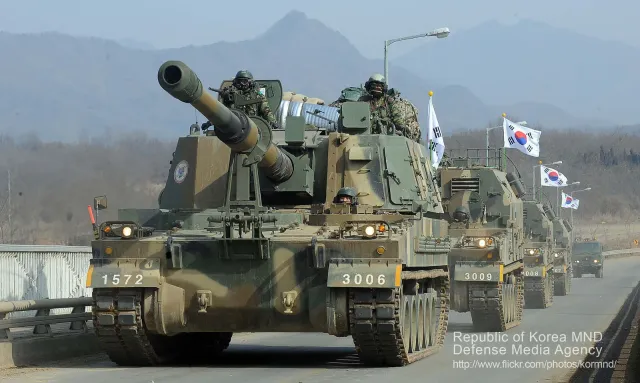
Artillery & MLRS
K9 Thunder
Artillery & MLRS
2S35 Koalitsiya-SV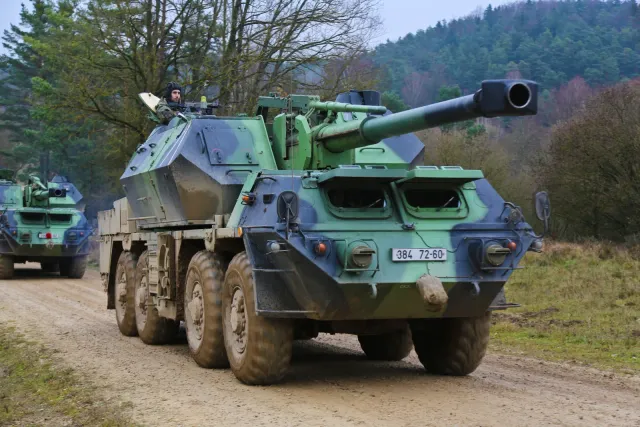
Artillery & MLRS
BM-21 GradFrequently asked questions
Why does 155mm dominate modern artillery calibers? +
NATO's Joint Ballistics MoU and STANAG 4425 set a shared 155mm chamber and projectile envelope for both 39-caliber and 52-caliber barrel lengths, giving manufacturers a common target to design around. Non-NATO makers from South Korea to China to Serbia adopted the same bore because it is the caliber the global export and ammunition-supply market already runs on, not because any alliance required it of them.
Does sharing the 155mm caliber mean two countries' howitzers can use the same shells? +
Not automatically. Ukraine alone fields seventeen different 155mm howitzer types from NATO and non-NATO manufacturers, and manages nearly fifty models of high-explosive shells plus multiple propellant charges and fuzes across that fleet. Adoption of the full NATO/JBMoU standard is voluntary, so a shared caliber number does not guarantee ammunition compatibility.
Why does Russia still use a 152mm gun instead of switching to 155mm? +
A legacy Soviet-era industrial base and deep ammunition stockpiles built around the 152mm bore, across the 2A65/2A64/D-22/2A88/2A37 gun family, gave Russia no practical or export pressure to convert. The Czech Republic is the notable anomaly: a NATO member since 1999 whose DANA howitzer still fields the Soviet-bore round, legacy stock that never got swapped for a 155mm platform.
Is the M982 Excalibur or Vulcano guided shell really a '155mm artillery system'? +
No. Both are precision-guided projectiles fired from existing 155mm-bore guns, not standalone platforms. The database's caliberMm field captures chamber and projectile compatibility, which is why ammunition and gun platforms both show up under the same number even though only one of them is a weapon system in its own right.
What's the real difference between a '155mm' howitzer and a '300mm' rocket system, if both get called artillery calibers? +
A gun tube's caliber is its bore diameter, sized to a shell accelerated by a propellant charge that burns out in milliseconds inside a fixed barrel. A rocket system's caliber is the rocket body's own diameter, and its motor keeps burning and accelerating well after leaving the tube, which is why rocket calibers run two to three times larger than gun calibers for a completely different reason. See our full breakdown of the [range gap between tube howitzers and rocket artillery](/blog/artillery-range-gap-howitzers-vs-rockets/).
Related reading


