Army Locks In $58.6B Lockheed Deal to Triple Patriot Output
The Army converted an emergency Patriot order into a seven-year, $58.6B deal with Lockheed Martin, the largest PAC-3 contract ever, tripling interceptor output by 2030.

U.S. Army photo by Maj. Nicholas Chopp, 94th Army Air and Missile Defense Command, via DVIDS, public domain (Valiant Shield 22, June 15, 2022)
The US Army has turned a $4.7 billion emergency munitions order into a seven-year, $58.6 billion multiyear contract with Lockheed Martin for PAC-3 MSE interceptors, the largest Patriot-related contract ever awarded, and one built explicitly to triple the missile’s production capacity by the end of 2030.
From emergency buy to seven-year commitment
The award, finalized July 29, 2026, builds on a much smaller $4.7 billion undefinitized contract action the Army issued in April, a mechanism used to start production quickly while contract terms are still being finalized. That interim deal has now been converted and expanded into a definitized seven-year multiyear procurement agreement covering fiscal years 2026 through 2032, adding $53.86 billion on top of the April figure for a combined total of roughly $58.62 billion. Multiyear procurement contracts are relatively rare in defense acquisition because they require Congress to authorize spending commitments across several budget cycles at once, in exchange for lower unit costs and a guarantee to industry that demand will not disappear year to year. Applying the tool to a single interceptor missile at this scale signals how central PAC-3 MSE has become to current US and allied defense posture.
The PAC-3 MSE (Missile Segment Enhancement) is the current-production interceptor for the MIM-104 Patriot air-defense system. It is worth being precise about who builds what here: Lockheed Martin manufactures the PAC-3 MSE interceptor itself, while the Patriot system prime contractor, the radar, launchers and battle-management software the interceptor plugs into, is RTX’s Raytheon business. This $58.6 billion award is a Lockheed Martin munitions deal, not a Raytheon systems deal. PAC-3 MSE uses hit-to-kill technology, physically colliding with an incoming target rather than detonating a proximity-fused warhead near it, favored by the Missile Defense Agency and Army for its precision against ballistic-missile threats. Patriot batteries built around this interceptor are fielded by the US Army and exported to more than a dozen countries.
Why the stockpile emptied out
The contract’s scale only makes sense against what has been happening to Patriot interceptor stocks over the past two years. The United States has been supplying substantial quantities of PAC-3 MSE and older PAC-2 GEM-T interceptors to Ukraine and other allies facing sustained missile and drone threats, while simultaneously expending its own munitions during the strike campaign against Iran, drawing both against the same finite production pipeline. WeaponSpecs has covered the sharpest edge of that shortage directly: on August 1, Ukraine’s Air Force reported it intercepted just one of 27 ballistic missiles fired at Kyiv in a single barrage, roughly a 4 percent intercept rate against precisely the missile class Patriot exists to stop, which President Zelenskyy attributed directly to running out of interceptors (see WeaponSpecs’ coverage of Kyiv’s Patriot interceptor shortage). This $58.6 billion contract is the industrial-base half of that same story, the Pentagon’s structural response to a shortage already visible on the ground in Ukraine.
That response falls under what the Department of War has been calling its Acquisition Transformation Strategy, an effort to buy critical munitions at what officials describe as wartime speed and scale rather than the peacetime procurement cadence the system was built around. Michael P. Duffey, Under Secretary of War for Acquisition and Sustainment, framed the deal in those terms.
“Today’s announcement turns concept into reality, providing industry with the long-term demand signals it needs to build a resilient supply chain, scale production, and deliver critical capabilities to our Warfighters at the speed of relevance,” said Michael P. Duffey, Under Secretary of War for Acquisition and Sustainment (Defence Industry Europe, U.S. Department of War expands Lockheed Martin PAC-3 MSE multiyear contract to $58.6 billion for interceptor production, July 30, 2026).
The “long-term demand signal” language matters beyond the press release. Missile production lines require specialized tooling, trained technicians and qualified subcomponent suppliers that cannot be spun up on a single-year contract, and manufacturers have historically been reluctant to invest in permanent capacity expansion against orders that could vanish the following budget cycle. A seven-year, $58.6 billion commitment removes that uncertainty, the mechanism by which a paper contract is supposed to translate into missiles actually rolling off a line faster.
What Lockheed is promising in return
Lockheed Martin has committed to tripling PAC-3 MSE production capacity by the end of 2030 under the deal. The company’s Camden, Arkansas facility, its primary PAC-3 manufacturing site, is expected to grow its workforce by roughly 50 percent, from about 1,200 employees to around 1,850, to support the ramp. Jim Taiclet, Lockheed Martin’s Chairman, President and CEO, described the scale of the commitment in similarly urgent terms to Duffey’s.
“This is a once-in-a-generation moment, and we are moving with wartime urgency to deliver the Arsenal of Freedom,” said Jim Taiclet, Lockheed Martin Chairman, President and CEO (Defence Industry Europe, U.S. Department of War expands Lockheed Martin PAC-3 MSE multiyear contract to $58.6 billion for interceptor production, July 30, 2026).
The PAC-3 MSE deal is not Lockheed’s only major munitions expansion underway. The company has referenced a broader $8 to $9 billion planned investment through 2030 spread across more than 20 facilities, and has separately signed a $35 billion contract tied to THAAD interceptor production expansion at its Troy, Alabama site, together describing a company reorganizing a meaningful share of its manufacturing footprint around sustained high-volume missile output. Whether that capacity actually materializes on the stated 2030 timeline, and whether it arrives fast enough to matter for allies drawing down stock today, are separate questions the contract itself cannot answer. Congress still controls annual appropriations even within a multiyear framework, and manufacturing ramps of this kind have a documented history of running behind schedule when qualified suppliers, not contract value, turn out to be the actual bottleneck.
The gap this doesn’t close
None of this changes the near-term math for units already drawing down inventory. A production line tripling capacity by 2030 does not put additional interceptors in the field in 2026 or 2027, which is precisely the window in which allied stockpiles are under the most visible strain. The contract is best read as the Pentagon’s answer to a multi-year structural problem, not an emergency fix for this winter’s shortages. For Ukraine specifically, whose Patriot batteries depend on the same finite global interceptor pool this contract is trying to expand, the practical effect of a 2030 capacity target is that any meaningful relief is still years away, a dynamic that continues to shape intercept rates in real time regardless of how large the contract’s headline number is.
Sources
- Army adds $54B to Lockheed PAC-3 agreement, totaling $59B — Breaking Defense, Jul 29, 2026
- U.S. Department of War expands Lockheed Martin PAC-3 MSE multiyear contract to $58.6 billion for interceptor production — Defence Industry Europe, Jul 30, 2026
Systems mentioned
Every system named in this story, with its photo and, where available, a video. Tap a card to open the full spec sheet.
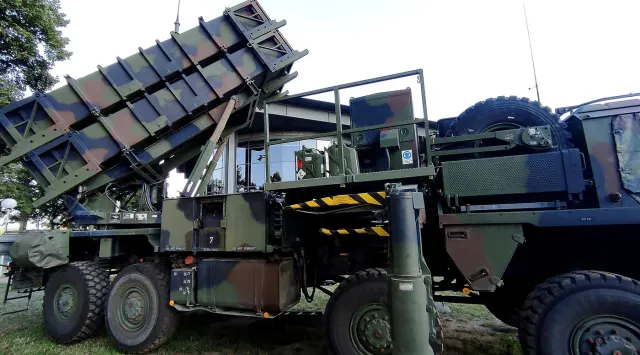
Air defense system
Patriot PAC-3Frequently asked questions
What is PAC-3 MSE? +
It is the current hit-to-kill interceptor missile for the Patriot air-defense system, built by Lockheed Martin, designed for higher-precision endo-atmospheric intercepts against ballistic missiles, cruise missiles and aircraft.
How big is this contract compared to past Patriot deals? +
At $58.6 billion it is described by multiple outlets as the largest PAC-3/Patriot contract ever awarded, superseding the $4.7 billion undefinitized contract action from April 2026.
Why now? +
It follows sustained drawdowns of Patriot interceptor stocks from supplying Ukraine and allies plus US strikes in the Iran campaign, and supports the Pentagon's push to buy munitions at wartime speed and scale.
What does it mean for production capacity? +
Lockheed says it will triple PAC-3 MSE manufacturing capacity by the end of 2030 and grow its Camden, Arkansas workforce by about 50 percent, from roughly 1,200 to 1,850 employees.
More news


