What 'Simultaneous Targets' Means on a SAM Spec Sheet
NASAMS claims 72 simultaneous targets, twice the S-400's 36, despite a 16th of its range. Across 41 systems, the number tracks radar architecture, not range.

Via Wikipedia, NASAMS (shown for identification)
Norway and Kongsberg-Raytheon’s NASAMS, a short-range, 25 km networked air-defense system, publishes a simultaneous-targets figure of 72. Russia’s flagship long-range S-400, reaching 400 km, publishes 36, exactly half. NASAMS is outranged 16 to 1 and still claims to hold twice as many targets at once. Across the 41 of WeaponSpecs’ 76 tracked air-defense systems that publish a simultaneousTargets figure, the correlation between that number and engagement range is essentially zero (Pearson r = 0.102, our analysis of the WeaponSpecs database). A system’s claimed range tells you almost nothing about how many targets it claims to handle at once. The number mostly encodes fire-control architecture, not raw system power, and buyers who read it as a power score are misreading the spec sheet.
How many air-defense systems even publish this number?
Of the 76 air-defense systems in the WeaponSpecs database, 41 (54%) publish a simultaneousTargets figure. The other 35 (46%) don’t publish one at all. That gap is worth noting on its own terms, an unpublished number isn’t necessarily a weaker system, some manufacturers withhold fire-control capacity for OPSEC reasons, and some spec sheets simply say “multiple” without a count. It is, however, a real hole in the public record, and it means any ranking built on this metric is a ranking of the 41 systems willing to publish it, not of all 76.
Why does a 25 km NASAMS battery out-rank a 400 km S-400 on “simultaneous targets”?
The answer is architecture, not power. NASAMS is a networked, distributed system: multiple independent AN/MPQ-64F1 Sentinel radars and missile-canister launchers spread across an area, tied together by Fire Distribution Centers that, per Wikipedia, “can form a network with geographically distributed sensors and use either centralised or distributed data fusion to process radar tracks.” Its missile, the AIM-120 AMRAAM, uses active radar homing, meaning it carries its own radar seeker and guides itself onto the target during the terminal phase after “using an inertial navigation system during initial approach.” The ground radar doesn’t have to keep illuminating the target all the way to intercept. That frees up many small, independent fire units to each juggle a handful of targets and sum to a large network-wide total: 72.
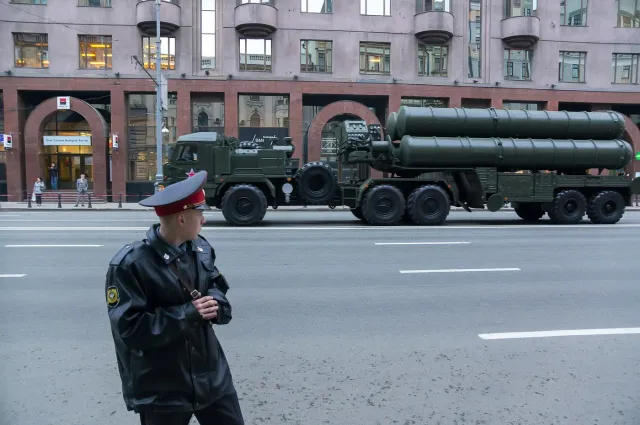
The S-400 is built the opposite way. One 92N6E fire-control radar per battery does the actual engagement guidance, while a separate 91N6E “Big Bird” acquisition radar handles long-range search and track, up to 300 targets at up to 600 km by multiple published accounts, but that is detection, not engagement. The 36-target figure is bounded by how many targets that one engagement radar and battery can actually guide missiles onto at once, not by how far the acquisition radar can see. Army Technology independently confirms the same split, describing a system that “can simultaneously engage 36 targets” while “simultaneously track[ing] up to 300 targets” with its multi-radar suite.
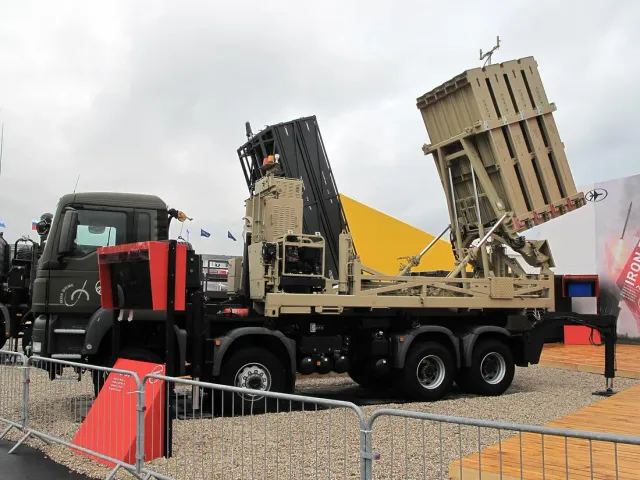
The same logic explains the rest of the field. THAAD publishes 24, bounded by a single AN/TPY-2 radar and battle-management channel per battery, the same single-radar-per-battery ceiling as the S-400, even though the AN/TPY-2 can hand off tracks to Aegis and Patriot in a layered defense. Iron Dome publishes 15, again one ELM-2084 radar per battery, but scaled for saturation rocket and rocket-artillery threats rather than the long dwell times a ballistic-missile intercept demands. Range and altitude describe the missile. Simultaneous targets describes the radar and battle-management architecture behind it, and a distributed network built around a self-guiding missile will always out-count a single powerful radar on this one metric, regardless of which system can actually reach farther or hit harder.
Is the S-400’s real number 36 or 72?
Both, and that’s the best illustration in this whole dataset of why a raw spec number needs a definition before it needs a comparison. Per Wikipedia’s S-400 article, the system’s own full-system figures are 36 simultaneously engaged targets and 72 simultaneously guided missiles, because standard S-400 doctrine fires two missiles at each target: 36 targets times 2 missiles equals 72 missiles in flight at once. So “72” appears on both NASAMS’ and the S-400’s spec sheets. On NASAMS, 72 means targets engaged. On the S-400, 72 means missiles guided, for half as many targets. Read the S-400’s 72 as a target count and you’ve doubled its real engagement capacity by mistake.
NASAMS' 72 and the S-400's 72 sit on the same axis of a spec sheet but count two different things, one a target, the other a missile, for half as many targets.
Does engagement range predict how many targets a system claims?
No, and the near-zero correlation (r = 0.102 across the 41 systems that publish both figures) shows up across the whole dataset, not just in the NASAMS-S-400 pair. The 600 km S-500 Prometheus, Russia’s longest-range system in this dataset, claims only 10 simultaneous targets. Israel’s SPYDER, engaging out to just 35 km, claims only 4. The UK’s Sky Sabre and Land Ceptor, both capped at 25 km, claim 24 each, matching Russia’s 400 km S-300V4. Range buys reach. It does not buy target count, because target count is set by how many independent radar channels the architecture puts in the field, not by how far any one of them can shoot.
How many of these figures are unverified state claims?
Nineteen of the 41 (46%), and every one of them gets WeaponSpecs’ state-claim caveat, not a pass as an independently verified figure. Twelve are Russian: S-400 Triumf, S-300PMU2 Favorit, S-300V4, Buk-M2, S-350 Vityaz, S-500 Prometheus, Buk-M3, Pantsir-SM, Pantsir-S1, Tor-M2, 9K33 Osa, and 9K35 Strela-10. Four are Chinese: HQ-9, HQ-22, HQ-16, and HQ-7. Three are Iranian: 15th Khordad, Khordad-3, and Azarakhsh. None of these 19 figures have been confirmed by an independent Western test agency or third party, they are the manufacturer’s or the state’s own number, and this piece treats them as claims throughout, the same standard applied to the S-400’s headline range in every other WeaponSpecs comparison.
The full dataset: simultaneous targets across 41 air-defense systems
| System | Country | Simultaneous targets | Engagement range | Engagement altitude |
|---|---|---|---|---|
| NASAMS | Norway | 72 | 25 km | 15,000 m |
| S-400 Triumf | Russia | 36 | 400 km | 30,000 m |
| S-300PMU2 Favorit | Russia | 36 | 195 km | 27,000 m |
| S-300V4 | Russia | 24 | 400 km | 30,000 m |
| THAAD | United States | 24 | 200 km | 150,000 m |
| Buk-M2 | Russia | 24 | 45 km | 25,000 m |
| Land Ceptor (CAMM) | United Kingdom | 24 | 25 km | 10,000 m |
| Sky Sabre | United Kingdom | 24 | 25 km | 10,000 m |
| Iron Dome | Israel | 15 | 70 km | 10,000 m |
| Arrow 3 | Israel | 14 | 2,400 km | 100,000 m |
| Arrow 2 | Israel | 14 | 90 km | 51,000 m |
| David’s Sling | Israel | 12 | 300 km | 15,000 m |
| S-350 Vityaz | Russia | 12 | 120 km | 30,000 m |
| S-500 Prometheus | Russia | 10 | 600 km | 200,000 m |
| Barak 8 | Israel | 10 | 150 km | 16,000 m |
| SAMP/T (Aster 30) | France | 10 | 120 km | 20,000 m |
| Patriot PAC-2 | United States | 8 | 160 km | 24,000 m |
| Patriot GEM-T | United States | 8 | 150 km | 24,000 m |
| Patriot PAC-3 | United States | 8 | 60 km | 24,000 m |
| IRIS-T SLM | Germany | 8 | 40 km | 20,000 m |
| HQ-9 | China | 6 | 200 km | 27,000 m |
| SİPER | Turkey | 6 | 150 km | 24,000 m |
| 15th Khordad | Iran | 6 | 120 km | 27,000 m |
| Buk-M3 | Russia | 6 | 70 km | 35,000 m |
| Cheongung II (KM-SAM Block II) | South Korea | 6 | 40 km | 20,000 m |
| VL MICA | France | 6 | 20 km | 9,000 m |
| HQ-22 | China | 4 | 100 km | 27,000 m |
| Khordad-3 | Iran | 4 | 75 km | 27,000 m |
| HQ-16 | China | 4 | 40 km | 18,000 m |
| SPYDER | Israel | 4 | 35 km | 16,000 m |
| Akash | India | 4 | 30 km | 18,000 m |
| Pantsir-SM | Russia | 4 | 30 km | 18,000 m |
| Azarakhsh | Iran | 4 | 25 km | 12,000 m |
| HISAR-O | Turkey | 4 | 25 km | 15,000 m |
| Pantsir-S1 | Russia | 4 | 20 km | 15,000 m |
| Tor-M2 | Russia | 4 | 16 km | 10,000 m |
| HISAR-A+ | Turkey | 4 | 15 km | 5,000 m |
| IRIS-T SLS | Germany | 4 | 12 km | 8,000 m |
| 9K33 Osa | Russia | 2 | 10 km | 5,000 m |
| HQ-7 | China | 1 | 15 km | 6,000 m |
| 9K35 Strela-10 | Russia | 1 | 5 km | 3,500 m |
What this means for a buyer
A “simultaneous targets” line on a spec sheet is not a leaderboard. It is a description of how the system’s radar and battle-management architecture is built, distributed network versus single powerful radar, self-guiding missile versus continuously illuminated one, saturation point-defense versus long-dwell strategic intercept. Comparing NASAMS’ 72 against the S-400’s 36 as if they were the same measurement, or reading the S-400’s own 72 as a second, bigger target count, gets a buyer to the wrong conclusion both times. Read the number against the mission it was built for, check whether it’s a state claim or an independently verifiable figure, and cross-reference it against the actual engagement envelope, not the raw digit. Model your own threat picture against these systems in the Advisor, map engagement envelopes directly with the Range Envelope tool, or browse the full air-defense category for every system in this dataset.
Sources
Systems in this comparison
Every system covered above, with its photo and, where available, a video. Tap a card to open the full spec sheet.
Compare these side by side →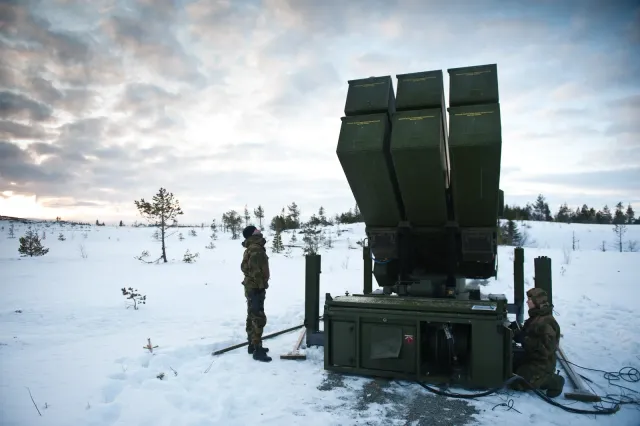
Air defense system
S-400 Triumf
Air defense system
David's Sling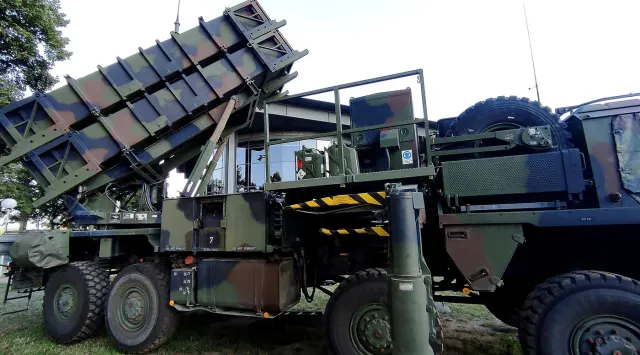
Air defense system
Patriot PAC-3Frequently asked questions
Why does NASAMS beat the S-400 on simultaneous targets despite far less range? +
Because the two numbers measure different things. NASAMS is a distributed network of independent AN/MPQ-64F1 Sentinel radars and launchers firing the active-radar-homing AIM-120 AMRAAM, so the missile guides itself in its terminal phase and many small fire units can each hold a handful of targets, summing to a large network-wide total. The S-400's 36 is bounded by how many targets a single 92N6E engagement radar per battery can guide missiles onto at once. Range measures how far a missile can fly. Simultaneous targets measures how the fire-control architecture is built. NASAMS wins on the second axis by design, not by being a more powerful system overall.
Is the S-400's real simultaneous-targets number 36 or 72? +
Both appear on its spec sheet and both are correct, they just count different things. The S-400's full-system figures are 36 simultaneously engaged targets and 72 simultaneously guided missiles, because standard doctrine fires two missiles per target, 36 targets times 2 missiles equals 72 missiles in flight at once. Confusing the two makes the S-400 look like it doubles its own engagement capacity when it does not; 72 is a missile count for half as many targets.
Are the Russian, Chinese, and Iranian figures in this dataset independently verified? +
No. Of the 41 air-defense systems in the WeaponSpecs database that publish a simultaneous-targets figure, 19 (46%) come from Russian, Chinese, or Iranian manufacturers or state sources, and none of those 19 have been independently verified by a Western test agency or third party. They are treated as manufacturer or state claims throughout this piece, not as facts.
Does a bigger simultaneous-targets number make a system better? +
No. It reflects mission tier and architecture, not overall capability. A networked, short-range point-defense battery like NASAMS is built to rack up a high target count across many distributed sensors. A single-radar, long-range strategic system like the S-400 or THAAD is built for long dwell times against harder, higher-value threats, and its engagement count is bounded by that one radar's channel capacity. Comparing the raw numbers across those two jobs tells a buyer nothing useful.
How many of the 76 air-defense systems in the database don't publish a simultaneous-targets figure at all? +
35 of 76 (46%) publish no simultaneous-targets figure. That is not necessarily a weakness, some manufacturers withhold fire-control capacity for OPSEC reasons, or the figure simply doesn't exist in public documentation. It is a real gap in the public record, and WeaponSpecs flags it as unknown rather than assuming zero or inferring a number.
Related reading


