How Many VLS Cells Does a Warship Actually Carry?
Sejong the Great publishes 128 VLS cells, ahead of Ticonderoga's 122 and Type 055's 112, but cell count isn't one comparable unit across navies.

U.S. Navy photo by Mass Communication Specialist 1st Class Brandon Raile, public domain, via Wikimedia Commons
South Korea’s Sejong the Great-class destroyer publishes 128 VLS cells in the WeaponSpecs database, the most of any of the 41 warships (of 71 total) that disclose a count, ahead of the US Navy’s Ticonderoga-class cruiser (122) and China’s newer Type 055 destroyer (112). But “VLS cells” is not one comparable unit, not across navies, and not even within Sejong’s own total: its 128 combines 80 US-standard Mark 41 cells with 48 entirely separate Korean K-VLS cells, two non-interchangeable launcher families added together into a single headline number. What follows is why that number needs a footnote every time it gets quoted as a firepower ranking.
Key takeaways:
- Sejong the Great-class destroyer publishes 128 VLS cells, the most of any warship with a disclosed count in the WeaponSpecs database, ahead of the US Ticonderoga-class cruiser (122) and China’s Type 055 destroyer (112).
- Only 41 of 71 warships (58%) in the database publish a VLS cell count at all.
- Sejong’s 128-cell total combines 80 US-standard Mark 41 cells with 48 separate Korean K-VLS cells, two non-interchangeable launcher families under one headline number.
- A single Mark 41 cell can hold up to four quad-packed RIM-162 ESSMs via the Mk 25 canister, so raw cell count undercounts missile-round capacity for ships loaded toward point defense.
- Russia’s Kirov-class battlecruiser, at 28,000 tons the largest surface combatant in the database, shows just 20 cells, a figure that reflects 20 angled P-700 Granit anti-ship missile tubes, not true vertical-launch cells.
What is a VLS cell, and why does the number get quoted as firepower?
A vertical launch system cell is an armored tube built into a ship’s deck that stores a missile and fires it straight up, rather than off an angled rail like older launcher designs. The Mark 41 vertical launching system is the closest thing the West has to an industry standard: more than 12,700 cells have been fielded across 26 ship classes and 13 navies since it entered service in the 1980s. That scale is exactly why “cell count” became shorthand for firepower in the first place, when most ships in a comparison are running the same launcher family, a bigger number really does mean more missiles.
The trouble is that VLS is not one system. China’s People’s Liberation Army Navy runs its own universal VLS. France and Italy’s Sylver family, South Korea’s K-VLS, and Russia’s older inclined tube launchers are all distinct hardware, with their own cell dimensions, their own missile compatibility lists, and no cross-loading between them. A “cell” on one ship is not interchangeable with a “cell” on another unless both are actually running the same launcher, per the general VLS overview on Wikipedia. Treating the number as a single global unit, the way a horsepower figure or a top speed figure can be, is the first assumption this piece is here to break.
Which warships publish the most VLS cells?
Sejong the Great leads the WeaponSpecs database at 128 cells, followed by Ticonderoga at 122 and Type 055 at 112. The next tier drops sharply: the Arleigh Burke-class destroyer and Japan’s Maya-class destroyer both carry 96, and the Zumwalt-class destroyer carries 80 in a launcher physically different from all of them, discussed below.
Kirov sits at the bottom of this list not because it is a weak ship, it is the largest surface combatant in the database, but because its "20" measures a different kind of launcher entirely.
Does one VLS cell always mean one missile?
No, and this is where a headline cell count actively misleads. A Mark 41 cell can carry one large missile like the SM-6 or Tomahawk, or it can carry up to four RIM-162 ESSM point-defense missiles quad-packed into the same tube using the Mk 25 quad-pack canister. Two ships with identical published cell counts can carry wildly different actual missile-round totals depending on how their magazine is loaded, and that loadout can change between deployments without the published cell number ever moving.
The US Navy’s own framing treats cells and missile inventory as separate quantities. “In the near term, I will tell you that we have plenty of VLS cells for the Tomahawk missiles that we have in inventory,” said Vice Admiral James Pitts, U.S. Navy Deputy Chief of Naval Operations for Warfighting Requirements and Capabilities, in comments reported by Naval News in January 2025. The statement only makes sense if cells and missiles are two different numbers being tracked separately, launch tube capacity on one side, missile stockpile on the other.
Cell size adds a second wrinkle. The Zumwalt-class destroyer’s 80 cells are not the same physical tube as an Arleigh Burke’s 96 Mark 41 cells. Zumwalt uses the Mark 57 Peripheral VLS, a larger-diameter cell arranged around the ship’s hull edge rather than clustered midship, purpose-built to eventually accommodate bigger next-generation weapons, including hypersonic missiles, that will not fit a standard Mark 41 tube. Comparing Zumwalt’s 80 to Arleigh Burke’s 96 as though they measure the same thing undercounts what each individual Zumwalt cell is actually built to hold.
Why does Sejong the Great’s headline number combine two systems?
Sejong the Great’s published 128 cells break down as 80 US-standard Mark 41 cells plus 48 separate Korean K-VLS cells, per the ship’s Wikipedia entry. These are two distinct launcher families: the Mark 41 cells fire US-compatible interceptors and strike weapons, while the K-VLS cells are built around Korean-developed missiles like the Hyunmoo cruise missile and K-ASROC anti-submarine rocket. A buyer reading “128 cells” and assuming a single homogeneous magazine, the way a 128-round ammunition count would work on a single gun, is making an assumption the number does not support. The ship’s real capability is two separate, smaller magazines running two separate missile families, summed into one number for the headline spec sheet.
Why does the largest ship in the comparison rank near the bottom?
The Kirov-class battlecruiser is the largest surface combatant in the WeaponSpecs database at 28,000 tons full load, roughly double the tonnage of the ships at the top of the cell-count chart. Its published cell figure is 20, near the bottom of this ranking. That is not because Kirov is lightly armed. It is because the “20” in the database reflects 20 angled P-700 Granit anti-ship missile tubes, launchers adapted from Soviet submarine-launched cruise missile systems, angled rather than vertical, and requiring the tube to be flooded with seawater before the missile can fire, per the ship’s Wikipedia entry and reporting on the class’s recent return to active service from The War Zone. That is a fundamentally different piece of hardware from a true vertical-launch cell, closer in mechanism to a torpedo tube than to a Mark 41.
Kirov’s actual air-defense armament, the S-300F Fort family, fires from an entirely separate rotary drum magazine below deck, a mechanism that isn’t counted in the “20” figure at all. So the single number in this database entry undercounts the ship’s real missile capacity on the air-defense side while overstating, by implying VLS-style flexibility, what its 20 anti-ship tubes can actually do. Treat both the P-700 tube count and the general silence around Fort’s magazine size as Russian-sourced figures, consistent with the state-claim caveat that applies to every Russian and Chinese entry in this comparison: Type 055’s 112 and Kirov’s 20 both come from open-source and Wikipedia reporting on state-controlled shipbuilders, not an independently audited Western inspection. Our own database’s Kirov entry is, in effect, a case study in exactly the confusion this piece set out to describe, not a clean cross-navy data point.
Full ranked list: 41 warships that publish a VLS cell count
30 of the 71 warships in the WeaponSpecs database do not publish a vlsCells figure at all, either because the ship uses a different launcher architecture entirely or the number simply isn’t public; this piece focuses on the 41 that do.
| System | Country | VLS cells | Full-load displacement | Status |
|---|---|---|---|---|
| Sejong the Great-class destroyer | South Korea | 128 | 10,000 t | active |
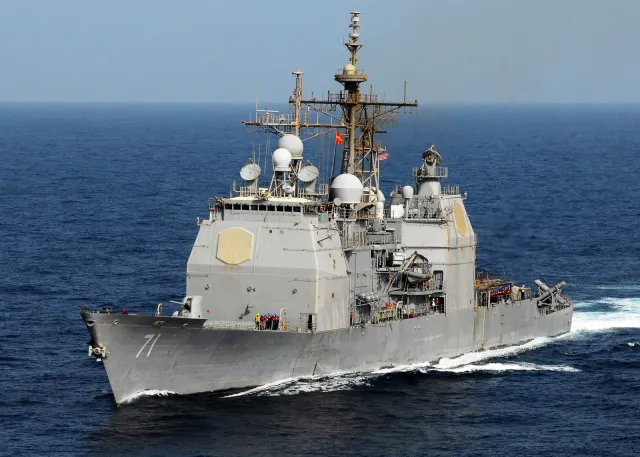
| Ticonderoga-class cruiser | United States | 122 | 9,800 t | legacy |
| Type 055 destroyer | China | 112 | 13,000 t | active |
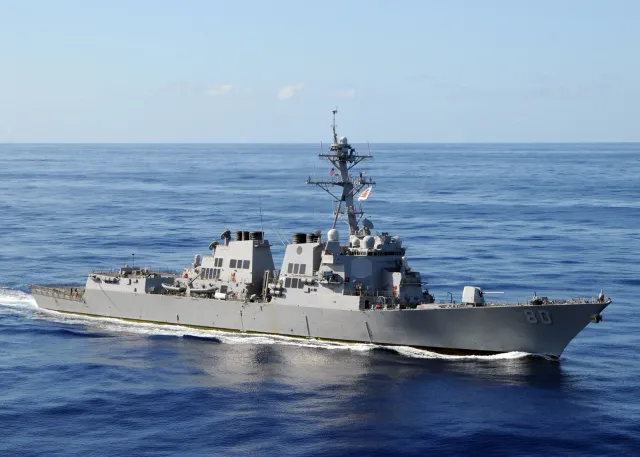
| Arleigh Burke-class destroyer | United States | 96 | 9,700 t | active |
| Maya-class destroyer | Japan | 96 | 10,250 t | active |
| Zumwalt-class destroyer | United States | 80 | 15,761 t | active |
| Type 052D destroyer | China | 64 | 7,500 t | active |
| Chungmugong Yi Sun-sin destroyer | South Korea | 56 | 6,520 t | active |
| Alvaro de Bazan F100 frigate | Spain | 48 | 6,250 t | active |
| Horizon-class frigate | France | 48 | 7,050 t | active |
| Horizon-class frigate (Italy) | Italy | 48 | 7,050 t | active |
| Type 26 City-class frigate | United Kingdom | 48 | 8,000 t | active |
| Type 45 Daring-class destroyer | United Kingdom | 48 | 8,500 t | active |
| De Zeven Provincien-class frigate | Netherlands | 40 | 6,300 t | active |
| Bonifaz F110 frigate | Spain | 32 | 6,250 t | announced |
| Constellation-class frigate | United States | 32 | 7,291 t | announced |
| Formidable-class frigate | Singapore | 32 | 3,600 t | active |
| FREMM frigate | France | 32 | 6,000 t | active |
| Hunter-class frigate | Australia | 32 | 8,800 t | announced |
| Iver Huitfeldt-class frigate | Denmark | 32 | 6,645 t | active |
| Kolkata-class destroyer | India | 32 | 7,500 t | active |
| Miecznik frigate | Poland | 32 | 6,000 t | announced |
| Nilgiri-class frigate | India | 32 | 6,670 t | active |
| Sa’ar 6-class corvette | Israel | 32 | 2,000 t | active |
| Sachsen-class frigate | Germany | 32 | 5,800 t | active |
| Type 054A frigate | China | 32 | 4,053 t | active |
| Type 23 Duke-class frigate | United Kingdom | 32 | 4,900 t | active |
| Type 31 Inspiration-class frigate | United Kingdom | 32 | 6,000 t | announced |
| Visakhapatnam-class destroyer | India | 32 | 7,400 t | active |
| Shivalik-class frigate | India | 24 | 6,200 t | active |
| Kirov-class battlecruiser | Russia | 20* | 28,000 t | active |
| Admiral Gorshkov-class frigate | Russia | 16 | 5,400 t | active |
| Daegu-class frigate | South Korea | 16 | 3,600 t | active |
| F126 frigate | Germany | 16 | 10,000 t | announced |
| FREMM Bergamini (Italy) | Italy | 16 | 6,900 t | active |
| Istif-class I frigate | Turkey | 16 | 3,200 t | active |
| Mogami-class frigate | Japan | 16 | 5,500 t | active |
| Thaon di Revel PPA | Italy | 16 | 6,250 t | active |
| Absalon-class frigate | Denmark | 12 | 6,300 t | active |
| Damen SIGMA frigate | Netherlands | 12 | 2,400 t | active |
| Dokdo-class LPH | South Korea | 4 | 19,500 t | active |
*Kirov’s 20 reflects angled P-700 Granit anti-ship tubes, not vertical-launch cells; see the section above.
The bottom line
A VLS cell count is a real number pulled from a real, disclosed spec sheet, and it is still not the clean, comparable firepower metric it gets treated as. Sejong the Great’s 128 beats everything else in this database, but it’s two launcher families stacked into one figure. A Mark 41 cell might hold one missile or four. Zumwalt’s 80 larger cells aren’t the same hardware as Arleigh Burke’s 96 smaller ones. And Kirov, the biggest hull in the entire comparison, posts one of the lowest numbers on the list because its “20” measures angled anti-ship tubes, not vertical launchers, while its actual air-defense magazine isn’t counted at all. Readers who want the launcher-family and missile-compatibility detail behind any single ship’s number should start from that system’s own page rather than the headline figure alone. Compare specific hulls side by side with the Compare tool, or browse the full warship category on WeaponSpecs for the underlying database this piece draws from.
Sources
- Mark 41 vertical launching system, Wikipedia
- RIM-162 ESSM, Wikipedia
- Kirov-class battlecruiser, Wikipedia
- Sejong the Great-class destroyer, Wikipedia
- Zumwalt-class destroyer, Wikipedia
- Type 055 destroyer, Wikipedia
- Ticonderoga-class cruiser, Wikipedia
- Arleigh Burke-class destroyer, Wikipedia
- Vertical launching system, Wikipedia
- U.S. Navy Comments on Future VLS Cell Count, Naval News, January 2025
- Russia's Upgraded Nuclear Battlecruiser Back At Sea After Nearly Three Decades, The War Zone
Systems in this comparison
Every system covered above, with its photo and, where available, a video. Tap a card to open the full spec sheet.
Compare these side by side →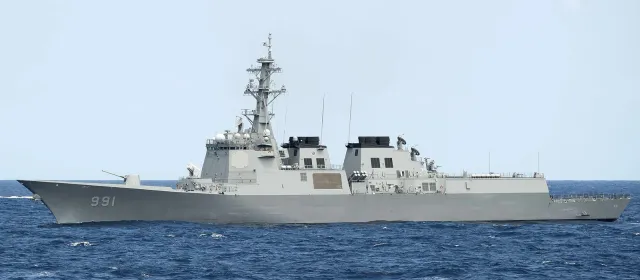
Warship
Ticonderoga-class Cruiser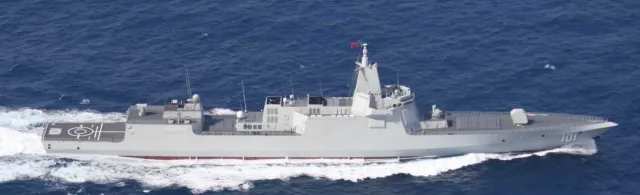
Warship
Arleigh Burke-class Destroyer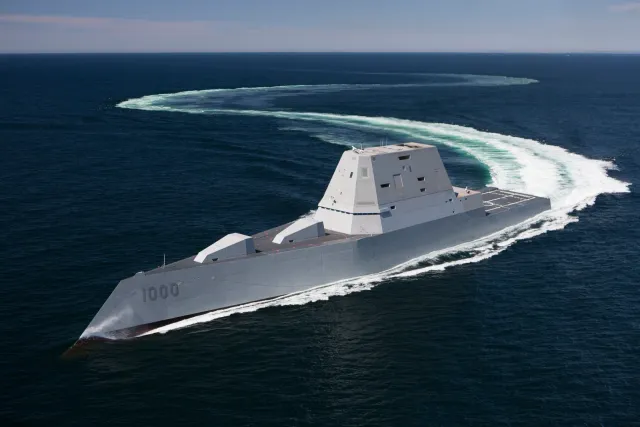
Warship
Zumwalt-class Destroyer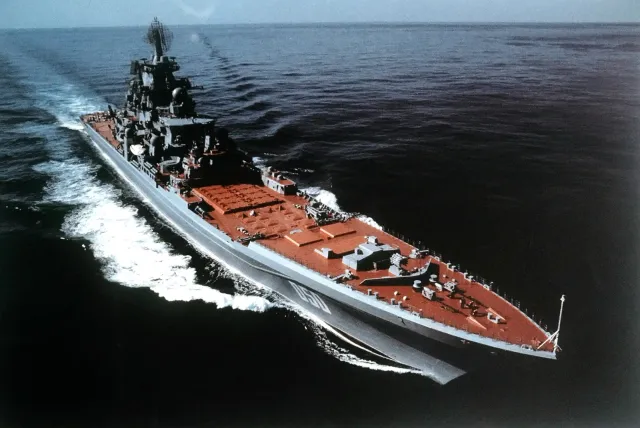
Warship
Kirov-classFrequently asked questions
What is a VLS cell? +
A vertical launch system (VLS) cell is an individual armored tube built into a warship's deck that stores and fires a missile straight up, rather than from an angled rail launcher. The US Mark 41 is the most widely used family, with more than 12,000 cells fielded across 26 ship classes and 13 navies, but China's universal VLS, France and Italy's Sylver, South Korea's K-VLS, and Russia's inclined tube launchers are separate, non-interchangeable systems, per the Mark 41's own Wikipedia entry.
Does more VLS cells mean more missiles? +
Not directly. A single Mark 41 cell holds one large missile like the SM-6, but up to four RIM-162 ESSM point-defense missiles can be quad-packed into one cell using the Mk 25 canister. A 96-cell Arleigh Burke loaded entirely for point defense could in theory carry far more missile rounds than its cell count suggests, while a ship loaded for long-range strike carries closer to one missile per cell.
Why does Sejong the Great's 128-cell total combine two different systems? +
The Sejong the Great-class destroyer's published 128 cells are actually 80 US-standard Mark 41 cells plus 48 separate Korean K-VLS cells. These are two distinct launcher families with different missile compatibility, added together into one headline number that reads as a single comparable figure but isn't.
Why does the Kirov-class battlecruiser rank near the bottom despite being the largest ship in the comparison? +
The Kirov-class battlecruiser's WeaponSpecs database entry lists 20 cells, but that figure reflects 20 angled P-700 Granit anti-ship missile tubes, tubes adapted from submarine launchers that require flooding with seawater before firing, not true vertical-launch cells. The ship's actual air-defense missiles, the S-300F Fort family, fire from a separate rotary magazine not counted in that number at all.
Which navies don't publish a VLS cell count at all? +
Only 41 of the 71 warships in the WeaponSpecs database publish a vlsCells figure, meaning 30 of 71 (42%) do not disclose one, either because the ship uses a different launch architecture entirely or because the figure simply isn't public.
Related reading


