Which Warship Packs the Most Missiles Per Ton?
Israel's Sa'ar 6 corvette packs 16.0 VLS cells per 1,000 tons, beating the Ticonderoga and Arleigh Burke classes despite a fifth of their size.

Via Wikipedia, Sa'ar 6-class corvette (shown for identification)
The Israeli Sa’ar 6 corvette packs 16.0 VLS cells per every 1,000 tons of displacement, the highest missile density of any warship in the WeaponSpecs database, ahead of the US Navy’s Ticonderoga-class cruiser (12.4) and Arleigh Burke-class destroyer (9.9), despite displacing roughly a fifth of their tonnage. That’s the headline from ranking all 41 warships in our database that publish both a VLS cell count and a displacement figure. But cell density isn’t missile count, and it isn’t a capability score, a distinction this piece treats as the whole point, not a footnote.
What does “missile density” actually measure?
Density here is a simple ratio: VLS cells divided by displacement in thousands of tons. A destroyer with 96 cells on a 9,700-ton hull scores 9.9. A corvette with 32 cells on a 2,000-ton hull scores 16.0. It’s a measure of how tightly a hull’s designers packed launch capacity relative to the steel around it, nothing more.
Of the 71 warships currently in the WeaponSpecs database, 41 publish both figures cleanly enough to compute this ratio. That’s the working dataset for this piece; ships missing either a VLS count or a displacement figure were excluded rather than estimated. Fleet-wide, the median density is 5.3 cells per 1,000 tons and the mean is 5.9, so anything above roughly 8 sits meaningfully above the pack.
One methodology caveat worth stating up front: navies don’t all report displacement the same way. Where the database records full-load displacement, that’s what’s used; where only standard displacement is published, that’s the fallback. The two bases aren’t always apples-to-apples, and that inconsistency is baked into every navy’s own public data, not something WeaponSpecs can correct after the fact.
Which warship packs the most missiles per ton?
Here’s the top 8 by density, in cells per 1,000 tons:
The lead bar belongs to the smallest hull on the chart: the Sa'ar 6 hits 16.0 by giving up hangar space, deep magazines, and endurance, not by outgunning the destroyers and cruisers stacked below it.
The Sa’ar 6 sits well clear of the field at 16.0, and the database figure may itself understate the ship’s real missile-cell total. Israel’s Sa’ar 6 corvette is reported to carry a separate 40-cell C-Dome point-defense VLS array in addition to the 32-cell Barak-8 array recorded in WeaponSpecs, per the Sa’ar 6-class corvette entry1. If that second array were folded into the ratio, the density figure would climb further. The 32-cell number used in this ranking is the conservative one.
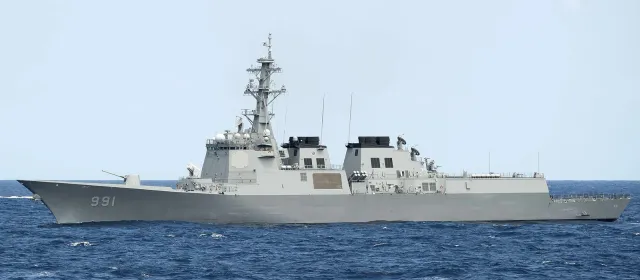
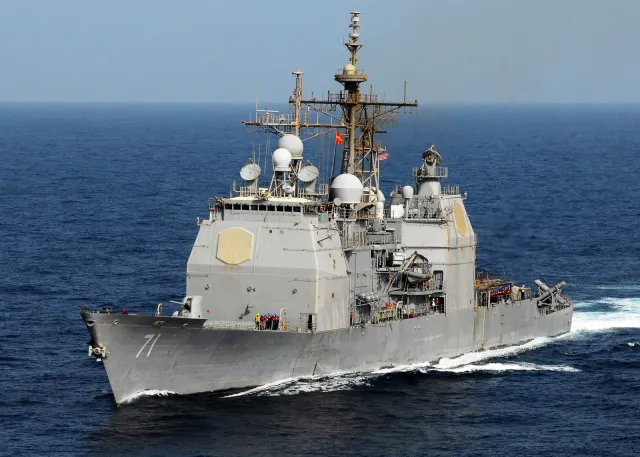
South Korea’s Sejong the Great-class destroyer and the US Navy’s Ticonderoga-class cruiser round out the next tier, both north of 12 cells per 1,000 tons despite carrying full destroyer- and cruiser-scale sensor suites and magazines. The Arleigh Burke-class destroyer, the most numerous surface combatant in the US fleet, sits at 9.9, a reminder that the Navy’s workhorse wasn’t built to maximize this particular ratio, it was built to balance density against range, sensors, and multi-mission flexibility.
Raw cell counts, not density, are what set US and Asian fleets apart from most of Europe. “One striking differential in terms of European navies’ capabilities concerns VLS capacity,” said Nick Childs, senior fellow for naval forces and maritime security at the International Institute for Strategic Studies (IISS), in a 2019 IISS analysis reported by The National Interest. “Most European platforms are built around a maximum forty-eight-cell VLS capability for their principal weapons systems. U.S. ships accommodate at least ninety cells, rising to 122 on the Ticonderoga.” Those absolute-cell numbers are a different measure than the per-1,000-ton density ratio used in this piece, a large hull can carry more cells while still posting modest density, but Childs’s point underlines why displacement-normalized comparisons matter: without them, a bigger ship’s raw cell count can look like an advantage the smaller, denser hull has already matched pound for pound.
Why does a 2,000-ton corvette out-density a cruiser five times its size?
Small, dense ships earn their density by giving something up. The Sa’ar 6 and Singapore’s Formidable-class frigate (8.9 cells per 1,000 tons) hit high density because they’re mission-focused hulls: no full hangar-and-flight-deck complex to speak of, no deep secondary-caliber magazines, shorter range and endurance, smaller crews with thinner damage-control margins, and sensor suites scaled to a corvette’s budget rather than a destroyer’s. Every ton not spent on those things is a ton that can go toward VLS cells instead.
The Ticonderoga and Arleigh Burke classes manage strong density and size at once for a different reason: the Aegis combat system was designed around the Mk 41 VLS from the outset, not retrofitted onto a hull built for something else. Per the Arleigh Burke-class destroyer’s own design history2, the ship and its launch cells were engineered together, which is part of why the class has stayed in production for decades with steadily updated combat systems rather than needing a hull redesign to add capacity.
Small combatants can chase a high ratio precisely because they have fewer competing demands on their tonnage. That’s an engineering tradeoff, not a superiority claim, and it’s the reason density numbers need to be read next to displacement, not instead of it.
What does low density actually mean?
At the other end of the scale sits Russia’s Kirov-class battlecruiser, just 0.7 cells per 1,000 tons, 20 cells on a 28,000-ton hull. That’s the lowest density among large combatants in the dataset, but it’s a legacy-design artifact, not a capability failing. The Kirov class was laid down in the 1970s and 80s, before the dense, modular VLS-per-ton doctrine that the Mk 41 popularized from the late 1980s onward became the design standard. Much of the Kirov’s tonnage instead goes to a nuclear propulsion plant, an unusually large sensor and command suite, and a broad mixed-caliber weapons fit rather than a single dense missile farm, per background on the class’s design and era3. As with any Russian-sourced performance figures elsewhere in this piece, treat those as manufacturer or state claims, not independently verified data.
Denmark’s Absalon-class frigate posts a similarly low 1.9, reflecting its flexible-deck design that trades dedicated VLS capacity for modular mission-bay space. And South Korea’s Dokdo-class amphibious assault ship scores just 0.2, 4 cells on 19,500 tons, but that’s a methodology caveat rather than a real finding: Dokdo is an amphibious assault and helicopter carrier, not a strike combatant, so its low density reflects a troop, vehicle, and helicopter-capacity mission, not a design shortfall. Comparing it to a destroyer on this metric is comparing the wrong category of ship.
The full ranked table
| Rank | Warship | Country | VLS Cells | Displacement (t) | Density (cells/1,000t) |
|---|---|---|---|---|---|
| 1 | Sa’ar 6 corvette | Israel | 32 | 2,000 | 16.0 |
| 2 | Sejong the Great-class destroyer | South Korea | 128 | 10,000 | 12.8 |
| 3 | Ticonderoga-class cruiser | United States | 122 | 9,800 | 12.4 |
| 4 | Arleigh Burke-class destroyer | United States | 96 | 9,700 | 9.9 |
| 5 | Maya-class destroyer | Japan | 96 | 10,250 | 9.4 |
| 6 | Formidable-class frigate | Singapore | 32 | 3,600 | 8.9 |
| 7 | Chungmugong Yi Sun-sin-class destroyer | South Korea | 56 | 6,520 | 8.6 |
| 8 | Type 055 destroyer* | China | 112 | 13,000 | 8.6 |
| 9 | Type 052D destroyer* | China | 64 | 7,500 | 8.5 |
| 10 | Type 054A frigate* | China | 32 | 4,053 | 7.9 |
| 11 | Alvaro de Bazan-class (F100) frigate | Spain | 48 | 6,250 | 7.7 |
| 12 | Horizon-class frigate | France | 48 | 7,050 | 6.8 |
| … | (fleet median: 5.3, mean: 5.9) | ||||
| 39 | Absalon-class frigate | Denmark | 12 | 6,300 | 1.9 |
| 40 | Kirov-class battlecruiser** | Russia | 20 | 28,000 | 0.7 |
| 41 | Dokdo-class amphibious assault ship (mission-mismatch, not a strike combatant) | South Korea | 4 | 19,500 | 0.2 |
*Chinese cell-count and displacement figures are state/manufacturer-sourced claims, not independently verified by a Western agency. **Russian figures are manufacturer/state claims, not independently verified.
The caveat that matters most
None of this ranking should be read as a firepower league table, and two mechanical facts explain why.
First, a VLS cell is not a missile. Many cells, including those built for the Evolved Sea Sparrow Missile and Israel’s C-Dome/Barak point-defense interceptors, can quad-pack: BAE Systems’ Mk 25 Quad-Pack canister lets a single Mk 41 VLS cell hold up to four ESSMs instead of one, according to Lockheed Martin’s Mk 41 VLS factsheet4 and the Mark 41 vertical launching system overview5. That means a raw cell-density number can undercount actual magazine depth, not overcount it, depending entirely on which missile a navy has loaded into which cell. The database tracks cells because that’s what’s publicly disclosed; real missile counts loaded at any given time are rarely published at all.
Second, density is an efficiency metric, not a quality or firepower metric. A corvette dense in short-range point-defense cells and a destroyer dense in long-range SM-6 or Standard-family cells can land near each other on this chart while doing entirely different jobs in a fleet. Don’t read “denser” as “deadlier.” And treat the Chinese entries in the top 10, the Type 055, Type 052D, and Type 054A, with the same skepticism WeaponSpecs applies to any Russian, Chinese, or Iranian state figure: published, not independently verified.
Where this leaves a buyer
For a full head-to-head that builds on these density numbers, including VLS launcher composition, radar, cost, and combat record, see Arleigh Burke vs Type 055 vs Sejong the Great. If you’re sizing a fleet’s strike-density profile rather than chasing a single headline ratio, run a side-by-side on the Sa’ar 6 vs Arleigh Burke comparison to see exactly what the smaller hull trades away for its density edge, or build a full threat and mission profile in the Advisor. For the broader class, browse every hull in the warship category on WeaponSpecs, and for more original-data columns like this one, see the WeaponSpecs articles archive.
Sources
Systems in this comparison
Every system covered above, with its photo and, where available, a video. Tap a card to open the full spec sheet.
Compare these side by side →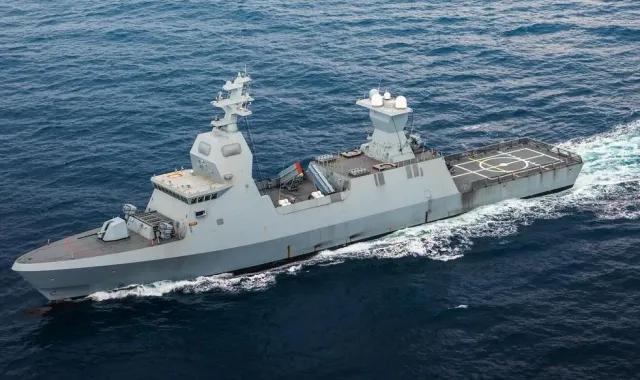
Warship
Ticonderoga-class Cruiser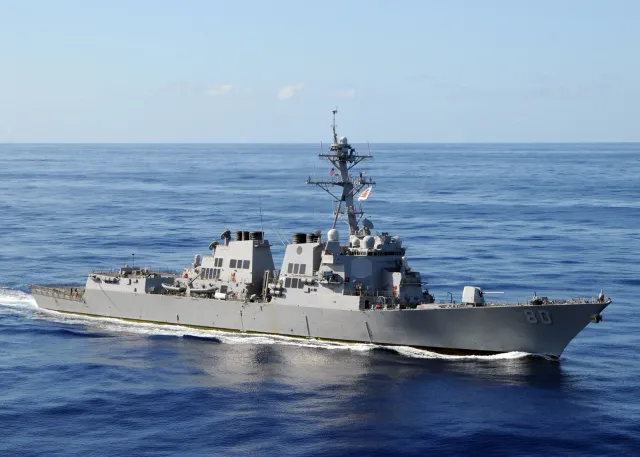
Warship
Arleigh Burke-class Destroyer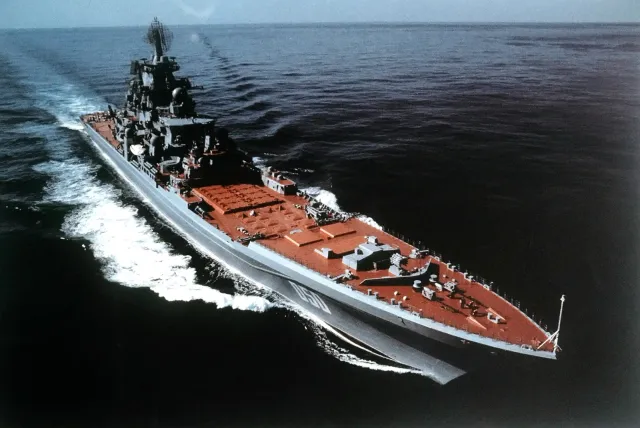
Warship
Kirov-class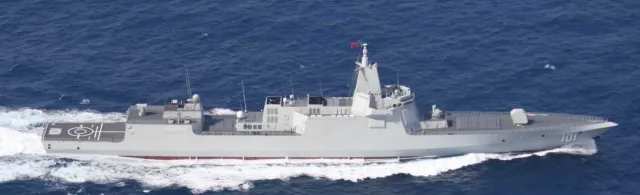
Frequently asked questions
What does missile density measure on a warship? +
Missile density, as used here, is VLS (vertical launch system) cell count divided by displacement in thousands of tons. It's a design-efficiency metric, how tightly a hull packs launch capacity relative to its size, not a measure of missile count, range, or combat power. A ship dense in short-range point-defense cells and a ship dense in long-range strike cells can post similar density scores while doing very different jobs.
Which warship has the highest missile density in the WeaponSpecs database? +
The Israeli Sa'ar 6 corvette leads at 16.0 VLS cells per 1,000 tons of displacement, 32 cells on a roughly 2,000-ton hull. That beats the US Navy's Ticonderoga-class cruiser (12.4) and Arleigh Burke-class destroyer (9.9), both of which displace roughly five times as much.
Why do Chinese warships need a caveat in this ranking? +
The Type 055, Type 052D, and Type 054A all place in the top 10 for density, but their published cell counts and displacement figures come from Chinese state and manufacturer sources. WeaponSpecs treats those as unverified claims rather than independently confirmed data, consistent with how the site handles all Russian, Chinese, and Iranian-sourced specs.
Does a higher missile density mean a more capable warship? +
No. Density is a packing-efficiency number, not a firepower or quality score. A corvette dense in short-range point-defense cells is not tactically equivalent to a destroyer dense in long-range SM-6 cells. High density can also reflect what a small hull gave up, hangar space, deep magazines, sensor suites, endurance, to fit the cells it has.
How does quad-packing affect these density numbers? +
Quad-pack canisters, like BAE Systems' Mk 25 for the Mk 41 VLS, let a single cell hold up to four Evolved Sea Sparrow Missiles instead of one. That means raw cell-count density can understate real magazine depth, not inflate it, depending on which missile is loaded in a given cell. A ship's true missile count can run well above its cell count.
Related reading


