NATO Puts 650 Troops, Dozens of C-UAS Systems Through Latvia Drill
NATO's Baltic Trust 26 runs Aug. 3-14 at Latvia's Selija range, testing counter-drone systems against massed attacks modeled on Russia's war on Ukraine.

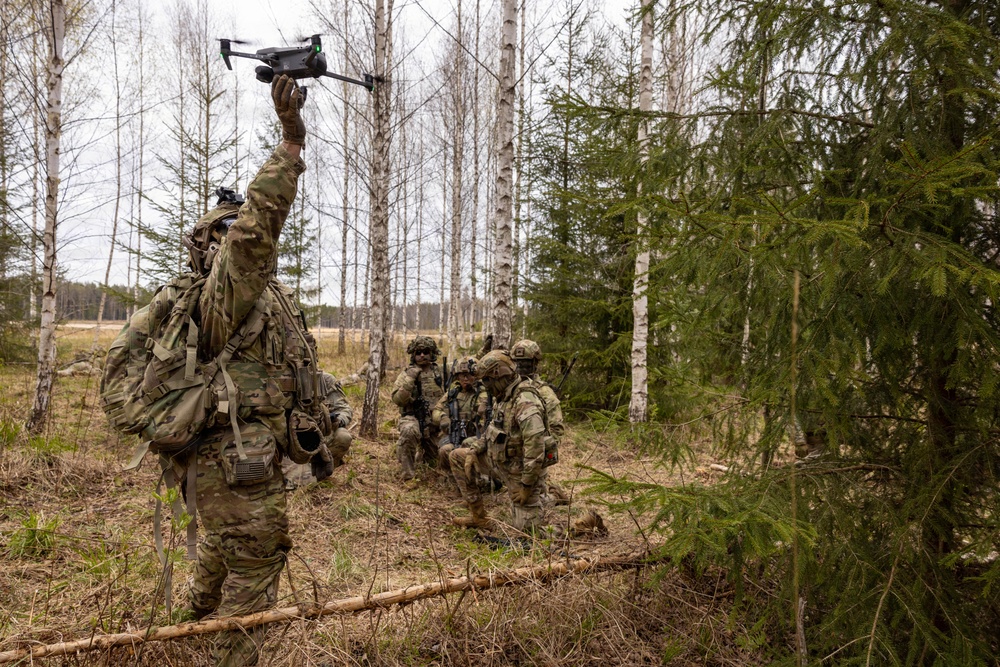
U.S. Army photo by Spc. Gabriel Martinez, DVIDS, public domain. File photo from an April 2026 live-fire exercise at the same range, not Baltic Trust 26 itself.
NATO opened its second annual Baltic Trust exercise on August 3, gathering roughly 650 personnel from Latvia, other NATO member states, and partner nations Ukraine, Australia, and Japan at the alliance’s dedicated Selija military range in southern Latvia. Over two weeks, running through August 14, the drill will put dozens of radars, jammers, and interceptors from different countries through live tests against simulated drone attacks built directly on lessons from Russia’s war on Ukraine.
Two weeks at NATO’s drone-testing range
Baltic Trust 26, designated BATT26, is organized jointly by the Latvian National Armed Forces and NATO’s Allied Command Transformation and NCI Agency, under the alliance’s Layered Counter-Unmanned Aircraft Systems Initiative. The systems in play span the full detection-to-kill chain that a real drone raid would have to defeat: radar arrays, acoustic and radio-frequency detectors, electronic-warfare jammers, and both kinetic interceptors and non-kinetic countermeasures, tested against a mix of reconnaissance and attack drone types flying as the simulated threat.
That range of equipment is the point. Individual NATO members already field their own counter-drone systems, bought from different manufacturers on different timelines, and the alliance has repeatedly found that those systems don’t necessarily talk to each other or hand off a tracked target cleanly between units from different countries. Baltic Trust 26 exists to find out where those interoperability gaps actually are, not just whether any single system works in isolation.
This is the second time the drill has run. Baltic Trust 25 took place at the same Selija range in 2025, and since then Selija has grown into NATO’s dedicated proving ground for uncrewed systems: a first joint UAS and counter-UAS testing campaign ran there in March 2026, followed by an AIRCOM Industry Day in late June and early July that drew 34 companies from more than 20 countries to show off counter-drone hardware ahead of this exercise. That buildup signals NATO now treats Selija as a standing test bed, not a one-off exercise site, which is why BATT26’s results matter beyond this single fortnight.
Why Latvia, why now
The timing is not incidental. Latvia separately deployed mobile drone-intercept units to its border with Russia in May 2026 after a string of drone incursions into its airspace earlier in the year, a step that put counter-drone defense at the center of the country’s border security posture rather than treating it as a purely military exercise topic. Baltic Trust 26 gives NATO a formal venue to test, at scale, the kind of response those border units would need to execute for real.
The drill also sits inside a larger NATO effort called Eastern Sentry, the alliance’s broader Enhanced Vigilance Activity for counter-drone air defense across its eastern flank, which has pushed NATO’s Allied Air Command to shift from routine Air Policing toward a more active, multi-domain air-defense posture. A May 2026 Eastern Sentry drill in Romania tested roughly 215 to 250 technical systems with about 500 personnel, a useful point of comparison: BATT26 fields more people at a single purpose-built range specifically to stress-test interoperability, while the Romania drill spread a wider set of systems across a live operational deployment. Together they show NATO running two different kinds of counter-drone rehearsal in parallel rather than betting on one format.
Latvia’s own defense ministry framed Baltic Trust 25 the same way last year, as a proving ground for exactly the kind of massed, cheap drone attacks Ukraine has faced since 2022. That framing has only gotten more literal a year later, with Ukrainian forces themselves now training alongside NATO troops at Selija rather than being cited only as the source of the lessons being tested. For background on where NATO’s broader counter-drone procurement money has been going, see WeaponSpecs’ earlier coverage of the US Army’s $500 million counter-drone contract with AeroVironment, part of the same alliance-wide buildup this exercise is meant to validate.
What the exercise is actually testing
Beyond individual system performance, BATT26’s stated purpose is to validate suppression tactics against massed or swarm drone incursions, the kind of coordinated, numbers-heavy attack that has proven far harder to stop cheaply than a single intruding drone. That distinction matters because most fielded counter-drone systems were designed and priced around defeating one or a handful of threats at a time, not the dozens-at-once raids that have become routine over Ukrainian cities. Testing suppression tactics, not just detection and single-shot intercepts, is what separates this exercise from a standard equipment demonstration.
The presence of industry representatives from several European Union countries alongside the military participants also signals that NATO is using the exercise to shape near-term procurement, not just doctrine. A system that performs well against a simulated swarm at Selija this month has an obvious sales case to make to alliance members shopping for their own counter-drone capability over the next budget cycle.
Sources
- Baltic Trust (BATT26) — NATO, Aug 3, 2026
- International drone defence exercise to take place in Latvia — LSM (Latvian Public Broadcasting), Jul 31, 2026
- International military anti-drone defence exercise 'Baltic Trust 25' taking place in Selija — Latvian Ministry of Defence (mil.lv), Aug 1, 2025
- AIRCOM Industry Day advances counter-drone innovation in support of NATO's Eastern Sentry — NATO Allied Air Command, Jul 1, 2026
Frequently asked questions
What is Baltic Trust 26? +
A NATO counter-drone exercise running August 3-14, 2026 at Latvia's Selija military range, involving about 650 personnel from NATO members plus partner countries Ukraine, Australia, and Japan, testing interoperability between different anti-drone detection and interception systems.
Why is this exercise happening now? +
It follows a string of Russian drone incursions into Baltic airspace in 2026 that prompted Latvia to deploy mobile intercept units to its border with Russia in May 2026, and builds on NATO's broader Eastern Sentry counter-drone posture along its eastern flank.
Is this the first time this exercise has run? +
No. Baltic Trust 25 ran at the same Selija range in 2025, making Baltic Trust 26 the second annual iteration.
What systems are being tested? +
Radars, acoustic and radio-frequency detectors, electronic-warfare jammers, and both kinetic and non-kinetic counter-drone systems, evaluated against staged drone attacks modeled on tactics seen in the Russia-Ukraine war.
More news


