NATO's Eastern Flank Deterrence Initiative moves from concept to early rollout
A U.S. Army V Corps-led effort to link sensors, drones and AI-assisted targeting along NATO's border with Russia is advancing from design to early implementation, distinct from but running alongside Operation Eastern Sentry.

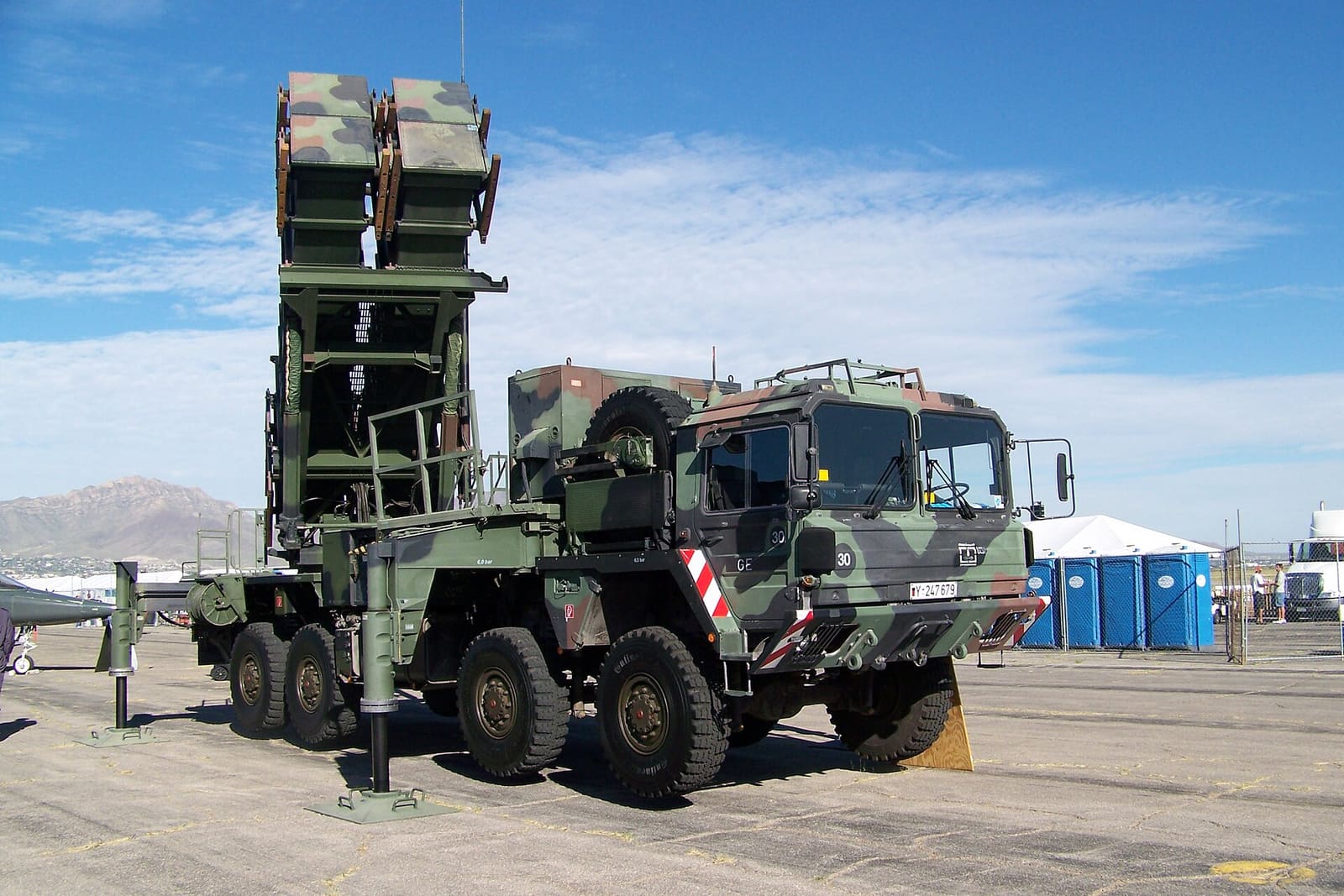
U.S. Army photo by Spc. Josefina Garcia, via DVIDS, public domain
By the numbers
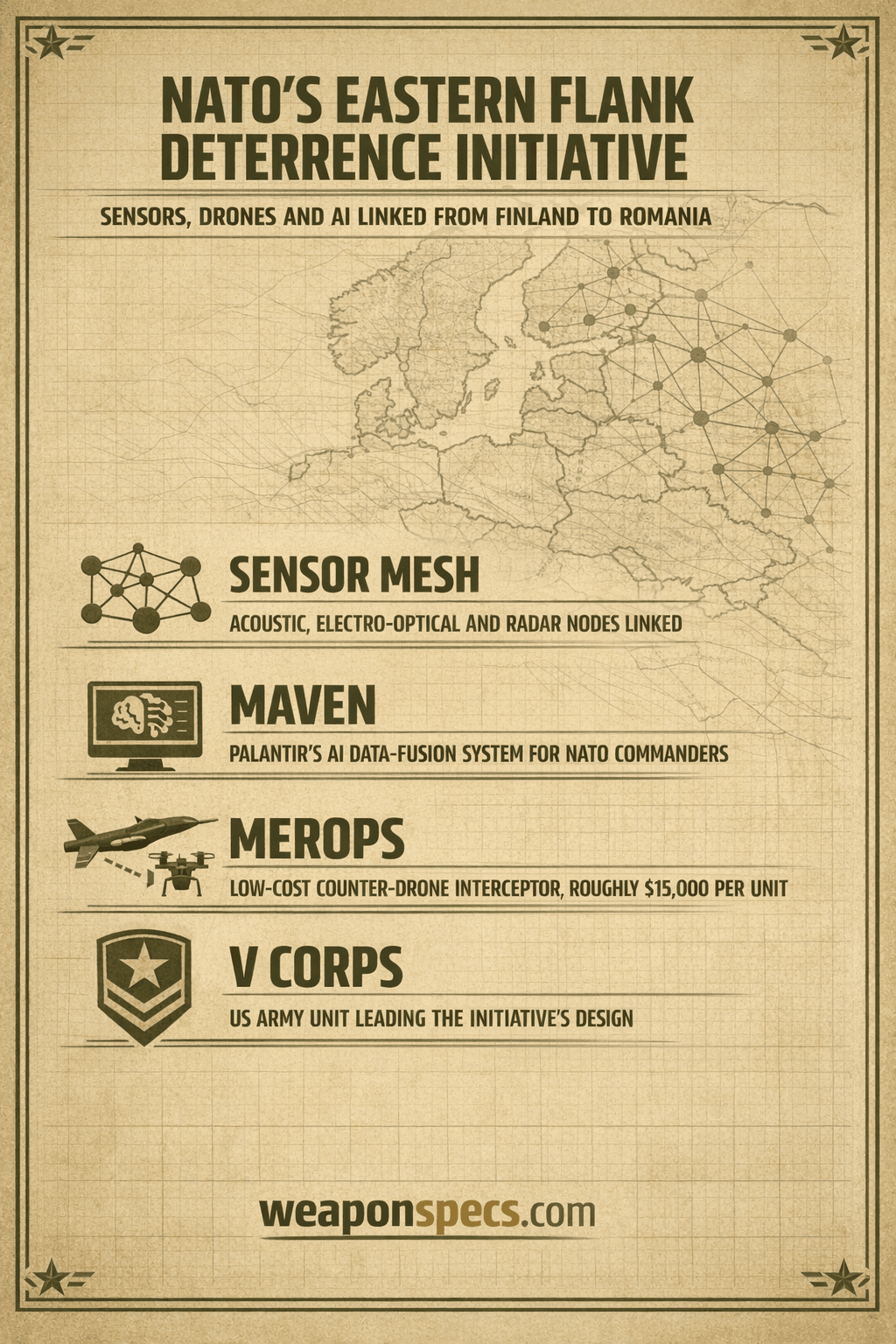
Infographic: WeaponSpecs News Desk
NATO’s Eastern Flank Deterrence Initiative, a U.S. Army V Corps-led effort to link sensors, drones and AI-assisted decision-making into a single networked architecture along the alliance’s border with Russia, is moving from design work into early implementation in 2026, according to reporting based on internal NATO documents obtained by the German outlet BILD and covered by The Next Web. The initiative, shorthanded EFDI, spans the geography from Finland through the Baltic states, Poland and down to Romania, and is separate from but runs alongside Operation Eastern Sentry, the specific reinforcement activity NATO launched after Russian drones crossed into Polish airspace in September 2025.

Two related programs, not one
The distinction matters for understanding what has actually changed. Operation Eastern Sentry began September 12, 2025, as an enhanced-vigilance activity: member states volunteering additional fighter jets, air-defense systems, surveillance aircraft and ships to reinforce the eastern flank in the near term, including Danish F-16s and a frigate, French Rafales, German Eurofighters, an Italian SAMP/T battery based in Estonia, and additional British and Spanish aircraft. It has no stated end date and functions as a visible, contribution-based reinforcement of existing NATO posture.
The Eastern Flank Deterrence Initiative is a different kind of effort. V Corps, the U.S. Army’s sole forward-deployed corps in Europe, describes it as an architectural redesign of how the alliance senses, decides and strikes: integrating sensing, AI-driven decision-making and distributed precision fires into a defense-in-depth network rather than simply adding more manned aircraft and ships to existing formations. “Deterrence on NATO’s eastern flank must be based on denial, not simply presence,” V Corps commanding general Lt. Gen. Charles Costanza said, according to the same DVIDS report. General Chris Donahue, commander of U.S. Army Europe and Africa, has described EFDI as having “really picked up momentum very quickly” and called it NATO’s broader war-fighting concept for the region, per The Next Web’s reporting.
The technology stack: Maven, Merops and a sensor backbone
At the center of EFDI’s software layer is Palantir’s Maven Smart System, which NATO’s Communications and Information Agency finalized for use across Allied Command Operations in March 2025. Maven fuses satellite imagery, drone video, radar and other sensor feeds into a single interface intended to compress the time between spotting a potential threat and deciding how to respond. NATO’s Joint Warfare Centre has said the system reached broader deployment across Allied Command Operations by August 2025 and was worked into exercises including Steadfast Deterrence 2025, with wider use planned through 2026.
On the counter-drone side, reporting on EFDI names Perennial Autonomy’s Merops interceptor as part of the initiative’s effector layer. Merops is a low-cost, roughly $15,000-per-unit interceptor drone, flyable by a human operator or guided autonomously, that rams or detonates near an incoming target; it has already seen use by Ukrainian, Polish and Romanian forces, and the U.S. Pentagon separately signed a three-year, $500-million-ceiling contract with Perennial Autonomy in 2026 to field Merops and related systems more broadly across American units, according to coverage of that award. V Corps’ own account of its build-out describes soldiers from the 1st Armored Brigade Combat Team, 3rd Infantry Division, testing purpose-built FPV drones at Grafenwoehr Training Area against autonomous targets, part of the same broader push toward integrating cheap, attritable drone systems into standard unit training rather than treating them as a specialty capability.

The Next Web’s reporting, drawing on the BILD-obtained internal documents, describes the goal as a “data backbone” tying together thousands of acoustic, electro-optical and other sensors with counter-UAS systems and unmanned ground vehicles, an architecture that same reporting says alliance personnel refer to internally as the “Kill Web,” distinct from the initiative’s formal EFDI name. That internal terminology comes from documents WeaponSpecs has not independently reviewed, and is presented here as reported by The Next Web rather than as a confirmed NATO publication.
What is not yet publicly confirmed
Public reporting reviewed for this story does not include a consolidated, sourced total program cost for EFDI, and no figure of that kind is included here; individual pieces of the effort, such as Perennial Autonomy’s $500 million U.S. contract ceiling, are separately documented, but they describe individual awards rather than an EFDI-wide budget. Similarly, while some coverage references a compressed detection-to-engagement timeline along the eastern flank, WeaponSpecs was not able to independently trace a specific minutes-based figure to a primary NATO or U.S. Army source strong enough to state as fact, so no such figure appears in this story. Readers should treat EFDI’s scale and cost as still-emerging rather than fully quantified in open reporting.
Sources
- NATO's AI 'Kill Web' on its eastern flank — The Next Web, Jul 8, 2026
- Forging the Eastern Flank Deterrence Initiative: How V Corps Is Building a 21st Century Defense — DVIDS / U.S. Army V Corps, Feb 20, 2026
- Operation Eastern Sentry — Wikipedia
- Merops (weapon) — Wikipedia
Systems mentioned
Every system named in this story, with its photo and, where available, a video. Tap a card to open the full spec sheet.
Artillery & MLRS
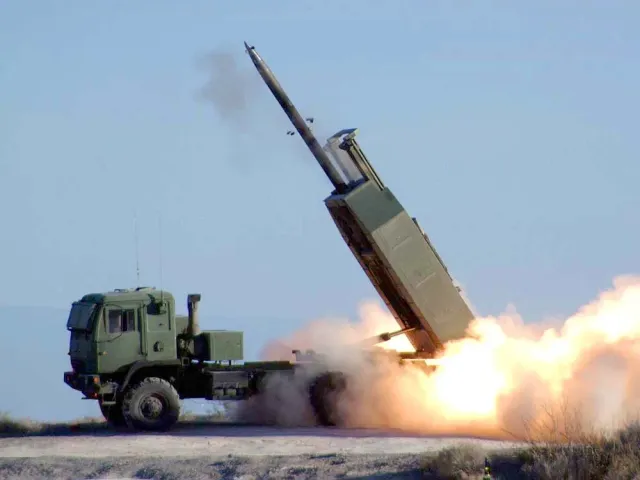
M142 HIMARSFrequently asked questions
Is the Eastern Flank Deterrence Initiative the same thing as Operation Eastern Sentry? +
No, they are related but distinct. Operation Eastern Sentry is a specific NATO enhanced-vigilance activity launched September 12, 2025, after Russian drones violated Polish airspace, under which member states have contributed additional fighter jets, air-defense systems and ships to reinforce the eastern flank. The Eastern Flank Deterrence Initiative (EFDI) is a broader, longer-horizon war-fighting concept, led by U.S. Army V Corps, aimed at building a networked architecture of sensors, drones and AI-assisted decision tools across the same geography. Eastern Sentry is the visible near-term reinforcement; EFDI is the underlying structural redesign meant to outlast it.
What does Palantir's Maven Smart System actually do in this context? +
Maven Smart System (MSS NATO), which NATO's Communications and Information Agency and Palantir finalized for use within Allied Command Operations in March 2025, fuses data from satellites, drones, radar and other sensors into a single interface so commanders can track troop movements and identify potential targets faster. It reached what NATO officials describe as full operational capability within NATO forces in 2026 and has been used in exercises including Steadfast Deterrence 2025. It is a data-fusion and decision-support tool, not a weapon itself.
What is the Merops system, and is it really part of this? +
Merops is a low-cost counter-drone interceptor built by California-based Perennial Autonomy, priced at roughly $15,000 per unit, that can be flown by an operator or guided autonomously to ram or detonate near an incoming drone. It has already been used by Ukrainian, Polish and Romanian forces, and the Pentagon separately awarded Perennial Autonomy a three-year, $500 million-ceiling contract in 2026 to expand counter-drone systems including Merops across U.S. forces. Reporting on EFDI names Merops as one of the interceptor systems integrated into the initiative's counter-drone layer.
What is the 'Kill Web' term reporters are using? +
It is described in reporting based on internal NATO documents, obtained by the German outlet BILD and covered by Business Insider, as an informal internal name alliance personnel use for the tightly linked sensor-to-shooter network EFDI is building, distinct from the initiative's formal name. WeaponSpecs has not independently viewed the underlying NATO documents and presents this as reported terminology rather than an officially published NATO designation.
More news