Military Transport Aircraft Cargo Capacity, Ranked
The C-5M Super Galaxy still carries 129,274 kg, 63,274 kg more than China's newest airlifter, the Y-20, despite a 1970s airframe.

Via Wikipedia, Lockheed C-5 Galaxy (shown for identification)
The Lockheed C-5M Super Galaxy still publishes the highest disclosed cargo payload of any military transport aircraft in the WeaponSpecs database: 129,274 kg. That is 63,274 kg more than the Xi’an Y-20, China’s newest strategic airlifter, which entered service in 2016 and tops out at 66,000 kg. The C-5M lifts nearly double what the newest airframe on the list can carry, and it does it on a design that first flew in 1968. The gap is not close, and it is not new. It is the product of a 2009-2013 re-engining program (the “M” upgrade) bolted onto an airframe old enough to have flown Vietnam-era resupply missions.
Which military transport aircraft carries the most cargo?
Ranked by maximum disclosed cargo payload across the 12 transport aircraft in our database, the C-5M Super Galaxy leads at 129,274 kg, well clear of the C-17 Globemaster III in second place at 77,519 kg. Both are American. Third place belongs to the Y-20 at 66,000 kg, followed by Russia’s Il-76MD-90A at 60,000 kg and the tanker-primary Il-78M at 40,000 kg. The A400M Atlas, Kawasaki C-2, and Boeing KC-46 Pegasus cluster between 29,500 and 37,000 kg, and the tactical end of the fleet, the C-130J Super Hercules and Airbus C-295, comes in far lower at 19,051 kg and 9,250 kg because they are built for austere-runway access, not maximum tonnage.
Three of the top five payloads are Chinese or Russian state claims with no GAO-style audit trail behind them, yet the two aircraft with the deepest institutional paper trail, the C-5M and C-17, still lead the ranking anyway.
Two of the top four aircraft, and three of the top five, are Chinese or Russian. That matters for how much weight the ranking deserves, because those figures are not backed the same way the American, European, Japanese, and Brazilian numbers are.
How reliable are China’s and Russia’s published payload figures?
Treat them as claims, not facts. The C-5M, C-17, A400M, C-2, KC-46, C-390, C-130J, and C-295 figures all come from official manufacturer or defense-ministry program documentation with decades of squadron service behind them, and for the US programs specifically, a public paper trail that includes GAO reports and congressional budget oversight. None of that makes a Western spec sheet independently audited in a strict sense; manufacturers have their own incentive to round favorably. But there is a name attached, a program office behind the number, and a history of that number being tested against real operations for years.
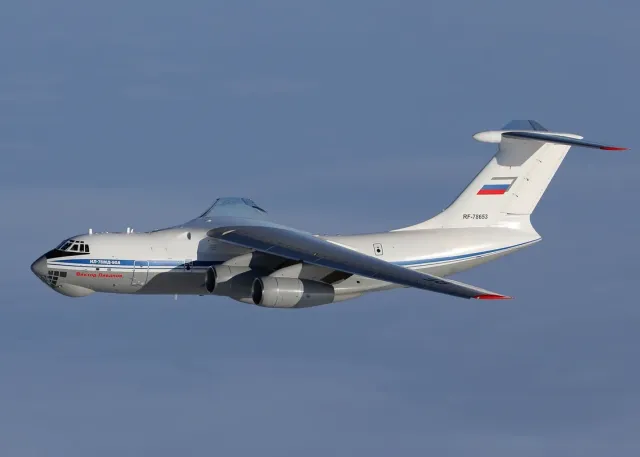
The Y-20’s 66,000 kg, the Il-76MD-90A’s 60,000 kg, and the Il-78M’s 40,000 kg have none of that external scrutiny. They are manufacturer and state figures from closed procurement systems, with no equivalent to a GAO audit, no open competitive bidding process, and no independent flight-test disclosure. That does not mean the numbers are wrong. It means there is no way to check them against anything beyond the state’s own word, and this list should not launder a Chinese or Russian claim into a verified fact just because it is presented next to figures that carry real institutional backing.
Does more cargo payload mean more troops?
Not necessarily, and the Y-20 versus C-5M comparison is the cleanest example in this dataset. The Y-20 carries 180 troops, more than any other aircraft on this list, despite lifting 63,274 fewer kilograms of cargo than the C-5M, which carries only 73. That is not a contradiction. It is two different design philosophies for two different missions.
The C-5M is built around outsized and oversized cargo: main battle tanks, attack helicopters, and other bulky equipment loaded and unloaded through both a nose door and a tail ramp for true drive-on/drive-off operation. That layout, plus the internal volume dedicated to heavy-lift structural reinforcement, leaves less floor space efficiently configured for dense troop seating. The Y-20’s published figure, by contrast, emphasizes paratroop and personnel density: the figure that counts for an airborne insertion mission, not a heavy-equipment delivery mission. A buyer comparing these two aircraft on “which one is better” by looking at a single spec is asking the wrong question. The right question is which mission the aircraft needs to fly.
Strategic vs tactical airlift
The 12 aircraft in this dataset split into two functional tiers. Strategic airlifters, the C-5M, C-17, Y-20, and Il-76MD-90A, are built to move the most weight over the longest distance between established, hardened airfields; none of them are designed to land on a dirt strip. Tactical airlifters, the C-130J and C-295, give up payload capacity in exchange for the ability to operate from short, unpaved, or damaged runways closer to the actual point of need, which is why their published cargo figures sit an order of magnitude below the strategic tier. The A400M, KC-46, C-2, and C-390 occupy the middle ground: aircraft designed to do at least part of both jobs, which is also why their payload figures cluster in the 26,000-37,000 kg range rather than at either extreme.
Full comparison table
| Aircraft | Origin | Role | Cargo Payload (kg) | Troop Capacity | Range (km) | Entered Service | Data Status |
|---|---|---|---|---|---|---|---|
| C-5M Super Galaxy | United States | Strategic airlifter | 129,274 | 73 | 12,800 | 1970 (airframe) / 2013 (M upgrade) | Western program spec |
| C-17 Globemaster III | United States | Strategic airlifter | 77,519 | 102 | 4,482 | 1995 | Western program spec |
| Xi’an Y-20 | China | Strategic airlifter | 66,000 | 180 | 7,800 | 2016 | State claim, unverified |
| Ilyushin Il-76MD-90A | Russia | Strategic airlifter | 60,000 | 126 | 6,000 | 1974 (Il-76) / 2010s (90A upgrade) | State claim, unverified |
| Ilyushin Il-78M | Russia | Tanker with secondary cargo role | 40,000 | not disclosed | 7,300 | 1987 | State claim, unverified |
| Airbus A400M Atlas | France / multinational (Airbus) | Tactical-strategic hybrid airlifter | 37,000 | 116 | 3,700 | 2013 | Western program spec |
| Kawasaki C-2 | Japan | Strategic/tactical airlifter | 30,000 | not disclosed | 6,500 | 2016 | Allied program spec |
| Boeing KC-46 Pegasus | United States | Tanker with secondary cargo role | 29,500 | 114 | 12,200 | 2019 | Western program spec |
| Embraer C-390 Millennium | Brazil | Tactical airlifter | 26,000 | not disclosed | 5,020 | 2019 | Allied program spec |
| Shaanxi Y-9 | China | Tactical airlifter | 25,000 | 98 | 5,700 | ~2012 | State claim, unverified |
| C-130J Super Hercules | United States | Tactical airlifter | 19,051 | 92 | 3,334 | 1999 | Western program spec |
| Airbus C-295 | Spain / multinational (Airbus) | Light tactical airlifter | 9,250 | 71 | 5,400 | ~2001 | Allied program spec |
Ranked by payload alone, this list looks like a straightforward American lead. Read the troop-capacity and role columns next to it and the picture is more specific: it is a ranking of which aircraft is built for which cargo, not a scoreboard of which country’s airlift fleet is best.
If you are weighing an airlift or logistics mix for a real force-planning exercise, model your own combination of strategic and tactical lift in the Budget Planner, or run the tradeoffs through the Decision Advisor before treating any single spec-sheet number as the deciding factor. See the full field in transport aircraft.
Raw payload is only half the picture: for how that cargo weight trades off against an aircraft’s design range, see The C-17 Hauls 7x More Cargo Per Km Than the KC-46.
FAQ
Which military transport aircraft can carry the most cargo? In our analysis of 12 transport aircraft in the WeaponSpecs database, the Lockheed C-5M Super Galaxy publishes the highest disclosed cargo payload at 129,274 kg, ahead of the Boeing C-17 Globemaster III at 77,519 kg. The C-5M’s original airframe dates to 1968; the current M-model figure reflects the 2009-2013 re-engining and avionics upgrade.
How much more cargo can the C-5M Super Galaxy carry than China’s Y-20? 63,274 kg more, nearly double the Xi’an Y-20’s published 66,000 kg. That gap should be read with a caveat: the C-5M figure traces to a US Air Force program with decades of squadron service and budget-oversight documentation behind it, while the Y-20’s 66,000 kg is a Chinese state and manufacturer claim with no comparable independent corroboration.
Is the Il-76’s published cargo payload figure independently verified? No. The Ilyushin Il-76MD-90A’s 60,000 kg figure is a Russian manufacturer and state claim. It has decades of civil and military service behind it, but there is no equivalent to the US GAO or congressional budget oversight that backs Western program figures, so treat it as a claim rather than an audited fact.
Does the highest cargo payload also mean the most troop capacity? No. The Xi’an Y-20 carries more troops (180) than the C-5M Super Galaxy (73) despite lifting 63,274 fewer kilograms of cargo. The two aircraft are optimized for different loads: the C-5M is built around outsized and oversized cargo like tanks and helicopters with drive-on/drive-off access through nose and tail doors, while the Y-20’s published figure emphasizes paratroop and personnel density.
What’s the difference between a strategic and tactical military airlifter? Strategic airlifters, the C-5M, C-17, Y-20, and Il-76, are built for long intercontinental hauls between established airfields with long, hardened runways. Tactical airlifters, the C-130J and C-295, trade payload for the ability to operate from short, austere, or unpaved runways closer to the point of need. Aircraft like the A400M and KC-46 sit in between, built to do part of both jobs.
Systems in this comparison
Every system covered above, with its photo and, where available, a video. Tap a card to open the full spec sheet.
Compare these side by side →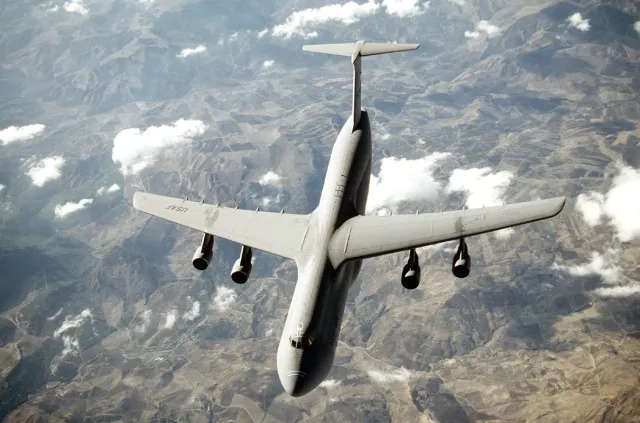
Transport & tanker
C-5M Super Galaxy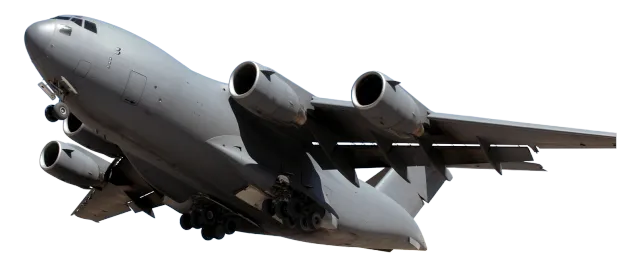
Transport & tanker
C-17 Globemaster III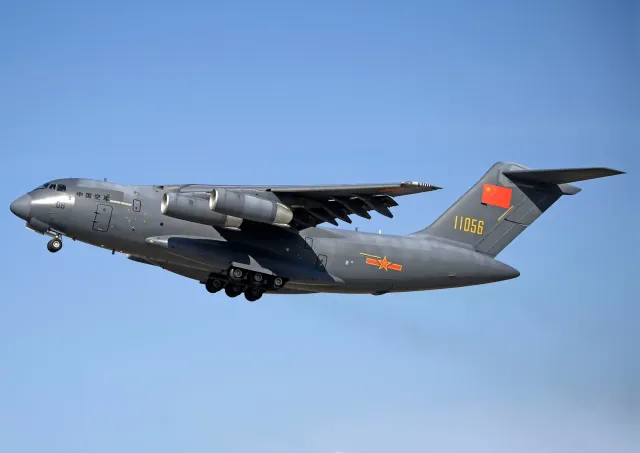
Transport & tanker
Il-76MD-90A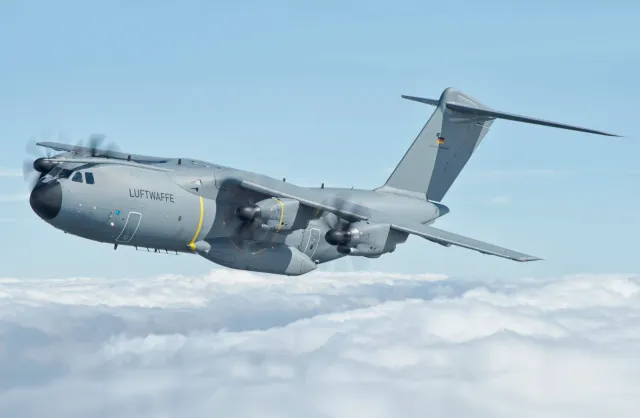
Transport & tanker
A400M Atlas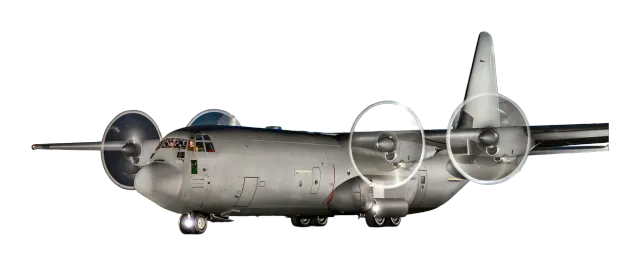
Transport & tanker
C-130J Super HerculesFrequently asked questions
Which military transport aircraft can carry the most cargo? +
In our analysis of 12 transport aircraft in the WeaponSpecs database, the Lockheed C-5M Super Galaxy publishes the highest disclosed cargo payload at 129,274 kg, ahead of the Boeing C-17 Globemaster III at 77,519 kg. The C-5M's original airframe dates to 1968; the current M-model figure reflects the 2009-2013 re-engining and avionics upgrade.
How much more cargo can the C-5M Super Galaxy carry than China's Y-20? +
63,274 kg more, nearly double the Xi'an Y-20's published 66,000 kg. That gap should be read with a caveat: the C-5M figure traces to a US Air Force program with decades of squadron service and budget-oversight documentation behind it, while the Y-20's 66,000 kg is a Chinese state and manufacturer claim with no comparable independent corroboration.
Is the Il-76's published cargo payload figure independently verified? +
No. The Ilyushin Il-76MD-90A's 60,000 kg figure is a Russian manufacturer and state claim. It has decades of civil and military service behind it, but there is no equivalent to the US GAO or congressional budget oversight that backs Western program figures, so treat it as a claim rather than an audited fact.
Does the highest cargo payload also mean the most troop capacity? +
No. The Xi'an Y-20 carries more troops (180) than the C-5M Super Galaxy (73) despite lifting 63,274 fewer kilograms of cargo. The two aircraft are optimized for different loads: the C-5M is built around outsized and oversized cargo like tanks and helicopters with drive-on/drive-off access through nose and tail doors, while the Y-20's published figure emphasizes paratroop and personnel density.
What's the difference between a strategic and tactical military airlifter? +
Strategic airlifters, the C-5M, C-17, Y-20, and Il-76, are built for long intercontinental hauls between established airfields with long, hardened runways. Tactical airlifters, the C-130J and C-295, trade payload for the ability to operate from short, austere, or unpaved runways closer to the point of need. Aircraft like the A400M and KC-46 sit in between, built to do part of both jobs.
Related reading


