Hypersonic Missiles: Only 2 of 38 Are New
Our database has 38 systems that exceed Mach 5. By the definition that separates real hypersonic weapons from fast ballistics, only 2 qualify.

Via Wikipedia, 3M22 Zircon (shown for identification)
Our database holds 38 systems that fly past Mach 5. Two of them are genuinely new hypersonic-weapon engineering. The other 36 earn the label from unpowered reentry physics, contested marketing, older rocket propulsion built for a different job, or the simple requirement that an interceptor must out-fly what it’s chasing. When a headline calls something “hypersonic,” it is almost never asking the question that actually separates those two systems from the other 36.
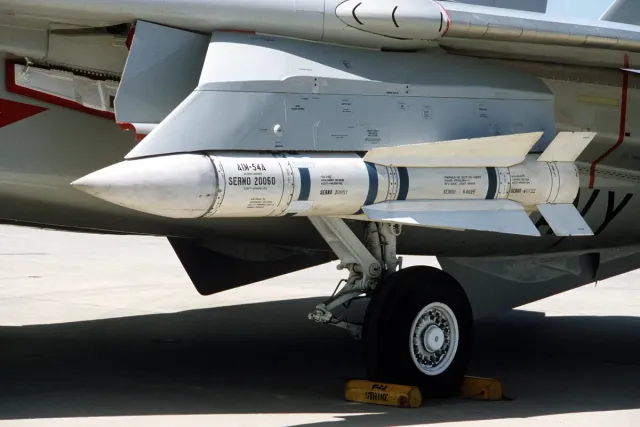
Start with the number that should have retired the panic years ago: the AIM-54 Phoenix, a US Navy air-to-air missile, entered service in 19741 and its AIM-54C variant already flew at Mach 5, the exact threshold today’s “hypersonic missile” coverage treats as a breakthrough. Hypersonic speed is fifty years old. What changed is not whether a missile can go that fast. What changed, in the two systems that matter, is whether it can maneuver once it gets there.
What actually separates a hypersonic weapon from a fast one?
The hypersonic weapon category is defined narrowly2: a weapon that can travel and make significant sustained maneuvers during atmospheric flight at hypersonic speed, split into hypersonic glide vehicles (boost-glide weapons) and hypersonic cruise missiles (airbreathing weapons). That is the whole test. Not top speed. Sustained atmospheric maneuvering.
Mining our own spec database of 1,017 systems for everything that publishes a Mach 5-plus figure turns up 38 systems: 25 offensive missiles and 13 air-defense interceptors. Running each of the 25 missiles against that definition leaves exactly two that qualify as genuinely new hypersonic-weapon engineering.
- 3M22 Zircon (Russia): a scramjet-powered3 hypersonic cruise missile, Mach 9, 1,000 km claimed range. This is airbreathing propulsion sustaining hypersonic flight in the atmosphere, the second half of the definition. Russia’s claimed operational combat use of Zircon has not been independently verified, treat that specific claim as a state assertion, not a confirmed fact.
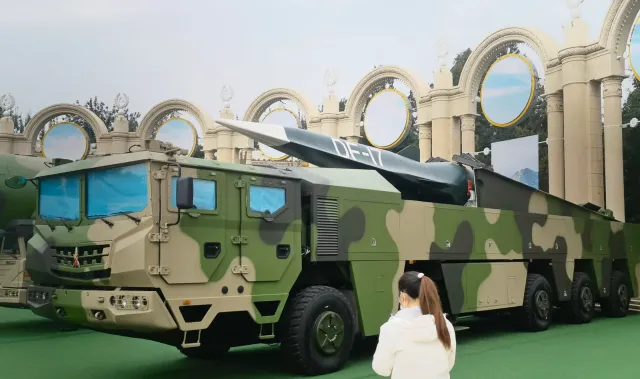
- DF-17 (China): carries the DF-ZF hypersonic glide vehicle4, a genuine boost-glide weapon, Mach 10, 2,500 km claimed range. A boost-glide vehicle is launched ballistically, then releases a maneuverable glider that rides the upper atmosphere rather than falling through it, the first half of the definition.
Every other Mach 5-plus system in the database, all 36 of them, misses that test for one of three distinct reasons.
Which systems get the “hypersonic” label without earning it?
Two missiles carry the branding without the substance, and it is worth separating a state calling something hypersonic from independent analysts agreeing.
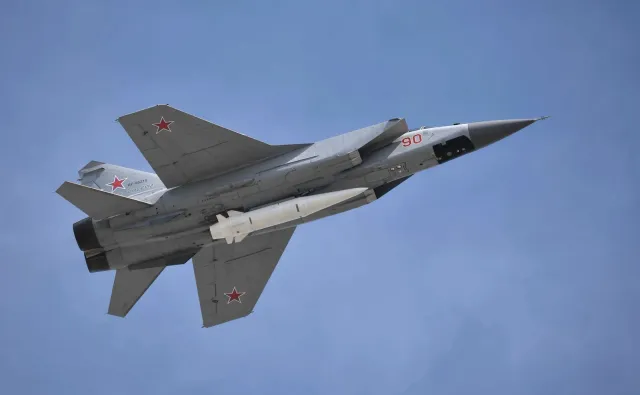
Kh-47M2 Kinzhal (Russia, Mach 10 claimed, most reporting cites roughly 2,000 km range): Chinese analysts, after reviewing Kinzhal’s combat performance in Ukraine, said it “is not really a hypersonic missile since it follows a ballistic trajectory and cannot maneuver at hypersonic speeds.”5 The UK Parliamentary Office of Science and Technology goes further, calling it a “quasi-ballistic trajectory” with only “limited manoeuvres,” and concludes that aeroballistic missiles like Kinzhal “are not generally called ‘hypersonic missiles.’” There is a second, separate problem with the headline range figure: independent reporting puts Kinzhal’s own powered flight at only 460-480 km once launched, essentially the same reach as the ground-launched Iskander it is derived from. The larger 2,000-3,000 km numbers reported in the press add the launching MiG-31K’s own combat radius to the missile’s flight distance, they are not the missile’s own range. That is consistent with a pattern our own database audit has flagged before: publicly reported missile ranges frequently blend platform reach with weapon reach, and a reader who does not separate the two ends up with a number roughly four times too generous.
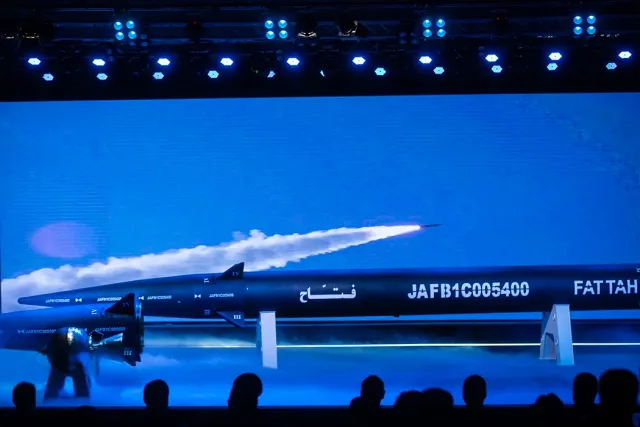
Fattah-1 (Iran, Mach 13 claimed, 1,400 km claimed range): Iran calls it hypersonic. The description has been called “dubious” by multiple outlets,6 and defense analyst Fabian Hinz said the hypersonic label “obscures more than it illuminates.” As with all Iranian state figures, treat the speed, range and maneuverability claims here as unverified until an independent source confirms them.
Why do so many ballistic missiles already exceed Mach 5?
Because falling is fast. Sixteen of the 25 offensive missiles in our Mach 5-plus list are ordinary ballistic missiles whose warheads reenter the atmosphere unpowered, under gravity and drag alone: Prithvi-II, Shahab-3, 9K720 Iskander-M, Ghadr-110, Sejjil, DF-21D, Qiam-1, Emad, Shaheen-III, DF-26, Zolfaghar, Khorramshahr, Agni-V, Dezful, Haj Qasem and Kheibar Shekan. Every ballistic missile with enough range has done this since 1950s and 1960s ICBMs. It is not an engineering breakthrough, it is physics that has been true for seventy years. Agni-V (India) tops the entire Mach 5-plus list at a claimed Mach 24 and 5,000 km range, and that top-of-chart speed is entirely a function of how far the warhead falls before reentry, not a new propulsion or guidance capability.
Five more missiles are fast for reasons that have nothing to do with boost-glide or scramjet engineering: they are rocket-powered weapons built to close on a target quickly, not to sustain a maneuvering glide. The AIM-54 Phoenix (Mach 5, in service since 1974) needed terminal speed to catch an intercepting aircraft. The Kh-15, R-37M and Kh-32 (Russia) are a short-range strike missile, a long-range air-to-air missile, and an anti-ship cruise missile respectively, each needing high terminal velocity for its own intercept problem. The SM-3 Block IIA (United States, Mach 13.5) is an exo-atmospheric interceptor, fast because it has to reach an incoming ballistic warhead above the atmosphere, not because it maneuvers once there.
Every claimed figure below needs the same caveat
Every Iranian, Russian and Chinese speed and range figure in this table is a manufacturer or state claim, not an independently verified measurement. Treat every “claimed” range the same way you would treat any other unverified state assertion: informative about what a government wants believed, not proof of an operational capability.
| Missile | Country | Class | Mach | Range (km, claimed) |
|---|---|---|---|---|
| Agni-V | India | Ballistic reentry | 24 | 5,000 |
| DF-26 | China | Ballistic reentry | 18 | 4,000 |
| Sejjil | Iran | Ballistic reentry | 14 | 2,000 |
| SM-3 Block IIA | United States | Fast interceptor (not boost-glide) | 13.5 | 2,500 |
| Fattah-1 | Iran | Contested hypersonic branding | 13 | 1,400 |
| Shaheen-III | Pakistan | Ballistic reentry | 12 | 2,750 |
| DF-17 | China | Genuine hypersonic weapon (boost-glide) | 10 | 2,500 |
| DF-21D | China | Ballistic reentry | 10 | 1,500 |
| Kh-47M2 Kinzhal | Russia | Contested hypersonic branding | 10 | 2,000 |
| 3M22 Zircon | Russia | Genuine hypersonic weapon (scramjet) | 9 | 1,000 |
| Emad | Iran | Ballistic reentry | 8 | 1,700 |
| Ghadr-110 | Iran | Ballistic reentry | 8 | 1,800 |
| Haj Qasem | Iran | Ballistic reentry | 8 | 1,400 |
| Kheibar Shekan | Iran | Ballistic reentry | 8 | 1,450 |
| Khorramshahr | Iran | Ballistic reentry | 8 | 2,000 |
| Shahab-3 | Iran | Ballistic reentry | 8 | 1,000 |
| 9K720 Iskander-M | Russia | Ballistic reentry | 6 | 500 |
| Qiam-1 | Iran | Ballistic reentry | 6 | 800 |
| R-37M | Russia | Fast interceptor/AAM (not boost-glide) | 6 | 300 |
| AIM-54 Phoenix | United States | Fast AAM (not boost-glide) | 5 | 190 |
| Dezful | Iran | Ballistic reentry | 5 | 1,000 |
| Kh-15 | Russia | Fast missile (not boost-glide) | 5 | 300 |
| Kh-32 | Russia | Fast anti-ship cruise missile (not boost-glide) | 5 | 1,000 |
| Prithvi-II | India | Ballistic reentry | 5 | 350 |
| Zolfaghar | Iran | Ballistic reentry | 5 | 700 |
Prithvi-II is Indian, not one of the state-adversary systems above it, but its figures are still undisclosed-testing claims rather than independently confirmed measurements, and should be read with the same caution.
Genuine hypersonic weapons and contested branding claims are each an 8 percent sliver here; the remaining 84 percent clears Mach 5 purely through reentry physics dating to 1950s ICBMs, not new propulsion or guidance.
What about the 13 air-defense interceptors that also exceed Mach 5?
They belong in a separate bucket entirely, because for an interceptor, Mach 5-plus terminal speed is not a marketing claim, it is a mechanical necessity. Arrow 2, Arrow 3, David’s Sling, Cheongung II, the Patriot family (GEM-T, PAC-2, PAC-3), S-300PMU2 Favorit, S-300V4, S-350 Vityaz, S-400 Triumf, S-500 Prometheus and THAAD all clear Mach 5 because an interceptor has to match or exceed the closing speed of a supersonic aircraft or a ballistic reentry vehicle to hit it at all. Patriot’s lineage runs back to the 1980s and 1990s. This has been true of missile defense engineering for decades, not a response to some new offensive threat category. Even on the defensive side of the ledger, “hypersonic” terminal speed is old news, not evidence that the threat environment just changed.
What question should a reader actually ask?
When a headline says a country “unveiled a new hypersonic missile,” the useful question is not how fast it goes. It is which of four buckets the system actually falls into: a genuine boost-glide or scramjet weapon like DF-17 or Zircon, a contested claim like Kinzhal or Fattah-1 that independent analysts dispute, an ordinary ballistic missile whose reentry physics have been unremarkable since the Cold War, or a rocket-powered weapon that is fast for an unrelated reason. Two systems out of 38 in our own database answer the first way. Run your own threat-profile comparison in the Advisor rather than taking a press release’s word for which bucket a new missile actually belongs in.
Sources
Systems in this comparison
Every system covered above, with its photo and, where available, a video. Tap a card to open the full spec sheet.
Compare these side by side →
Frequently asked questions
What makes a missile genuinely hypersonic rather than just fast? +
By the standard definition, a genuine hypersonic weapon sustains significant maneuvering during atmospheric flight at Mach 5-plus, either as a boost-glide vehicle or an airbreathing cruise missile. Speed alone does not qualify a weapon. Most Mach 5-plus missiles in our database are unpowered ballistic reentry bodies that never maneuver in the atmosphere at all.
Why do so many ballistic missiles already exceed Mach 5? +
Reentry physics, not engineering novelty. Any ballistic missile flown far enough re-enters the atmosphere under gravity and drag alone, and that unpowered fall routinely exceeds Mach 5. Sixteen of the 25 offensive missiles in our Mach-5+ list are ordinary ballistic reentry vehicles, a capability ICBMs have had since the 1950s and 1960s.
Is Russia's Kinzhal missile really a hypersonic weapon? +
It is contested. Chinese analysts, after reviewing its combat performance in Ukraine, said Kinzhal is not really a hypersonic missile since it follows a ballistic trajectory and cannot maneuver at hypersonic speed. The UK Parliamentary Office of Science and Technology calls it quasi-ballistic with only limited maneuvers, and independent reporting puts its actual powered range at 460-480 km, far short of the 2,000 km-plus figures that include the launch aircraft's own combat radius.
Are air-defense interceptors like Patriot or THAAD hypersonic weapons too? +
By raw speed, yes. Thirteen interceptors in our database exceed Mach 5, including Patriot variants, THAAD, and the S-400, because catching a supersonic or ballistic threat requires matching or exceeding its closing speed. This has been true of interceptor design since the 1980s and 1990s, so Mach 5-plus terminal speed on defense is not a new threat category, it is an old engineering requirement.
Why does the boost-glide versus ballistic distinction matter for missile defense? +
Because it determines whether existing interceptors can even engage the threat. A ballistic reentry vehicle follows a predictable arc that legacy missile defense was built to track and intercept. A genuine boost-glide vehicle sustains atmospheric maneuvers specifically to defeat that kind of predictable-trajectory intercept, which is the actual capability jump the 2 genuine systems in this list represent, and the other 36 do not.
Related reading


