UK joins US PrSM program, commits £190M for long-range missiles
Britain becomes second NATO ally to procure Precision Strike Missiles, integrating with M270 MLRS and aligning with broader European deep-strike ambitions.

Photo by Cpl. Cameron Pegg, Australian Army / DVIDS, public domain
By the numbers

Infographic: WeaponSpecs News Desk
The United Kingdom has committed £190 million (roughly $254 million) to procure Lockheed Martin’s Precision Strike Missile, becoming the second international partner after Australia to join the US Army’s PrSM program, according to Breaking Defense. The announcement landed during the NATO Ankara summit on July 7, positioning Britain’s ground-launched deep-strike capability as part of a broader alliance-wide push toward longer-range precision fires that this story’s companion coverage of the 12-nation European strike coalition captures at the multinational level.
PrSM is a Lockheed Martin-built ballistic missile fielded by the US Army since 2023, with a stated range of 500 kilometers, a top speed around Mach 3, and a high-explosive fragmentation warhead guided by an inertial and GPS package. It was designed from the outset to replace the older ATACMS missile in US and allied inventories, and one of its more consequential design choices is packaging: PrSM ships two rounds per launch pod, doubling the magazine depth of ATACMS, which carries a single round per pod. That difference matters tactically, since it lets a battery generate twice the volume of fire from the same number of launch platforms without needing to reload between shots, a meaningful edge in a sustained exchange where reload cycles under fire are themselves a vulnerability.
A joint-procurement shortcut, not a national program
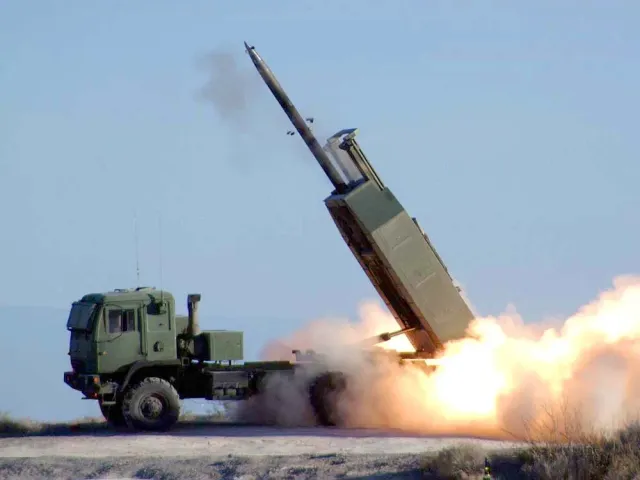
Britain’s approach here is a deliberate choice to buy into an existing US-Australia procurement track rather than develop or adapt a standalone national system. PrSM is compatible with both the HIMARS launcher, in UK service as the M142 HIMARS, and the tracked M270A2 MLRS, the platform the UK is expected to use for its own PrSM integration. Joining a program already in production and already fielded by the US Army since 2023 means the UK can plausibly field a working deep-strike capability years faster than standing up a comparable national development effort, at the cost of tying its ground-strike magazine to a shared, US-controlled supply chain rather than sovereign production.
Australia signed the first international PrSM partnership in a mid-2025 memorandum of understanding, and its 14th Regiment Royal Australian Artillery has already conducted live PrSM firings from HIMARS during Exercise Talisman Sabre, the drill depicted in this story’s cover photograph. Britain’s entry roughly a year later makes it the second, not the first, international customer, and the existence of an established Australian precedent likely eased both the technical integration questions and the political case for the UK Ministry of Defence’s own commitment. The arrangement also sits within the broader AUKUS Pillar 2 framework for advanced-capability technology sharing among the US, UK and Australia, even though PrSM procurement itself runs as a separate US Army foreign military sales track rather than a formal AUKUS program line.
Where this fits in the UK’s wider spending picture
The £190 million PrSM commitment is one specific line item inside the UK’s much larger £298 billion, four-year Defence Investment Plan announced June 30, which this outlet covered in detail at the time. That earlier story flagged the PrSM allocation as part of the plan’s broader deep-strike ambitions; this piece is the dedicated follow-up now that the procurement decision itself has been confirmed. PrSM’s near-term 500-kilometer reach is best understood as the first rung of a longer UK range ladder: a separate UK-Germany Deep Precision Strike program targets 2,000-plus kilometers using stealth and hypersonic variants, aiming for the 2030s, a program this outlet’s coverage of the 12-nation European coalition examines alongside the related Stratus cruise missile effort.
It is worth being direct about the sourcing here: this story rests on a single trade-press report from Breaking Defense, not on multiple independently confirming outlets, which is a meaningfully thinner evidentiary base than some of this desk’s other coverage. The Breaking Defense report is itself credible and specific (a named dollar figure, a named program, a named platform), but readers should weigh that single-source status accordingly, and this piece does not claim independent confirmation it does not have.
One claim from the announcement that also deserves a caveat: reporting characterizes the PrSM integration as requiring “no additional vehicle modifications” to the UK’s existing M270A2 fleet. That is presented in the original announcement, not independently verified engineering detail, and integration programs of this kind not infrequently surface unforeseen modification requirements once live testing begins, so it should be read as a stated intention rather than a confirmed technical fact.
What comes next
No public fielding timeline has been announced for UK PrSM. Based on comparable NATO procurement programs, a three-to-five-year span from contract signature to initial operational capability would not be unusual, meaning British PrSM batteries operational before the end of this decade is a plausible but unconfirmed expectation rather than a stated Ministry of Defence target. The more immediate signal to watch is whether the UK’s PrSM order translates into an actual signed contract with Lockheed Martin in the coming months, since the £190 million figure reported so far describes a budget commitment and program entry, not a confirmed, signed procurement contract with delivery dates attached.
Sources
- UK to join US Army's PrSM program, buy $254M in long-range missiles (Breaking Defense, Jul 7, 2026)
Systems mentioned
Every system named in this story, with its photo and, where available, a video. Tap a card to open the full spec sheet.
Compare these side by side →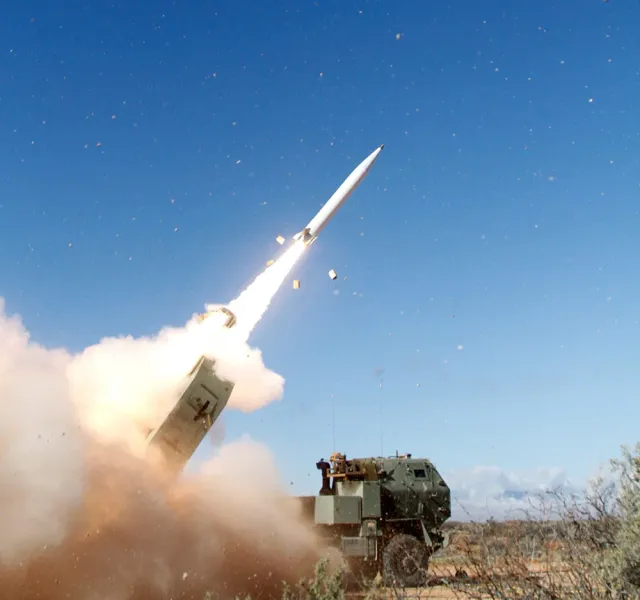
Artillery & MLRS
M142 HIMARS Artillery & MLRS
M270A2 MLRSFrequently asked questions
Why does the UK need PrSM if it already has long-range air-launched cruise missiles? +
PrSM provides dedicated ground-launched deep-strike capability independent of air operations, enabling rapid fires from distributed artillery positions without requiring airspace clearance, complementing RAF Storm Shadow/Scalp cruise missiles with a ground-based 500km reach.
How does PrSM compare to other ballistic missiles in the region? +
PrSM's 500km range and Mach 3 speed sit in a similar envelope to systems like Iran's Qiam-1 (750km) or Russia's Iskander-M (500km), but its modular guidance and two-round-per-pod magazine give it more flexibility and depth than single-warhead systems, since each missile in a volley can be independently targeted.
When will UK PrSM actually be operational? +
No public timeline has been announced. Integration with the M270A2 platform is ongoing, and comparable NATO procurement programs typically take three to five years from contract signature to initial operational capability.
Is this a response to a specific event, like the Ukraine war or Middle East escalation? +
The timing aligns with the NATO Ankara summit and the broader European defense modernization push rather than one triggering event. It sits alongside the UK's June 30 Defence Investment Plan and the 12-nation deep-strike coalition announced two days later.
More news


