No ICBM Has Ever Flown Its Claimed Max Range
Published ICBM ranges span 1,000-18,000 km across our database, but no country has ever flight-tested one to its full claimed distance.

U.S. Navy, via Wikimedia Commons, Public Domain (shown for identification)
Across the 13 strategic-missile systems in the WeaponSpecs database, published maximum ranges run from 1,000 km for Turkey’s TAYFUN Block 4 up to 18,000 km for Russia’s RS-28 Sarmat. Not one of those systems, American, Russian, Chinese, or North Korean, has ever been flight-tested to its full claimed distance. A live shot to true intercontinental range would mean flying a nuclear-capable missile across another country’s territory or a crowded shipping lane, so nobody does it. Every published max-range figure in this category is a model-based extrapolation built from a shorter test flight, either a partial-distance shot or a deliberately lofted one. The number on the spec sheet is not the differentiator here. What actually separates these programs is how much public test data sits behind the extrapolation.
What does “ICBM range” actually mean, and why can’t it be flight-tested directly?
The conventional definition of an intercontinental ballistic missile is a range greater than 5,500 km1. Below that threshold you’re in medium- or intermediate-range territory, which is why the TAYFUN Block 4, still in flight-test development at a self-reported 1,000 km, doesn’t really compete in the same class as the other 11 systems here despite sharing a database systemType with them.
The reason none of these missiles get tested at true max range is geography, not secrecy. A missile claimed at 13,000-18,000 km flown on its normal trajectory from any of the countries that build them would cross the airspace or waters of other nations, several of them nuclear powers themselves. Nobody wants to explain that phone call. So every test program either flies a shorter partial-distance course to an approved impact zone, or lofts the missile on a steep trajectory that trades range for altitude and keeps the flight inside safe boundaries. Analysts then extrapolate a max-range figure from the propulsion burn, trajectory shape, and payload data collected on that shorter flight. It’s a legitimate engineering method. It is also, by definition, not the same thing as a missile actually flying that far.
How did North Korea calculate a 15,000 km range from a 1,000 km flight?
The Hwasong-182 is the cleanest public example of the method. Its July 12, 2023 test flew a deliberately lofted trajectory: a steep launch angle, an apogee of roughly 6,648 km, and a horizontal flight distance of just 1,001.2 km over a 74.85-minute flight. North Korea flies its ICBM tests this way specifically to avoid sending the missile over Japan or other neighboring territory. Open-source analysts then took the energy and trajectory data from that lofted shot and calculated what the same missile would achieve on a standard, flatter trajectory, which is where the widely cited ~15,000 km figure3 comes from. That number has never been flown. It’s a physics calculation from a flight that covered fifteen times less ground. As with any Russian, Chinese, or North Korean state-linked figure, treat it as a claim built on real but partial data, not an independently confirmed range.
“Japan’s Ministry of Defense estimated that the missile reached an altitude of over 6,000 kilometres and a range of about 1,000 km and that it flew for around 74 minutes before falling into the Sea of Japan,” wrote Zuzanna Gwadera, Research Analyst for Defence and Military Analysis at the International Institute for Strategic Studies, in an IISS Missile Dialogue Initiative analysis of the July 12, 2023 test.
Independent tracking by an allied government and a non-state analyst landed on essentially the same 1,000 km demonstrated distance this piece cites from CSIS, which is the point: the flown number is well corroborated. The 15,000 km figure is not flown at all, it is calculated from it.
Why has Russia’s Sarmat, claimed at 18,000 km, never come close to that distance?
RS-28 Sarmat4 carries the highest claimed range in the database, and it has the thinnest track record to back it up. Its first test launch, September 1, 2023 from Plesetsk, flew a partial distance to the Kura test range on Kamchatka, roughly 5,700 km, well under a third of the claimed figure. A spring 2024 test reportedly failed. A September 24, 2024 test was worse than a failure to reach distance: Maxar satellite imagery analyzed by Arms Control Association and RUSI5 showed a crater roughly 60 meters wide at the Plesetsk launch silo and fire damage in the surrounding woods, a launch-pad-level failure, not a downrange shortfall. A further suspected Sarmat failure near Yasny in Orenburg Oblast was reported on November 28, 2025, with video showing the missile cartwheeling and crashing shortly after launch. Russia has not publicly confirmed most of these failures; they surfaced through Western commercial-satellite monitoring and open-source analysis, which is itself the pattern across Russian, Chinese, and North Korean systems generally: state channels tend not to announce test failures the way NATO militaries do. Combine that reporting gap with a program that has never flown a fraction of its claimed distance successfully, and 18,000 km is currently the least-tested number on this list relative to how large it is.
Does the US test Minuteman III at its full claimed range?
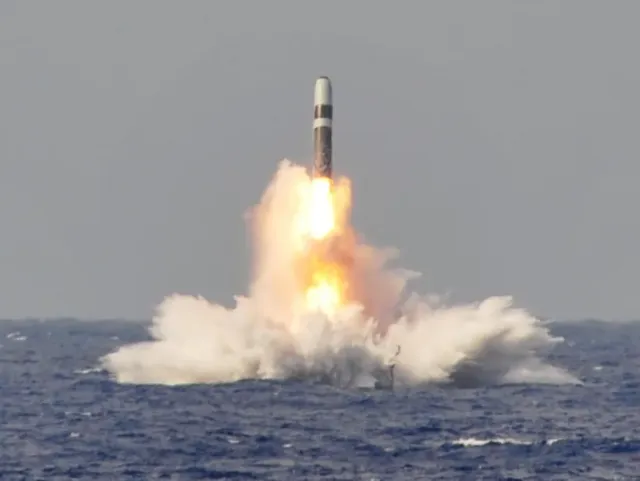
No, and this is the point in the piece where it would be easy to slide into a “the US does it properly” framing, which would be wrong. The US Air Force and Space Force conduct unarmed Minuteman III6 test launches roughly twice a year, publicly announced in advance, from Vandenberg Space Force Base, California, to the Army’s Reagan Test Site at Kwajalein Atoll in the Marshall Islands, a flight of about 6,760 km. The missile’s claimed range is 13,000 km. The US test program is genuinely more transparent than any other country’s, with a public launch cadence, advance notice, and open reporting of results, but transparency about the test is not the same as flight-verification of the number. Even the most publicly documented ICBM test program on the planet flies to roughly half its claimed max range, because going further means the same problem every other country has: someone else’s airspace or ocean gets in the way. The Trident II D5 and the still-untested LGM-35A Sentinel sit in the same position. This is a structural limit on how ICBM range gets measured, not a flaw specific to any one country’s program.
The full picture: 12 systems, ranked by claimed range
| System | Country | Claimed range (km) | Flight-test status |
|---|---|---|---|
| RS-28 Sarmat | Russia | 18,000 | One partial-distance test (2023, ~5,700 km to Kamchatka), then reported failures in 2024 and 2025; never flown near its claimed range |
| DF-41 | China | 15,000 (est.) | No publicly confirmed flight-test data |
| Hwasong-18 | North Korea | 15,000 (extrapolated) | 3 flights, each on a lofted trajectory reaching only ~1,000 km downrange |
| LGM-30G Minuteman III | United States | 13,000 | Twice-yearly unarmed test launches, ~6,760 km Vandenberg-to-Kwajalein, well short of claimed range |
| LGM-35A Sentinel | United States | 13,000 (design target) | Still in development; no flight test conducted yet |
| UGM-133A Trident II D5 | United States | 12,000 | Regularly flight-tested by the US and UK navies, similarly shorter-distance profile |
| DF-31AG | China | 11,700 (est.) | No publicly confirmed flight-test data |
| RS-24 Yars | Russia | 11,000 | Periodic domestic test flights; not independently confirmed at full range |
| JL-3 | China | 10,000 (est.) | No publicly confirmed flight-test data |
| M51 | France | 10,000 | Flight-tested by the French Navy, some tests publicly announced |
| RSM-56 Bulava | Russia | 9,300 | Widely-documented history of test failures 2005-2016 before entering service in 2018 |
| TAYFUN Block 4 | Turkey | 1,000 (in development toward greater range) | Below the 5,500 km ICBM threshold; self-reported by manufacturer, still in flight-test development |
None of the three missiles with an actual public test flight behind them, all US or French, ranks in the top three by claimed distance; every Chinese system on this list carries zero public flight-test data at all.
Which of these 12 systems has the most and least publicly-verifiable range claim?
By the same logic, the most defensible claim on this list is not the largest number, it’s the Minuteman III’s 13,000 km. Not because it has been flown that far, it hasn’t, but because the test program behind it is public, regular, and independently observable twice a year. The least defensible claims belong to DF-41 and JL-3, China’s two longest-reach systems, neither of which has any publicly confirmed flight-test data attached to its range figure at all, no partial shot, no lofted trajectory, nothing to extrapolate from in the open literature. Sarmat and the Hwasong-18 sit in an odd middle position: both have documented test flights, and both of those flight records currently argue against the claimed number rather than for it. An unverified figure backed by a failed or partial test is still a weaker claim than a flight-proven one, but it’s a different kind of weak than a figure with no test data behind it at all.
None of this means these missiles don’t work or that the real ranges are fiction. It means the number on a strategic-missile spec sheet, Russian, American, or otherwise, is closer to an engineering estimate than a measured fact, and the gap between US and Russian doctrine on this specific point is mostly a gap in test transparency, not a gap in whether the underlying number has been proven by flight.
Want to see how these claimed ranges actually compare on a map instead of a bar chart? The Range Envelope Visualizer supports the strategic-missile systemType, so you can plot any of these 12 claimed ranges as a ring from a real launch point and judge the geography for yourself.
Sources
Systems in this comparison
Every system covered above, with its photo and, where available, a video. Tap a card to open the full spec sheet.
Compare these side by side →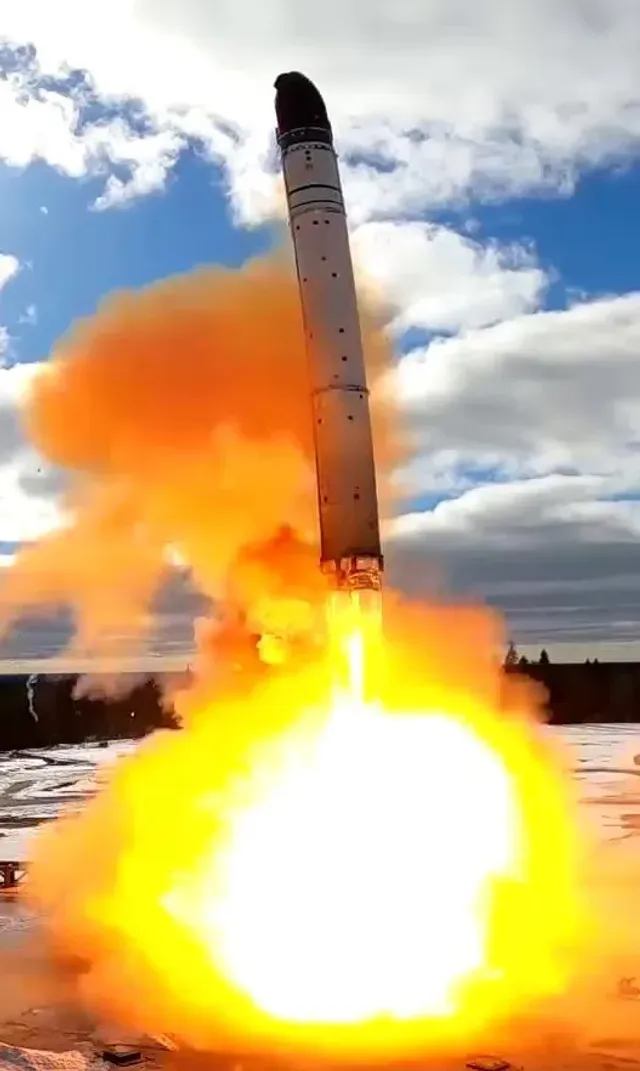
Strategic missiles
RS-28 SarmatStrategic missiles
Hwasong-18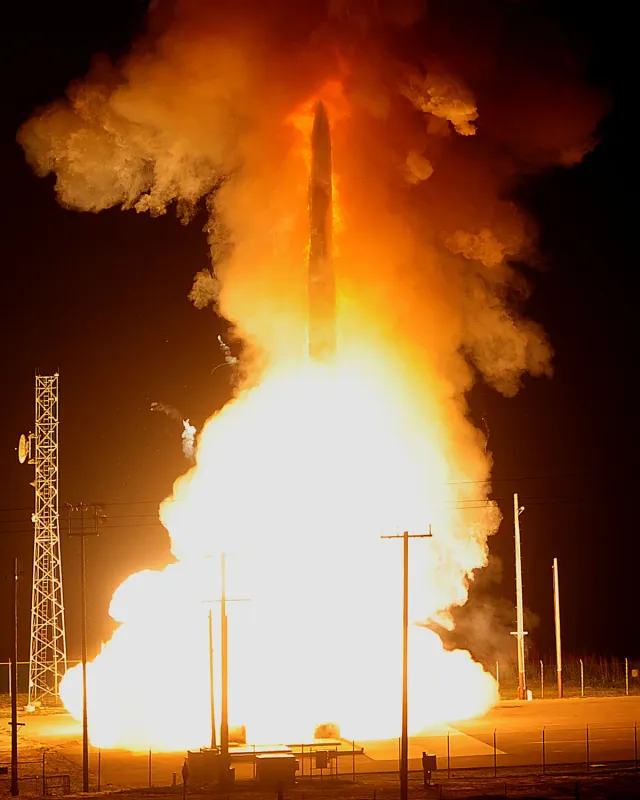
Strategic missiles
LGM-30G Minuteman III
Strategic missiles
UGM-133A Trident II D5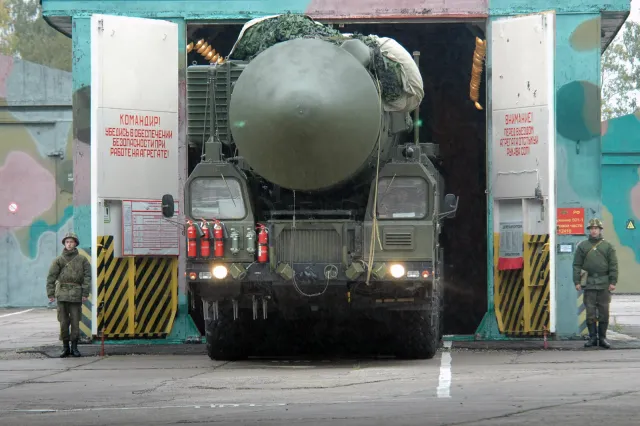
Strategic missiles
RS-24 YarsFrequently asked questions
What range counts as 'intercontinental' for a ballistic missile? +
The conventional threshold is a range greater than 5,500 km. Below that, a system is a medium- or intermediate-range ballistic missile, not an ICBM. That definition is why Turkey's TAYFUN Block 4, claimed at 1,000 km and still in development, sits in the same database category as the Sarmat and Minuteman III without being remotely comparable to them yet.
Has Russia's RS-28 Sarmat ever successfully flown to its claimed 18,000 km range? +
No. Its first test in September 2023 flew a partial distance, roughly 5,700 km from Plesetsk to the Kura test range on Kamchatka, nowhere near 18,000 km. A spring 2024 test reportedly failed, and a September 2024 test ended in a catastrophic silo explosion documented by Maxar satellite imagery. A further suspected failure near Yasny was reported in November 2025. There is no public record of a Sarmat flight covering anything close to its claimed range.
Why does North Korea test its ICBMs on a lofted trajectory instead of a normal one? +
A normal, flat trajectory to full range would send the missile over Japan or other neighboring territory, which North Korea avoids for the same reason every other country avoids full-range shots. Instead it fires steeply upward, trading downrange distance for altitude. The Hwasong-18's July 2023 test reached roughly 6,648 km in apogee but only 1,001.2 km of horizontal distance. Analysts then use the energy and trajectory data from that lofted shot to calculate what the missile's range would be on a standard trajectory, arriving at the widely cited 15,000 km figure.
Does the US Minuteman III actually fly the full 13,000 km it claims? +
No. Roughly twice a year, the US Air Force and Space Force launch an unarmed Minuteman III from Vandenberg Space Force Base, California, to the Reagan Test Site at Kwajalein Atoll, a flight of about 6,760 km, roughly half the missile's claimed range. These tests are publicly announced in advance. That transparency is real and unusual, but it does not mean the 13,000 km figure has itself been flight-proven; even the most publicly documented test program on Earth cannot fly to true max range without crossing another nation's territory or shipping lanes.
Which strategic missile in the database has the least publicly-verifiable range claim? +
By a fair reading of what's public, China's DF-41 and JL-3. Neither has any publicly confirmed flight-test data attached to its range figure, no partial-distance shot, no lofted-trajectory test, nothing. Sarmat and the Hwasong-18 at least have documented test flights, even if those flights fell far short of the claimed distance or ended in failure. An unverified number with zero test data behind it is a weaker claim than an unverified number with a failed or partial test behind it.
Related reading


