Bomber Range Ranked: Why Subsonic Beats Supersonic
Ranking all 9 bombers in the WeaponSpecs database: the subsonic Tu-95 Bear outranges every supersonic jet in the fleet by up to 8,200 km unrefueled.

Via Wikipedia, Tupolev Tu-95 (shown for identification)
Rank all 9 bombers in the WeaponSpecs database by range and the slowest one wins by the widest margin. The Tu-95MS Bear, a subsonic turboprop that first flew in 1956 and tops out at 830 km/h, publishes an unrefueled range of 15,000 km. That’s 2,700 km farther than the supersonic Tu-160 Blackjack (Mach 2.05, 12,300 km) and 8,200 km farther than the fastest bomber in the database, the Tu-22M3 Backfire (Mach 1.88, 6,800 km). Speed and range move in opposite directions here, though not for the simple reason it looks like at first glance.
Which bomber has the longest range in the database?
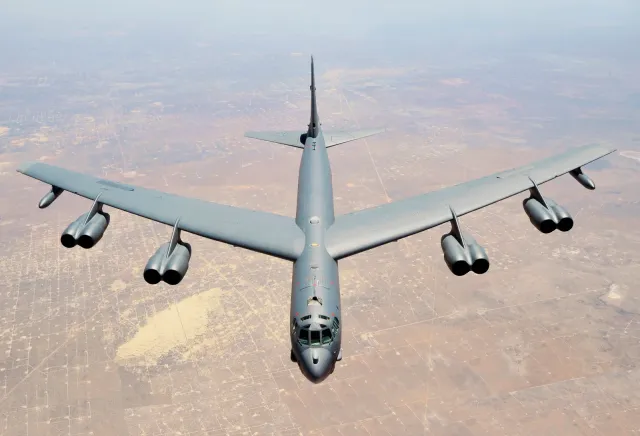
Two bombers separate themselves from the rest of the field: the Tu-95MS Bear at 15,000 km and the Boeing B-52H Stratofortress at 14,162 km. Both are subsonic. Both are Cold War designs, the Tu-95 first flying in 1956 and the B-52H’s lineage dating to 1952. Both were built around sustained fuel-efficient cruise at altitude rather than a dash speed advantage over an interceptor. Everything else in the database, supersonic or subsonic, comes in below them.
Why does a 1950s turboprop outfly Mach 2 jets?
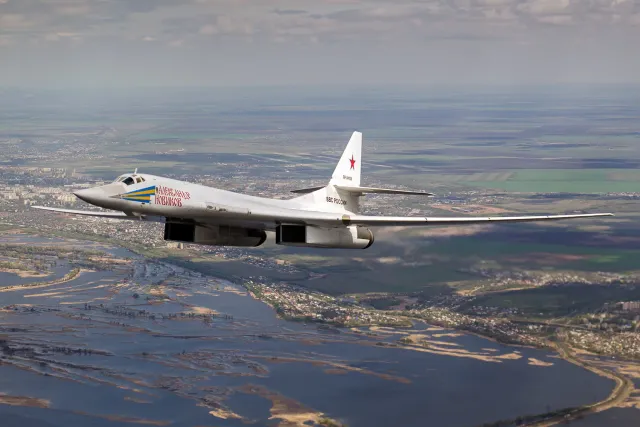
The Tu-95’s four turboprop engines are loud, slow by modern jet standards, and about as far from stealthy as an airframe gets. They are also efficient at converting fuel into distance when the mission is cruise, not dash. A supersonic airframe built to sustain Mach 1.88 to Mach 2.05, like the Tu-22M3 or Tu-160, needs a shape and powerplant that can push through transonic drag, and that costs fuel fraction relative to a design that never has to do that. The Tu-160 carries the heaviest payload in the entire database, 40,000 kg, and reaches Mach 2.05, but its range tops out at 12,300 km, well short of the Tu-95’s 15,000 km. Supersonic capability and long range are pulling against each other in the same airframe.
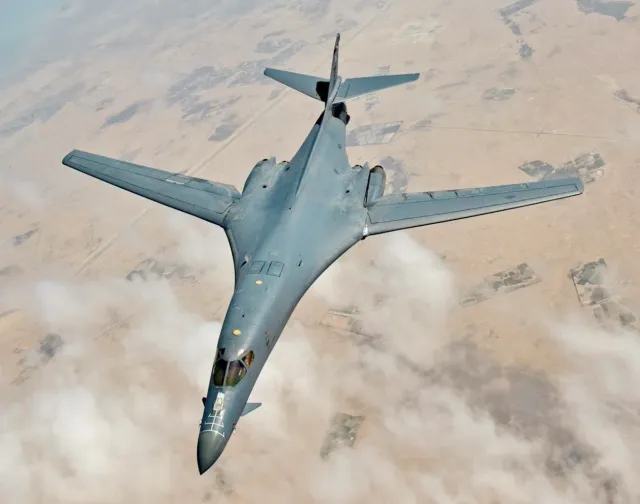
That’s a real engineering tradeoff, not a coincidence limited to one pair of aircraft. The subsonic B-52H (1,047 km/h, 14,162 km) and the supersonic B-1B Lancer (Mach 1.2, 11,998 km) show the same pattern inside a single air force: same country, same modern jet-fuel logistics chain, and the subsonic design still outranges the supersonic one by 2,164 km.
Does a heavier payload cost you range?
Payload and range don’t trade off as cleanly as speed and range do, but the Tu-160 is still the clearest data point for the question. It carries the single largest payload in the database, 40,000 kg, more than double the B-2 Spirit’s 18,144 kg, and it ranks third on range at 12,300 km, behind two aircraft carrying far less weight. The B-1B tells a similar story at a smaller scale: 34,019 kg of payload and 11,998 km of range, both trailing the Tu-95 and B-52H on range despite the B-1B carrying more weight than either. Neither case proves payload alone drives the range gap, since propulsion class and airframe age are moving at the same time, but in this dataset the heaviest-payload, highest-speed aircraft is never the longest-range one.
Is subsonic always the answer?
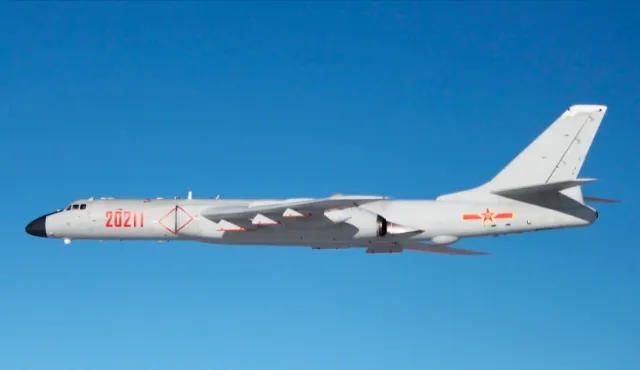
No, and the Xian H-6K is the exception that keeps this honest. It’s subsonic, 1,050 km/h, slower even than the Tu-95’s already-modest cruise speed. By the “subsonic wins” logic that explains the Tu-95 and B-52H, it should rank near the top. Instead it has the shortest full range of the six long-haul bombers in the database, 6,000 km, with a disclosed combat radius of only 3,500 km. The H-6K is a derivative of the 1950s Soviet Tu-16 airframe, smaller and with a much lower fuel fraction than the Tu-95 or B-52H. Being subsonic is necessary but not sufficient for long range. Airframe size and fuel capacity matter just as much as propulsion class, and a design built around a smaller 1950s airframe doesn’t get Tu-95-class range just because it shares the Tu-95’s speed regime.
What does stealth cost the B-2 Spirit?
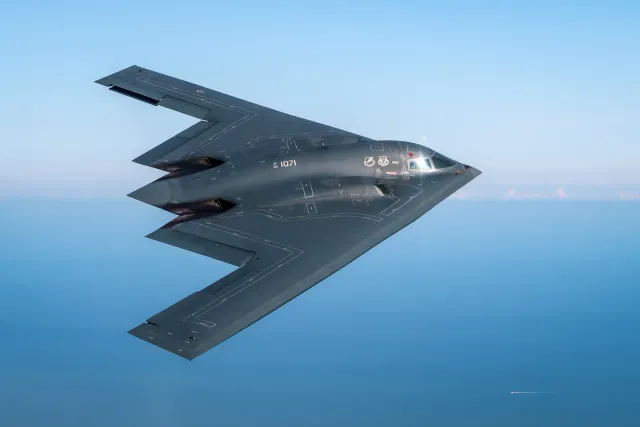
The B-2 Spirit is a third case entirely. It’s subsonic, 1,010 km/h, and jet-powered rather than turboprop, so on propulsion class alone it should sit closer to the B-52H. Instead its unrefueled range, 11,100 km, undercuts both the Tu-95 and the B-52H. The likely reason isn’t cruise efficiency at all: the B-2’s flying-wing shape is optimized to minimize radar cross-section, not to minimize drag for maximum range. Stealth has its own cost, distinct from the supersonic-dash cost that explains the Tu-160 and Tu-22M3. Three different design priorities, cruise efficiency, dash speed, and radar-cross-section reduction, produce three different range penalties on top of the same basic subsonic-versus-supersonic split.
Which of these figures are actually verified?
None of them, in the sense of independent flight-test verification, and the provenance differs by country in a way worth stating plainly. The Tu-951, Tu-1602, and Tu-22M33 figures are Russian state and manufacturer claims, not confirmed by any independent Western test agency. The Federation of American Scientists4 has published independent open-source analysis of Russian strategic aviation, and it’s a useful cross-check, but it is not a substitute for flight-test data Moscow has never released. The H-6K5 figure carries the same caveat as a Chinese state/manufacturer claim. The B-52H6, B-1B7, and B-2 figures are USAF-published specs, a different provenance, an official government fact sheet rather than a state propaganda claim, but “official” and “independently flight-test verified” are not the same thing either. Treat every number in this piece as a claim with a stated source, not a settled fact.
Where does the Su-24 fit, and where does it not?
It doesn’t fit this comparison at all, and that’s a data-categorization note worth being explicit about. The Su-24 Fencer8 sits in the same bomber systemType as the other 8 aircraft in the WeaponSpecs database, but it’s a tactical strike and interdiction aircraft, not a strategic bomber. It has no disclosed full range figure, only a combat radius of 615 km, a fraction of even the shortest-range aircraft in the long-haul group. That’s not a design failure, it’s a different mission entirely. Reading the Su-24’s 615 km combat radius as evidence it’s a weak bomber misunderstands what it was built to do.
What about the B-21 Raider?
The B-21 Raider9 genuinely doesn’t have a public range figure yet, and that’s worth saying plainly rather than estimating around it. The USAF and Northrop Grumman have disclosed a top speed class, subsonic, roughly Mach 0.9, but no range or payload figures, and the program is still in flight test and low-rate initial production with about 6 aircraft built. Any range number attached to the B-21 in open reporting is speculation, and WeaponSpecs doesn’t publish estimates in place of disclosed figures.
The full ranking
| Bomber | Country | Max speed | Range | Payload | Status of figures |
|---|---|---|---|---|---|
| Tu-95MS Bear | Russia | 830 km/h (subsonic) | 15,000 km | 15,000 kg | State/manufacturer claim, unverified |
| B-52H Stratofortress | United States | 1,047 km/h (subsonic) | 14,162 km | 31,500 kg | USAF-published spec |
| Tu-160 Blackjack | Russia | 2,220 km/h / Mach 2.05 | 12,300 km | 40,000 kg | State/manufacturer claim, unverified |
| B-1B Lancer | United States | 1,448 km/h / Mach 1.2 | 11,998 km | 34,019 kg | USAF-published spec |
| B-2 Spirit | United States | 1,010 km/h (subsonic) | 11,100 km | 18,144 kg | USAF-published spec |
| Tu-22M3 Backfire | Russia | 2,300 km/h / Mach 1.88 | 6,800 km | 24,000 kg | State/manufacturer claim, unverified |
| H-6K | China | 1,050 km/h (subsonic) | 6,000 km (3,500 km combat radius) | 12,000 kg | State/manufacturer claim, unverified |
| Su-24M Fencer | Russia | 1,700 km/h / Mach 1.35 | not disclosed (615 km combat radius only) | 8,000 kg | Tactical strike aircraft, not comparable on range; state/manufacturer claim, unverified |
| B-21 Raider | United States | Mach 0.9 (subsonic) | not publicly disclosed | not publicly disclosed | Still in flight test/LRIP, ~6 built |
Speed alone does not sort this plot: the subsonic H-6K lands at the bottom despite matching the top two on speed, while the also-subsonic, jet-powered B-2 undercuts both, so airframe design intent explains range better than propulsion class.
The two subsonic outliers at the top left, Tu-95 and B-52H, sit apart from the supersonic cluster on the right, Tu-160 and Tu-22M3, which trade speed for range in the expected direction. But H-6K sits at the bottom despite matching the top two on subsonic speed, and B-2 sits in the middle despite also being subsonic and jet-powered, which is the point: propulsion class alone doesn’t sort this chart, airframe design intent does.
None of this is targeting or operational guidance, it’s a reach comparison built from publicly disclosed figures with the provenance flagged. If you want to see how any of these ranges actually compare on a map rather than a spec sheet, plot them yourself in the Range Envelope tool, or browse the full bomber category for the underlying system pages this analysis draws from.
Sources
Systems in this comparison
Every system covered above, with its photo and, where available, a video. Tap a card to open the full spec sheet.
Compare these side by side →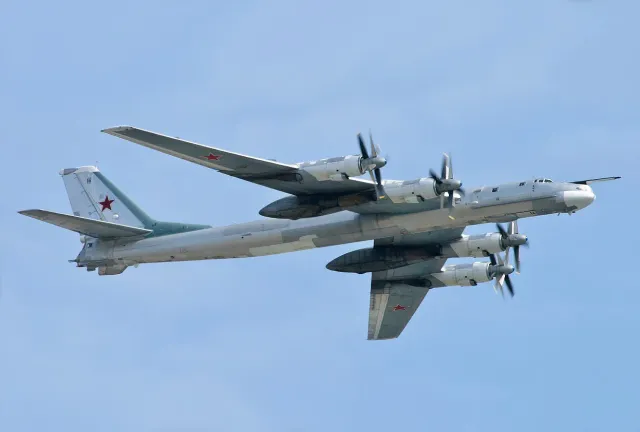
Frequently asked questions
Which bomber has the longest range in the WeaponSpecs database? +
The Tu-95MS Bear, a Russian subsonic turboprop first flown in 1956, publishes an unrefueled range of 15,000 km, the longest of any of the 9 bombers in the database. That figure is a Russian state/manufacturer claim, not independently verified.
Why does the subsonic Tu-95 outrange supersonic bombers like the Tu-160? +
Supersonic dash capability costs fuel fraction. A design built to sustain Mach 2 needs engines and an airframe shaped for high-speed drag, which burns fuel faster than a subsonic cruise design optimized purely for range at altitude. The Tu-95's turboprops trade speed for efficiency; the Tu-160's afterburning turbofans trade efficiency for speed.
Does supersonic capability always cost a bomber range? +
Not as a clean rule. It explains why Tu-160, Tu-22M3, and B-1B rank below the subsonic Tu-95 and B-52H, but it doesn't explain the whole database. The subsonic H-6K has the shortest full range of the six long-haul bombers, because its 1950s-derived airframe carries a smaller fuel fraction than the Tu-95 or B-52H, regardless of speed. Airframe size and fuel fraction matter as much as propulsion class.
Is the B-21 Raider's range publicly known? +
No. The US Air Force and Northrop Grumman have not published a range figure for the B-21 Raider, which is still in flight test and low-rate initial production with roughly 6 aircraft built. WeaponSpecs does not estimate figures a manufacturer or government has not disclosed.
Is the Su-24 Fencer really a strategic bomber? +
No, and grouping it with the others in a single systemType is a categorization quirk, not a design judgment. The Su-24 is a tactical strike and interdiction aircraft with a disclosed combat radius of 615 km, not an intercontinental range figure. It was never built for the same mission as the Tu-95 or B-52H, so its short reach isn't a shortfall, it's a different job.
Related reading


