Su-57 vs F-35 vs J-20: Claimed vs Verified
On paper the J-20 leads on combat radius and the Su-57 on speed. The catch: the numbers that flatter them are the ones no one outside Moscow or Beijing can verify.

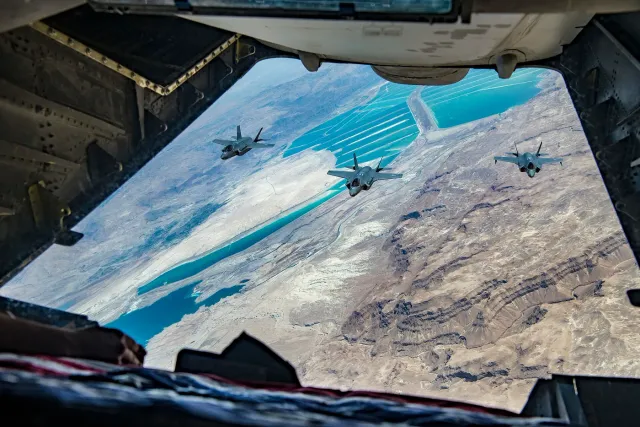
Master Sgt. Patrick O'Reilly, Public domain
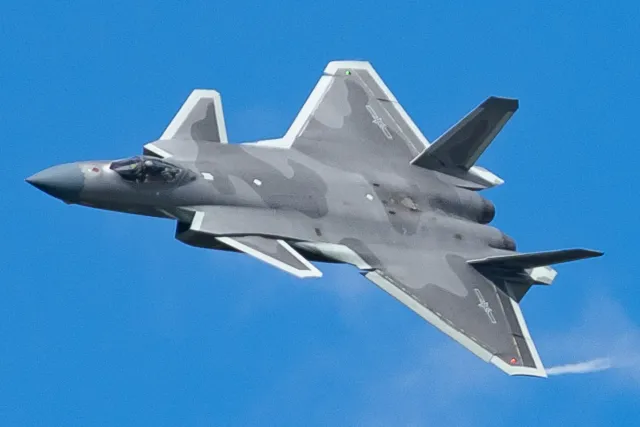
On published specifications the Chengdu J-20 leads fifth-generation combat radius at roughly 2,000 km and the Su-57 leads top speed at Mach 2.0, both ahead of the F-35A’s 1,240 km and Mach 1.6. The catch is which numbers those are. The J-20’s radius and the Su-57’s speed are Chinese and Russian state-linked figures with no independent audit trail behind them, while the F-35A’s trailing numbers sit on top of roughly a decade of combat deployments, export scrutiny, and cost audits across 20 countries. This is a comparison of three jets marketed as peers. It is not a comparison of three equally verifiable data sets.
Which fifth-gen fighter wins on paper?
Line up the sheet specs and the Russian and Chinese jets look better on the metrics that get quoted in headlines: bigger payload, longer legs, faster top end. Here is the published data, with the Su-57 and J-20 columns flagged as claims rather than verified fact.
| Spec | F-35A (US) | Su-57 (Russia, claim) | J-20 (China, claim) |
|---|---|---|---|
| Top speed | Mach 1.6 | Mach 2 | Mach 2 |
| Combat radius | 1,240 km | 1,500 km | 2,000 km |
| Service ceiling | 15,240 m | 20,000 m | 20,000 m |
| Weapons payload | 8,160 kg | 10,000 kg | 11,000 kg |
| Hardpoints | 10 | 10 | 6 |
| Radar cross-section | Not disclosed | Not disclosed | Not disclosed |
| Unit cost | ~$82.5M (flyaway) | ~$50M (disputed est.) | Not disclosed |
| Built / operators | ~1,100 / 20 | ~30 / 1 | ~250 / 1 |
| First operational | 2,016 | 2,020 | 2,017 |
The two longer bars are both unverified state claims: the only figure here with an independent audit trail behind it is also the shortest one.
The pattern in that table is not subtle. Every category where the Su-57 or J-20 leads is a category sourced to Sukhoi, AVIC, or Russian and Chinese state media. Every category where the F-35A leads, or where the numbers are close, is a category with an independent paper trail: flight test reports, export contracts, GAO cost audits, squadron deployment records. The J-20’s 2,000 km radius and the Su-57’s Mach 2.0 top speed are exactly the kind of round, favorable figures that state-linked programs release and rarely have to defend under outside scrutiny. That does not make them false. It makes them unverified, which is a different thing, and the distinction matters more than the numbers themselves.
How many of them publish the one number that defines stealth?
Zero. Radar cross-section, the single figure that would let you actually rank these three jets on the attribute they are most marketed for, is not disclosed for the F-35A, the Su-57, or the J-20. Lockheed Martin does not publish an RCS figure for the F-35A on its official product page. Sukhoi has never released one for the Su-57. AVIC has never released one for the J-20. This is the most important gap in the entire comparison and it gets skipped past constantly, because “stealth fighter” headlines don’t wait for classification review.
That means every claim you have read about one of these jets being “stealthier” than another is an inference from shape, materials commentary, or analyst speculation, not a measured number. The F-35A’s low-observable design has been validated indirectly through operational deployments against contested airspace and allied radar testing, which is more corroboration than the Su-57 or J-20 have accumulated, but “more corroboration” is still not “a published RCS.” Treat every cross-jet stealth ranking, including implicitly the one in this article’s own combat-radius chart, as qualitative, not numerical.
Whose numbers can you actually verify?
This is the real fault line in the comparison, and it runs through the whole table, not just the stealth question. The Su-57 program has produced roughly 30 aircraft for a single operator, Russia, and has seen limited, disputed combat exposure. The J-20 has produced roughly 250 aircraft for a single operator, China, with almost no export or third-party operational data. Neither program has been through the kind of cross-checking that comes from selling jets to allied air forces who run their own maintenance logs, cost audits, and readiness reporting.
The F-35A is a different animal on this specific axis. Roughly 1,100 built, 20 operators, in service since 2016, with a documented combat and export record that includes GAO cost reports, allied parliamentary reviews, and squadron-level readiness data published across multiple democracies. None of that makes the F-35A’s raw performance numbers automatically superior. It makes them auditable in a way the Su-57’s and J-20’s are not. When a number can be checked against an independent institution’s own bookkeeping, in The Military Balance or a national audit office, it earns a different category of trust than a manufacturer’s brochure line, and that is the actual comparison being made here.
What does the price tell you?
Cost transparency is itself a verifiability signal, and it lines up with everything above. The F-35A publishes a real, recurring flyaway cost, about 82.5 million dollars for recent production lots, tracked lot by lot in public defense budget documents. The Su-57’s roughly 50 million dollar figure is a disputed estimate, assembled by outside analysts rather than confirmed by Sukhoi or the Russian defense ministry, and it has moved around depending on which export pitch or state media report you’re reading. China has never disclosed a J-20 unit cost at all.
That gradient, disclosed and audited, disclosed but disputed, undisclosed, tracks almost exactly with how much outside corroboration exists for each jet’s performance claims. A program that will not tell you what the aircraft costs is rarely a program that will let outsiders check its combat radius either. Cost opacity and spec opacity travel together.
So which number should drive the decision?
The same claimed-versus-verified split shows up outside the air domain too: our Arleigh Burke vs Type 055 vs Sejong the Great comparison found an undisclosed Chinese destroyer price and an unconfirmed radar detection range standing next to a fully audited American combat record, the same pattern as this jet comparison. Run your own side-by-side on these or any other airframe in the Compare tool, or browse the full field in the fighter aircraft category to see how the rest of the world’s fifth-generation programs stack up against the same claimed-versus-verified standard. For more claim-skeptical breakdowns like this one, see the Articles archive.
Sources
Systems in this comparison
Every system covered above, with its photo and, where available, a video. Tap a card to open the full spec sheet.
Compare these side by side →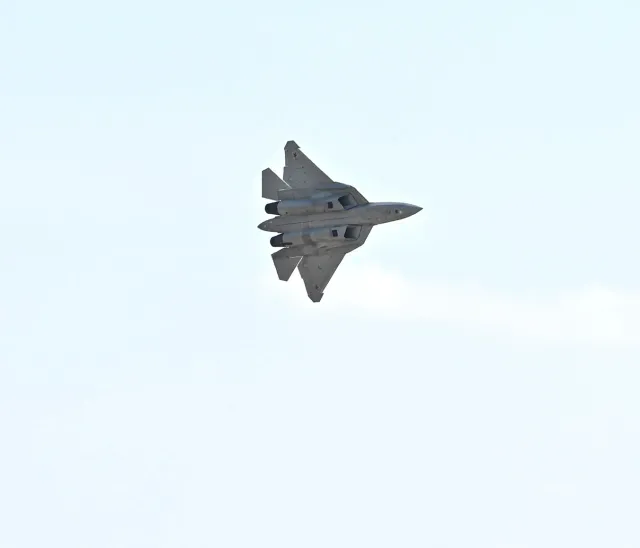
Frequently asked questions
Which fifth-generation fighter has the longest combat radius? +
On published figures the Chengdu J-20 leads at about 2,000 km, ahead of the Su-57 at 1,500 km and the F-35A at 1,240 km. But the J-20 and Su-57 figures are Chinese and Russian state-linked claims with limited independent verification, while the F-35A figure is drawn from a long, independently documented record.
Do any of these jets publish a radar cross-section? +
No. None of the three publishes a real radar cross-section number. All three are marketed as very low observable, but the single figure that would actually let you compare their stealth is classified for every one of them, so cross-jet stealth claims cannot be verified from specifications.
How much does each cost? +
Only the F-35A publishes a real recurring flyaway cost, about 82.5 million dollars for recent lots. The Su-57's roughly 50 million dollar figure is a disputed estimate, and China has never disclosed a J-20 unit cost. Cost transparency itself is a data point.
Are Russian and Chinese fighter specs reliable? +
Treat them as manufacturer and state claims, not verified facts. Neither the Su-57 nor the J-20 has the long, cross-checked combat, export, and audit record that lets outside analysts corroborate published range, speed, and sensor figures, so their numbers deserve the same skepticism as any brochure figure.
Which fifth-gen fighter is actually the most proven? +
By production and operational record the F-35A is far ahead, with roughly 1,100 aircraft built and 20 operators versus about 250 J-20s for one operator and roughly 30 Su-57s for one. Maturity and a documented track record are where the verifiable gap is widest.
Related reading


