Lockheed wins $502M to sustain Apache night-vision sensors
The U.S. Army extends Lockheed Martin's Apache TADS/PNVS targeting and night-vision sustainment through 2031 in a $502.4 million award.

U.S. Department of Defense photo, DVIDS, public domain
By the numbers

Infographic: WeaponSpecs News Desk
The U.S. Army awarded Lockheed Martin a $502.4 million fixed-price hybrid IDIQ contract on July 9 to sustain the night-vision and targeting sensors that give the AH-64E Apache its ability to fight after dark, according to reporting from ClearanceJobs. The award covers support for the Modernized Target Acquisition Designation Sight/Pilot Night Vision Sight, known across the fleet by its acronym M-TADS/PNVS, and runs from July 9, 2026 through July 5, 2031, a five-year window that keeps the sensor suite serviced well into the next decade.
What the money actually buys
This is not a production contract. The Army already has roughly 900 Apaches in active, National Guard and Reserve service, and every one of them carries a nose-mounted M-TADS/PNVS turret built around two distinct sensor packages. TADS, the Target Acquisition Designation Sight, is the gunner’s system: a gyro-stabilized forward-looking infrared camera, a laser rangefinder and a laser designator that let a crew spot, track and mark a target for a Hellfire missile or 30mm cannon fire from several kilometers out, day or night. PNVS is the pilot’s half of the pairing, a separate thermal viewer that projects a stabilized night image onto the pilot’s helmet-mounted display so the aircraft can be flown at low altitude in total darkness without losing situational awareness of terrain and obstacles.
Sustainment contracts like this one fund the unglamorous but essential work of keeping fielded sensor turrets calibrated, repaired and periodically upgraded rather than buying new hardware. Army Recognition’s coverage of the award places the production and support work at Lockheed Martin’s Orlando, Florida facility, which builds and maintains the sensor pod itself, and at Troy, Michigan, where the associated cockpit display and control systems are handled. That geographic split reflects how the Apache’s sensor architecture has always been divided between the externally mounted turret and the internal systems that translate its imagery into something a crew can act on in the cockpit.
Why a sustainment deal is the actual story
It would be easy to read a $502 million award as a routine maintenance line item and move on, but the timing and duration say more than the dollar figure alone. The Army is simultaneously running its Future Attack Reconnaissance Aircraft, or FARA, evaluation, a program meant to eventually field a faster, more survivable scout-attack helicopter as a complement to the existing Apache fleet. A five-year M-TADS/PNVS sustainment commitment stretching to mid-2031 is the Army effectively signaling that whatever FARA ultimately becomes, the Apache is not going anywhere in the near term. Fleets do not get multi-year sensor sustainment contracts if the plan is to retire them; they get sustainment contracts because they remain the backbone of Army attack aviation and will stay that way for years regardless of how FARA develops.
There is also a quieter modernization thread running underneath the sustainment language. The Apache program has been working through V6.5 software and sensor upgrades in testing, part of a broader effort to keep the M-TADS/PNVS sensor picture current against newer thermal-imaging and laser technology even as the core hardware architecture stays in service. A sustainment contract of this size and duration typically leaves room for incremental technical refresh work alongside pure repair-and-replace tasking, which is consistent with how the Army has managed Apache sensor upgrades in past sustainment cycles rather than through standalone modernization buys.
The export dimension
The M-TADS/PNVS sensor lineage is not a U.S.-only concern. Variants of the AH-64D Apache Longbow and the newer AH-64E remain in service with a range of export operators, including Israel, the United Kingdom, Japan and Saudi Arabia, all of whom depend on the same underlying sensor technology tree for their own night and all-weather targeting capability. A U.S. Army sustainment contract does not automatically extend to those foreign military sales fleets, which typically run their own parallel support arrangements, but the continuity of the core M-TADS/PNVS supply chain and technical baseline in the U.S. Army program has downstream implications for how easily those partner nations can source spares, upgrades and technical support for their own aircraft over the same period.
The Apache has held its role as the Army’s primary attack helicopter since the mid-1980s largely because its sensor package kept pace with the threats it was built to counter, and the aircraft’s night and all-weather targeting advantage has been a defining feature of nearly every conflict it has flown in since. That advantage is entirely a function of the M-TADS/PNVS turret rather than the airframe itself; a grounded or degraded sensor suite turns a heavily armed helicopter into a daylight-only asset in an era when adversaries increasingly plan around operating at night specifically to avoid detection. Sustainment awards of this size are a reminder that the Apache’s continued relevance rests less on the aircraft’s speed or weapons load than on whether the Army keeps funding the sensor technology that lets a crew find a target in the dark in the first place.
Sources
- Lockheed Martin Lands $502M Army Contract to Support AH-64 Apache Night Vision Systems (ClearanceJobs, Jul 9, 2026)
- Lockheed Martin's $502M Apache sensor award keeps U.S. attack helicopters ready for night warfare (Army Recognition, Jul 9, 2026)
Systems mentioned
Every system named in this story, with its photo and, where available, a video. Tap a card to open the full spec sheet.
Compare these side by side →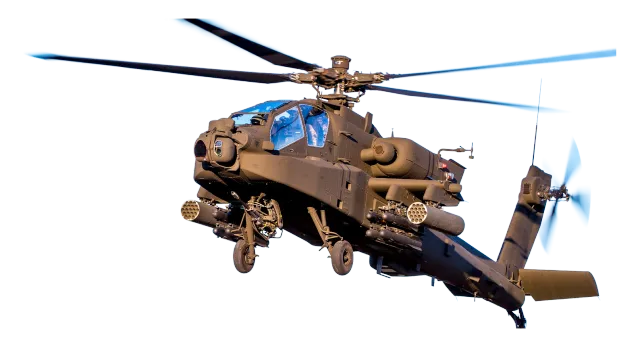
Helicopter
AH-64E Apache Guardian Helicopter
AH-64D Apache LongbowFrequently asked questions
What is the M-TADS/PNVS and why does it matter? +
The Modernized Target Acquisition Designation Sight/Pilot Night Vision Sight is the Apache's nose-turret sensor suite: a gyro-stabilized FLIR camera, laser rangefinder and laser designator for the gunner, paired with the pilot's separate night-vision viewer. Together they let a crew detect, track and designate targets several kilometers out in darkness, smoke, dust or rain. Without it working, the Apache loses the night and all-weather targeting edge that has defined the aircraft since the 1980s.
Is this new production or sustainment? +
Sustainment. The $502.4 million award funds support, repair and upgrade work on M-TADS/PNVS units already fielded across the Apache fleet through July 2031, not a manufacturing ramp of new sensor pods.
Does this delay Apache retirement? +
A five-year sustainment term running to 2031 signals the Army intends to keep flying Apaches well past 2030. It does not by itself change the Future Attack Reconnaissance Aircraft program, which the Army is still evaluating as an eventual complement to, not an immediate replacement for, the Apache fleet.
Who else flies the Apache and depends on this sensor? +
Roughly 900 Apaches serve across U.S. Army active, National Guard and Reserve units, and export operators including Israel, the United Kingdom, Japan and Saudi Arabia fly Apache variants that rely on the same TADS/PNVS sensor lineage for night operations.
More news


