Ukraine's SkyFall Drone, JetKiller Interceptor Enter Mass Output
SkyFall begins serial output of a $25-30K, 600km strike drone and starts mass-producing its 370km/h P1-SUN JetKiller interceptor this month.

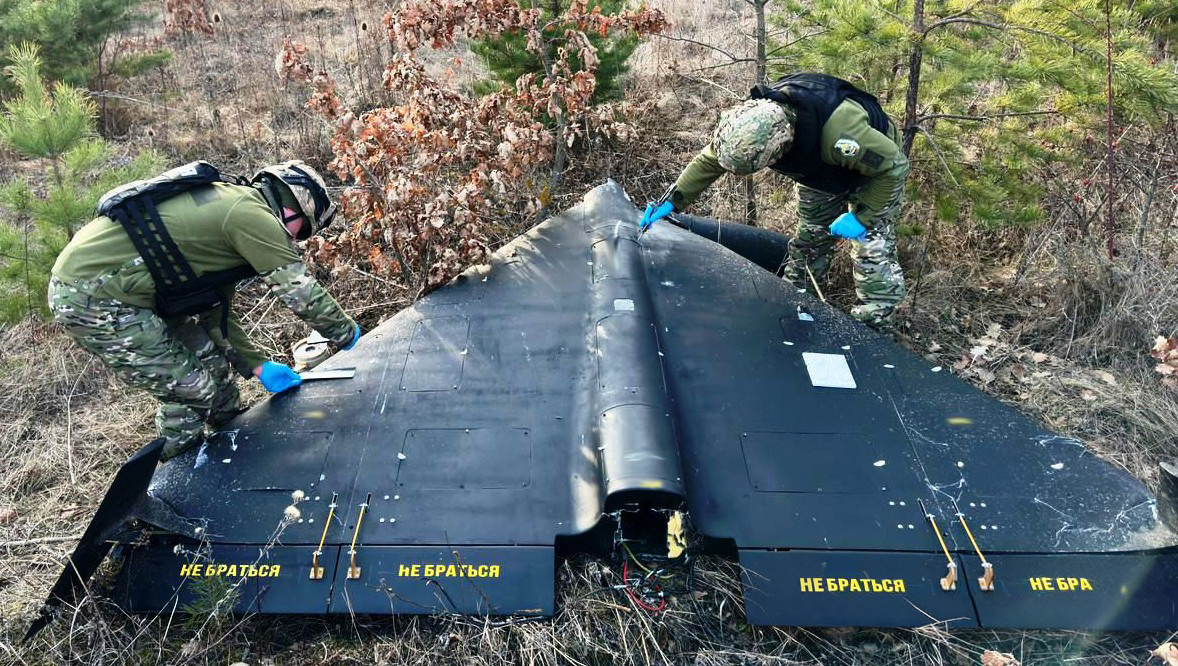
General Staff of the Armed Forces of Ukraine, CC BY 4.0, via Wikimedia Commons
Ukrainian drone maker SkyFall has moved both of its newest systems from prototype into production this month: a 600-kilometer-range strike drone priced at $25,000 to $30,000 per unit, targeting 1,000 units a month by the end of 2026, and the P1-SUN “JetKiller” interceptor, a faster variant of its Shahed-hunting drone now capable of 370 km/h, entering mass production this month at a claimed rate of 50,000 interceptors a month. Both systems were first unveiled in late July; what changed this week is that serial production of both actually began.
What’s actually new this week
It matters to be precise about the timeline here. SkyFall unveiled the JetKiller interceptor and disclosed the 600-kilometer strike drone’s specifications around July 21 to 27, 2026, and that unveiling generated its own round of coverage at the time. The genuinely new development, reported August 3 to 6, is that both systems moved into serial or mass production this month. This piece is about the production ramp, not a re-announcement of a debut that already happened, and the two should not be conflated even though several outlets’ headlines this week blur that distinction.
The 600km strike drone
SkyFall’s strike drone carries a 40 to 50 kilogram fragmentation or high-explosive-fragmentation warhead, depending on mission profile, on a 3.5-meter wingspan airframe with a stated range of 600 kilometers. At a unit cost of $25,000 to $30,000, it sits in the same broad cost category as Iran’s Shahed-136, the loitering munition that popularized cheap, long-range, one-way-attack drones in the first place, though it is a different airframe built for a different air force. SkyFall says the type has already been supplied to Ukrainian forces with claimed combat use, though as with all of the company’s figures, that claim comes from the manufacturer itself rather than an independent source. SkyFall is a private Ukrainian company, not a state actor, so its figures do not carry the same state-claim flag WeaponSpecs applies to Russian, Chinese, Iranian or North Korean government statements, but they are still unverified vendor claims and should be read with the same caution.
JetKiller: a faster edge on an existing interceptor line
The P1-SUN family is SkyFall’s answer to the Shahed problem from the other direction, not a strike weapon but an interceptor built specifically to catch and destroy Iranian-designed Shahed-136 and Russian-built Geran-2 drones in flight. The baseline P1-SUN reportedly cruises around 310 km/h; the new JetKiller variant pushes that to 370 km/h, with a 30-kilometer operating range, a 9,000-meter ceiling and roughly 15 minutes of endurance. It carries a small 500-gram warhead and an AI-assisted automated terminal-guidance module SkyFall says can lock onto a target at up to 1 kilometer using day and night cameras.
A SkyFall spokesman identified only by the security pseudonym “Ares” explained the tactical logic behind the speed increase to Breaking Defense in the same late-July unveiling:
“What we see on the radars in Ukraine is actually that the top speed of Russian Shaheds can reach 400km/h, but they cannot sustain or go at this speed constantly, they dial the speed down during some parts of the flight, which is when we can catch up and hit them,” said a spokesman for SkyFall using the security pseudonym “Ares,” a practice the outlet notes is used for the company’s spokespeople (Breaking Defense, July 22, 2026).
SkyFall claims the JetKiller has destroyed “more than a dozen” jet-powered Shaheds in testing, and that the baseline P1-SUN family has destroyed more than 5,500 drones since November 2025. Those figures, like the production targets, are company claims relayed by defense press rather than independently audited numbers, and this piece treats them accordingly.
Not Ukraine’s only interceptor program
JetKiller is not replacing an existing system so much as joining one. Wild Hornets’ STING interceptor, a different Ukrainian manufacturer’s FPV quadcopter built for the same mission, already claims more than 200 confirmed intercepts, 78 against Shahed-136/131 drones and 127 against cheaper Gerbera decoys, at a reported 80 to 90 percent hit rate, and costs roughly $2,500 per unit per the manufacturer. JetKiller and STING are not the same system and should not be conflated; Ukraine is now running at least two competing low-cost interceptor programs simultaneously rather than consolidating around a single design.
Wild Hornets' STING interceptor costs roughly a twentieth of the disputed $50,000 figure commonly cited for the Shahed-136 it exists to shoot down. SkyFall's separate 600-kilometer strike drone, a different mission built to attack rather than intercept, still lands well under that same figure. All three numbers are manufacturer or vendor claims, not independently audited prices, and published Shahed-136 cost estimates range from the low thousands of dollars to well over $100,000 depending on the source and whether technology-transfer costs are included.
Why this matters more than the specs alone
Iran’s Shahed-136, and Russia’s locally built Geran-2 copies, created what WeaponSpecs’ own database describes as a new category of threat: the cheap, slow, persistent cruise-munition swarm, with May 2026 marking record monthly launch volumes against Ukraine even as interception rates climbed. That is the economic problem JetKiller and STING both exist to solve. Ukraine cannot answer mass Shahed raids with Patriot interceptors that cost well over $1 million each; it needs something that costs closer to what it is shooting down. A sub-$5,000-class interceptor protects the same airspace as a Patriot round at a small fraction of the cost, which is not a substitute for high-end air defense against ballistic and cruise missiles, but it does free scarce PAC-3 stock for the threats that actually require it, the same production-economics logic WeaponSpecs traced in its recent coverage of Lockheed’s PAC-3 MSE contract surge.
Sources
- Ukraine Begins Mass Production of SkyFall 600 km Strike Drone as JetKiller Shahed Interceptor Debuts — Army Recognition, Aug 3, 2026
- Ukrainian defense firm Skyfall unveils new 'JetKiller' interceptor drone — Kyiv Independent, Jul 22, 2026
- Ukraine's Skyfall unveils new drone interceptor to strike Russian Shaheds faster — Breaking Defense, Jul 22, 2026
Systems mentioned
Every system named in this story, with its photo and, where available, a video. Tap a card to open the full spec sheet.
Compare these side by side →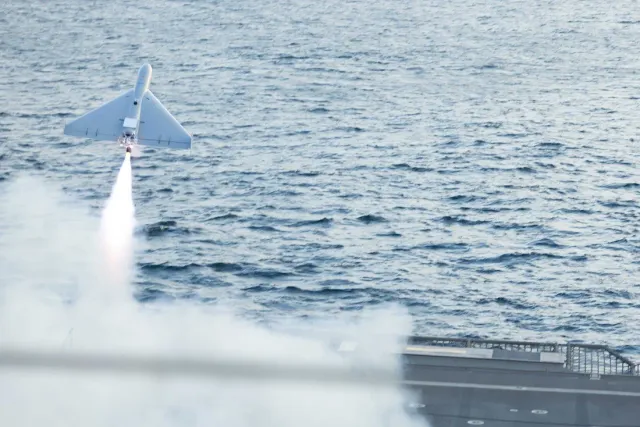
UAV / drone
Shahed-136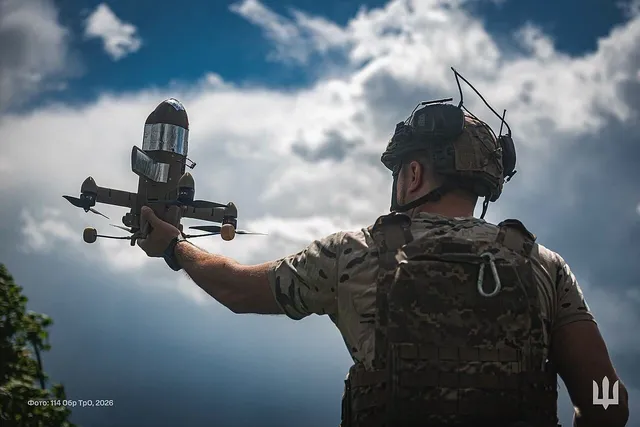
Frequently asked questions
What actually happened this week versus three weeks ago? +
Both systems were first unveiled in late July 2026. What is new as of August 3 to 6 is that both entered serial or mass production, at claimed rates of 1,000 units a month for the strike drone and 50,000 units a month for the interceptor.
Is JetKiller replacing Ukraine's existing interceptor drones? +
No. It is a second, competing program alongside Wild Hornets' STING, which already claims more than 200 intercepts. Ukraine is running multiple parallel low-cost interceptor programs rather than consolidating on one.
How does this fit the Patriot interceptor shortage WeaponSpecs already covered? +
These are cheap FPV-class interceptors built for slow, low-flying Shahed and Geran drones. They do not substitute for Patriot or PAC-3 against faster ballistic or cruise threats. The connection is cost economics: a sub-$5,000-class interceptor and a Patriot interceptor costing well over $1 million protect the same skies at radically different unit costs, which frees scarce PAC-3 stock for higher-end threats.
Are the kill claims verified? +
No. All intercept counts, speed figures and cost figures come from the manufacturer, SkyFall, relayed largely uncritically by defense press. They should be treated as company claims pending independent confirmation, not settled facts.
More news


