Taiwan War-Games Wartime Arms Production, Debuts Abrams
Han Kuang 42 tests relocating Taipei's 202nd Arsenal and drafting civilian factories as M1A2T Abrams tanks join the drills for the first time.

Lin Yen-Ting, Office of the President, Republic of China (Taiwan), CC BY 4.0
Taiwan’s live-fire Han Kuang 42 exercise, running August 5 through 14, 2026, is testing for the first time whether the island can relocate its main arsenal and convert civilian factories to keep producing weapons if China strikes Taiwan’s supply hubs, while M1A2T Abrams tanks join the drills for the first time since their delivery began in 2024.
Why the arsenal drill is the actual story
Han Kuang is Taiwan’s largest annual live combat-readiness exercise, now in its 42nd edition, and its live-fire phase this year runs from August 5 through 14, 2026, following a tabletop and simulation phase held April 11 through 24. What makes this year’s edition genuinely new is not a weapon system but a supply-chain test: for the first time, the drill simulates wartime relocation of the Armaments Bureau’s 202nd Arsenal in Taipei and the mobilization of civilian factories for what Taiwanese officials describe as “whole-system assembly” of weapons under an emergency order. The scenario assumes sustained combat output even if Chinese strikes hit Taiwan’s existing production hubs, a scenario planners have not previously built into Han Kuang at this scale.
That detail matters more than it might first appear. Most public attention to Taiwan’s defense goes to hardware, jets, missiles, tanks, but a military can only sustain a war for as long as it can keep replacing what it loses, and Taiwan’s defense-industrial base is geographically concentrated in ways an opposing military would be expected to target early. Testing whether the 202nd Arsenal’s output can survive a strike on its home location, and whether civilian manufacturers can be converted into wartime weapons producers fast enough to matter, is a rehearsal for the part of a conflict that doesn’t show up in a highlight photo of a tank column.
The Abrams arrives, three years after the order
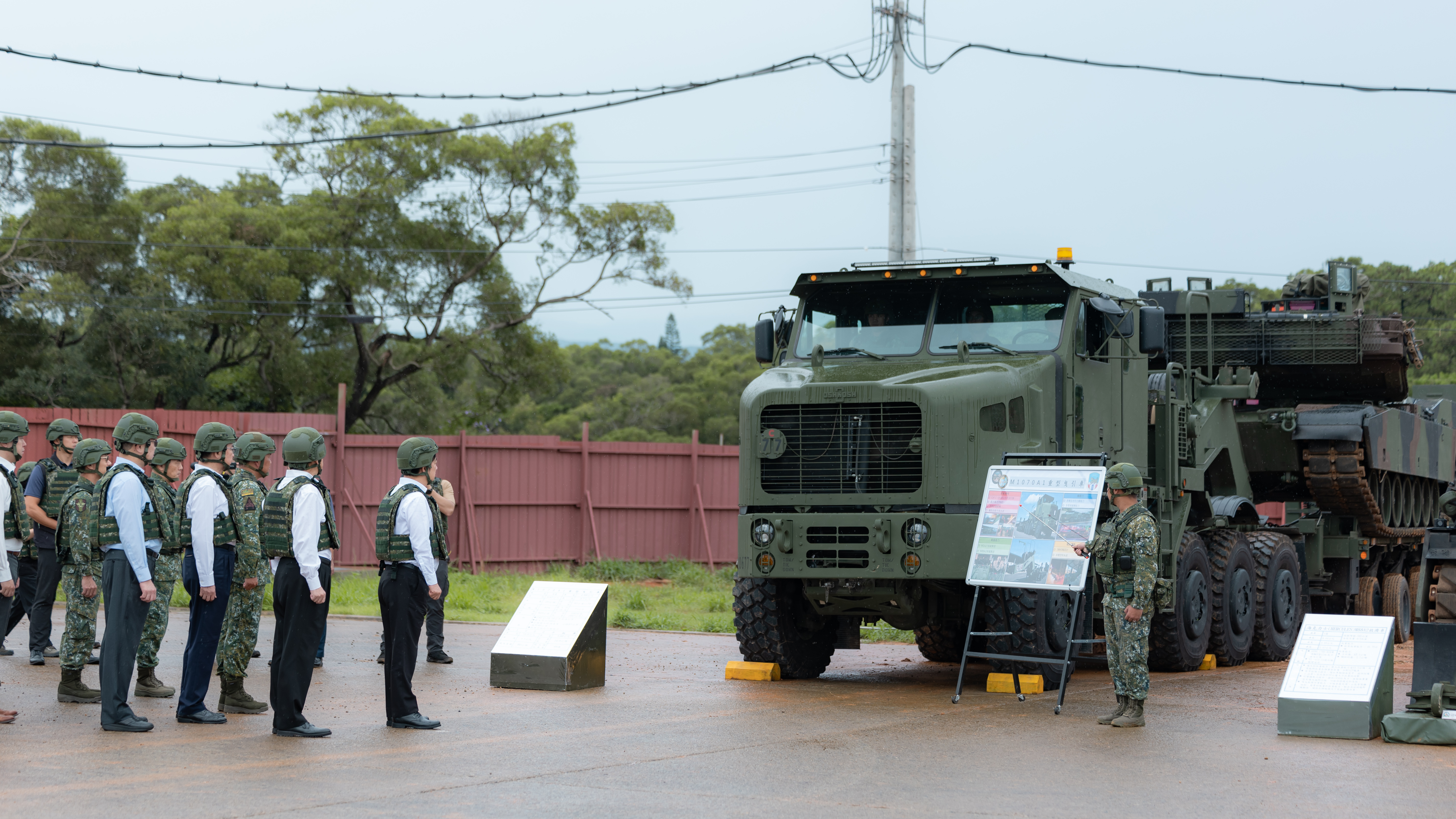
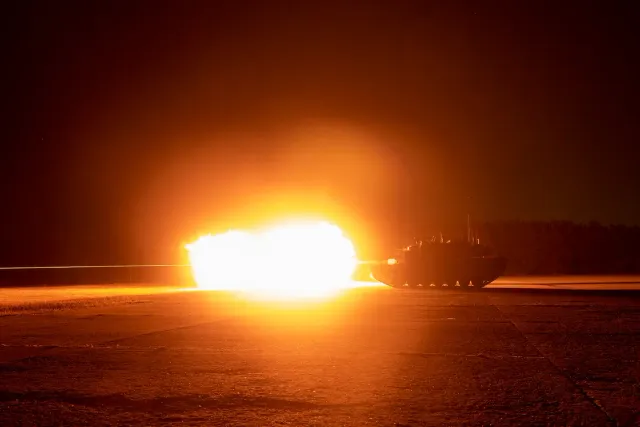
The M1A2T Abrams, Taiwan’s export variant of the M1A2 SEP v3 built without the depleted-uranium armor inserts used in the US Army’s own version, joined Han Kuang drills for the first time this year, testing defenses against amphibious landings in northern Taiwan. WeaponSpecs’ database entry for the M1A2 SEP v3 Abrams covers the baseline US configuration, not Taiwan’s export variant specifically, a distinction worth stating plainly since the two are related but not identical hardware.
Delivery has come in three tranches from General Dynamics Land Systems in Lima, Ohio: 38 tanks in December 2024, 42 more in July 2025, and a final batch of 28 scheduled for 2026, bringing the total order to 108. The July 2025 delivery was enough to let Taiwan stand up its first M1A2T battalion on October 31, 2025, at Hukou base in Hsinchu County. This year’s Han Kuang is the first time that battalion, or any M1A2T unit, has taken part in the exercise, giving Taiwan its first live test of how the tanks perform against a simulated amphibious assault rather than in a training-ground demonstration.
A reserve call-up built for a specific test, not just headcount
This year’s exercise includes what the Associated Press describes as the largest-ever structured reserve mobilization built into Han Kuang, with up to 5,000 reservists called up across two brigade-level units in northern and southern Taiwan. That figure needs context to read correctly: it is not directly comparable to 2025’s Han Kuang 41, which mobilized 22,000 reservists across the full exercise, a much broader scope than this year’s two-unit structured call-up. The distinction is about what’s being tested, not just how many people show up. Last year’s number measured overall reserve turnout; this year’s measures whether two specific brigade-level units can be reconstituted and integrated into a live exercise on a defined mobilization timeline.
The exercise also incorporates a US Army practice known as the “backbrief” method, expanded this year, in which subordinate units explain their understanding of a mission back to senior commanders before executing it, a process meant to catch planning gaps before they become battlefield failures. Separately, planners deliberately throttled mobile internet speeds during part of the drill to simulate the kind of wartime communications disruption Taiwan would likely face in an actual conflict, while urban resilience drills ran simultaneously in Kaohsiung, Taichung and Taipei.
Taiwan’s own framing of Chinese intent
Maj. Gen. Lu Wen-yuan, head of the Joint Operations Division at Taiwan’s Ministry of National Defense, offered the ministry’s standing explanation for why Han Kuang treats Chinese military activity as a live threat rather than routine posturing.
“Chinese forces use routine annual joint military exercises as cover for large-scale landing training, concealing plans to attack Taiwan while completing final assault preparations,” said Maj. Gen. Lu Wen-yuan, head, Joint Operations Division, Taiwan Ministry of National Defense.
That characterization is Taiwan’s own military assessment of Chinese intent and has not been independently verified by outside sources. It is presented here as the ministry’s stated reasoning for the exercise’s design, not as a confirmed fact about Chinese planning. Maj. Gen. Fu-Chun Chiao, director of the Military Information Division and the ministry’s deputy spokesperson, has represented the exercise publicly alongside Lu.
The budget backdrop
Han Kuang 42 runs against a broader Taiwanese procurement push. Taiwan’s $24.8 billion supplementary defense budget has been approved, President Lai Ching-te has proposed a further $40 billion budget on top of that, and a $14 billion US arms-sale package remains pending American approval, following an $11 billion package already cleared. Those figures, drawn from AP and Taipei Times reporting, frame the M1A2T’s debut and the arsenal-relocation drill as pieces of a sustained, multi-year buildup rather than a single exercise cycle, one that both TaiwanPlus and Taipei Times describe as increasingly modeled on US planning methods, including the backbrief practice used this year.
Sources
- Taiwan kicks off annual military drills to counter a potential Chinese attack — ABC News (AP), Aug 5, 2026
- Taiwan's military drills suggest deeper alignment with the U.S. — ABC News (AP), Aug 6, 2026
- Taiwan Prepares for Han Kuang 2026 With Live-Fire Beach Drills — TaiwanPlus, Aug 4, 2026
- Han Kuang live-fire exercises to test US-style methods — Taipei Times, Aug 3, 2026
Systems mentioned
Every system named in this story, with its photo and, where available, a video. Tap a card to open the full spec sheet.
Main battle tank
M1A2 SEP v3 AbramsFrequently asked questions
What's new about this year's Han Kuang exercise? +
For the first time, the drill tests relocating the Armaments Bureau's 202nd Arsenal in Taipei and converting civilian factories to sustain weapons production if Chinese strikes hit supply hubs, and M1A2T Abrams tanks join the drills for the first time.
How many M1A2T Abrams has Taiwan received? +
108 total ordered from General Dynamics Land Systems: 38 delivered in December 2024, 42 in July 2025, which enabled Taiwan's first Abrams battalion to stand up on October 31, 2025, and a final batch of 28 due in 2026.
How big is this year's reserve call-up? +
Up to 5,000 reservists across two brigade-level units in northern and southern Taiwan, described by the Associated Press as the largest structured reserve-mobilization test in the exercise's recent history. That is a different, narrower figure than 2025's Han Kuang 41, which called up 22,000 reservists across the full exercise.
Is this a response to a specific Chinese threat? +
Taiwan's Ministry of National Defense frames it as a standing response to what it calls China's use of routine drills as invasion-prep cover. That characterization is Taiwan's own military assessment and has not been independently verified.
More news


