Taiwan Launches Integrated Defense Drill with M1A2T Abrams Deployment
Taiwan launched a tri-service drill July 13 mobilizing Marines toward Taipei, weeks after M1A2T Abrams tanks debuted in a Taoyuan readiness exercise.

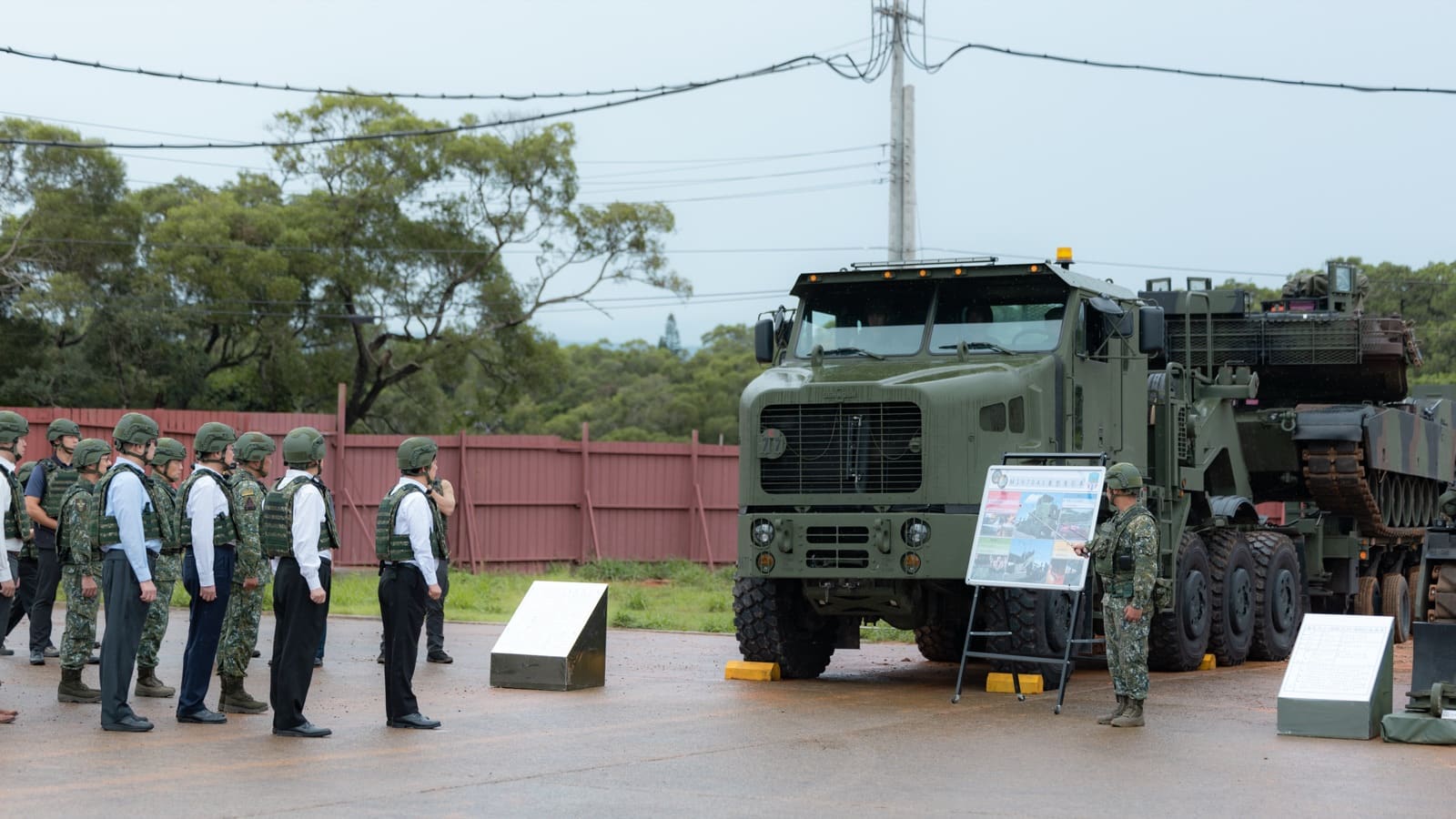
Presidential Office of the Republic of China (Taiwan), CC BY 4.0, via Wikimedia Commons
By the numbers

Infographic: WeaponSpecs News Desk
Taiwan’s military launched a new five-day joint defense exercise on July 13, mobilizing Marine Corps units toward the Taipei metropolitan area to test whether its three services can fight under a single, decentralized command structure, according to Focus Taiwan. The drill comes three weeks after a separate but related exercise put Taiwan’s new M1A2T Abrams tanks through their most visible combat-readiness deployment yet, rolling armor through the streets of Taoyuan under camouflage netting meant to defeat drone reconnaissance. Together, the two exercises mark an accelerating cadence of realistic, integrated readiness training ahead of Taiwan’s annual Han Kuang war games in August.
Two drills, three weeks apart
The exercise that began Monday is not the same event that put M1A2T tanks on Taoyuan’s roads in June, and the distinction matters. Su Tzu-yun, a research fellow at the government-funded Institute for National Defense and Security Research, told Focus Taiwan that the new drill sits at a higher level than the “Immediate Combat Readiness Exercise” format Taiwan’s Army, Navy and Air Force each run on their own, because it is integrated across operational commands rather than run service by service. It remains below Han Kuang, Taiwan’s largest annual exercise, expected in August.
The July 13 drill’s centerpiece so far has been logistics and command, not armor. Marine Corps units moved dozens of vehicles, including trucks, field ambulances and communications vehicles, from bases in southern Taiwan to Taipei’s Nangang District and New Taipei’s Xizhi District, where they set up temporary command posts and conducted reconnaissance, according to Focus Taiwan. The exercise is built around scenarios simulating hostile vessels entering Taiwanese waters and is explicitly testing decentralized command-and-control mechanisms, meaning individual operational commands must be able to keep functioning if communication with higher headquarters is disrupted. A source familiar with the matter told Focus Taiwan that under Taiwan’s defense strategy, Marine units are not tied to a single operational area but are tasked with reinforcing whichever government or economic center needs protection, part of a broader plan to build a layered defense of greater Taipei through cross-regional reinforcement.
Su noted the Marine Corps has modernized in recent years through drone integration, Stinger missile fielding and improved interoperability with partner militaries, capabilities this drill is meant to exercise in a realistic reinforcement scenario rather than a scripted demonstration.
The Abrams debut in Taoyuan
The M1A2T Abrams deployment that drew wider attention happened during a separate exercise, the Army-run Immediate Combat Readiness Exercise, which ran June 22 to 26, according to The Japan Times and IRIA News. Taiwan’s defense ministry described that drill as using “actual troops, on actual terrain, in real time, using actual equipment,” a deliberate shift away from scripted set-piece training toward scenarios built around the possibility that a routine Chinese exercise around the island could suddenly turn into a real attack.
On the exercise’s fourth day, June 25, troops from the Army’s 53rd Engineer Group left their base and built a three-layer roadblock, concrete blocks, steel hedgehogs and HESCO barriers, on a stretch of Provincial Highway 15 near Taiwan Taoyuan International Airport in under four hours, according to Taipei Times. Personnel from the 584th Combined Arms Brigade secured positions along County Road 110 while M1A2T tanks, CM-34 armored vehicles and TOW-2B missile carriers moved through Taoyuan’s Qingpu, Zhongli and Dayuan districts, at one point passing the Rakuten Taoyuan Baseball Stadium in a convoy escorted by light tactical vehicles.
Some of the tanks photographed in Taoyuan wore irregular-pattern camouflage netting draped unevenly over the turret and hull. According to Army Recognition, the netting is not physical protection against a strike, it is a visual countermeasure. A tank’s silhouette from above is normally easy to read: a rectangular hull, a round turret ring, a long gun tube and consistent shadows. An irregular net, hung at inconsistent heights with an uneven front edge, breaks up those cues and distorts the shadows a drone camera or automated recognition system would otherwise key on. It is a low-cost, low-tech countermeasure to a specific problem: a nearly 66-ton vehicle that cannot hide its thermal and acoustic signature, borrowing directly from concealment lessons that have circulated since Russia’s invasion of Ukraine exposed how vulnerable armor is to cheap surveillance drones.
What the M1A2T actually is
Taiwan’s M1A2T is a Taiwan-specific configuration of the M1A2 Abrams, built around a 120mm M256 smoothbore cannon, a four-person crew, 42 rounds of 120mm ammunition and a 1,500-horsepower gas turbine engine, according to Army Recognition. Taiwan received its final batch of tanks on April 27, 2026, completing a 108-vehicle fleet moved under military and police escort to the Armor Training Command in Hukou, Hsinchu County, the same source reported. The program was funded through roughly NT$40.52 billion (about $1.3 billion) in Taiwanese appropriations, on top of an original U.S. Foreign Military Sale package valued near $2 billion covering tanks, ammunition, support equipment, training and logistics.
The Abrams buy replaces part of an aging fleet built around the CM-11 Brave Tiger and M60A3 Patton, both armed with 105mm rifled guns roughly a third smaller in bore diameter than the Abrams’ 120mm smoothbore, a jump in main-gun caliber that gives Taiwanese crews meaningfully more range and penetration against modern armor. Under Taiwan’s defense planning, the M1A2T fleet is assigned to the Sixth Army Command for the defense of northern Taiwan, an area that concentrates Taipei, Taoyuan International Airport, key command nodes and the Hsinchu technology corridor, which is why the June exercise staged its roadblock drill specifically on the highway approach to the airport.
The regional backdrop
Taiwan’s back-to-back drills land during a period of elevated activity around the island. China and Russia’s own state media reported that their “Joint Sea-2026” naval exercise in the Yellow Sea, underway since July 6 with roughly 10 vessels, concluded on July 13, the same day Taiwan launched its own drill, according to Xinhua, a state-media characterization not independently verified, with no confirmed link to Taiwan’s scheduling. Separately, China test-fired a JL-3 submarine-launched ballistic missile into the Pacific on July 6, its first publicly acknowledged strategic SLBM test since 2024, a development WeaponSpecs covered separately and does not revisit here. Taiwan’s defense ministry has not publicly tied either drill’s timing to a specific Chinese activity, and this piece treats them as scheduled readiness training, not a declared response to any single event.
Sources
- DEFENSE/Taiwan launches joint defense drill featuring Marine Corps deployment — Focus Taiwan (CNA), Jul 13, 2026
- M1A2T Abrams tanks deployed in combat readiness drill — Taipei Times, Jun 26, 2026
- Taiwan to stage five days of combat readiness drills — The Japan Times, Jun 21, 2026
- Taiwan holds combat readiness drills to strengthen defense capabilities — IRIA News, Jun 23, 2026
- Taiwan Deploys 108 M1A2T Abrams Tanks to Strengthen Defense Against China Threat — Army Recognition, Apr 27, 2026
- Taiwan's M1A2T Abrams Tanks Adapt to Drone Warfare with Irregular Camouflage Netting to Disrupt Aerial Detection — Army Recognition, Jun 27, 2026
Systems mentioned
Every system named in this story, with its photo and, where available, a video. Tap a card to open the full spec sheet.
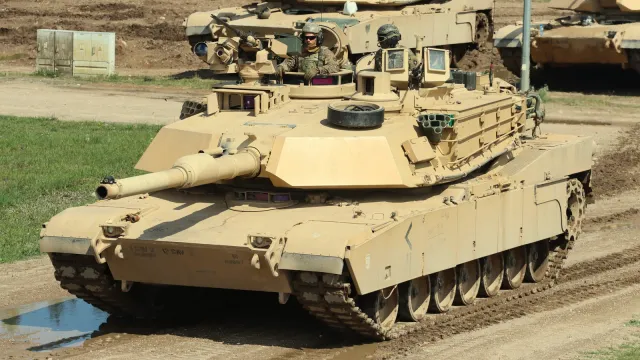
Main battle tank
M1A2 SEP v2 AbramsFrequently asked questions
Why is Taiwan conducting this drill now? +
Taiwan's Ministry of National Defense says the July 13 exercise is meant to strengthen the rapid transition from peacetime to wartime operations and to test whether operational commands can function under a decentralized command-and-control structure. It comes amid elevated Chinese military activity, including a China-Russia naval exercise that concluded the same day and a Chinese submarine-launched ballistic missile test on July 6, though the ministry has not tied the drill's timing directly to either event.
What makes this different from the individual service exercises Taiwan runs? +
According to Su Tzu-yun of the Institute for National Defense and Security Research, the July 13 drill is command-integrated across Taiwan's operational commands, a level above the single-service Immediate Combat Readiness Exercises the Army, Navy and Air Force each run separately, but still below Han Kuang, Taiwan's annual full-force exercise expected in August.
Why do the M1A2T tanks deploy with camouflage netting? +
During the Army's Immediate Combat Readiness Exercise in Taoyuan in late June, M1A2T crews from the 584th Armored Brigade rigged irregular-pattern camouflage netting over their tanks. The netting is not armor, it is meant to break up the vehicle's recognizable turret and hull silhouette so aerial and drone-based reconnaissance has a harder time identifying it, an adaptation defense analysts trace directly to lessons from drone warfare in Ukraine.
How many M1A2T tanks does Taiwan have, and when did they arrive? +
Taiwan received the last of 108 M1A2T Abrams tanks from the United States in April 2026, completing a fleet ordered under a Foreign Military Sale package reported at roughly $2 billion. The tanks replace part of Taiwan's aging M60A3 and CM-11 Brave Tiger fleets, both armed with older 105mm guns, and are assigned to defend northern Taiwan's approaches, including the Taoyuan International Airport corridor.
More news


