 Ukraine
 Security Service of Ukraine (SBU)
Sea Baby
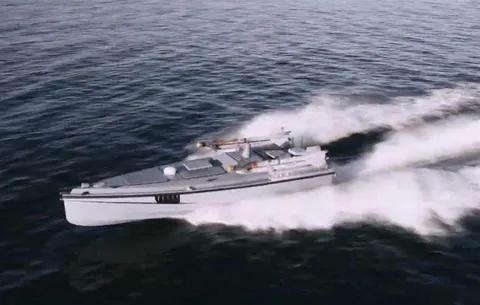
A Ukrainian unmanned surface vessel developed and operated by the Security Service of Ukraine (SBU) since 2022, used for kamikaze strikes on Russian warships and infrastructure in the Black Sea, including the 2023 Crimean Bridge attack. The latest publicly shown generation is stated to operate at distances over 1,500 km and carry a payload of up to 2,000 kg.
Compiled from public sources ·primary reference ↗ ·last verified 2026-07-30
💲 ≈ $245,581, Early production units reported at roughly 8.5 million hryvnias (about $245,600 at 2025 exchange rates); later, longer-range, higher-payload generations have not had a public unit cost disclosed
Procurement snapshot
Availability & export
National export licensing
Subject to Ukraine export-control approval; verify eligibility with the manufacturer.
Channel: Direct commercial / G2G
Fielded & proven
Operator data not public
Status: active.
Lifecycle cost (est.)
Unit cost known; one-shot / small-arms class has no meaningful O&S tail to model.
Interoperability
No standardised NATO calibre / datalink detected in public specs.
Derived guidance from public data, export regime by country of origin, lifecycle from the GAO ~30% acquisition rule. Verify eligibility, pricing and offsets with the manufacturer and your acquisition authority.
Overview
Sea Baby (Ukrainian: Morskyi Maliuk) is a multipurpose unmanned surface vessel developed for the Security Service of Ukraine (SBU) during the Russian invasion of Ukraine. Early models were designed in July 2022; by late 2023 the platform carried redundant communications systems and explosive warheads reported up to 850 kg, and it was inducted into Ukraine's 385th Unmanned Surface Vehicles Brigade in August 2023. In October 2025 the SBU publicly unveiled its latest generation, stated by SBU Brigadier General Ivan Lukashevych to operate at distances over 1,500 km and carry a payload of up to 2,000 kg, roughly double the previous limit, with variants configured for kamikaze strikes, a gyro-stabilized machine-gun turret, or a multiple rocket-launcher payload for use against amphibious landings. Sea Baby USVs have struck at least 11 Russian ships since the start of the full-scale war, most notably the July 2023 attacks on the Kerch Strait (Crimean) Bridge, and have also been used to lay naval mines and strike Crimean infrastructure. The SBU states the primary design goal is a reusable platform that returns to Ukrainian shores for repeated missions, with a self-destruct mechanism to deny capture if intercepted. In November 2025 Sea Baby USVs were used against Russian shadow-fleet tankers in the Black Sea, and in December 2025 the SBU claimed an uncrewed underwater variant, the "Sub Sea Baby", struck a Kilo-class submarine in the Port of Novorossiysk.
Full specifications
Performance
Speed, range, altitude and engagement capability.
| Max speed Maximum level speed. For aircraft this is at optimal altitude; for ground vehicles, top road speed. Higher means faster response and better kinematic performance. | 90 km/h |
|---|---|
| Range Maximum distance: ferry range for aircraft, operational range for vehicles, maximum engagement distance for missiles. Higher means more standoff or persistence. | 1,500 km |
Firepower
Armament, payload and guidance.
| Warhead Warhead mass. Heavier generally means larger effect radius, at the cost of range. | 2,000 kg |
|---|---|
| Warhead type Blast-fragmentation, shaped charge (HEAT), penetrator, thermobaric or nuclear-capable. | Explosive charge (kamikaze payload); earlier variants also carried MN-103 Manta naval mines and a 10-barrel Grad rocket-pod configuration |
| Guidance How the weapon finds its target: inertial, GPS/GLONASS, active/semi-active radar, infrared, laser, TV, wire. | Remote operator control via satellite/redundant communications link |
Physical
Dimensions, weight and crew.
| Length Overall length including gun/probe where applicable. | 6 m |
|---|---|
| Width Overall width, matters for rail/road transport of vehicles. | 2 m |
| Height Overall height. Lower profile is harder to spot and hit for ground vehicles. | 0.6 m |
Program
Cost, production scale and operators.
| Unit cost Approximate flyaway/unit cost where public. Defense pricing varies hugely by contract, offsets and configuration. Lower is cheaper. | $245,581 |
|---|
Specifications compiled from public Security Service of Ukraine (SBU) and reference sources ↗. Published defense figures are approximations, treat comparisons as directional. Last verified 2026-07-30.
Compare with rivals
See how it stacks up
Frequently asked questions
What is the top speed of the Security Service of Ukraine (SBU) Sea Baby? +
The Security Service of Ukraine (SBU) Sea Baby has a maximum speed of 90 km/h.
What is the range of the Security Service of Ukraine (SBU) Sea Baby? +
The Security Service of Ukraine (SBU) Sea Baby has a maximum range of 1,500 km.
What is the Security Service of Ukraine (SBU) Sea Baby used for? +
The Security Service of Ukraine (SBU) Sea Baby is a naval typically used for anti ship strike, kamikaze usv, port infrastructure strike, minelaying.
How much does the Security Service of Ukraine (SBU) Sea Baby cost? +
The Security Service of Ukraine (SBU) Sea Baby has an approximate unit cost of 245,581 USD. Defense pricing varies by contract, offsets and configuration, treat this as directional.