How Polymer Frames Changed Pistol Rounds Per Kilogram
9x19mm pistols from 1982 on average carry 20.7 rounds per kilogram versus 15.4 for older designs, a 34% gain from polymer frames alone.

Steve Dock / UK Ministry of Defence, Open Government Licence v1.0, via Wikimedia Commons
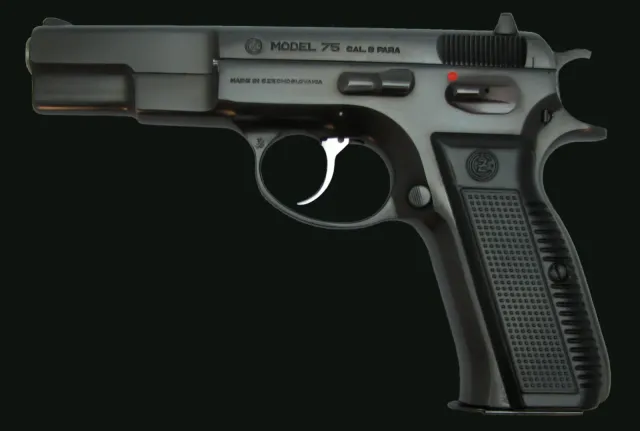
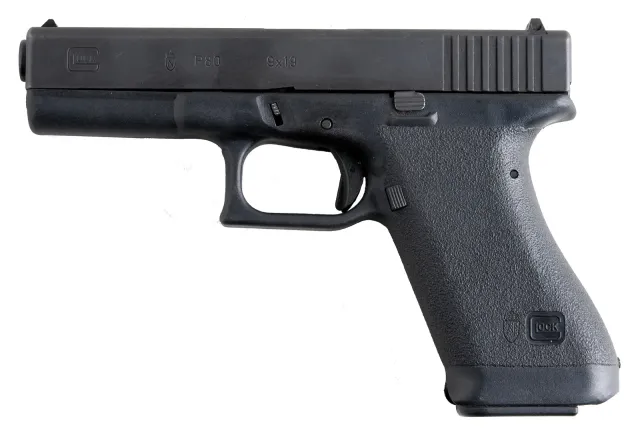
The CZ 75 (1975) and the Glock 17 (1982) hold almost the same magazine, 16 rounds against 17, but the Glock is 39% lighter unloaded, 0.625 kg versus 1.03 kg. Same cartridge, seven years apart, nearly identical capacity, and one gun carries a third less weight on the belt. That single comparison is the whole story of this piece in miniature. Widen it to every 9x19mm Parabellum service pistol in the WeaponSpecs database and the pattern holds at scale: pistols released in 1982 or later average 20.7 rounds of capacity per kilogram of unloaded weight, versus 15.4 rounds/kg for 9x19mm pistols that came before, a 34% increase, with the cartridge held constant across the entire comparison.
Why isolate a single caliber before comparing weight and capacity?
Rounds-per-kilogram is an easy number to compute and an easy number to misread. Cartridge size alone can swing it further than frame material ever does: the Desert Eagle chambered in .50 AE (12.7mm) carries just 7 rounds at 2 kg, 3.7 rounds/kg, while the FN Five-seven’s tiny 5.7x28mm case gets 20 rounds into a 1 kg polymer frame, 32.4 rounds/kg. That nearly 9x spread is a caliber effect, not a frame-material effect, and WeaponSpecs already covered that specific tradeoff in Service Pistol Magazine Capacity Compared. This piece asks a different question: hold the cartridge fixed at 9x19mm Parabellum, the world’s most common service pistol round, and see what changes when only the frame material and magazine geometry change. That isolation is what makes the 34% figure below a genuine materials story rather than a caliber artifact wearing a materials costume.
What does the frame material actually change?
A pistol’s grip and frame housing never held ammunition, even in an all-steel design, it was structural mass wrapped around the magazine well and the fire-control group, there to keep the gun rigid under recoil. Cutting that mass with injection-molded polymer does not compete with the magazine for space the way a bigger cartridge case does. So when Gaston Glock, a plastics-manufacturing engineer with no prior firearms background, answered the Austrian Army’s early-1980s service pistol trial with a polymer frame, he was not trading capacity for lighter weight, he was decoupling the two. According to Glock’s own account of that trial, “reduced weight” sat alongside reliability and safe, simple operation as a top specification, and Glock called the injection-molded approach “a completely new and bold approach” at the time. Prototypes (B1 through B5) went to trial in March 1982, and Austria took delivery of more than 25,000 Generation 1 pistols between 1982 and 1984.
That is a manufacturer’s own framing of its history, worth reading as such, but the surrounding facts check out against the database: the CZ 75, a well-regarded all-steel 1975 design, and the Glock 17 that followed it seven years later land almost on top of each other for capacity, 16 rounds versus 17, while sitting 39% apart on weight. Two gains that used to trade against each other, more rounds and less weight, landed together in the same design generation because the frame material stopped fighting the magazine for space.
Does the data hold up across the full 9x19mm field, not just one pair?
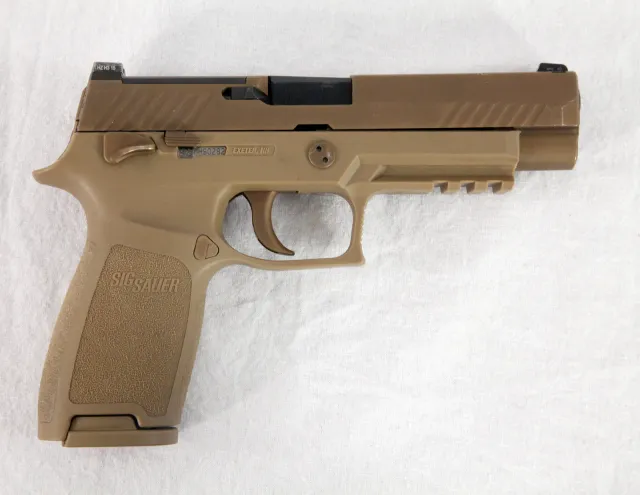
Sixteen 9x19mm pistols in the WeaponSpecs database carry a confirmed release year, spanning the 1935 Browning Hi-Power through the 2017 SIG P320-M17 adopted by the US Army as the M17 under the Modular Handgun System program. Sorted by year, the pre-1982 group (three pistols: Browning Hi-Power, Beretta 92, CZ 75) averages 15.4 rounds/kg. The 1982-and-later group (thirteen pistols, Glock 17 through SIG P320-M17) averages 20.7 rounds/kg. That 34% gap is the entire dataset’s answer to the CZ 75/Glock 17 pair, not an outlier those two happened to produce.
Every metal-frame pistol before 1982 sits below 20 rounds/kg. The Glock 17 breaks that ceiling immediately, and every later polymer design clusters well above the pre-1982 metal band, while later metal-frame entrants (SIG P226, Zastava CZ99, Yavuz-16) stay stuck near the same 15-16 rounds/kg floor their material always allowed.
The full sorted list, with every capacity and weight figure pulled directly from the database:
| Year | Pistol | Capacity | Unloaded weight | Rounds/kg | Frame |
|---|---|---|---|---|---|
| 1935 | Browning Hi-Power | 13 rounds | 1 kg | 14.8 | Steel |
| 1975 | Beretta 92 | 15 rounds | 1 kg | 15.9 | Steel |
| 1975 | CZ 75 | 16 rounds | 1 kg | 15.5 | Steel |
| 1982 | Glock 17 | 17 rounds | 1 kg | 27.2 | Polymer |
| 1983 | SIG Sauer P226 | 15 rounds | 1 kg | 15.6 | Aluminum alloy |
| 1988 | Glock 19 | 15 rounds | 1 kg | 25.2 | Polymer |
| 1988 | Zastava CZ99 | 15 rounds | 1 kg | 15.0 | Aluminum alloy |
| 1990 | Jericho 941 | 16 rounds | 1 kg | 17.2 | Steel |
| 1993 | HK USP | 15 rounds | 1 kg | 20.1 | Polymer |
| 1996 | Walther P99 | 16 rounds | 1 kg | 25.2 | Polymer |
| 2001 | Kilinc 2000 | 13 rounds | 1 kg | 19.1 | Steel |
| 2001 | Yavuz-16 | 15 rounds | 1 kg | 15.8 | Aluminum alloy/steel slide |
| 2005 | S&W M&P9 | 17 rounds | 1 kg | 23.9 | Polymer |
| 2011 | Walther PPQ | 15 rounds | 1 kg | 21.6 | Polymer |
| 2014 | HK VP9 | 17 rounds | 1 kg | 22.5 | Polymer |
| 2017 | SIG P320-M17 | 17 rounds | 1 kg | 20.5 | Polymer |
“A completely new and bold approach,” said Glock, describing its own decision to answer the Austrian Army’s 1980s reduced-weight requirement with an injection-molded polymer frame instead of machined steel (GLOCK P80 History).
Why did some manufacturers stick with metal after Glock proved the point?
Read the table again and the strangest row is not the Glock 17, it is everything that came after it and still used steel or aluminum. The SIG Sauer P226 (1983), Zastava CZ99 (1988), Yavuz-16 (2001) and Kilinc 2000 (2001) all launched after the Austrian trial had already proven polymer worked, and all four sit clustered near the same 15-19 rounds/kg band the pre-1982 field occupied. That is not evidence the physics reversed, it is evidence of production lines already tooled for machined-metal manufacturing, buyers and militaries who trust a known design over a newer one, and contracts that specify what already passed qualification rather than what the market had since proven superior. The SIG P226 in particular went on to a long US and NATO service life on the strength of exactly that trust, weight-per-round efficiency was never the variable those buyers were optimizing.
Where did the gain plateau?
The step change happened once, at the 1982 line, and it never repeated. Look at the post-2000 cluster: Walther PPQ (2011) reaches 21.6 rounds/kg, HK VP9 (2014) reaches 22.5, and the SIG P320-M17 (2017), adopted by the US Army as the M17 through the XM17 Modular Handgun System competition and formally fielded starting November 2017, reaches 20.5. None of those beat the HK USP’s 20.1 from 1993 by much, and none approach the Walther P99’s 25.2 from 1996. Once every serious manufacturer had adopted polymer framing and double-stack magazine geometry, the low-to-mid-20s band became the ceiling the cartridge itself, not the frame, now sets. The materials-driven jump already happened, and 44 years of subsequent design iteration has mostly optimized around it rather than beyond it.
So what does this actually buy a carrier?
A soldier, police officer, or licensed civilian carrier today gets roughly a third more rounds for the same weight on a belt or in a holster than they would have carried in 1975, and none of that gain came from a smaller or weaker cartridge, a bulkier grip, or any compromise in terminal performance. It came entirely from a plastics engineer answering a weight requirement with a material the firearms industry had not tried at scale, and from magazine geometry catching up to space the cartridge always allowed once the frame stopped competing for it. That is a genuine engineering-materials story, not a marketing one, though it is also worth remembering that rounds-per-kilogram measures exactly one thing. It says nothing about reliability, trigger feel, recoil control, or accuracy, and a dense, light pistol that fails to run under stress is not a better duty weapon than a heavier one that doesn’t.
Run any two of these 16 pistols, or their more heavily armed rivals, side by side in the Compare tool, or filter the full field yourself in Types: Pistol to see where a candidate lands before it goes on a procurement shortlist.
Sources
Systems in this comparison
Every system covered above, with its photo and, where available, a video. Tap a card to open the full spec sheet.
Compare these side by side →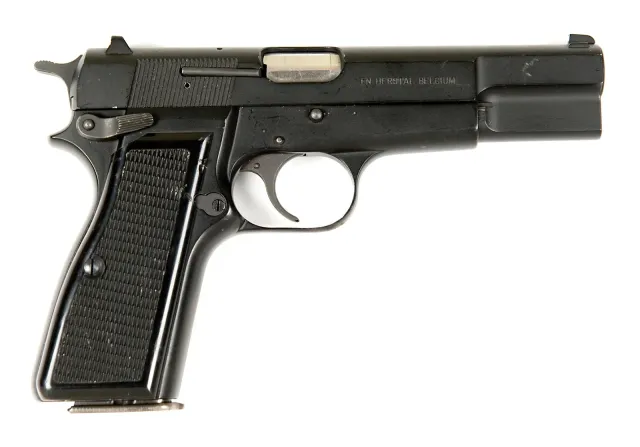
Frequently asked questions
Isn't this just because modern pistols use smaller cartridges? +
No, this analysis holds cartridge size constant. Every pistol in the primary chart fires the same 9x19mm Parabellum round, so caliber cannot explain the gap. The 34% increase in rounds-per-kilogram is isolated to frame material and magazine geometry, not to a smaller case letting more rounds fit. That is a different, orthogonal question to the one WeaponSpecs already answered in [Service Pistol Magazine Capacity Compared](/articles/best-pistols-2026/), which looks at how cartridge size itself trades off against capacity across calibers. Both are real effects, they just measure different axes.
Why did some manufacturers keep building metal-frame pistols after Glock proved polymer worked? +
The SIG Sauer P226 (1983), Zastava CZ99 (1988), Yavuz-16 (2001) and Kilinc 2000 (2001) all launched years, in some cases decades, after the Glock 17 entered Austrian service, and all use steel or aluminum-alloy frames. The reasons are institutional, not technical: existing production lines and tooling sunk into machined-metal manufacturing, durability perception among conservative buyers, and military and police contracts that specify a known, already-qualified design rather than a newer polymer platform. None of those reasons required the physics to have changed.
Has rounds-per-kilogram kept climbing since the 1990s? +
No, it plateaued. Post-2000 designs cluster in the same low-to-mid-20s band as 1990s pistols: the Walther PPQ (2011) reaches 21.6 rounds/kg, the HK VP9 (2014) reaches 22.5, and the SIG P320-M17 (2017) reaches 20.5, not far off the HK USP's 20.1 from 1993 or the Walther P99's 25.2 from 1996. The big jump happened once, when polymer frames arrived, and it has not repeated since.
What does rounds-per-kilogram leave out? +
Everything that actually decides whether a pistol works under stress. This metric says nothing about reliability, ergonomics, trigger quality, recoil control, or accuracy. A lighter, denser pistol is not automatically a better duty weapon, it is a pistol that carries more rounds for its weight, full stop. Treat it as one input to a procurement decision, not the decision itself.
How complete is this dataset? +
Of the 28 pistols in the WeaponSpecs database, 21 have a confirmed release year and are used in this analysis, 16 in the primary 9x19mm comparison and 5 more in the caliber-outlier context table. The remaining 7 (Canik METE, Canik TP9, Sarsilmaz SAR-9, Springfield Hellcat, Taurus G3, Taurus Judge, Taurus PT92) lack a confirmed release year in our records and are excluded from this time-trend analysis.
Related reading


