Pentagon Gives Arms Makers 21 Days to Speed Up Production
Deputy Defense Secretary Feinberg told industry to submit faster delivery plans within 21 days after the Iran war cut Patriot stocks by two-thirds.

Photo by Leah Garton, Missile Defense Agency, via DVIDS, public domain
Deputy Defense Secretary Steve Feinberg has given the US defense industry no more than 21 days to submit concrete plans for faster missile deliveries and expanded production capacity, an ultimatum triggered by interceptor stockpiles that fell by roughly two-thirds during the 2026 Iran war. The memo, sent to industry leaders on Aug. 5 or 6 and first reported by The Washington Post, does not name a single program by name, but the numbers behind it are unambiguous: the US started the war with an estimated 2,330 Patriot interceptors and now has somewhere between 759 and 827 left, according to the Center for Strategic and International Studies.
A three-week clock on a two-thirds hole
Feinberg’s memo tells manufacturers to “drive significantly faster, more aggressive delivery schedules and/or increased production for critical capabilities” and gives them no more than 21 days to respond, a deadline that lands around Aug. 26 or 27. That is a fraction of the 12 to 18 months a defense contract of this size normally takes just to negotiate, let alone execute, and it signals how acute the Pentagon judges the shortfall to be.
“Years-long development cycles are not acceptable. We must dramatically accelerate our program schedules and expand our production capacity now,” Feinberg wrote in the memo (Associated Press via WFMZ, Pentagon pushes defense companies to boost weapons production after concerns of depleted stocks, Aug. 8, 2026).
The scale of the drawdown is what makes the deadline make sense. Patriot PAC-3 interceptors, the US Army’s primary hit-to-kill defense against ballistic missiles, fell from roughly 2,330 before the war to about 1,030 by April’s ceasefire, then down again to a CSIS-estimated 759 to 827 after the most recent round of fighting, a decline of at least 65%. THAAD interceptors, the Army’s higher-altitude complement to Patriot, dropped from 452 to somewhere between 234 and 278, a decline of at least 38%. Put plainly, fewer than one in three of the Patriot interceptors the US had stockpiled before the war are still on hand, and both systems were expended at rates the industrial base was never sized to match.
Bars for the "now" figures are sized to the midpoint of CSIS's estimated range; the labels show the full range. Precise Pentagon inventories are classified, so these are open-source estimates, not official Pentagon disclosures.
Betting industry’s own capital ahead of Congress’s check
What sets Feinberg’s memo apart from an ordinary procurement request is what it asks companies to risk before any money changes hands. Manufacturers are being asked to detail which factories they are willing to expand and what capital investments they are prepared to make, effectively asking them to commit their own money ahead of guaranteed congressional funding rather than waiting for an appropriation first. Pentagon spokesman Sean Parnell confirmed the department is “actively focused on boosting munitions acquisitions to provide the weapons our warfighters need at the pace the threat demands,” language that frames the memo as part of a broader effort rather than a one-off reaction.

President Trump has publicly pushed back on the idea that shortages are severe, posting on Truth Social that the US has “massive amounts” of munitions and that “large amounts” are “being manufactured and shipped to the U.S. as needed.” He struck a more qualified tone with reporters separately, saying, “We have certain types of munitions that are very powerful, that we have unlimited, virtually unlimited supply. We have others where it’s a little bit tighter.” That second comment lines up with what the Feinberg memo actually targets: not every munitions category, but specifically the “critical capabilities” where the Iran war exposed the tightest margins, chief among them the interceptors that defend against ballistic and cruise missiles.
Not starting from zero: the $58.6 billion head start
The memo does not arrive in a vacuum. On July 29, the Army converted an emergency Patriot order into a $58.62 billion, seven-year contract with Lockheed Martin, the largest Patriot missile deal ever signed, aimed at tripling PAC-3 MSE output by 2030 and expanding production beyond its current home in Camden, Arkansas, to new sites in Alabama. That deal alone is expected to grow Lockheed’s associated workforce by roughly half and push output toward as many as 2,000 missiles a year. Feinberg’s memo is a different, broader instrument: where the Lockheed contract is a single signed deal for one interceptor family, the 21-day ask reaches across “critical capabilities” industry-wide, asking every major manufacturer, not just Lockheed, to show its own faster-delivery math.

What a three-year rebuild actually means
Even with the Lockheed contract already running and Feinberg’s memo pressing the rest of industry to match its pace, independent analysts cited by Task & Purpose estimate it could take roughly three years to fully restock US missile-defense inventories at the currently planned expanded production rates. That timeline matters because the demand driving it has not gone away. As of Aug. 7, US Central Command reported eight consecutive nights without strikes inside Iran, the closest the conflict has come to a lull since it began in February, but Trump himself said only that “the war’s got to end pretty soon,” not that it had. More than 70 ships remained stalled in the Persian Gulf as of that date, a reminder that even a quiet week has not translated into a settled ceasefire. WeaponSpecs’ Aug. 8 weekly recap on interceptor math covered the same underlying scarcity from Ukraine’s side of the ledger; Feinberg’s memo is the US industrial-base response to that same dynamic playing out at home.
Sources
- Pentagon pushes defense companies to boost weapons production after concerns of depleted stocks — Associated Press via WFMZ, Aug 8, 2026
- Pentagon pushes defense companies to boost production amid munitions concerns — UPI, Aug 8, 2026
- The US military started the Iran war with about 2,330 Patriot interceptors. CSIS estimates it now has between 759 and 827. — 19FortyFive, Aug 8, 2026
- Iran war depleted US Patriot missile stockpiles, creating readiness challenges, experts say — Military Times, Jul 30, 2026
- Department of War Awards Lockheed Martin $58.62B for Multiyear PAC-3 MSE Production to Strengthen the Arsenal of Freedom — Lockheed Martin, Jul 29, 2026
Systems mentioned
Every system named in this story, with its photo and, where available, a video. Tap a card to open the full spec sheet.
Compare these side by side →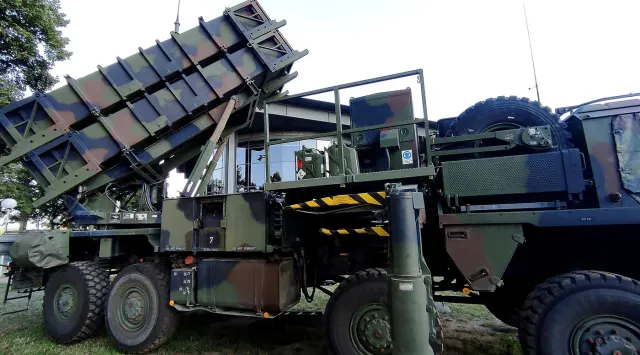
Air defense system
Patriot PAC-3
Frequently asked questions
Why are Patriot and THAAD interceptors running low? +
The US and Israel used them at an unprecedented rate defending against Iranian ballistic-missile barrages during the 2026 Iran war, burning through roughly two-thirds of the pre-war Patriot inventory and more than a third of THAAD stocks, according to CSIS estimates.
What is Feinberg actually asking companies to do? +
Submit, within 21 days, concrete plans for faster delivery schedules and expanded production capacity, including which factories they are willing to expand and what capital they will invest before Congress guarantees full funding.
Is this the same as the $58.6 billion Lockheed Martin contract from July? +
No. That was a separate, already-signed multiyear PAC-3 MSE production deal. Feinberg's memo is a broader, industry-wide push covering other critical capabilities beyond Patriot missiles alone.
How long will it take to rebuild stockpiles? +
Independent analysts estimate it could take roughly three years to fully restock US missile-defense inventories even at the currently planned expanded production rates.
More news


