The Armor Number No Tank Will Publish
Zero of 134 tanks and IFVs in our database publish an armor thickness figure. The only protection rating that appears at all tops out at 32 tonnes.

U.S. Army photo by Kevin Payne, Public domain
Zero of the 134 tanks and IFVs in the WeaponSpecs database publish an armor thickness figure in any unit. Not one. The only quantified protection indicator that appears anywhere in that population is a NATO STANAG 4569 rating, and it shows up on just 18 of the 134 systems (13.4%), concentrated entirely at or below 32 tonnes. The world’s actual main battle tanks, the 65-70 tonne class that includes the M1A2 SEP v3 Abrams and the Leopard 2A8, publish nothing quantified about protection at all.
What does “composite armor” actually tell a buyer?
Of the 134 systems classified as tank or IFV in the database, 132 (98.5%) carry some qualitative armorType text, “composite armor,” “rolled homogeneous armor,” “modular add-on packages.” The field is not empty. It is just never a number. Compare that to what the same 134 systems are perfectly willing to publish: 111 of 134 (82.8%) list a main gun caliber, and 133 of 134 (99.3%) list a combat weight. Those are the two figures that sell a vehicle in a brochure, the punch and the size. The one figure that would let a buyer actually judge survivability, how much protection the hull and turret provide against a given round or blast, is the figure that goes missing.
When analysts need a stand-in, the closest thing to a common currency is RHAe, rolled homogeneous armor equivalent: an estimate of what thickness of plain rolled homogeneous armor would offer the same resistance as a given composite armor or reactive package. It is a useful analytical convention. It is not a manufacturer-published spec. No system in this database publishes an official RHAe figure, and any number that circulates in open-source writeups is a third-party estimate built from incomplete information, not a verified fact.
Even the 13% sliver overstates disclosure: two-thirds of it is a bare namedrop of STANAG 4569 with no level attached, and the whole slice sits below 32 tonnes, meaning nothing in the database's heavy-armor class contributes to that wedge at all.
Who actually publishes a protection number, and why only them?
The 18 systems that mention STANAG 4569 at all, ranked by weight, are worth reading as a full list because the pattern only becomes obvious in aggregate:
| System | Country | Combat weight | STANAG 4569 disclosure |
|---|---|---|---|
| Harimau (light tank) | Indonesia | 32,000 kg | Level III-IV |
| Zaha | Turkey | 30,000 kg | Rated, no level given |
| Tulpar | Turkey | 29,000 kg | Rated, no level given |
| Kestrel WhAP 8x8 | India | 25,000 kg | Level III (mine) / Level IV (ballistic) |
| TITUS | France/Czech Republic | 23,000 kg | Level 4 |
| Kaplan-20 | Turkey | 22,000 kg | Rated, no level given |
| Arma | Turkey | 22,000 kg | Rated, no level given |
| Ejder Yalçın | Turkey | 16,500 kg | Rated, no level given |
| PARS 6x6 | Turkey | 16,000 kg | Rated, no level given |
| Kirpi | Turkey | 15,000 kg | Rated, no level given |
| TRACKX | Finland | 15,000 kg | Level 1 (ballistic + mine) |
| Hızır | Turkey | 15,000 kg | Rated, no level given |
| Vuran | Turkey | 14,000 kg | Rated, no level given |
| Anoa | Indonesia | 13,000 kg | Level II |
| NMS 4x4 | Turkey | 12,500 kg | Rated, no level given |
| Cobra II | Turkey | 12,500 kg | Rated, no level given |
| Akrep IIe | Turkey | 9,000 kg | Rated, no level given |
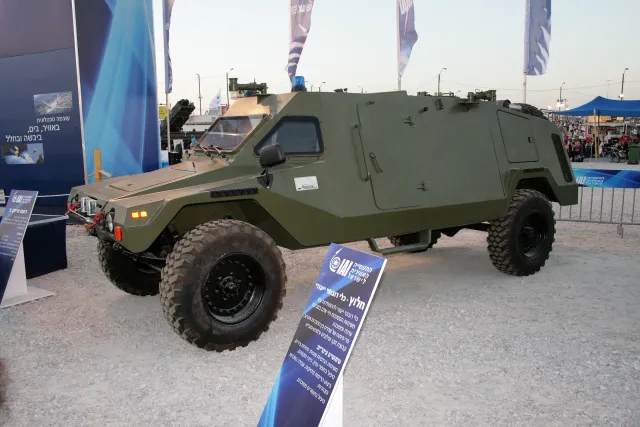
| RAM 2000 Sandcat | Israel | 7,250 kg | Level 2 |
STANAG 4569 is a NATO standardization agreement that grades a vehicle’s ballistic and mine protection against a defined ladder of threats, from rifle-caliber small arms at the low levels up toward heavier autocannon fire and larger mine charges at the top, six levels in total (Mehler Protection). It functions less like a full engineering spec and more like a crash-test rating: a bounded, standardized threat, a pass/fail grade, useful for comparing wheeled troop carriers against each other. That is exactly why it only appears on light protected-mobility vehicles. The heaviest system anywhere in this table, Harimau, tops out at 32 tonnes, less than half the weight of the lightest tank on the database’s heavy end.
The sharper finding sits inside the list itself. Eleven of these 18 systems (61%) are Turkish, by far the largest national bloc naming STANAG 4569 at all: Zaha, Tulpar, Kaplan-20, Arma, Ejder Yalçın, PARS 6x6, Kirpi, Hızır, Vuran, NMS 4x4, and Akrep IIe. Not one of those 11 gives an actual level number. Every one just says “rated” or describes ballistic and mine protection in general terms, with no digit attached. The six systems that do give an explicit level are all non-Turkish: Indonesia’s Harimau and Anoa, India’s Kestrel WhAP 8x8, France and Czechia’s TITUS, Finland’s TRACKX, and Israel’s Sandcat. Naming the standard, in other words, is not the same as disclosing the number, and the country that namedrops STANAG 4569 most is the country that quantifies it least.
The heaviest system to mention the standard at all, Harimau at 32.0 tonnes, is still lighter than the lightest tank on the heavy end of this database. Whether a system gives a level number tracks no obvious weight pattern within this group, it tracks national habit instead, which is why Turkey's 11 entries cluster on the "named, no level" side almost without exception.
Why does the number disappear above 32 tonnes?
Push past 32 tonnes and STANAG 4569 vanishes entirely, along with every other quantified protection figure. The 10 heaviest systems in the full 134-system database, the world’s actual main battle tanks, disclose nothing:
| System | Country | Combat weight | Published armor description |
|---|---|---|---|
| Leopard 2A8 | Germany | 70,000 kg | ”Composite armor with modular add-on packages” |
| Merkava Barak | Israel | 70,000 kg | ”Modular composite armor with front-mounted engine block” |
| Arjun Mk1A | India | 68,000 kg | ”Kanchan composite armor with explosive reactive armor” |
| Arjun Mk2 | India | 68,000 kg | ”Kanchan composite armor” |
| Leopard 2A7 | Germany | 67,500 kg | ”Composite armor with modular add-on packages” |
| M1A2 SEP v3 Abrams | United States | 66,800 kg | ”Composite armor with third-generation depleted-uranium mesh inserts” |
| Challenger 3 | United Kingdom | 66,000 kg | ”Composite armor with modular add-on packages” |
| M1A2 SEP v2 Abrams | United States | 65,900 kg | ”Composite armor with depleted-uranium mesh inserts” |
| Altay | Turkey | 65,000 kg | ”Modular composite armor” |
| Merkava Mk3 | Israel | 65,000 kg | ”Modular composite armor with front-mounted engine block” |
The reason is not that heavy-tank programs simply forgot to fill in a field. It is that STANAG 4569’s own ceiling, Level 6, defeats 30mm armor-piercing autocannon fire (Mehler Protection; Wikipedia), a threat category far below what a real main battle tank is built to survive. A tank engineered against tank-fired kinetic penetrators and shaped charges is not being tested against a scale built for troop carriers and reconnaissance vehicles, so the standard simply does not apply at that weight class, and nobody uses it there.
What replaces it, at the top of the market, is not silence by oversight, it is classification by design. The best-documented case is the M1A2 SEP v3 Abrams: its composite armor, layered with depleted-uranium mesh inserts, was developed under a Top-Secret Special Access Program the U.S. Army nicknamed “Green Grape.” That program was downgraded to plain Secret in 1988 and has never been declassified further, a fact confirmed as recently as 2023, when the same secrecy was cited as a reason the U.S. sent Ukraine an export version of the Abrams with the composite package removed rather than the armor American crews actually run (The War Zone). That is not a gap in a spec sheet. That is a number the U.S. government has spent four decades actively keeping out of public view, on the single most publicly discussed tank in the Western inventory.
The clearest proof that this is a weight-class effect, not a national-transparency habit, sits inside the database’s own Turkish entries. Eleven of Turkey’s export-oriented light vehicles freely namedrop STANAG 4569, more than any other country. But Turkey’s own heaviest, most advanced tank, the Altay at 65 tonnes, does not mention STANAG at all. Same national industry, same disclosure instinct on cheap export hardware, total silence on the flagship. Russia’s newest tank, the T-14 Armata, follows the pattern from the other direction: what little is claimed about its armor composition comes entirely from state and manufacturer sources, none of it independently verified, which is exactly the caveat any Russian-origin protection figure needs regardless of how specific it sounds.
So what should a buyer or analyst actually compare instead?
With the headline number structurally unavailable, the honest fallback is a set of proxies, none of them a substitute for a real published figure, all of them more grounded than an unverified estimate. Documented combat-loss tracking from open-source conflict monitors is the closest thing to real-world evidence of how a given vehicle class actually performs under fire, imperfect and incomplete, but drawn from observed outcomes rather than a brochure claim. The presence and tier of an active protection system or explosive reactive armor package is a second, more concrete signal, and it is exactly the angle covered in our ranking of active protection systems across tanks and IFVs. Operator count matters too, a design that multiple militaries have committed budgets and crews to says something about institutional confidence that a single manufacturer’s own marketing copy cannot. And if an RHAe estimate does turn up in an analyst writeup, treat it as directional scaffolding, not a verified spec, for the reasons laid out above.
For background on how the underlying armor types actually work, composite, reactive, and beyond, see our explainer on tank armor. To see how these systems actually stack up against each other on the specs that are published, run your own side-by-side in the comparison tool or build a threat-specific shortlist in the Advisor.
Sources
Systems in this comparison
Every system covered above, with its photo and, where available, a video. Tap a card to open the full spec sheet.
Compare these side by side →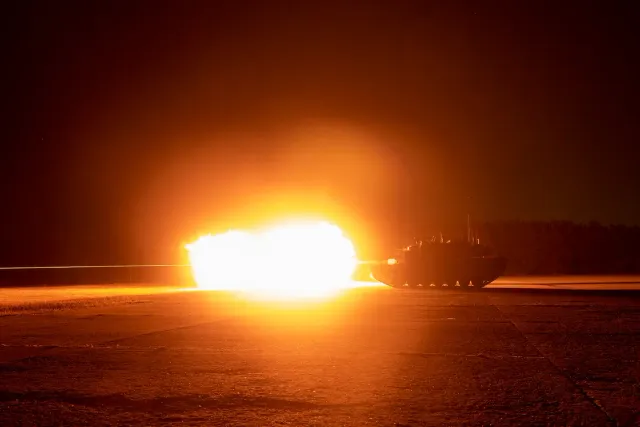
Main battle tank
M1A2 SEP v3 Abrams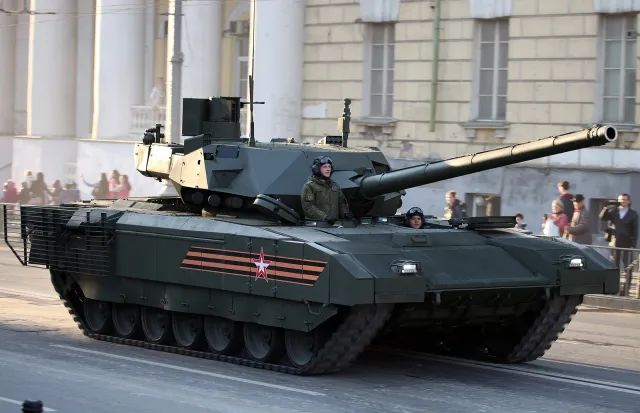
Main battle tank
T-14 Armata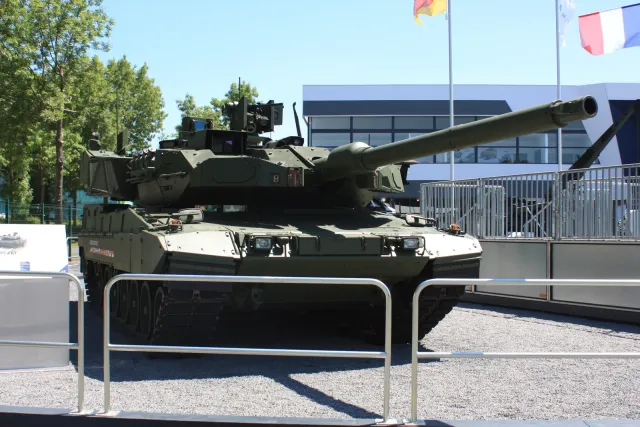
Main battle tank
Leopard 2A8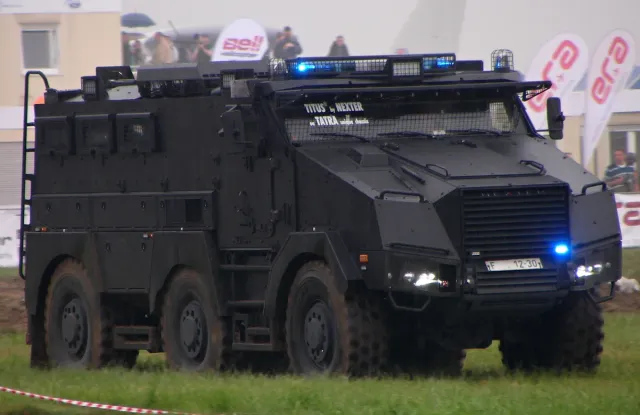
IFV / APC
RAM 2000 Sandcat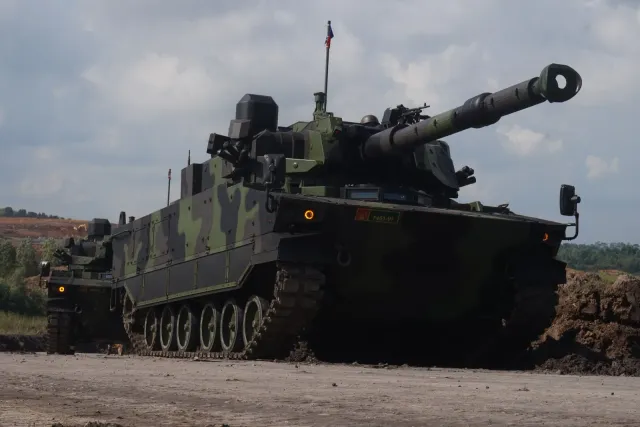
Frequently asked questions
Does any tank in the WeaponSpecs database publish an armor thickness in millimeters? +
No. Of the 134 tanks and IFVs in the WeaponSpecs database, zero publish an armor thickness figure in millimeters or any equivalent unit, including the M1A2 SEP v3 Abrams. What 132 of the 134 systems do publish is a qualitative armorType description, phrases like composite armor or rolled homogeneous armor, with no accompanying number.
What is STANAG 4569, and which vehicles actually publish a rating under it? +
STANAG 4569 is a NATO standardization agreement that defines six protection levels for light armored vehicles against threats like small-arms fire, artillery fragments, and mine blasts. In the WeaponSpecs database, 18 of 134 tanks and IFVs (13.4%) mention STANAG 4569 at all, and every one of those 18 weighs 32 tonnes or less. Only 6 of the 18 (4.5% of the full population) give an explicit numeric level.
Why don't heavy main battle tanks publish a STANAG 4569 level or any protection figure? +
STANAG 4569 tops out around Level 6, which defeats 30mm armor-piercing autocannon fire, a threat far below what a real main battle tank is engineered to survive. The composite armor, explosive reactive armor, and depleted-uranium packages used on heavy tanks are developed under classified national programs; the U.S. Army's own depleted-uranium Abrams armor was built under a Top-Secret Special Access Program nicknamed Green Grape and has only ever been downgraded to plain Secret, in 1988, never further declassified.
What is RHAe, and is it an official manufacturer spec? +
RHAe stands for rolled homogeneous armor equivalent, a convention open-source analysts use to translate a composite or reactive armor package's estimated resistance into an equivalent thickness of plain steel plate. It is not a manufacturer-published figure. No system in the WeaponSpecs database publishes an official RHAe value; any RHAe number in circulation is a third-party estimate and should be treated as directional, not authoritative.
How should a buyer or analyst compare tank protection without a real published number? +
Lean on proxies instead of a phantom spec: documented combat-loss tracking from open-source conflict monitors, the presence and tier of an active protection system or explosive reactive armor package, and operator count as a signal of institutional confidence. Any RHAe estimate that does circulate should be treated as directional only, never as a verified figure.
Related reading


